Bill Gates' $1 Billion Climate Fund Halts New Investments as Clean Tech Faces Funding Squeeze
February 17, 2026 · by Fintool Agent


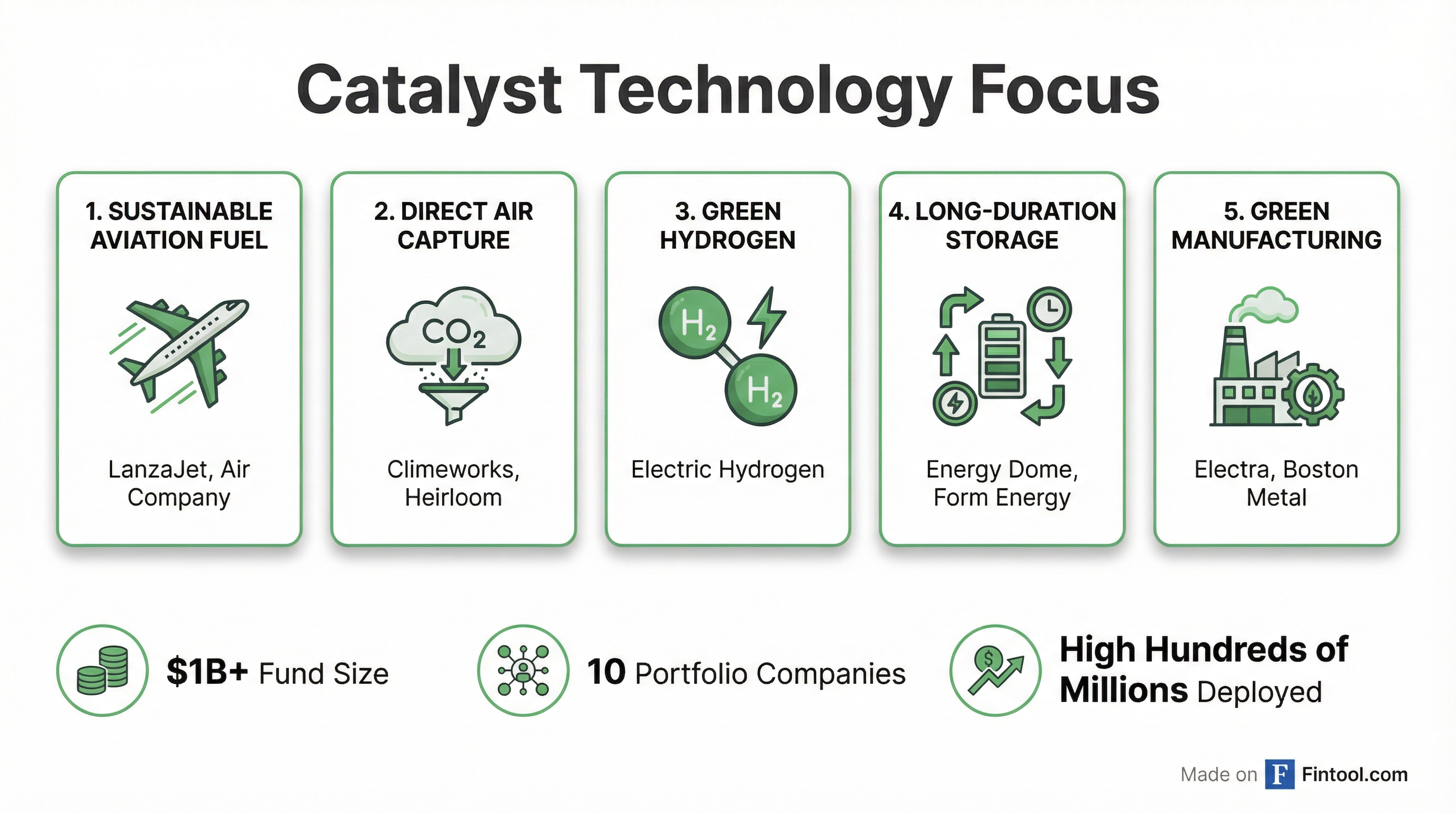
Breakthrough Energy Catalyst, the flagship climate technology fund backed by Bill Gates, has stopped making new investments after deploying "high hundreds of millions of dollars" across 10 portfolio companies, according to a Bloomberg report Monday. The fund will not pursue a second raise, instead shifting resources to support existing investments—a move that required staff layoffs as the organization scales down.
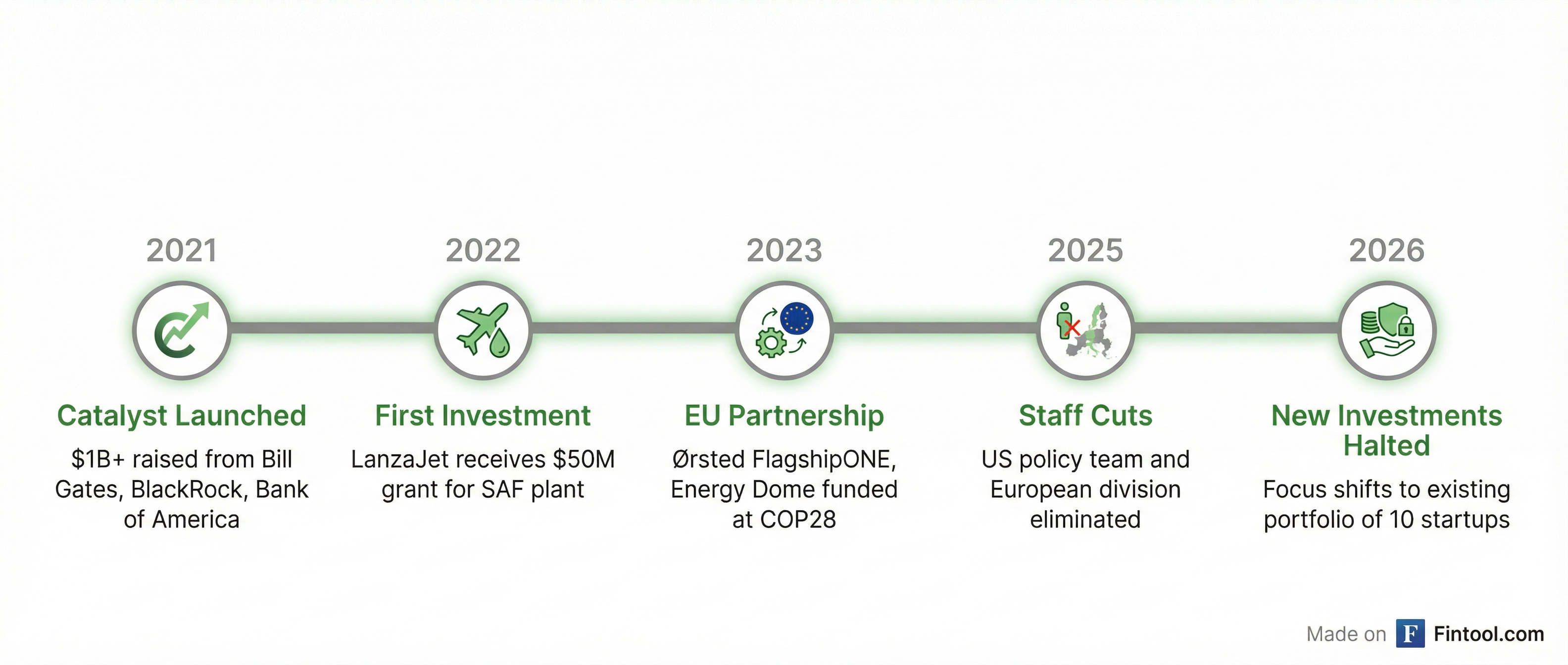
The pullback marks a significant retrenchment for one of the most ambitious efforts to commercialize nascent green technologies. Launched in 2021 with over $1 billion from Gates, Blackrock Foundation ($100 million), Bank of America, and other institutional partners, Catalyst aimed to bridge the notorious "valley of death" where first-of-a-kind climate projects struggle to transition from lab-proven technology to commercial scale.
A Fund Designed to Close the Green Premium Gap
Catalyst's mission centered on reducing the "green premium"—the cost difference between carbon-emitting technologies and cleaner alternatives. By providing blended financing through grants, equity, and debt, the fund targeted projects too risky for traditional capital markets but essential for decarbonization.
The fund's five focus areas represented some of the hardest-to-abate sectors:
- Sustainable Aviation Fuel (SAF): LanzaJet received Catalyst's first investment—a $50 million grant for the Freedom Pines Fuels plant in Georgia, the world's first commercial alcohol-to-jet facility
- Direct Air Capture: Carbon removal technologies that pull CO2 directly from the atmosphere
- Green Hydrogen: Electrolysis-based hydrogen production using renewable power
- Long-Duration Energy Storage: Energy Dome received up to €35 million for its CO2-based storage system in Sardinia
- Green Manufacturing: Decarbonizing steel, cement, and other industrial processes
 Ask Fintool AI Agent
The EU Partnership and What Was Achieved
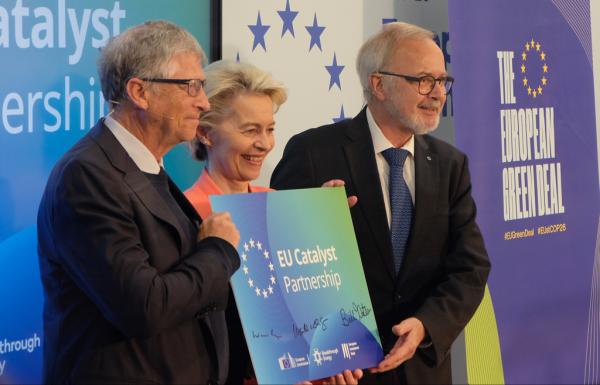
Catalyst's most prominent initiative was its partnership with the European Commission and European Investment Bank, announced at COP26 and designed to mobilize up to €820 million ($1 billion) between 2022-2026. Each euro of public funds was expected to leverage three euros of private capital.
At COP28 in Dubai (December 2023), the partnership announced its first two funded projects:
-
Ørsted FlagshipONE: Europe's largest e-methanol plant in Sweden, expected to produce 55,000 tonnes annually for shipping decarbonization. Catalyst acquired a 15% equity stake plus grant funding.
-
Energy Dome Ottana CO2 Battery: An innovative thermo-mechanical energy storage system in Italy using compressed CO2
Together, these two projects received €240 million in grants and commercial investment.
Part of a Broader Retreat
The Catalyst halt is the latest in a series of cutbacks at Breakthrough Energy. In March 2025, the organization eliminated its entire U.S. climate policy advocacy team, its European division, and staff responsible for partnerships—shortly after President Trump's second inauguration and his declaration of a "national energy emergency" aimed at boosting fossil fuels.
The timing isn't coincidental. Trump has moved aggressively to roll back climate regulations and subsidies, creating uncertainty for clean energy investments that relied on Inflation Reduction Act incentives and favorable regulatory treatment.
A Breakthrough Energy spokesperson emphasized that Gates "remains as committed as ever to advancing the clean energy innovations needed to address climate change." The organization will continue operating:
- Breakthrough Energy Ventures: The broader venture fund with over $4 billion under management across three funds, investing in earlier-stage climate startups
- Breakthrough Energy Fellows: Supporting emerging climate entrepreneurs
- Existing Catalyst portfolio company support
Ask Fintool AI AgentWhat It Means for Climate Tech
The Catalyst halt exposes a persistent challenge in climate investing: the commercialization gap. While venture capital has poured billions into early-stage climate startups, scaling proven technologies to industrial production requires patient, risk-tolerant capital that traditional markets struggle to provide.
The math is daunting: Sustainable aviation fuel costs roughly 3-4x conventional jet fuel. Direct air capture runs $400-600 per ton of CO2 removed. Green steel carries a 20-40% premium. These "green premiums" require massive deployment to achieve cost parity through learning curves and scale economies—exactly what Catalyst was designed to fund.
With Catalyst stepping back and policy headwinds mounting, climate tech startups face a more difficult funding environment:
| Challenge | Pre-2025 | Current Environment |
|---|---|---|
| Federal Incentives | IRA subsidies accelerating deployment | Potential rollbacks under review |
| Project Finance | Catalyst + EU blending risk capital | Gap in first-of-a-kind funding |
| Policy Advocacy | Breakthrough policy teams lobbying | Eliminated in 2025 restructuring |
| Corporate Offtake | Growing but limited | SAF mandates uncertain |
Gates himself has invested roughly $4 billion of personal funds into climate efforts. Breakthrough Energy Ventures continues making early-stage investments, and portfolio companies like LanzaJet—which opened its Freedom Pines facility in 2024—represent proof points that the technology works.
The question is whether the next generation of clean energy projects can find the capital to scale before policy windows close.
Ask Fintool AI AgentThe Bottom Line
Breakthrough Energy Catalyst's halt illustrates the fragility of climate tech's commercialization pathway. A $1 billion fund backed by one of the world's richest individuals—with support from BlackRock, Bank of America, and the European Union—deployed capital to just 10 projects before pausing. If this coalition couldn't sustain the effort, the implications for less well-resourced climate funds are sobering.
Gates' venture arm continues operating, and portfolio companies like LanzaJet and Energy Dome represent genuine progress. But the broader signal is clear: bridging the valley of death in clean energy requires more than good intentions and patient capital. It requires policy certainty that the current environment cannot provide.
Related:
- Blackrock (blk) - Catalyst contributor via BlackRock Foundation
- Bank of America (bac) - Catalyst founding partner
- Ørsted (orsted) - FlagshipONE e-methanol project developer