BYD Officially Dethrones Tesla as World's Largest EV Maker After 2025 Deliveries
January 01, 2026 · by Fintool Agent


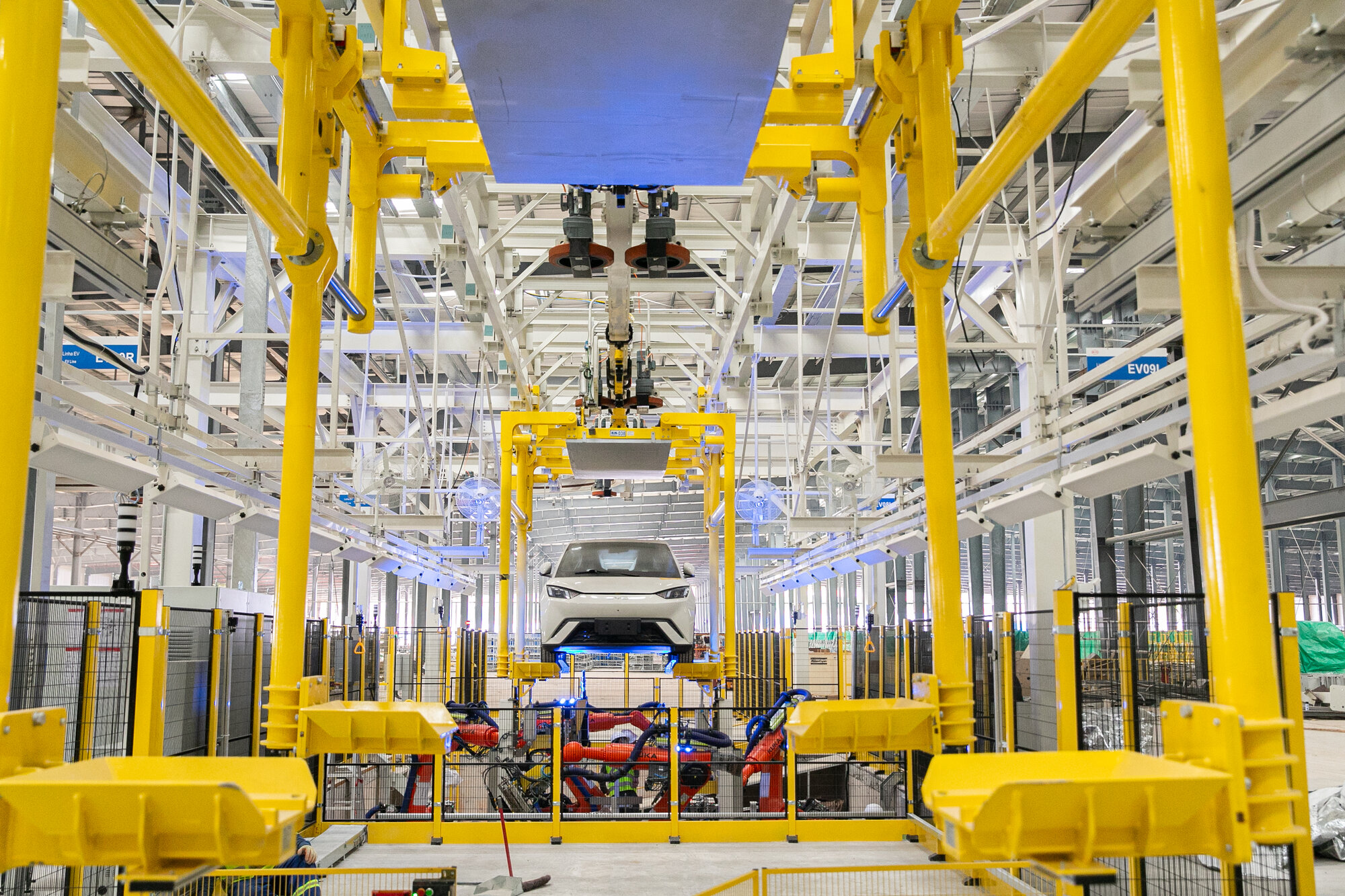
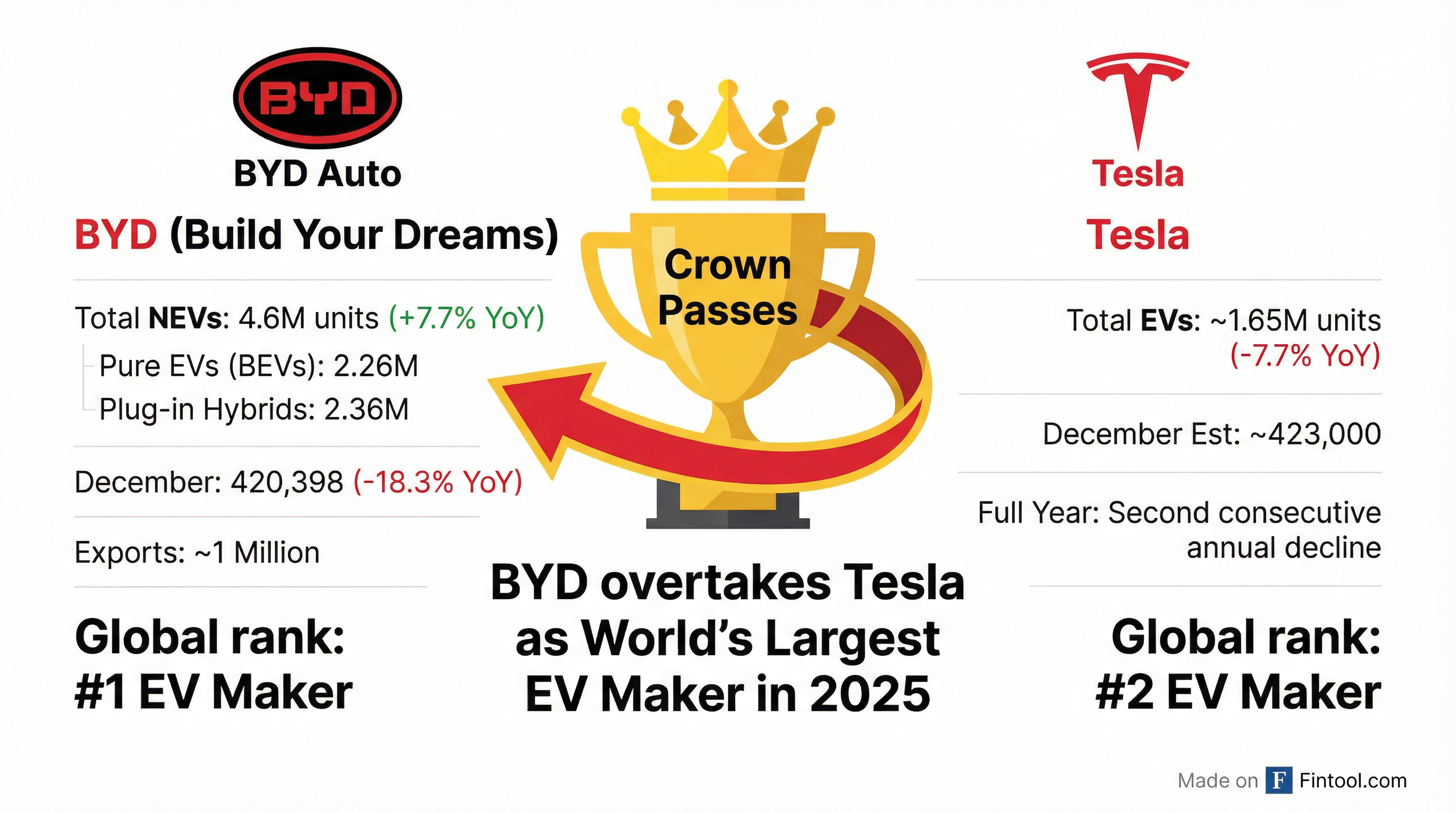
The changing of the guard is official: BYD+5.48% has overtaken Tesla+3.50% as the world's largest electric vehicle maker by annual sales—a seismic shift in an industry Tesla created and dominated for over a decade. The Shenzhen-based automaker sold 4.6 million new energy vehicles in 2025, more than double Tesla's expected 1.65 million deliveries, according to figures released Wednesday.
Even counting pure battery-electric vehicles only—excluding BYD's plug-in hybrids—the Chinese giant sold approximately 2.26 million BEVs versus Tesla's projected total, making the leadership transition unambiguous.
The Numbers Tell the Story
BYD's 2025 deliveries rose 7.73% year-over-year, hitting its revised target of 4.6 million units. The result marks the company's weakest growth in five years—a stark contrast to the 41% surge in 2024—but still comfortably extends its lead over Tesla.
| Metric | BYD 2025 | Tesla 2025 (Est.) |
|---|---|---|
| Total Deliveries | 4.60M | 1.65M |
| YoY Change | +7.7% | -7.7% |
| Pure EVs (BEVs) | 2.26M | 1.65M |
| Plug-in Hybrids | 2.36M | — |
| December | 420,398 | 423,000 (Est.) |
Sources: BYD filings, Reuters, company-compiled analyst consensus
Tesla publishes Q4 deliveries on January 3rd. The company took the unusual step of releasing its own analyst consensus last week, projecting 422,850 Q4 deliveries—lower than Wall Street's estimates—in an apparent move to set expectations. Full-year 2025 would mark Tesla's second consecutive annual sales decline.
 Ask Fintool AI Agent
Two Paths Diverge
The divergence reflects fundamentally different circumstances in each company's core markets.
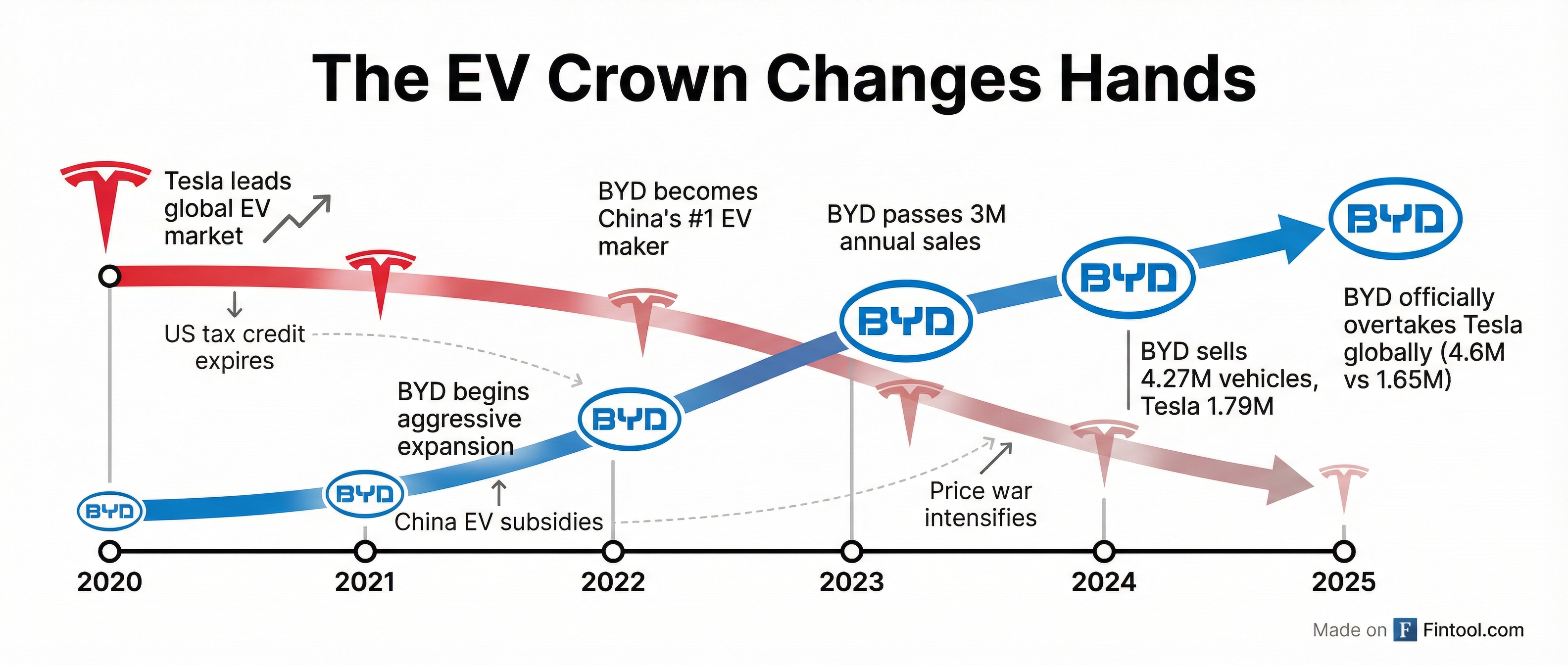
BYD's challenges are domestic. Despite global headline growth, BYD's December sales fell 18.3% year-over-year—the fourth consecutive monthly decline and largest drop in nearly two years. Chairman Wang Chuanfu acknowledged at a December investor conference that domestic sales weakened due to "weakening technological leadership" against rivals including Geely and Leapmotor.
Tesla's problems stem from policy and perception. The expiration of the $7,500 U.S. federal EV tax credit at the end of September 2025 created a demand cliff. Q3 deliveries of 497,099 were artificially boosted by buyers rushing to claim credits; Q4 is the hangover.
Deutsche Bank projects Tesla's Q4 sales down roughly one-third in North America and Europe, and down 10% in China. CEO Elon Musk's increasingly visible political involvement has also weighed on demand in key markets.
The China Price War Reshapes the Industry
BYD's ascent came amid a brutal price war that has consolidated China's EV market around a handful of winners. New energy vehicles now account for nearly 60% of new car sales in China—a saturation level that's compressing margins and forcing consolidation.
The U.S.-listed Chinese EV startups—NIO, XPeng, and Li Auto—all posted strong growth in 2025, but remain an order of magnitude smaller:
| Company | 2025 Deliveries | YoY Change |
|---|---|---|
| BYD | 4,602,436 | +7.7% |
| Tesla | 1,650,000 | -7.7% |
| Li Auto | 500,000 (est.) | — |
| XPeng | 429,445 | +126% |
| NIO | 326,028 | +47% |
Sources: Company announcements
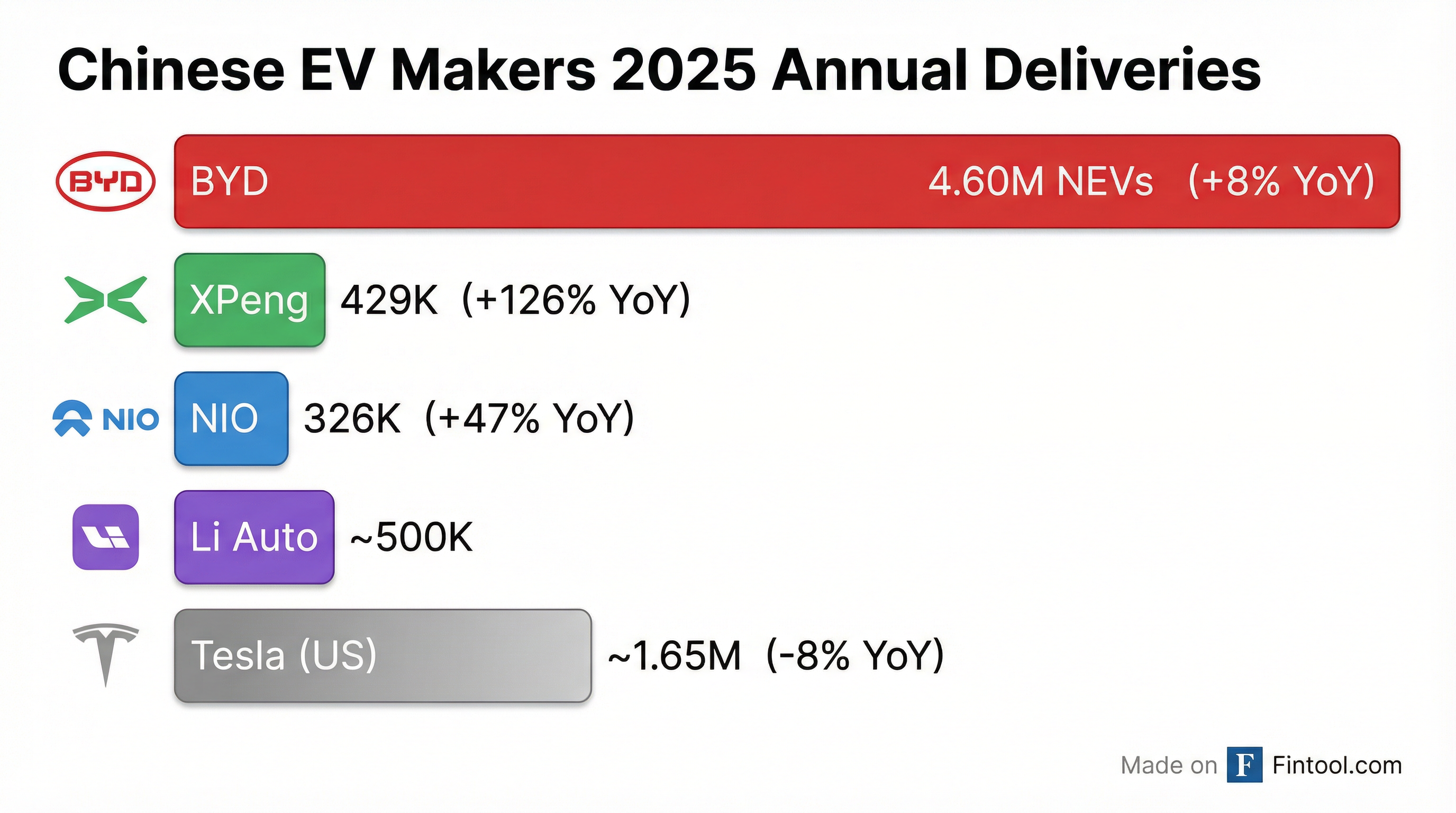
XPeng's 126% growth was the standout, driven by its AI-powered smart driving features and expansion into 60 countries. NIO hit a record 48,135 deliveries in December with its new FIREFLY and ONVO sub-brands gaining traction.
Ask Fintool AI AgentBYD's Global Expansion Accelerates
With domestic growth stalling, BYD has pivoted aggressively to exports. The company shipped approximately 1 million vehicles overseas in 2025, roughly doubling the prior year. December alone saw a record 131,935 exports—up 326% year-over-year.
Key expansion initiatives:
- Hungary factory set to ramp production in 2026, giving BYD a European manufacturing footprint that avoids tariffs
- Brazil production commenced in 2025, the first BYD factory outside Asia
- Mexico has become a top-10 global market with over 80,000 vehicles sold and 80 dealerships
- Middle East, Southeast Asia expansion accelerating
Chairman Wang told analysts he expects the majority of BYD's profits to eventually come from overseas markets—a remarkable statement for a company that built its dominance in China.
Ask Fintool AI AgentTesla's Pivot to Autonomy
Tesla is reframing the delivery narrative as increasingly irrelevant to its investment thesis. On the Q3 earnings call, Musk devoted extensive commentary to:
- Robotaxi deployment expanding to 8-10 metro areas by year-end, including Nevada, Florida, and Arizona
- Unsupervised Full Self-Driving expected in "large parts of Austin" with no safety drivers
- Cybercab production starting Q2 2026, optimized for autonomous operation
- Optimus V3 humanoid robot reveal planned for Q1 2026
"I feel confident in expanding Tesla's production," Musk said. "I was reticent to do that until we had clarity on achieving unsupervised Full Self-Driving. At this point, I feel like we've got clarity."
The market appears to be buying the pivot. Despite facing its second consecutive delivery decline, Tesla shares have risen roughly 14% in 2025—though trailing the S&P 500's gains.
| Metric | Q4 2024 | Q1 2025 | Q2 2025 | Q3 2025 |
|---|---|---|---|---|
| Revenue | $25.7B | $19.3B | $22.5B | $28.1B |
| Gross Margin | 16.3% | 16.3% | 17.2% | 18.0% |
| Net Income | $2.3B | $409M | $1.2B | $1.4B |
Ask Fintool AI AgentWhat Comes Next
For BYD, 2026 is about executing overseas expansion while defending market share at home. The company has promised "major innovations" but faces intensifying competition from Geely, Huawei-powered vehicles, and Xiaomi's automotive push. Analysts expect China's EV price war to continue "for years."
For Tesla, the narrative depends on the autonomy timeline. Wall Street is "laser focused on the autonomous chapter kicking off in 2026," according to Wedbush's Dan Ives. Tesla reports Q4 deliveries on January 3rd—those numbers will confirm or refute the extent of the tax credit hangover.
For the industry, the crown changing hands marks the definitive arrival of Chinese manufacturing dominance in EVs. BYD's Blade Battery technology, vertical integration, and cost discipline have proven formidable advantages. Whether that translates to global market share gains—particularly in tariff-protected Western markets—remains the key question for 2026.
Ask Fintool AI AgentRelated: