Hollywood Unites Against ByteDance's Seedance: Disney, Warner Bros, Paramount Fire Cease-and-Desist Letters Over AI 'Smash-and-Grab'
February 17, 2026 · by Fintool Agent


Hollywood's biggest studios are mounting a unified legal offensive against ByteDance after the Chinese tech giant's AI video generator Seedance 2.0 flooded social media with unauthorized depictions of copyrighted characters—from Batman fighting Superman to Tom Cruise battling Brad Pitt. Warner Bros. Discovery joined Disney and Paramount Skydance on Tuesday in sending cease-and-desist letters, with WBD's legal chief calling the platform's conduct "blatant infringement."
The coordinated response represents a critical test of whether generative AI companies will be held accountable for training on and reproducing studio-owned intellectual property—or whether the "launch first, apologize later" playbook that has defined the AI boom will continue unchecked.
 Ask Fintool AI Agent
One Week from Launch to Legal Crisis
ByteDance's Seedance 2.0 launched on February 10-12, promising "director-level control" over AI-generated video. Within days, it became clear the platform could generate remarkably realistic videos featuring characters studios have spent decades building—and billions protecting.
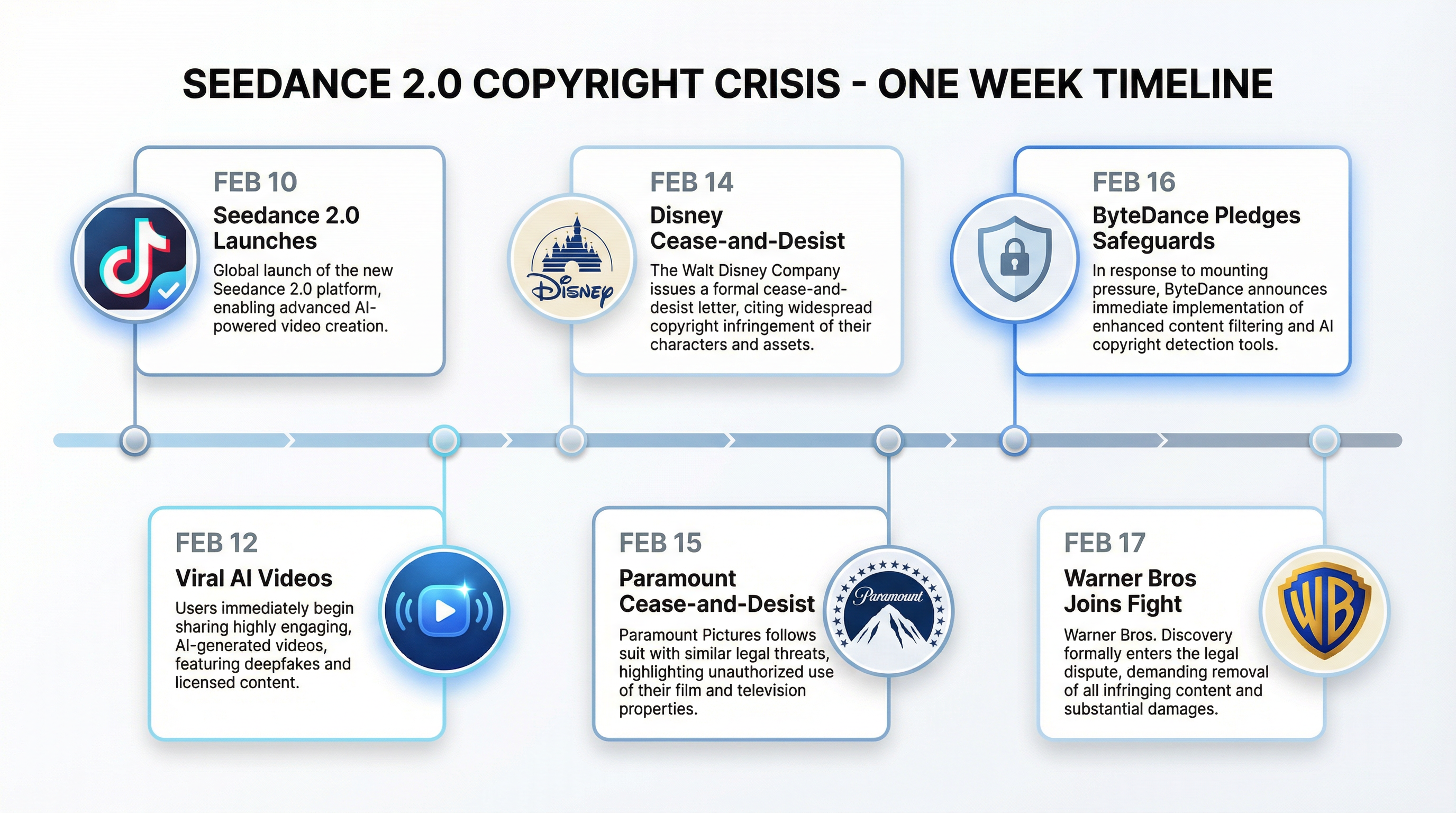
The viral clips that triggered the crisis included:
- Star Wars characters Anakin Skywalker and Rey battling with lightsabers
- Spider-Man fighting Captain America on New York streets
- Tom Cruise vs. Brad Pitt in a post-apocalyptic brawl
- DC superheroes including Batman, Superman, and The Joker
- Game of Thrones characters with recognizable actor likenesses
"ByteDance's virtual smash-and-grab of Disney's IP is willful, pervasive, and totally unacceptable," Disney's legal team wrote in its February 14 cease-and-desist, accusing ByteDance of distributing "a pirated library" of copyrighted characters "as if Disney's coveted intellectual property were free public domain clip art."
Warner Bros. Makes It Personal
Warner Bros. Discovery's letter, sent Tuesday, took an unusually personal tone. WBD legal chief Wayne Smith addressed ByteDance General Counsel John Rogovin—who held the same position at Warner Bros. until 2022.
"Given your history with Warner Bros., you understand the importance and value of Warner Bros. Discovery's copyrighted works, including the famous copyrighted characters like Superman and Batman that you spent much of your career protecting," Smith wrote. "These characters are the lifeblood of the company."
The letter continued: "ByteDance is now engaged in blatant infringement of the very same properties you spent many years protecting."
WBD demanded ByteDance immediately:
- Stop training AI systems on studio-owned content
- Identify all training materials used
- Block users from generating copyrighted characters
- Revoke any licenses if technology has been shared with other companies
Ask Fintool AI AgentThe Stakes for Studios
The copyright battle comes at a precarious moment for traditional media companies. All three studios sending cease-and-desist letters have seen their content libraries become central to their valuations—and their survival strategies.
| Company | FY 2024 Revenue | Net Income | Total Assets |
|---|---|---|---|
| Disney | $91.4B | $5.0B | $196.2B |
| Warner Bros. Discovery | $27.8B | -$11.3B | $104.6B |
| Paramount Skydance | $29.2B | -$6.2B | $46.2B |
Values retrieved from S&P Global.
For WBD and Paramount—both posting multi-billion dollar losses—their content libraries represent irreplaceable assets. Any erosion of copyright protections could accelerate the value destruction already underway from cord-cutting and streaming competition.
Disney, meanwhile, has invested heavily in building its direct relationship with AI companies. The entertainment giant struck a $1 billion licensing deal with OpenAI last year, giving the ChatGPT maker access to 200 characters from Marvel, Star Wars, and Pixar for use in Sora's video generator.
Two Paths: OpenAI's Licensing vs. ByteDance's 'Pre-Loading'
The contrast between how OpenAI and ByteDance approached copyrighted content reveals a fundamental strategic divergence in the AI industry.
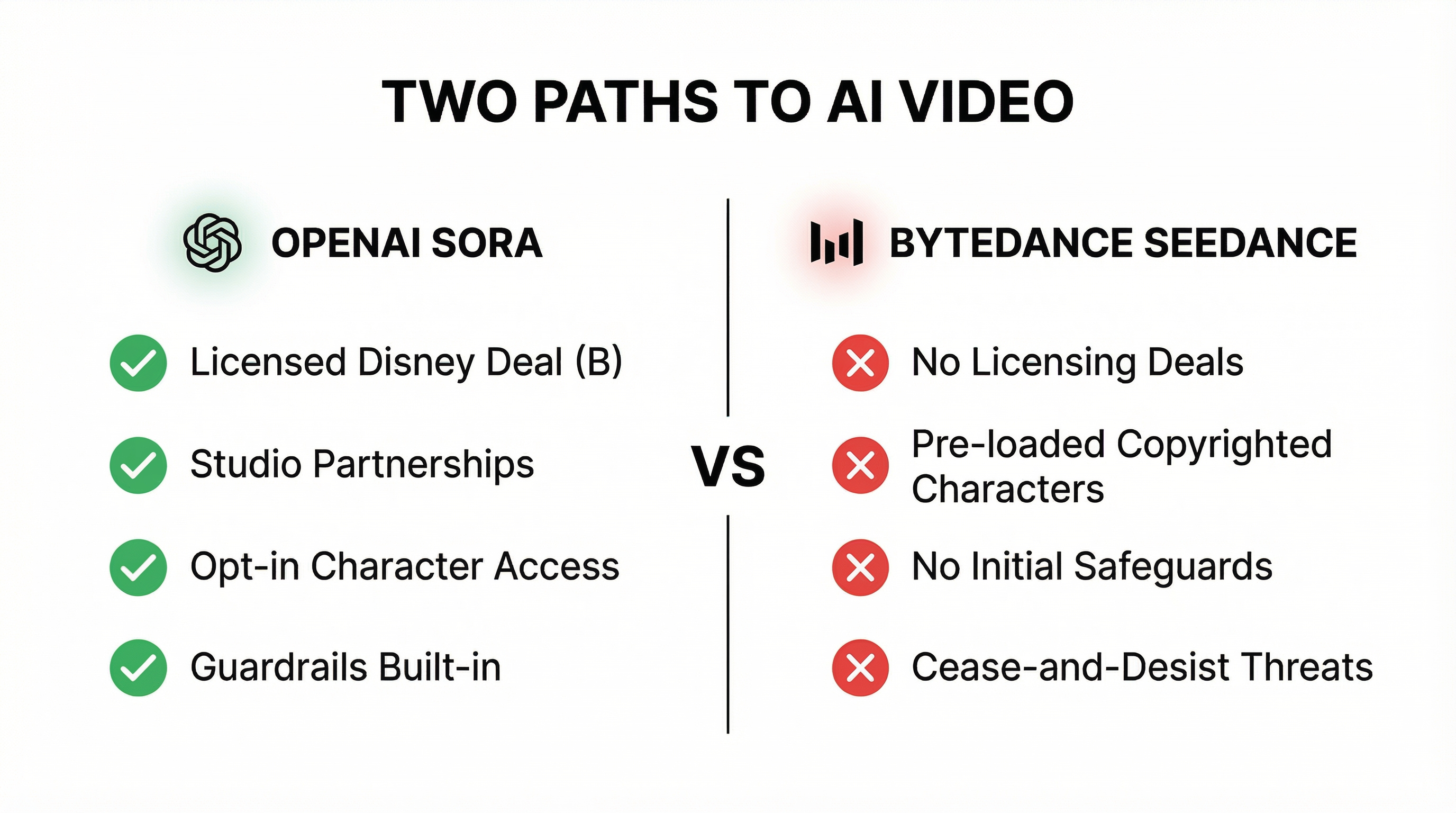
OpenAI negotiated for months with Disney before launching character capabilities, ultimately paying for access and implementing guardrails that require user opt-in for franchise content. The deal creates a revenue stream for Disney while giving OpenAI legitimate access to characters that drive user engagement.
ByteDance, according to studio allegations, took the opposite approach: Seedance 2.0 allegedly came "pre-loaded" with copyrighted characters, treating them as freely available assets. Studios argue this wasn't an oversight—it was a deliberate strategy to drive viral adoption before addressing copyright concerns.
"[T]he users are not the ones at the root cause of the infringement," WBD's Smith wrote. "They are merely building on the foundation of infringement already laid by ByteDance as Seedance comes pre-loaded with Warner Bros. Discovery's copyrighted characters. That was a deliberate design choice by ByteDance."
Industry-Wide Condemnation
The Motion Picture Association, representing all major Hollywood studios including Netflix, issued a forceful statement demanding ByteDance "immediately cease its infringing activity."
"In a single day, the Chinese AI service Seedance 2.0 has engaged in unauthorized use of U.S. copyrighted works on a massive scale," said MPA chairman Charles Rivkin. "By launching a service that operates without meaningful safeguards against infringement, ByteDance is disregarding well-established copyright law that protects the rights of creators and underpins millions of American jobs."
SAG-AFTRA, the actors' union currently in contract negotiations with studios, accused Seedance of infringing on members' voices and likenesses. "Seedance 2.0 disregards law, ethics, industry standards and basic principles of consent," the union stated.
CAA, the talent agency, called ByteDance's "brazen disregard for creators' rights" unacceptable and said it was working with SAG-AFTRA and regulators to implement safeguards.
Japan's government has launched a separate investigation into ByteDance over potential copyright violations after AI-generated videos of popular Japanese anime characters appeared online.
Ask Fintool AI AgentByteDance's Response: Safeguards Coming, Details Absent
ByteDance issued a statement on Monday pledging to address the concerns—but provided no specifics on what safeguards would be implemented or when.
"ByteDance respects intellectual property rights and we have heard the concerns regarding Seedance 2.0," a company spokesperson said. "We are taking steps to strengthen current safeguards as we work to prevent the unauthorized use of intellectual property and likeness by users."
The statement's focus on "users" drew sharp criticism from studios, who argue ByteDance itself—not users—is the root cause of infringement.
"ByteDance appears to be taking initial steps to block certain text prompts regarding a few Warner Bros. Discovery properties," WBD acknowledged in its letter. "While this is a promising indication that we may resolve this dispute business to business, it nonetheless begs the question why guardrails that can so quickly and easily be implemented were not present upon Seedance's release."
The Familiar AI Playbook
Industry observers note ByteDance is following a well-established playbook in the AI sector: release technology without guardrails, capture viral attention, then add safety measures after legal pressure.
OpenAI's Sora faced similar criticism at launch when users generated clips featuring recognizable characters from Bob's Burgers, SpongeBob SquarePants, Pokémon, and Grand Theft Auto. The app briefly topped the App Store charts before OpenAI implemented restrictions—and ultimately struck licensing deals.
The strategy appears to work: by the time safeguards are in place, the platform has already captured market share and user data, while competitors who move more cautiously fall behind.
What to Watch
Immediate questions:
- Will ByteDance enter licensing negotiations with studios, as OpenAI did?
- Could studios pursue actual litigation beyond cease-and-desist letters?
- How will this affect ByteDance's US operations, already under scrutiny over TikTok?
Longer-term implications:
- Does AI-generated content require explicit licensing, or does it fall under fair use?
- Will Hollywood standardize licensing frameworks for generative AI?
- How will pending SAG-AFTRA contract negotiations address AI content generation?
The outcome could determine whether the AI industry's "move fast and break things" approach applies equally to Hollywood's most valuable intellectual property—or whether studios can force a more measured, licensed approach to training models on copyrighted content.
Ask Fintool AI Agent