Carnival Reinstates Dividend for First Time Since Pandemic After Record $3.1B Year
December 19, 2025 · by Fintool Agent



Carnival Corporation declared victory over the pandemic today, announcing the reinstatement of its dividend for the first time since COVID-19 devastated the cruise industry in early 2020. The announcement came alongside record financial results that crushed expectations and sent shares surging more than 10%.
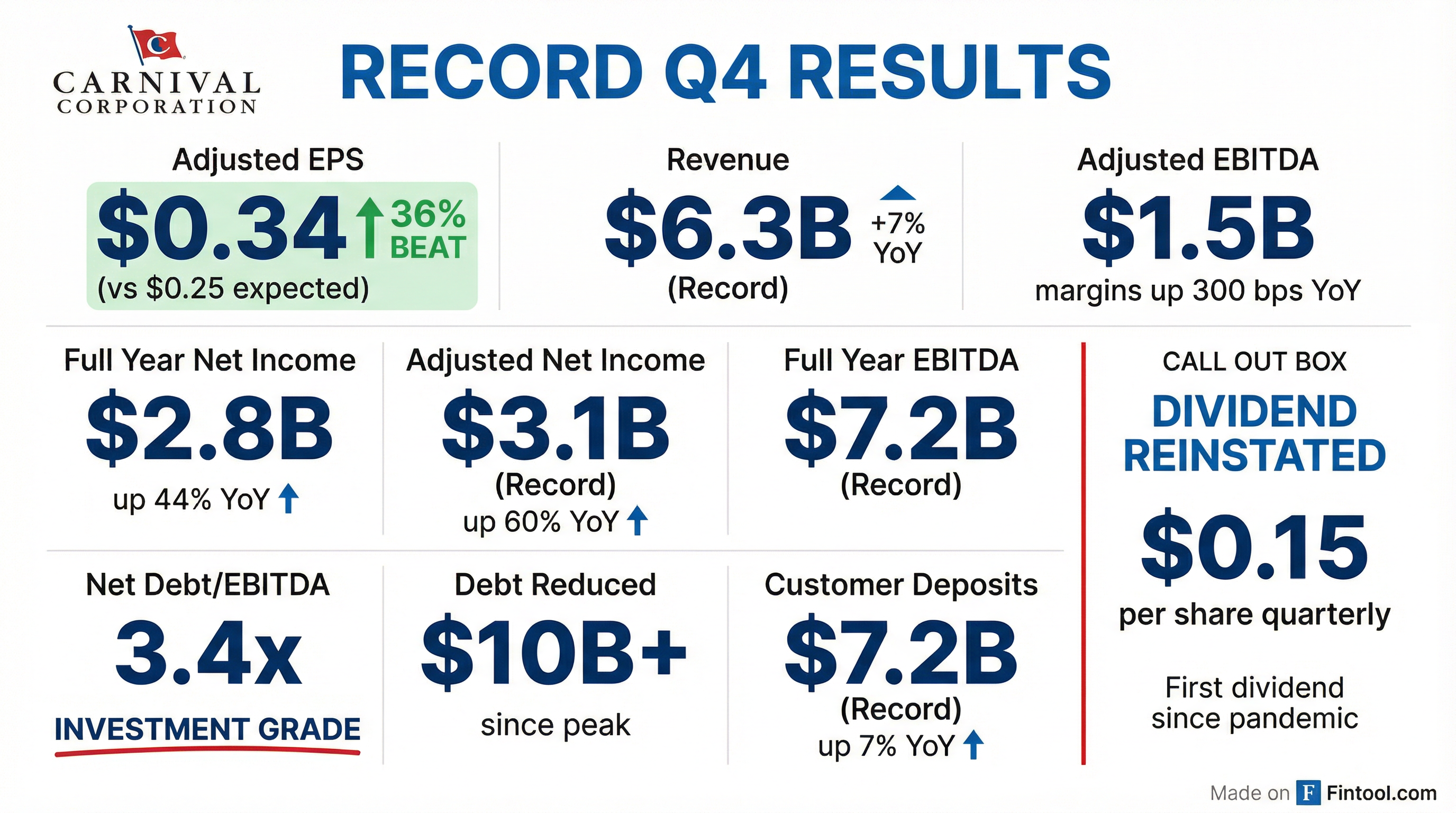
The world's largest cruise operator reported adjusted EPS of $0.34 for Q4 2025, demolishing consensus estimates of $0.25—a 36% beat. The outperformance capped a remarkable fiscal year that saw adjusted net income reach $3.1 billion, up over 60% from the prior year and exceeding initial guidance by more than 30%.
For an industry that saw ships sitting idle and billions in losses just four years ago, the milestone represents a full-circle recovery that few thought possible so quickly.
The Dividend Returns
The Board of Directors approved a quarterly dividend of $0.15 per share, with a record date of February 13, 2026 and payment date of February 27, 2026. While modest compared to pre-pandemic levels, the reinstatement carries enormous symbolic weight.
"This decision highlights confidence in our future performance and continued commitment to delivering value to shareholders," CFO David Bernstein said on the earnings call.
CEO Josh Weinstein framed the move as possible only because the company "surpassed investment grade leverage metric threshold" a full year ahead of schedule. Net debt to EBITDA reached 3.4x at year-end, down from 4.3x a year ago—a nearly one-turn improvement that earned the company investment-grade recognition from Fitch.
Weinstein emphasized that dividend growth will be "responsible over time" while the company continues deleveraging toward its sub-three times target.
Record Results Across the Board
Fiscal 2025 was a record-setting year across virtually every metric:
| Metric | FY 2025 | FY 2024 | Change |
|---|---|---|---|
| Revenue | $26.6B | $25.0B | +6.4% |
| Adjusted Net Income | $3.1B | $1.9B | +63% |
| Adjusted EBITDA | $7.2B | $6.1B | +18% |
| Operating Income | $4.5B | $3.6B | +25% |
| Return on Invested Capital | 13%+ | 10% | Highest in 19 years |
The Q4 beat was driven by "strong close-in demand" and "effective cost management." Net yields surged 5.4% compared to the prior year—on top of last year's robust 7% increase—outperforming September guidance by 110 basis points.
Customer deposits hit an all-time high of $7.2 billion, up 7% year-over-year, signaling continued strong forward demand.
The Pandemic Recovery Complete
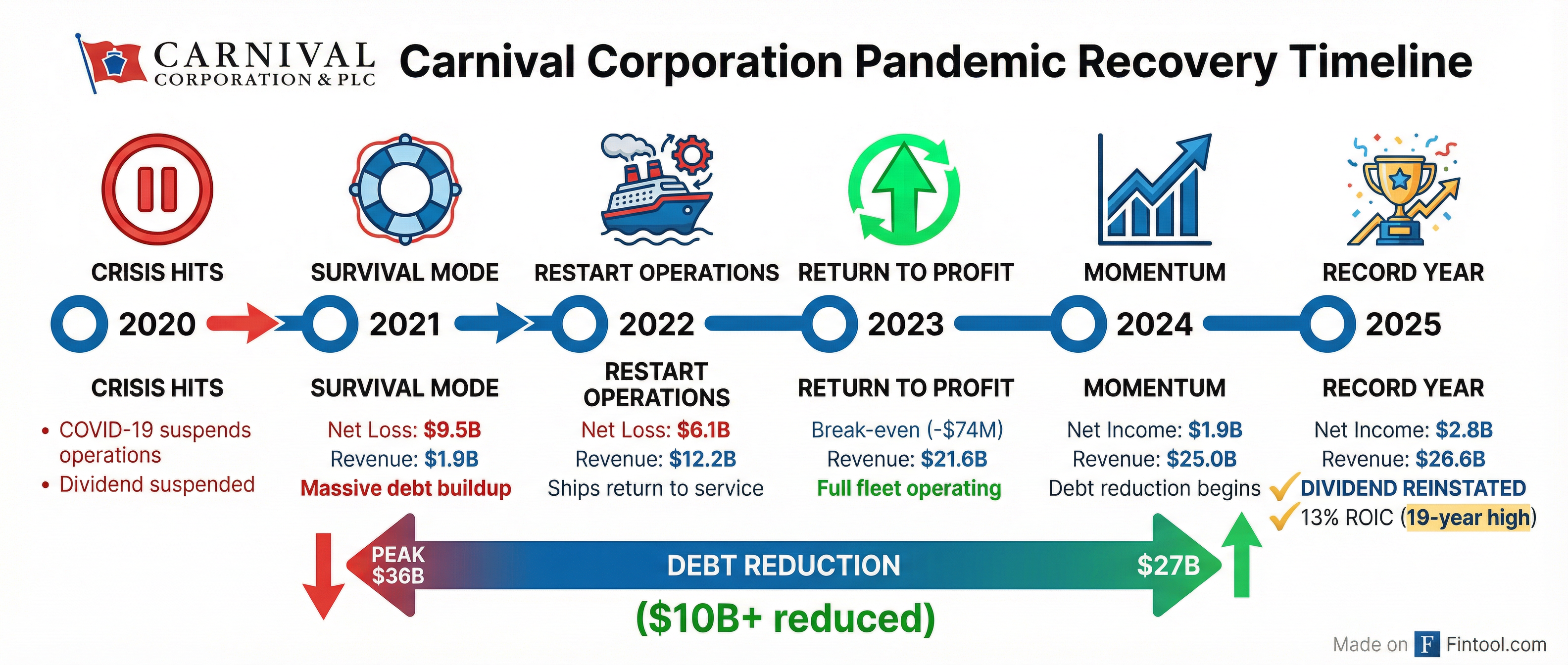
The journey from pandemic crisis to record profitability represents one of the most dramatic turnarounds in corporate America. When COVID-19 forced Carnival to suspend operations in March 2020, the company faced an existential threat. With ships sitting empty and revenue at zero, Carnival accumulated nearly $35 billion in debt to survive.
The losses were staggering: $9.5 billion in fiscal 2021, another $6.1 billion in 2022. The dividend—a staple for income investors since 1990—was suspended indefinitely.
But as travel demand roared back, Carnival's massive scale became an advantage. The company has now reduced debt by over $10 billion since the peak less than three years ago. The $19 billion refinancing plan was completed in less than a year, simplifying the capital structure and cutting interest expense.
"We have reached a meaningful turning point," Bernstein said.
Consumer Resilience Defying Sentiment
Perhaps most remarkable is how cruise demand has remained strong despite persistently weak consumer sentiment readings. Weinstein noted that Michigan's U.S. consumer sentiment index "dipped quite low for several months throughout 2025, and in fact, last month dropped pretty close to its lowest level in recorded history."
Yet booking volumes hit record levels for both 2026 and 2027 sailings over the past three months. Black Friday through Cyber Monday volumes "even outpaced prior year's robust levels."
"The disconnect between consumer sentiment and actual booking behavior continues to reinforce what we've said for a long time. Demand for our cruise lines is proving far more resilient than traditional macro indicators would suggest," Weinstein explained.
The company is already two-thirds booked for 2026 at "historical high prices" for both North America and Europe.
2026 Outlook: Another Double-Digit Year
Management is guiding for continued momentum:
- Adjusted net income: Up ~12% to approximately $3.45 billion
- Net yields: Up ~2.5% (or ~3% normalized for loyalty program accounting and deployment changes)
- ROIC: Expected to exceed 13.5%, approaching a 20-year high
- Adjusted EBITDA: Approximately $7.6 billion
This guidance comes despite significant headwinds. Non-Carnival capacity in the Caribbean is up 14% year-over-year, bringing the two-year increase to 27%—while Carnival's own capacity grew just 4% over that period.
"Our 2026 guidance fully incorporates the 14% increase in non-Carnival Corporation capacity growth in the Caribbean," Weinstein said.
Corporate Simplification
Beyond financials, Carnival announced plans to unify its dual-listed company structure into a single NYSE-listed entity. The company has operated as a dual-listed corporation (DLC) since 2003, with shares trading on both the New York and London Stock Exchanges.
Under the plan, Carnival plc shareholders would receive Carnival Corporation shares on a one-for-one basis. The company would also reincorporate from Panama to Bermuda.
Management believes the simplification will:
- Create a single global share price
- Streamline governance and reporting
- Reduce administrative costs
- Increase liquidity and weighting in U.S. stock indexes
Shareholder votes are expected in April 2026, with completion targeted for Q2 2026.
Industry Implications
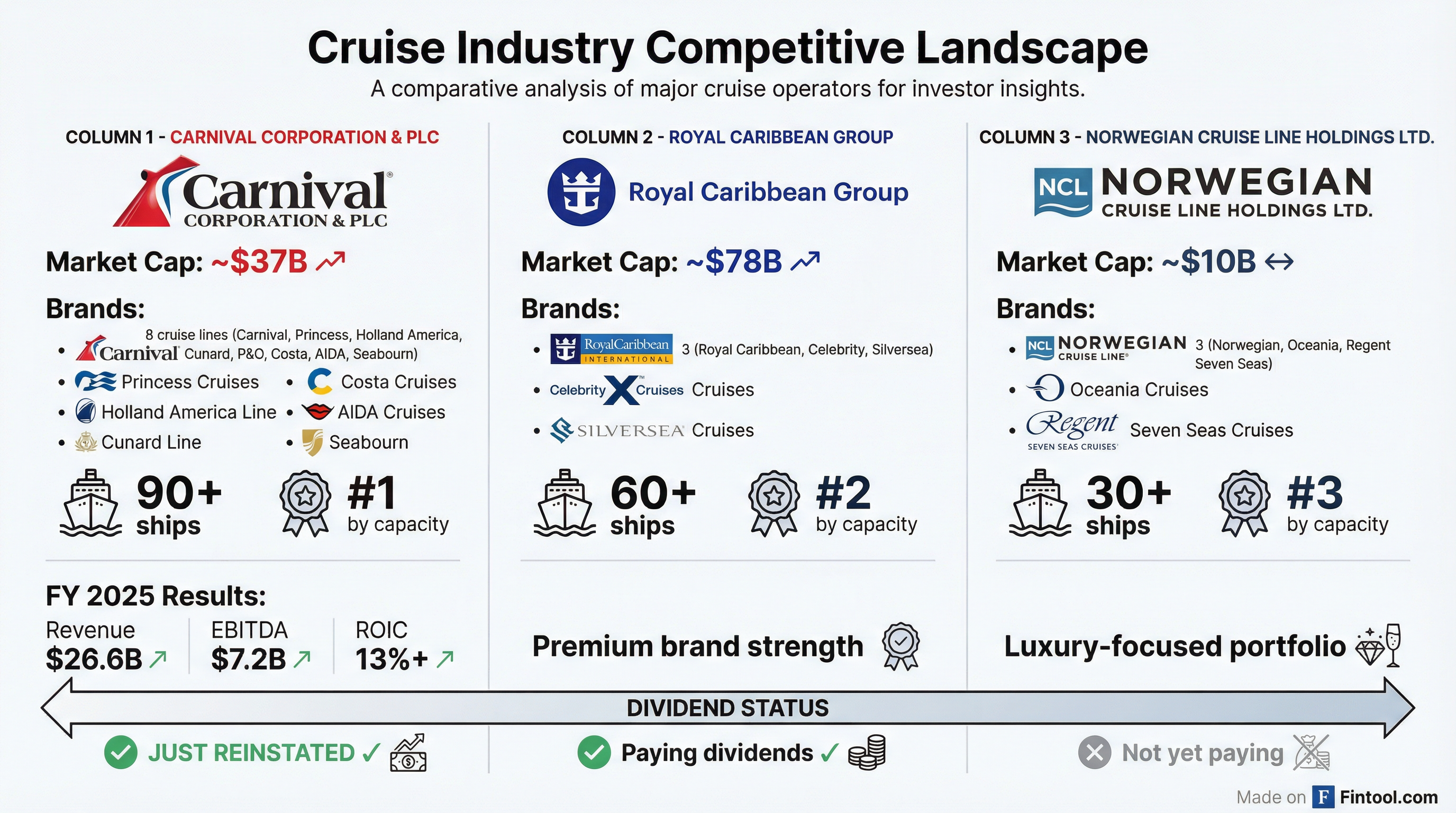
Carnival's dividend reinstatement puts it back on competitive footing with Royal Caribbean, which reinstated its dividend in late 2023. Norwegian Cruise Line, the smallest of the three majors, has not yet resumed dividend payments.
The strong results from Carnival add to evidence that the cruise industry has fully recovered from the pandemic and is now in expansion mode. Royal Caribbean shares were up in sympathy on Friday, while Norwegian also gained.
Weinstein's comments about resilient demand despite weak consumer sentiment may be the most important takeaway for the broader consumer discretionary sector. Cruises have positioned themselves as a relative value compared to land-based vacations, and consumers are responding.
"The price-to-experience ratio to land-based alternatives is still at a ridiculous value and provides enormous headroom for many years to come," Weinstein said. "And that's despite what will be an approximately 20% cumulative yield increase for us since 2023."
What to Watch
Near-term catalysts:
- Wave season booking trends (January-March 2026)
- Caribbean yield performance amid elevated industry capacity
- Shareholder vote on corporate simplification (April 2026)
Key risks:
- Consumer spending pullback if recession materializes
- Fuel price volatility
- Caribbean capacity glut pressuring yields
- Execution risk on deleveraging while paying dividends
Longer-term opportunities:
- Celebration Key destination ramping (already hosted 1 million guests)
- Half Moon Cay expansion later in 2026
- Continued yield improvement as brand positioning strengthens
Related: