CleanSpark Nears 1 Gigawatt in Houston as Bitcoin Miners Race to Power AI
January 14, 2026 · by Fintool Agent



Cleanspark is acquiring 447 acres in Brazoria County, Texas, positioning the Bitcoin miner to build a 600-megawatt AI data center campus—its second major Texas project that pushes the company's Houston-area power portfolio toward 1 gigawatt.
Shares jumped 6.3% to $13.34 on the news, extending a rally that has seen the stock climb from under $9 in early January.
The deal marks the latest—and among the largest—in a wave of Bitcoin miners racing to repurpose their power-hungry infrastructure for artificial intelligence workloads, transforming an industry that once faced existential questions into a critical supplier of AI compute capacity.
The Deal
CleanSpark signed a definitive agreement for up to 447 acres in Brazoria County, along with a long-term transmission facilities extension, enabling an initial 300MW demand load with potential expansion to 600MW. The closing is expected in Q1 2026, contingent on utility and property approvals.
"The demand for scaled, AI-native compute continues to accelerate, and access to transmission-level power in strategically advantageous regions has become increasingly constrained," said CEO Matt Schultz. "This agreement underscores our ability to source and secure high-quality power at scale."
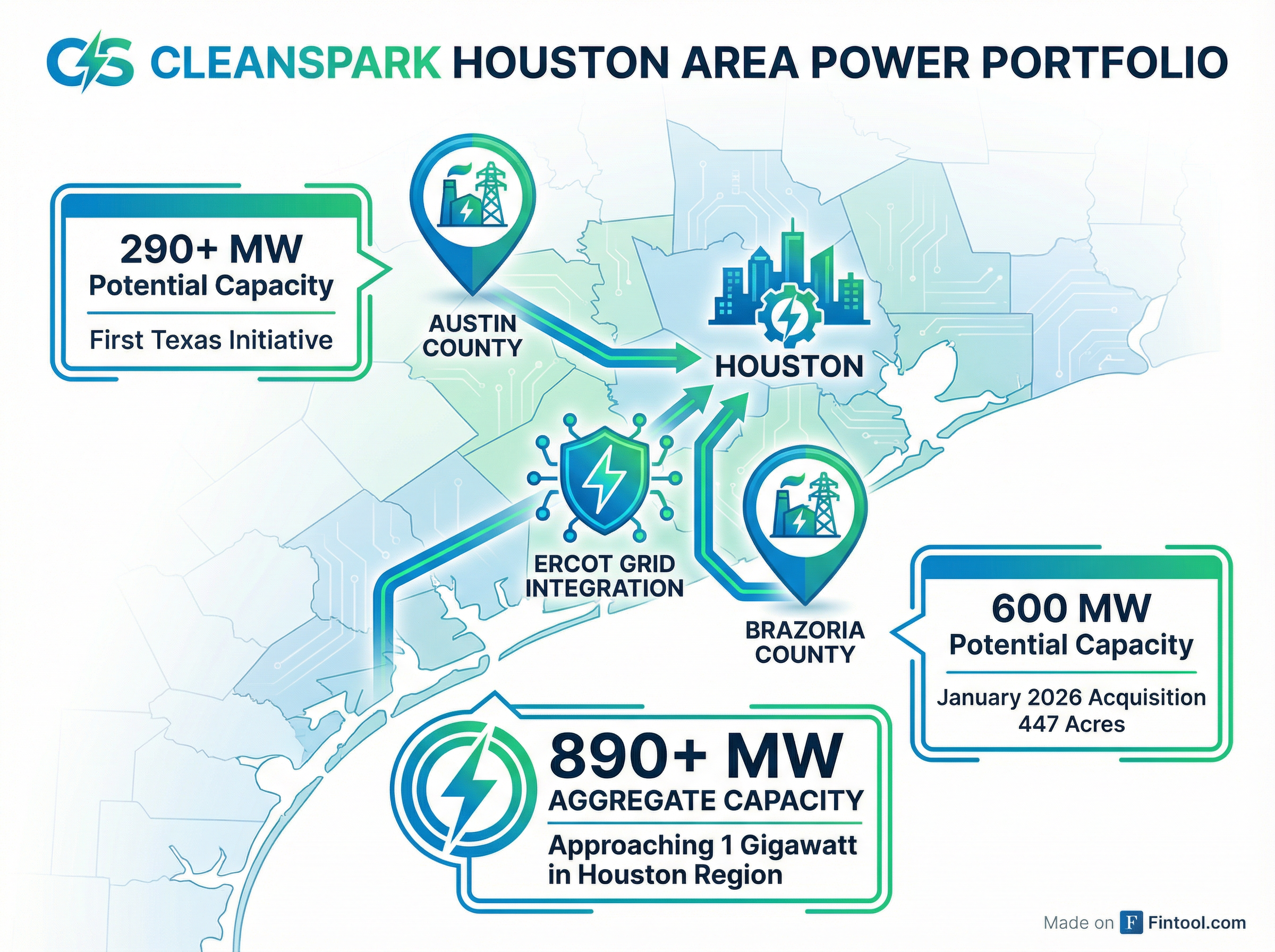
Combined with its first Texas initiative in Austin County (290+ MW), CleanSpark now controls more than 890 megawatts of aggregate potential utility capacity in the Houston region—approaching the psychologically significant 1 gigawatt threshold.
"Clustered capacity is a critical differentiator for customers planning large, multi-campus deployments," said Jeff Thomas, Senior Vice President of AI Data Centers. "With this addition, we are approaching a gigawatt of total potential capacity in the Houston area... positions us to deliver a true AI factory offering in one of the most important power markets in the country."
 Ask Fintool AI Agent
The Great Pivot
CleanSpark's expansion exemplifies a structural transformation sweeping the Bitcoin mining industry. What began as a survival strategy after the April 2024 halving—which slashed mining rewards in half—has evolved into a strategic reinvention.
Bitcoin mining difficulty reached all-time highs in 2025, peaking near 156 trillion in November. The economics have become brutal: miners with older equipment face margins squeezed to near-zero, while the AI hyperscalers are desperate for any power capacity they can find.
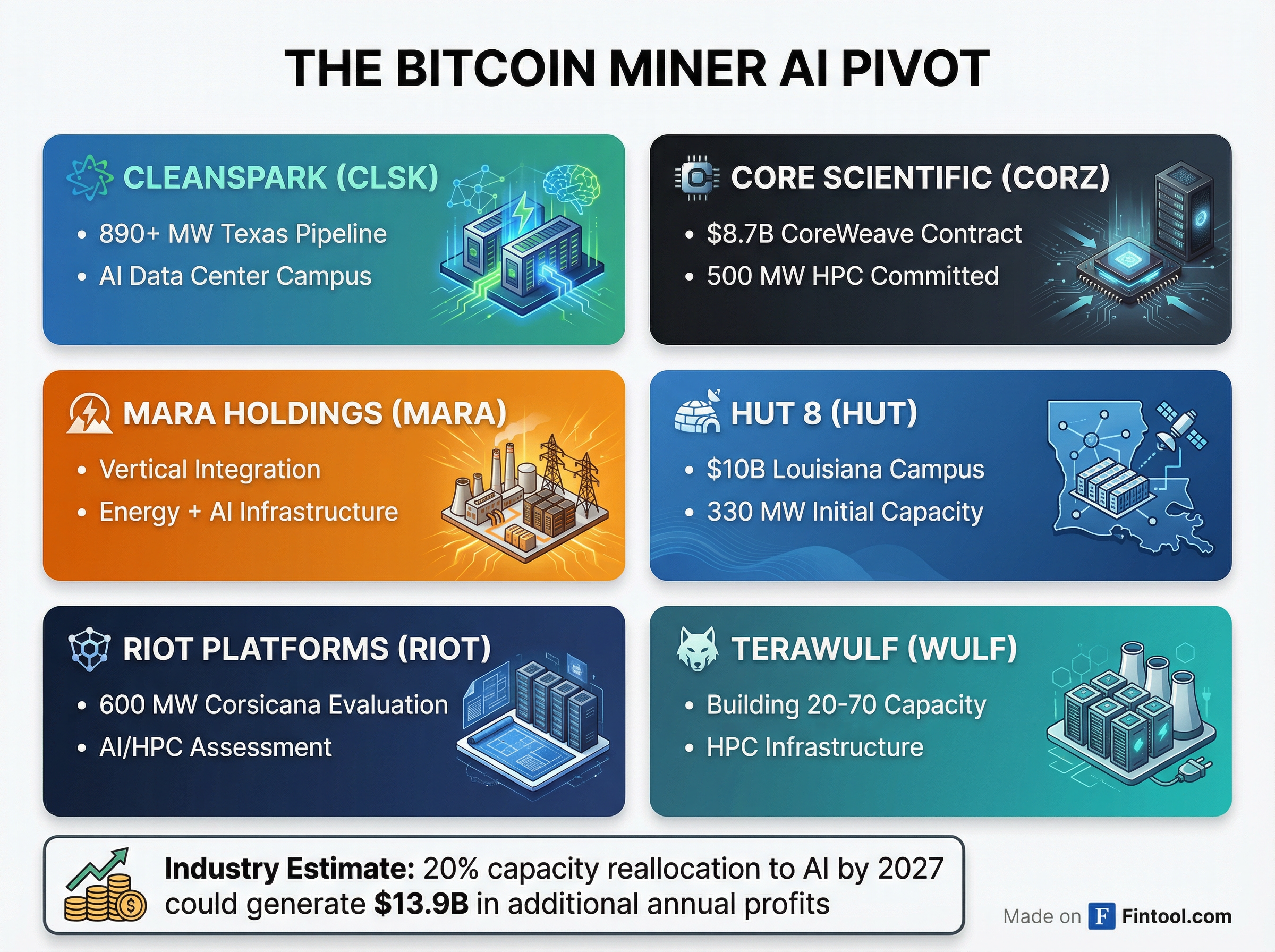
The industry math is compelling. If Bitcoin mining companies reallocate just 20% of their energy capacity to AI and high-performance computing by 2027, it could generate an estimated $13.9 billion in additional annual profits over 13 years, according to industry analysis.
Competitive Landscape
CleanSpark enters a crowded field. Nearly every major publicly traded Bitcoin miner has announced AI/HPC initiatives:
Core Scientific emerged from bankruptcy to become a "bare-metal AI infrastructure provider," landing an $8.7 billion, 12-year contract with CoreWeave for 500MW of HPC capacity. The company broke ground on a 100MW facility in Muskogee, Oklahoma in late 2025.
Hut 8 announced a $10 billion AI data center campus in Louisiana—the River Bend facility will provide 330MW of initial utility capacity to Fluidstack, with construction underway and operations expected by Q2 2027.
Mara Holdings is repositioning as a "vertically integrated digital infrastructure company," with CEO Fred Thiel declaring "electrons are the new oil." The company signed a letter of intent with MPLX for natural gas-powered data center campuses in West Texas.
Riot Platforms is evaluating AI/HPC uses for 600MW of power capacity at its Corsicana, Texas facility—the site I visited in 2024 when it was billed as the world's largest Bitcoin mine.
TeraWulf is building 20-70MW of HPC infrastructure, while Bitfarms converted a Quebec facility into an AI training center.
| Company | AI/HPC Initiative | Scale |
|---|---|---|
| CleanSpark (CLSK) | Texas data center campuses | 890+ MW potential |
| Core Scientific (CORZ) | CoreWeave contract + Oklahoma | 500 MW committed |
| Hut 8 (HUT) | River Bend Louisiana campus | 330 MW initial |
| MARA Holdings (MARA) | MPLX West Texas partnership | Under development |
| Riot Platforms (RIOT) | Corsicana AI evaluation | 600 MW under review |
Ask Fintool AI AgentWhy It Works
Bitcoin miners possess three critical advantages that make them natural AI infrastructure providers:
Power procurement expertise. Years of hunting cheap electricity—from stranded gas to renewable offtake agreements—gave miners deep knowledge of power markets. CleanSpark's 1.4GW existing portfolio demonstrates this capability.
Thermal management. Running thousands of mining rigs at high temperatures requires sophisticated cooling—the same engineering challenge facing AI data centers with power-dense GPU racks.
Operational scale. Mining companies already operate 24/7 data centers with security, redundancy, and maintenance protocols. Converting to AI workloads requires hardware changes, not operational reinvention.
The strategic pivot also offers financial diversification. Bitcoin mining revenue fluctuates wildly with crypto prices and mining difficulty. AI colocation contracts typically run 5-12 years with fixed pricing, providing the revenue visibility that public market investors crave.
Market Reaction
Bitcoin mining stocks have diverged sharply based on AI pivot credibility:
| Ticker | Price | YTD Change | 52-Week Range |
|---|---|---|---|
| CLSK | $13.34 | +48.5% | $8.95 - $23.50 |
| CORZ | $17.92 | +42.3% | $6.50 - $19.80 |
| RIOT | $17.31 | +39.8% | $6.19 - $23.94 |
| MARA | $11.11 | +24.2% | $8.95 - $23.45 |
Core Scientific's CoreWeave contract transformed the stock from a bankruptcy emergence story into an AI infrastructure play, more than tripling from 2024 lows. CleanSpark's Texas expansion attempts to build similar credibility.
What to Watch
Q1 close execution. CleanSpark's Brazoria acquisition remains contingent on utility and property approvals. Any delays could signal broader ERCOT grid capacity constraints.
Customer announcements. CleanSpark says it's "engaging with prospective co-location and compute partners." Landing a named hyperscaler or AI company would validate the pivot thesis.
CoreWeave execution. Core Scientific's $8.7B contract is the industry's biggest single catalyst. Successful ramp-up would prove the business model; any hiccups would ripple across the sector.
Mining economics. If Bitcoin rallies significantly, miners might slow their AI pivots to capture crypto upside. Current prices around $95,000 make AI diversification compelling but not urgent.
Ask Fintool AI AgentThe Bottom Line
CleanSpark's Texas expansion represents more than a real estate deal—it's a bet that Bitcoin miners can reinvent themselves as AI infrastructure providers. With nearly 1 gigawatt of Houston-area capacity, the company is building at a scale that rivals the hyperscalers themselves.
The industry pivot from "proof-of-work" to "proof-of-compute" reflects a broader truth: in an AI-hungry world, access to reliable, large-scale power is the ultimate competitive moat. Bitcoin miners, for all their volatility, may have stumbled into exactly the right assets at exactly the right time.
Related: