De Beers Cuts Diamond Prices for First Time in Over a Year as Lab-Grown Gems Surge to 50% of Market
January 19, 2026 · by Fintool Agent


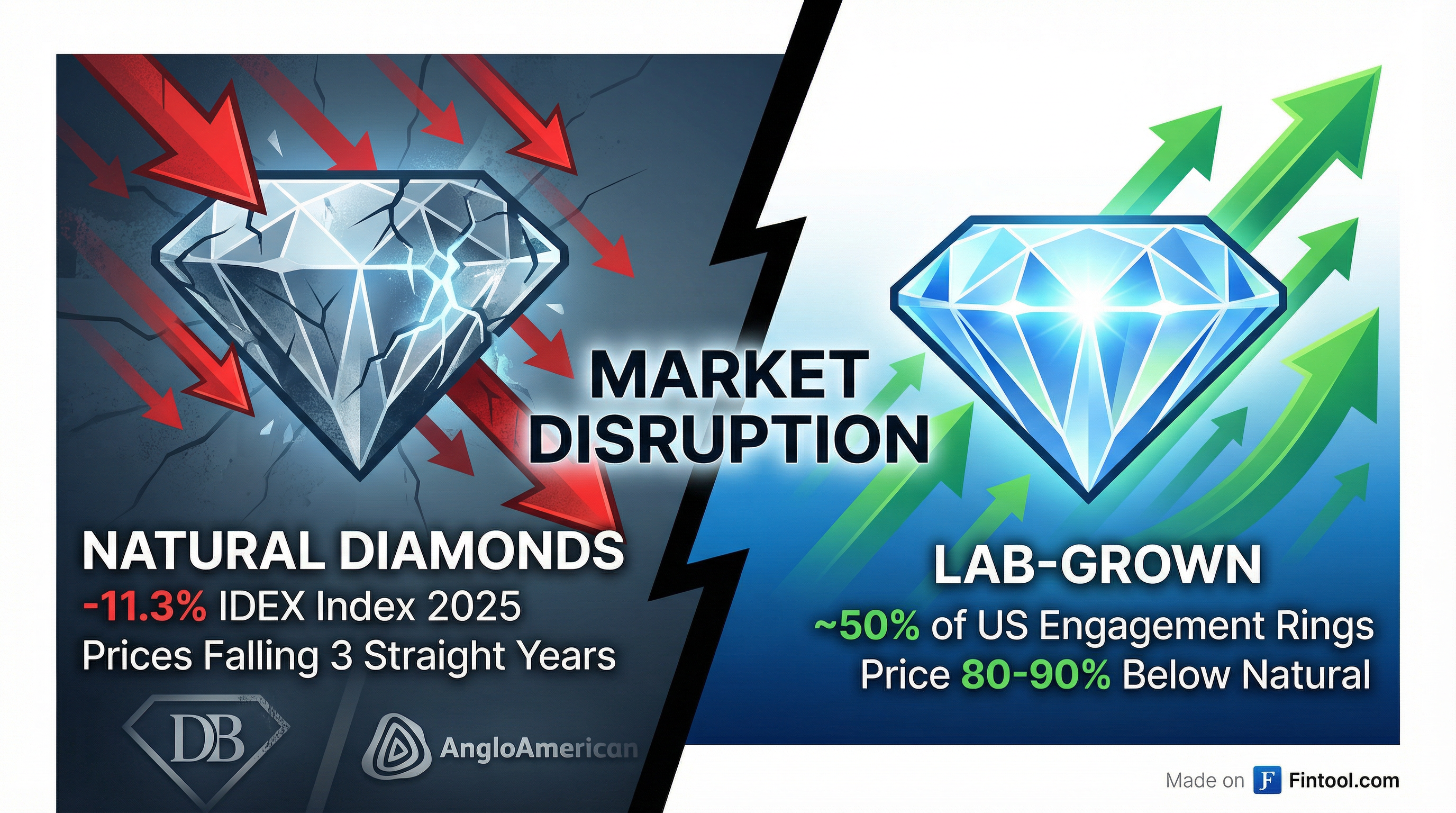
De Beers has cut official diamond prices for the first time in more than a year, ending its attempts to support a market that has been in freefall for three consecutive years. The move comes as lab-grown diamonds now account for 52% of US engagement ring center stones—a stunning reversal from just 3% in 2018—and marks a capitulation by the company that invented the modern diamond industry.
At its first regular sale of 2026, De Beers made deep cuts in the price of rough diamonds bigger than three-quarters of a carat. The company had been selling discounted stones in secret while maintaining official prices approximately 25% higher than the going market rate—a strategy that became untenable as the structural forces reshaping the industry intensified.
For Anglo American, which owns 85% of De Beers and is actively trying to sell the business, the timing couldn't be worse. The mining giant has written down De Beers' book value by $4.5 billion over the past two years, leaving the crown jewel of the diamond industry valued at just $4.1 billion—less than half of what it was worth in 2022.
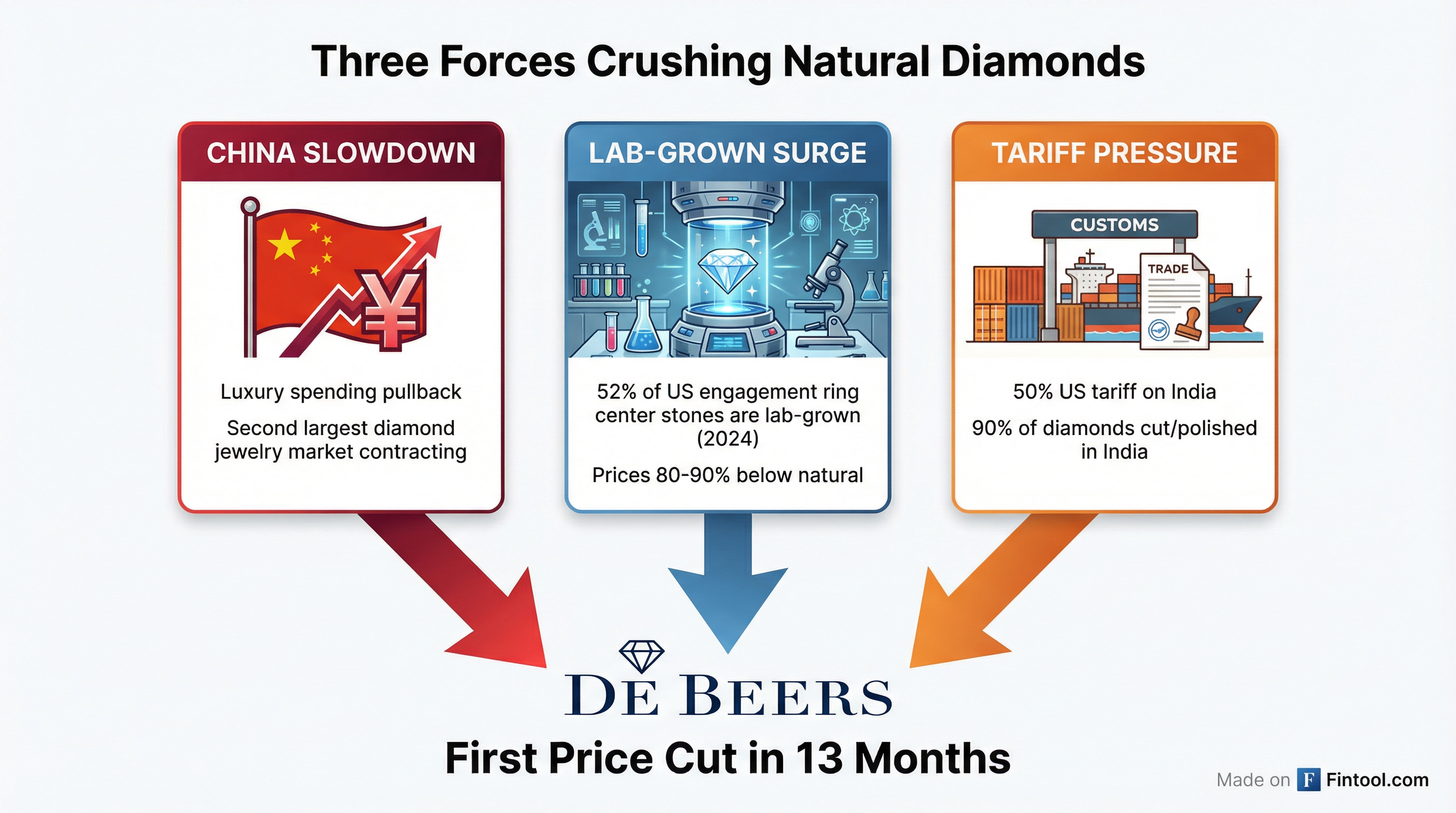
The Three Forces Crushing Natural Diamonds
1. Lab-Grown Diamond Surge
The most disruptive force is the rise of laboratory-created diamonds, which are chemically, physically, and optically identical to natural diamonds but cost 80-90% less.
According to wedding platform The Knot and insurance data from BriteCo, lab-grown diamonds now account for 52% of engagement ring center stones in the United States—up from just 12% in 2019 and a mere 3% in 2018. The shift has been particularly pronounced among younger consumers, with 45% of adults aged 18-35 open to lab-grown diamonds for engagement rings, compared to just 15% of those over 51.
Signet Jewelers, the world's largest jewelry retailer, reported that lab-grown diamonds represented 17% of its merchandise sales in fiscal 2025. CEO Virginia Drosos noted on earnings calls that lab-grown pieces actually carry higher margins and higher average transaction values than natural diamonds, as consumers trade up to larger stones at similar price points.
"We're seeing consumers gravitate increasingly to lab-created diamonds—they do offer a great value for customers, especially in this macroeconomic environment," Drosos said. "Through our scaled sourcing efforts and the work that we've done on branding, our LCD items actually carry both a higher margin and a higher ATV than natural diamonds on average."
 Ask Fintool AI Agent
2. China Luxury Spending Pullback
Consumer demand for diamond jewelry remained weak in China, previously the world's second-largest market. The pullback in Chinese luxury spending has persisted throughout 2025, contributing to a global surplus of polished diamond inventory in the midstream.
De Beers noted in its Q3 2025 production report that "rough diamond trading conditions continued to be challenging" as the improvement seen in early 2025 was "undermined" by trade tensions and weak end-market demand.
3. US Tariffs on India
In August 2025, President Trump imposed 50% tariffs on India, where approximately 90% of the world's diamonds are either traded, cut, or polished. While the US later included natural diamonds on its Tariff Annex III list—making them eligible for exemptions for countries with trade agreements—the damage to trading conditions was already done.
The EU has since secured tariff exemptions, but the industry continues to navigate uncertainty around potential agreements with other trading partners.
Anglo American's Exit Problem
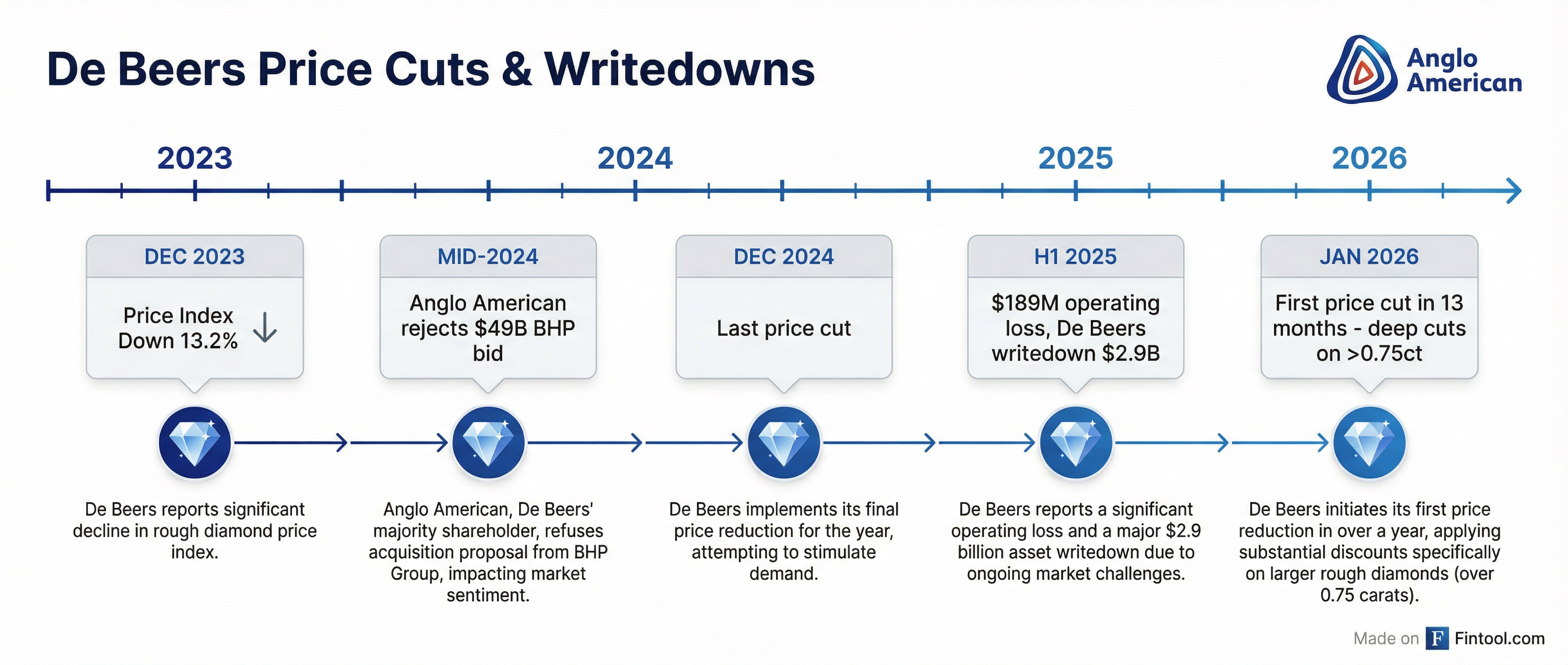
Anglo American is actively looking to exit the diamond business as part of a radical restructuring that began after fending off a $49 billion takeover bid from BHP in 2024. But finding a buyer for De Beers has proven challenging as the company racks up consecutive years of losses.
De Beers recorded an underlying EBITDA loss of $189 million in the first half of 2025, compared with income of $300 million in the same period of 2024. Full-year revenue totaled $1.95 billion, down 13% year-over-year.
The consolidated average realized price for rough diamonds fell to $155/carat—down 5% from $164/carat a year earlier. More ominously, the average rough price index declined 14% as the company resorted to selling assortments at lower margins to clear excess inventory.
Adding complexity to any sale is the Government of Botswana, which owns the remaining 15% of De Beers and has signaled interest in increasing its stake—potentially to a controlling position. Newly elected Botswana President Duma Buko has argued that the country should have ownership of its natural resource, though the IMF has warned against the move.
Production Cuts and Industry Contraction
De Beers has slashed production guidance to 20-23 million carats for 2025, down from 30-33 million carats originally planned—a cut of more than a third. Global diamond production fell to multi-decade lows of around 100 million carats in 2025 and is expected to remain near those levels in 2026.
| Metric | H1 2024 | H1 2025 | Change |
|---|---|---|---|
| Revenue | $2.25B | $1.95B | -13% |
| Underlying EBITDA | $300M | -$189M | - |
| Average Realized Price | $164/ct | $155/ct | -5% |
| Production | 13.3M ct | 10.2M ct | -23% |
Source: De Beers/Anglo American financial reports
The diamond industry "is going to get smaller," according to industry analyst Avi Krawitz of The Diamond Press. "The US jewelry sector continues to shrink by roughly 3% a year as a growing number of independent retailers close when boomer jewelers retire without succession plans."
Ask Fintool AI AgentWhat This Means for Investors
Natural Diamond Miners: The price cuts signal that De Beers' strategy of maintaining artificially high official prices has failed. Other producers including Russia's Alrosa will face continued margin pressure.
Jewelry Retailers: Companies like Signet Jewelers (SIG) that have embraced lab-grown diamonds are better positioned, as they can offer consumers larger stones at higher margins. Signet's lab-grown attachment rates are "well above other merchandise in both Bridal and Fashion categories."
Luxury Goods Sector: The diamond crisis is emblematic of broader challenges facing luxury goods, as Chinese demand weakens and younger consumers prioritize experiences over products. Richemont, LVMH, and other luxury conglomerates with jewelry exposure face similar headwinds.
Anglo American: The company's ability to exit De Beers at an acceptable valuation looks increasingly challenged. At $4.1 billion, De Beers is worth less than some of the writedowns Anglo has taken on the business.
The Road Ahead: Can Natural Diamonds Recover?
Industry stakeholders signed the Luanda Accord in 2025, committing to use 1% of rough sales to fund category marketing through the Natural Diamond Council. However, funding pledged for 2025 remained outstanding, leaving the NDC short of the roughly $100 million it has identified as necessary for effective marketing.
Signet's Drosos suggested there's reason for cautious optimism: "I think we're seeing a more educated consumer over time about the difference. Consumers are understanding that with lab created, they have a point-in-time opportunity to trade-up to potentially a larger diamond but that—I don't believe they have the expectation that it will hold its value necessarily over time in the same way that natural diamonds traditionally have."
But the structural challenges remain formidable. Lab-grown diamond production costs are now near the cost of raw ingredients plus power, leaving little room for further declines but also no floor to support natural diamond premiums. As long as consumers can buy a visually identical 2-carat lab-grown diamond for less than a 1-carat natural stone, the price umbrella protecting natural diamonds will continue to collapse.
Ask Fintool AI Agent