Diamondback Energy Takes $3.7B Impairment as Oil Prices Bite, But Cash Flow Machine Keeps Humming
February 23, 2026 · by Fintool Agent

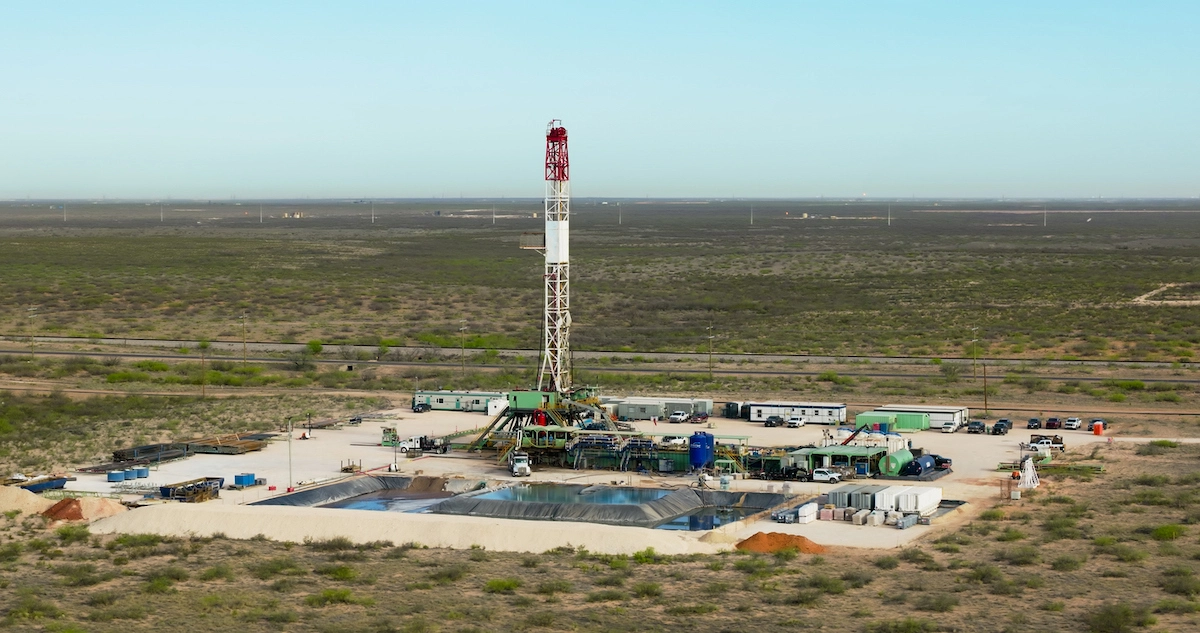
Diamondback Energy swung to a $1.46 billion Q4 net loss after booking a $3.7 billion non-cash impairment—one of the largest write-downs in recent shale history—as falling oil prices triggered an SEC ceiling test on assets acquired in last year's transformational Endeavor merger.
Yet beneath the GAAP carnage, the Permian Basin's largest pure-play producer delivered exactly what shareholders have come to expect: $5.5 billion in full-year free cash flow, a 5% dividend increase, and $2 billion in share repurchases.
The stock fell approximately 2% in after-hours trading as investors digested the headline loss, though the adjusted results largely met expectations.
The Impairment: Accounting Math Meets Commodity Reality
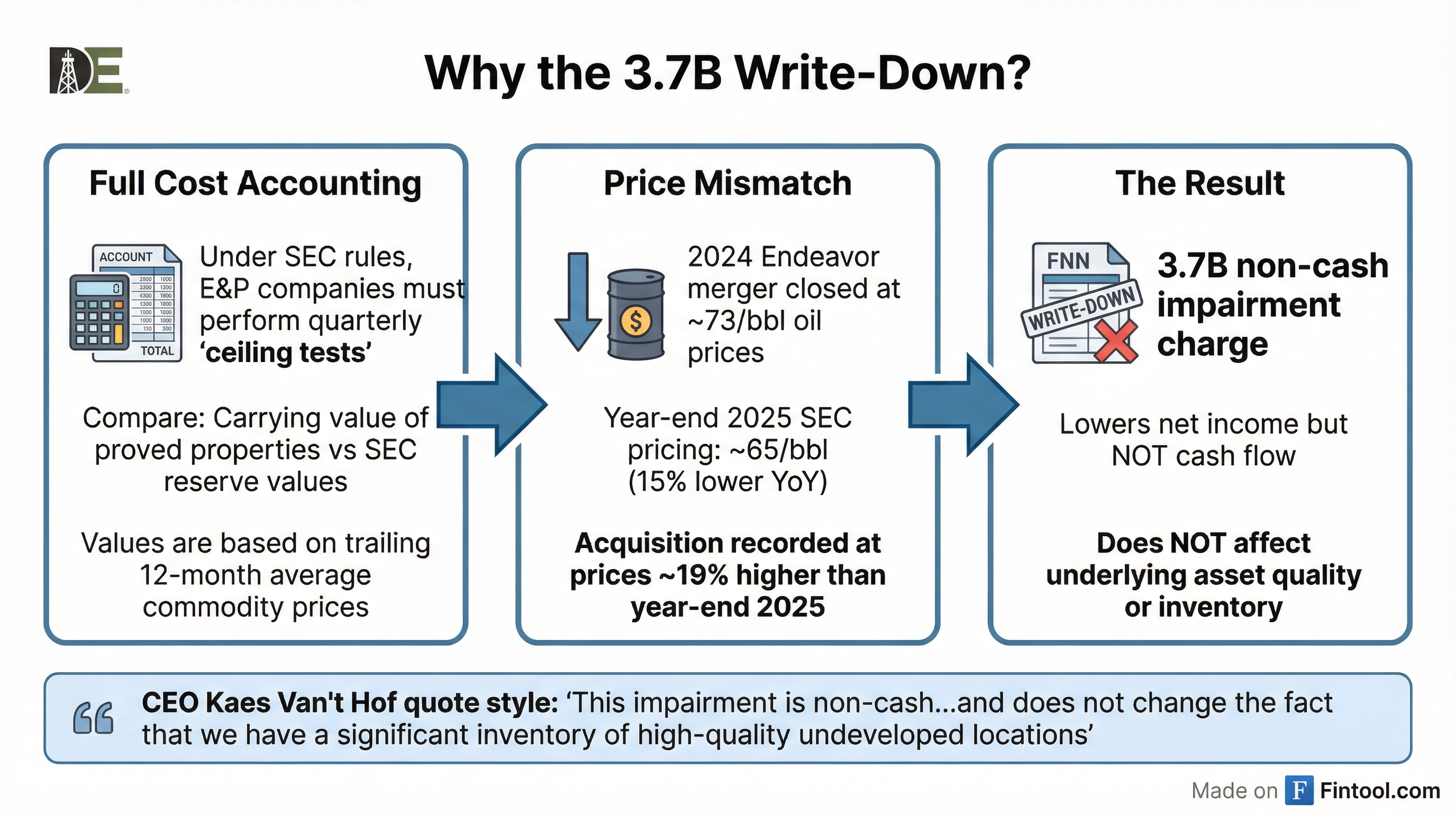
The $3.7 billion write-down stems from SEC full cost accounting rules that require quarterly "ceiling tests" comparing the carrying value of proved properties against reserve values calculated using trailing 12-month average prices.
Here's the math that caught Diamondback:
- 2024 Endeavor merger: Closed when oil prices hovered around $73-75/bbl
- Year-end 2025 SEC pricing: Approximately $65/bbl (down ~15% YoY)
- Q4 2025 realized price: $58.00/bbl—the lowest in nearly two years
The acquisition was recorded at prices roughly 19% higher than year-end 2025 reserves, leaving billions in asset value stranded on the balance sheet.
CEO Kaes Van't Hof emphasized the non-cash nature of the charge in his shareholder letter: "This impairment is non-cash, lowering net income, but was not a result of anything other than commodity price impact. Importantly, we remain conservative in booking our proved undeveloped reserves, and this impairment does not change the fact that we have a significant inventory of high-quality undeveloped locations that are not reflected in SEC reserve values today."
 Ask Fintool AI Agent
Cash Flow Strength Belies the GAAP Loss
While the income statement shows a $5.11 per share loss, the cash flow statement tells a different story:
| Metric | Q4 2025 | Full Year 2025 |
|---|---|---|
| Net Cash from Operations | $2.3B | $8.8B |
| Free Cash Flow | $1.0B | $5.5B |
| Adjusted Free Cash Flow | $1.2B | $5.9B |
| Cash Capex | $943M | $3.5B |
| Reinvestment Ratio | — | 39% |
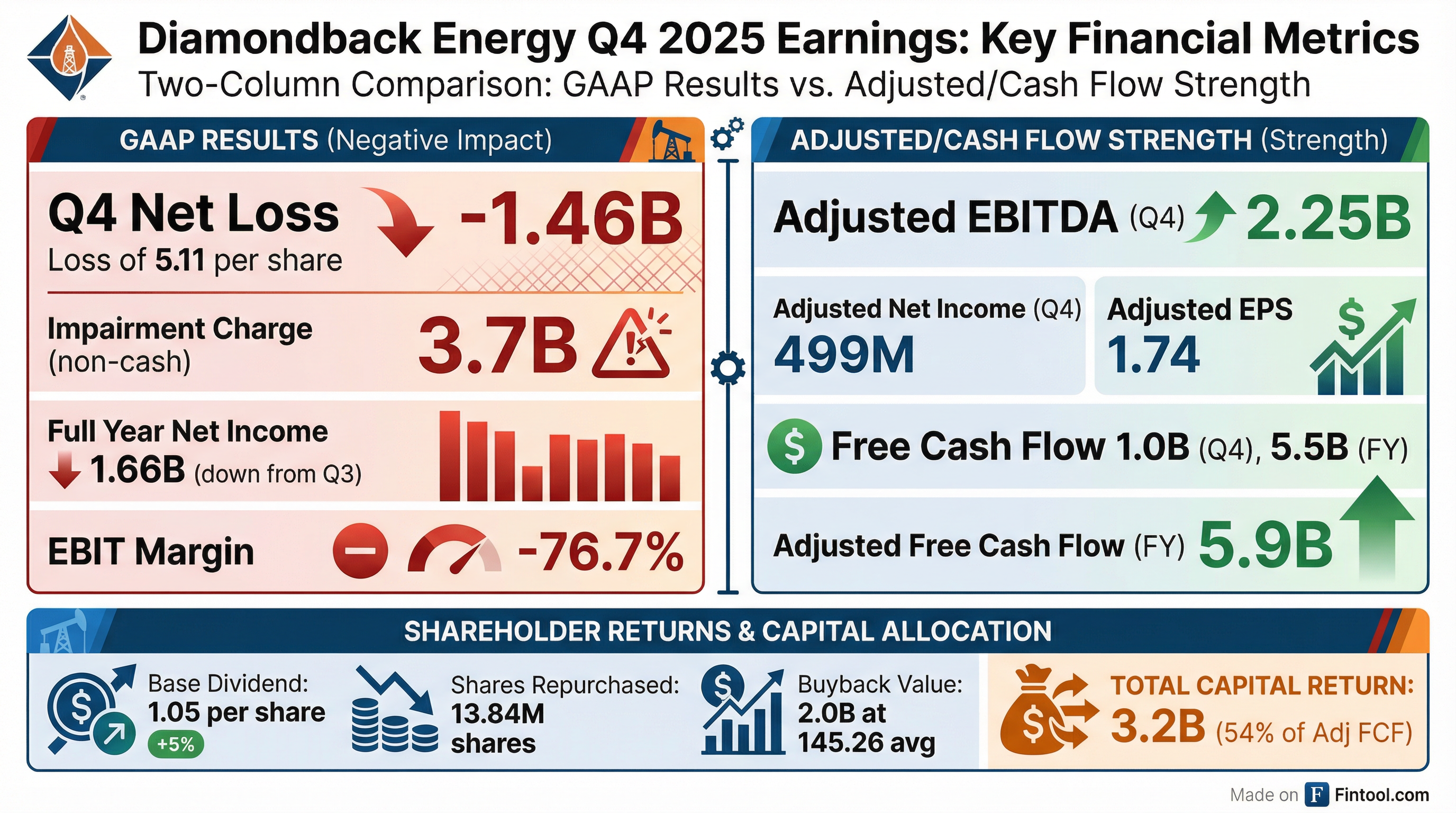
The company's adjusted net income of $499 million ($1.74/share) for Q4 strips out the impairment and other non-cash items, providing a cleaner read on operational performance.
Production and Operational Records
Diamondback's operational machine continued to hum despite macro headwinds:
| Metric | Q4 2025 | Full Year 2025 |
|---|---|---|
| Oil Production | 512.8 MBO/d | 497.2 MBO/d |
| Total Production | 969.1 MBOE/d | 921.0 MBOE/d |
| Wells Drilled | 107 | 463 |
| Wells Completed | 127 | 503 |
| Avg Lateral Length | 12,474 ft | 12,138 ft |
| Cash Operating Costs | $10.31/BOE | $10.23/BOE |
Van't Hof highlighted the efficiency gains: "Just two years ago, we would have needed around 22 rigs to drill that many wells, a testament to the efficiencies gained throughout the organization." The company now averages close to eight-day spud-to-TD times, with its fastest 15,000-foot lateral drilled in under six days.
Shareholder Returns: Aggressive Despite Macro Headwinds
Diamondback leaned heavily into shareholder returns in 2025:
- Base dividend: Raised 5% to $1.05/share quarterly ($4.20 annualized), implying a 2.4% yield
- Share repurchases: 13.84 million shares for $2.0 billion at $145.26 average price
- Total capital returned: $3.2 billion (54% of adjusted free cash flow)
Notably, Diamondback executed a structured buyback agreement with SGF FANG Holdings (the former Endeavor shareholders) allowing up to 3 million share repurchases per quarter through December 2026, addressing investor concerns about share overhang. The company has already bought back 4 million shares from SGF since November.
Ask Fintool AI AgentThe "Yellow Light" Macro Outlook
Van't Hof maintained Diamondback's "stoplight" framework, characterizing the current environment as a "yellow light"—though he noted the "red light" scenario seems less likely than during 2025: "The wave of oversupply that has been widely telegraphed for the better part of the last two years continues to get pushed to the right—at some point the market will slowly begin to find reasons to be less bearish as demand is strong and the global economy is growing."
The company is positioned with "ultimate flexibility": inventory depth and operational capacity to accelerate if the market tightens, or moderate activity if conditions soften.
2026 Guidance: Flat and Disciplined
Diamondback set conservative guidance for 2026, keeping activity flat versus Q4 2025 levels:
| Metric | 2026 Guidance |
|---|---|
| Oil Production | 500-510 MBO/d |
| Total Production | 926-962 MBOE/d |
| Cash Capex | $3.6-$3.9B |
| Q1 Oil Production | 502-512 MBO/d |
| Q1 Capex | $900M-$975M |
| Average Lateral Length | 12,900 ft |
The capital budget includes approximately $125 million for Barnett/Woodford shale testing—a new frontier in the Midland Basin where Diamondback has secured nearly 200,000 acres and identified roughly 600 net high-quality locations.
Balance Sheet Improvement
Despite the impairment, Diamondback made significant progress on deleveraging:
- Q4 gross debt: $14.7 billion (down 11% QoQ)
- Q4 net debt: $14.6 billion (down 8% QoQ)
- Repurchased $203M of 2051/2052 senior notes at 82.3% of par
- Repaid $950M of term loan due 2027
In February 2026, subsidiary Viper Energy closed its non-Permian asset sale for $617 million, immediately deploying proceeds to fully repay its $500 million term loan and revolving credit balance.
The Investment Case
The Diamondback print crystallizes the bifurcated reality of modern shale economics: GAAP accounting can produce startling headline losses when commodity prices decline, yet best-in-class operators continue generating substantial free cash flow through operational excellence and disciplined capital allocation.
For investors, the key questions are:
- Oil prices: Can prices stabilize or recover, reducing impairment risk and boosting realized prices?
- Inventory quality: Does the Barnett/Woodford expansion provide runway beyond the Midland Basin's core zones?
- Capital allocation: Will management maintain discipline on returns versus growth?
With a 2.4% dividend yield, aggressive buybacks, and one of the lowest cost structures in the basin, Diamondback remains positioned as a blue-chip option for Permian exposure—even as the commodity backdrop remains uncertain.
Ask Fintool AI AgentRelated: Diamondback Energy Company Profile