Doximity CFO Takes Medical Leave as Stock Hits 52-Week Low on Q3 Earnings
February 5, 2026 · by Fintool Agent


Doximity shares fell 5.4% to a fresh 52-week low on Wednesday after the healthcare networking platform announced that CFO Anna Bryson is taking a temporary medical leave of absence—news that overshadowed a quarterly earnings beat and a new $500 million share repurchase authorization.
The stock closed at $33.34, touching an intraday low of $32.66—its lowest level since going public in June 2021.
CFO Medical Leave: What We Know
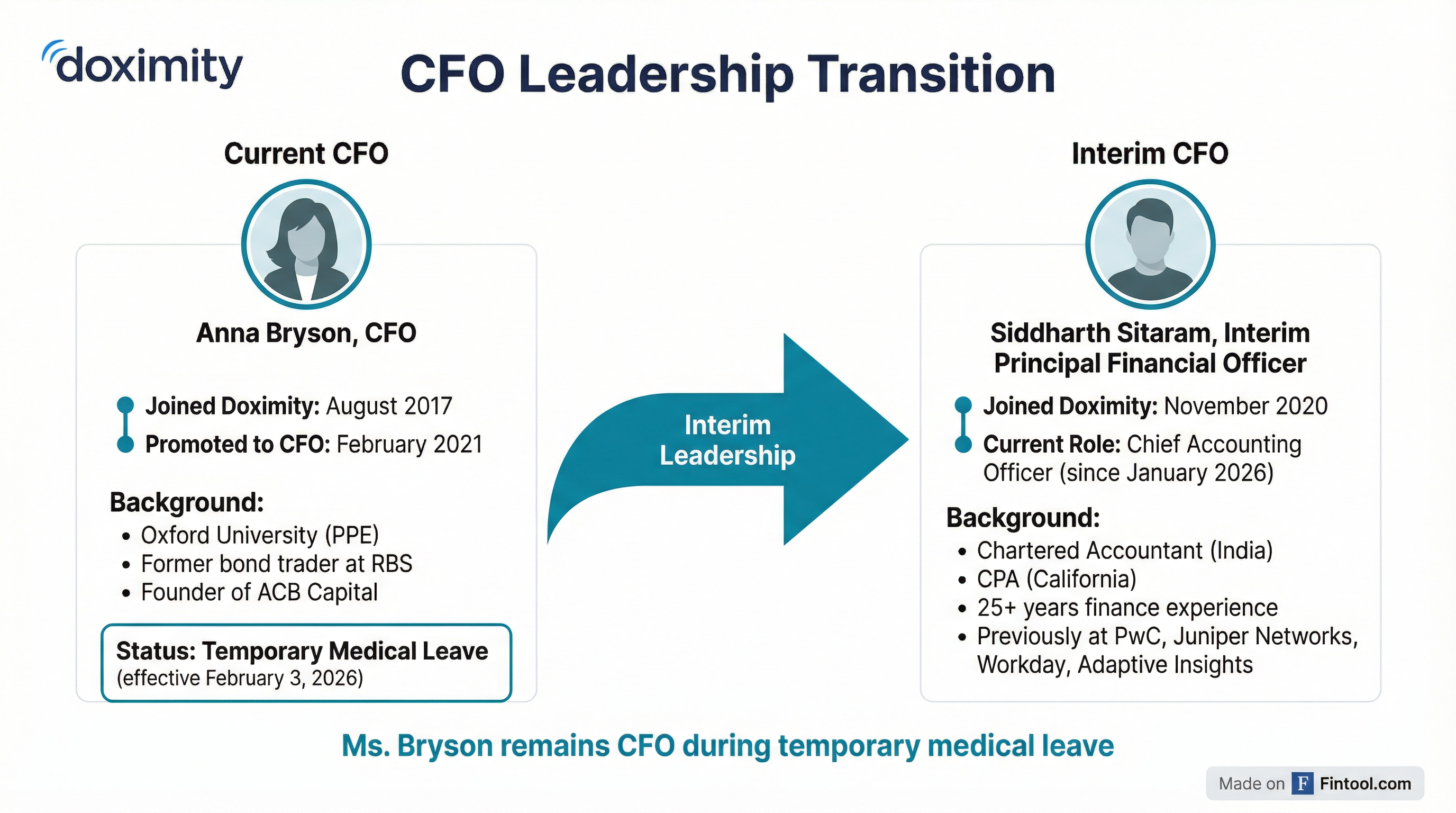
Bryson, 35, has served as Doximity's CFO since February 2021 and has been with the company since August 2017, when she joined as VP of Strategic Finance, Financial Planning, and Analysis. Prior to Doximity, she founded ACB Capital, an investment advisory firm, and worked as a bond trader at Royal Bank of Scotland. She holds both a B.A. and M.A. in Philosophy, Politics, and Economics from Oxford University.
The company disclosed no details about the nature or expected duration of Bryson's medical condition, stating only that the leave is "temporary" and effective February 3, 2026.
Interim Leadership
The board appointed Siddharth Sitaram, Doximity's Chief Accounting Officer since January 2026, as interim principal financial officer and principal accounting officer. Sitaram, 47, brings over 25 years of finance experience, including stints at PwC, Juniper Networks, Workday, and Adaptive Insights. He holds a Chartered Accountant designation from India and is a licensed CPA in California.
Sitaram has been with Doximity since November 2020, serving as VP Corporate Controller before being promoted to SVP Finance & Accounting in 2023 and then Chief Accounting Officer in January 2026—a rapid ascent that positions him as a logical interim choice.
 Ask Fintool AI Agent
Q3 FY2026: Solid Numbers Overshadowed by Concerns
The CFO announcement came alongside fiscal Q3 2026 results that beat on both top and bottom lines:
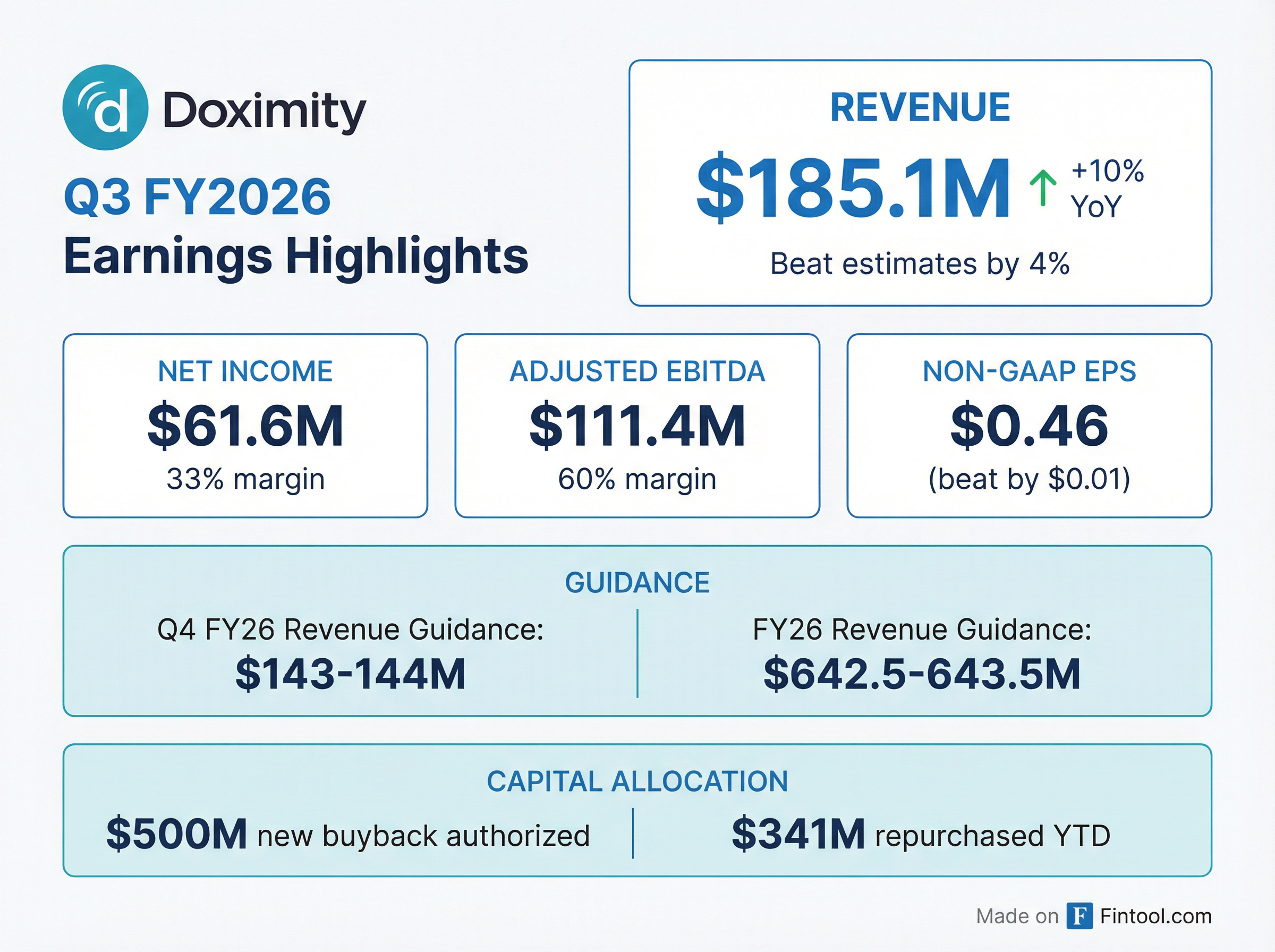
| Metric | Q3 FY2026 | Q3 FY2025 | YoY Change |
|---|---|---|---|
| Revenue | $185.1M | $168.6M | +10% |
| Net Income | $61.6M | $75.2M | -18% |
| Net Income Margin | 33.3% | 44.6% | -11.3pp |
| Adjusted EBITDA | $111.4M | $102.0M | +9% |
| Adjusted EBITDA Margin | 60.2% | 60.5% | -0.3pp |
| Non-GAAP EPS | $0.46 | $0.45 | +2% |
| Free Cash Flow | $58.5M | $63.4M | -8% |
The company also guided Q4 FY26 revenue of $143-144 million and updated full-year guidance to $642.5-643.5 million.
CEO Jeff Tangney highlighted record engagement metrics: "Our newsfeed had more than 1 million quarterly active prescribers, our workflow products had 720,000 (a record QoQ jump), and our nascent AI products had over 300,000. In short, the addition of AI features across our platform has made us more useful than ever."
$500M Buyback: Confidence Signal Amid Pressure
The board authorized a new $500 million share repurchase program with no expiration date, adding to an already aggressive capital return strategy. Year-to-date through December 31, Doximity has repurchased $341 million of stock.
With the stock down 44% from its February 2025 peak of $85.21, the buyback authorization signals management confidence in intrinsic value—though it also raises questions about capital allocation given the company's slowing revenue growth trajectory.
Ask Fintool AI AgentWhy the Stock Keeps Falling
The CFO medical leave, while temporary, adds another layer of uncertainty to a stock already under significant pressure from multiple headwinds:
1. OpenAI's Healthcare Ambitions
In August 2025, OpenAI hired Doximity co-founder Nate Gross to lead its healthcare strategy, along with Instagram's Ashley Alexander as VP of healthcare product. In January 2026, OpenAI launched "ChatGPT for Healthcare" with major hospital partners including Cedars-Sinai, Memorial Sloan Kettering, and Stanford Medicine—directly competing with Doximity's AI offerings.
2. Pharma Advertising Headwinds
BofA Securities noted in January that its quarterly pharma advertising survey showed "a slightly weaker macro" with Q4 budget flushes down year-over-year and a "somewhat weak" outlook for digital budgets in 2026, attributed to FDA caution around direct-to-consumer advertising.
3. Medicare Policy Changes
The Centers for Medicare & Medicaid Services' Wasteful and Inappropriate Service Reduction (WISeR) Model, launched in mid-2025, introduced AI-driven prior authorization rules that caused many hospital systems to pause technology spending.
4. Valuation Reset
Despite the decline, Doximity still trades at a premium: roughly 29x forward P/E and 12x EV/revenue, reflecting expectations for high growth that have yet to materialize.
Bryson's Track Record
Under Bryson's CFO tenure since February 2021, Doximity has delivered consistent financial performance:
| Metric | FY 2022 | FY 2023 | FY 2024 | FY 2025 |
|---|---|---|---|---|
| Revenue | $344M | $419M | $475M | $570M |
| Net Income | $155M | $113M | $148M | $223M |
| EBITDA Margin | 33.6%* | 31.3%* | 37.4%* | 41.3%* |
| Free Cash Flow | $82M* | $138M* | $164M* | $217M* |
*Values retrieved from S&P Global
Revenue has compounded at roughly 18% annually during her tenure, while maintaining exceptional profitability—adjusted EBITDA margins consistently above 55% and free cash flow conversion north of 35%.
Her most recent Form 4 filings show routine insider activity: tax withholding dispositions tied to equity vesting, with no open market sales. As of November 15, 2025, Bryson held 364,672 shares of Class A common stock directly.
What to Watch
- Duration of leave: Any update on Bryson's return timeline will be closely monitored by investors
- Sitaram's first earnings call: The Q4 call will test his ability to communicate with Wall Street
- Pharma advertising trends: Q4 results will reveal whether the "budget flush" season recovered
- OpenAI competition: Hospital adoption of ChatGPT for Healthcare vs. Doximity's AI suite
- Buyback execution: Whether the company accelerates repurchases at current depressed prices
Ask Fintool AI AgentBottom Line
Doximity's CFO medical leave is temporary and the interim leadership bench is deep—Sitaram's background and tenure make him a capable steward. But the timing compounds an already difficult narrative for a stock that has lost nearly half its value in 12 months amid AI disruption fears, policy uncertainty, and a valuation reset.
The Q3 beat demonstrates the business remains fundamentally healthy, with 60% adjusted EBITDA margins and strong engagement growth. Yet the market is clearly focused on forward risks rather than current profitability. The $62 average analyst price target suggests roughly 85% upside from current levels, but investors will need to see evidence that Doximity can defend its moat against generalist AI players before conviction returns.
Related: