EA Shareholders Greenlight $55 Billion Saudi Takeover in Largest LBO Ever
December 24, 2025 · by Fintool Agent

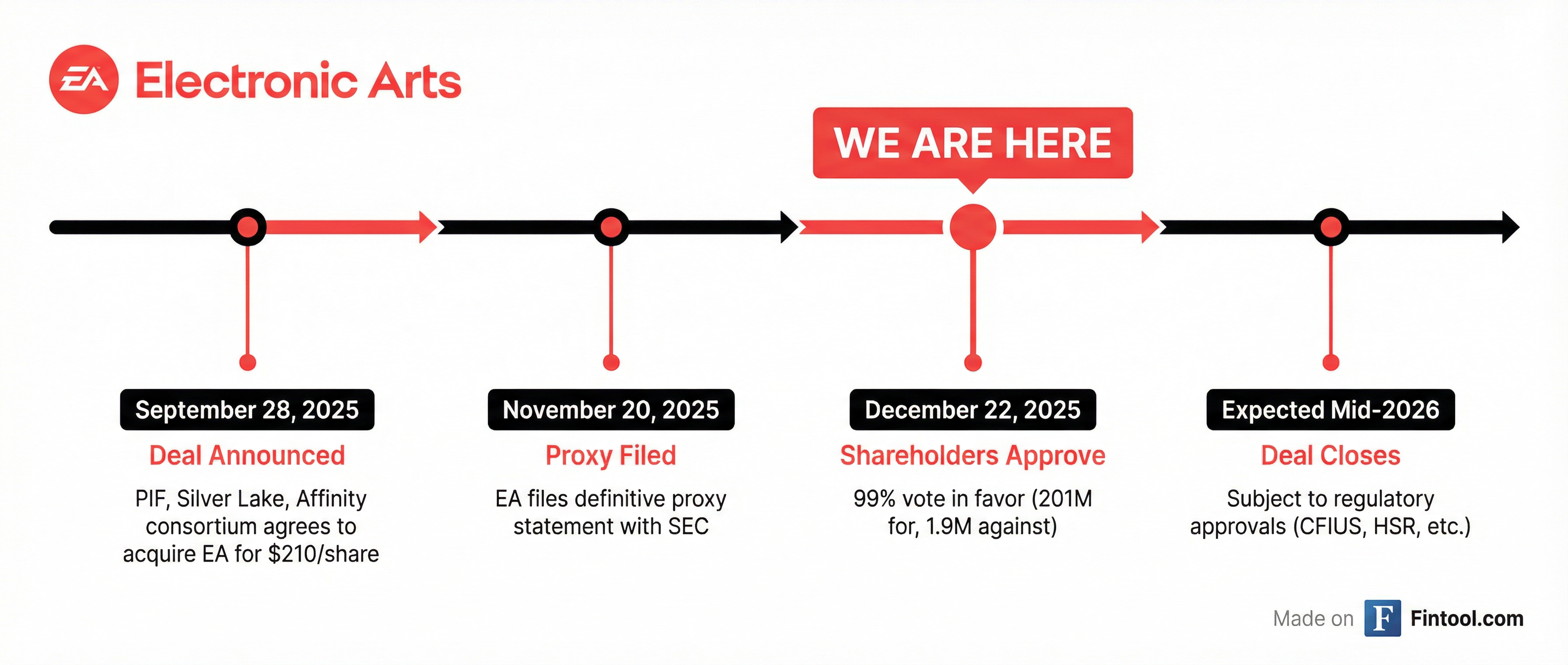
Electronic Arts shareholders voted overwhelmingly to approve the company's $55 billion sale to a consortium led by Saudi Arabia's Public Investment Fund, clearing the final private-sector hurdle for what will become the largest leveraged buyout in history.
The vote wasn't close. Of the 250.1 million shares entitled to vote, 201.5 million were cast in favor—representing 99% of shares present and voting—versus just 1.9 million against and 90,000 abstentions. The lopsided margin reflects the significant premium shareholders are receiving: $210 per share in cash, a 25% premium to EA's unaffected trading price before the deal was announced in September.
The Deal Structure
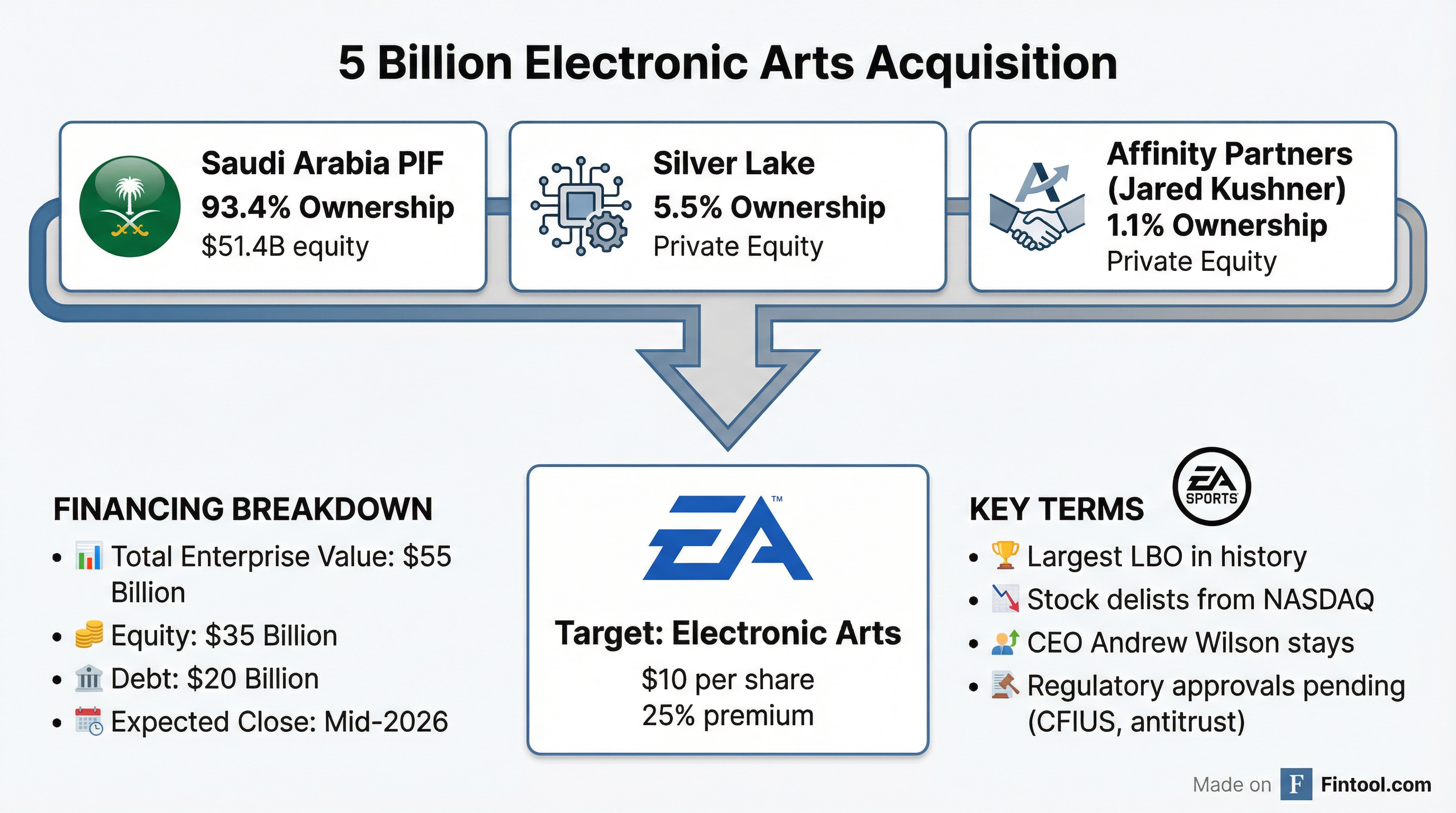
The acquisition values EA at approximately $55 billion, including debt. Upon closing, Saudi Arabia's PIF will own 93.4% of the company, with Silver Lake holding 5.5% and Jared Kushner's Affinity Partners taking 1.1%. PIF already owned approximately 24.8 million shares of EA prior to the deal announcement—a stake that will be rolled into the new ownership structure rather than cashed out.
The financing package includes $20 billion in debt commitments from lenders, making this among the most leveraged major acquisitions in recent memory. The deal is not subject to any financing condition—meaning if regulatory approval is secured, the consortium is contractually obligated to close.
 Ask Fintool AI Agent
What Happens Next
The deal now faces regulatory review from multiple jurisdictions. Key approvals include:
- CFIUS (Committee on Foreign Investment in the United States): Given PIF's majority ownership and Saudi government ties, this national security review will be closely watched
- Hart-Scott-Rodino antitrust clearance: Standard competition review
- Foreign investment reviews: Required in jurisdictions where EA operates
The merger agreement sets an outside date of September 28, 2026, with provisions for extension if regulatory approvals remain pending. The company expects to close by mid-year 2026.
Several U.S. senators have already raised concerns. Senators Richard Blumenthal and Elizabeth Warren sent a letter to Treasury Secretary Scott Bessent urging "searching scrutiny to this unprecedented, proposed foreign privatization of a major American technology and entertainment company."
However, market observers note the involvement of Affinity Partners—founded by Jared Kushner, son-in-law of President Donald Trump—may smooth the regulatory path domestically.
Ask Fintool AI AgentEA's Financial Profile
EA goes private with a strong financial foundation. The company generated $7.5 billion in revenue in fiscal 2025, with EBITDA margins around 26% and free cash flow exceeding $1.6 billion:*
| Metric | FY 2023 | FY 2024 | FY 2025 |
|---|---|---|---|
| Revenue ($B) | $7.4 | $7.6 | $7.5 |
| Net Income ($B) | $0.8 | $1.3 | $1.1 |
| EBITDA ($B) | $1.9 | $2.0 | $1.9 |
| EBITDA Margin | 25.7% | 26.2% | 26.0% |
| Levered FCF ($B) | $1.3 | $1.7 | $1.7 |
*Values retrieved from S&P Global
The stable margins and strong cash generation will be critical for servicing the $20 billion debt load post-acquisition. At roughly 10x EBITDA of debt, the leverage is aggressive but serviceable given EA's recurring revenue model from franchises like EA Sports FC, Madden NFL, and Apex Legends.
Ask Fintool AI AgentStrategic Rationale
For PIF, the acquisition represents the crown jewel of Saudi Arabia's aggressive push into gaming and entertainment. The kingdom has been building a gaming portfolio through its Savvy Games Group, but EA brings something none of those investments could: control of some of the world's most valuable sports gaming franchises.
CEO Andrew Wilson will remain at the helm post-closing. In September, he assured employees that EA's "values will remain unchanged" under new ownership.
The private ownership structure could give EA more flexibility for long-term investments without quarterly earnings pressure. The company has faced criticism in recent years for aggressive monetization practices in sports games—a dynamic that could shift under patient, deep-pocketed ownership less focused on near-term stock performance.
Market Reaction
EA shares traded at $204.78 on Christmas Eve, just 2.5% below the $210 deal price. The tight spread reflects high market confidence in deal closure, though it leaves modest upside for merger arbitrage investors willing to wait 6+ months for regulatory approvals.
Prior to the September announcement, EA traded around $174—meaning shareholders who held through the announcement captured a 21% gain. The stock hit a 52-week high of $204.84 this week.
Ask Fintool AI AgentThe Bigger Picture
This transaction crystallizes a broader trend: sovereign wealth funds and private equity are acquiring marquee gaming assets at unprecedented scale. The $55 billion price tag makes Microsoft's $69 billion Activision Blizzard acquisition look like the start of a wave rather than an anomaly.
For the U.S. regulatory apparatus, the EA deal presents a genuine test. Can CFIUS block a transaction when one of the buyers is closely tied to the sitting president's family? Will national security concerns about Saudi ownership of a platform reaching hundreds of millions of American users carry the day?
Those questions will be answered in the months ahead. For now, EA's 40-year run as a public company is entering its final chapter—with one of the world's most influential sovereign wealth funds waiting to turn the page.
Related