Eaton CTO: DC Power Is 'Biggest Transformation Since Edison' as Data Center Backlog Swells to 200+ GW
February 17, 2026 · by Fintool Agent


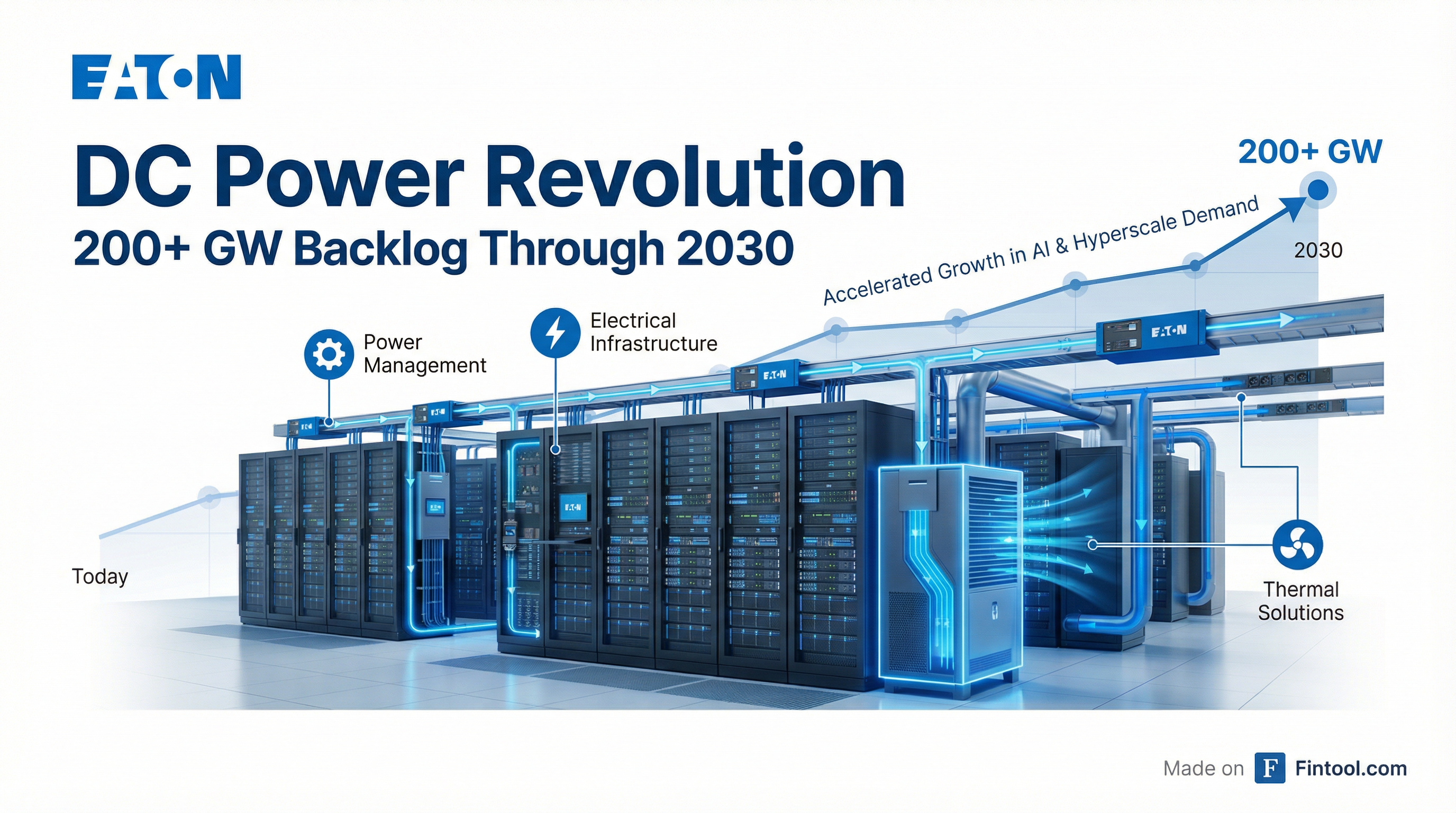
Eaton Corporation's data center backlog has ballooned to 165-200+ gigawatts planned through 2030—double the company's March 2024 estimate—with solid-state transformers positioned to reach mass adoption in 2-3 years, CTO Michael Regelski revealed at the Barclays 43rd Annual Industrial Select Conference today.
The comments mark the most detailed technology roadmap Eaton has provided since announcing its $9.5 Billion Boyd Thermal Acquisition in November, painting a picture of a decade-long infrastructure buildout that could transform how data centers manage power and cooling.
"DC power is probably one of the biggest transformational things that are going to hit the electrical industry since, quite frankly, AC electricity was around in the Edison days," Regelski told conference attendees.
ETN shares closed at $391.62, up 0.6% on the day, and have gained 25% over the past year. The stock touched a 52-week high of $408.45 on February 12.
The Backlog Surge
The numbers Regelski shared reveal an acceleration that caught even bullish analysts off guard. Back in March 2024, Eaton estimated the US data center buildout would reach roughly 100 GW by 2028.
Today's reality looks far larger:
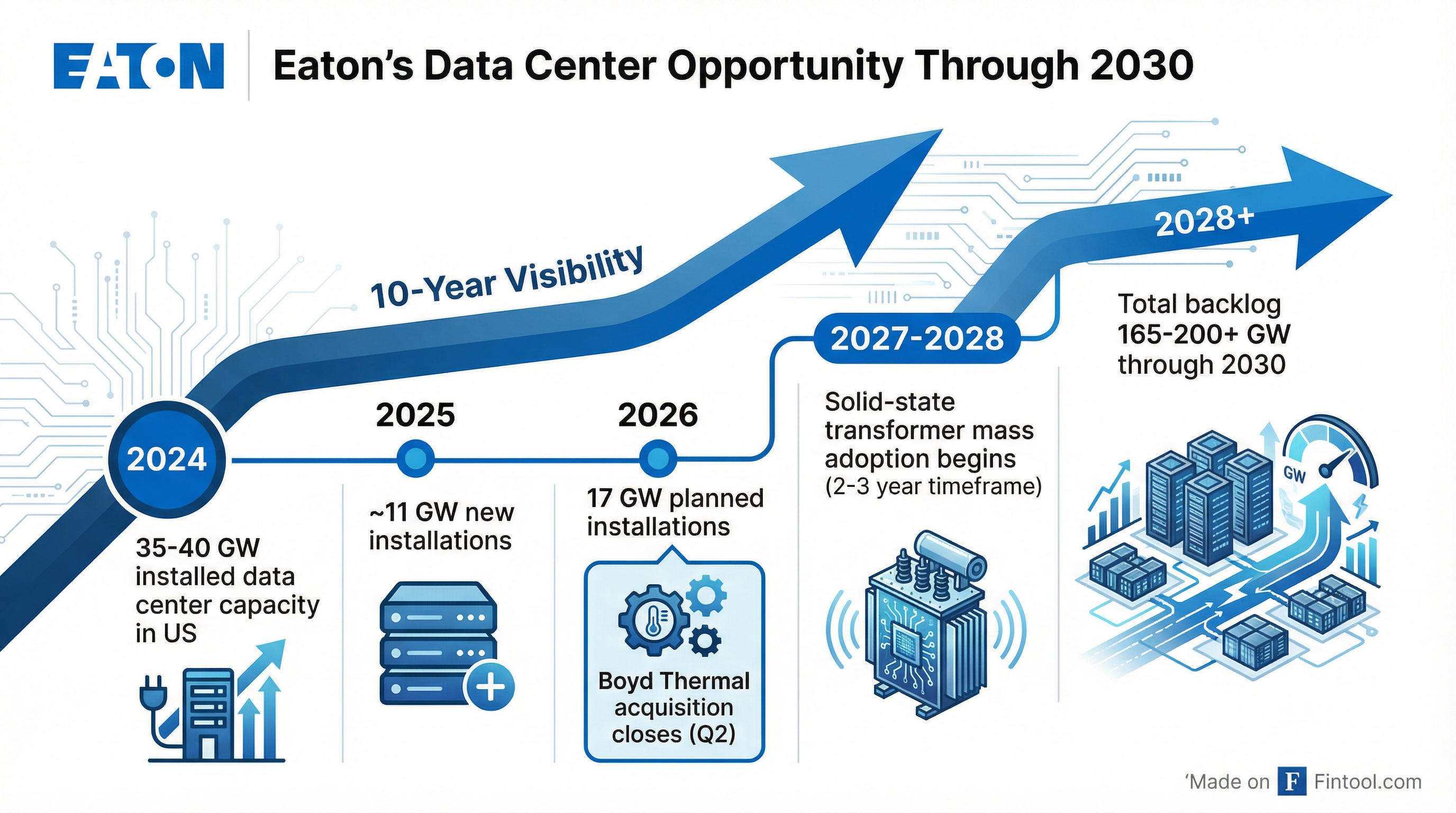
- 35-40 GW of installed data center capacity existed at year-end 2024
- ~11 GW was installed during 2024
- 17 GW is planned for 2026
- 165-200+ GW is now in the backlog through 2030 and beyond
"We could see this going up to 10 years or so," Regelski said regarding visibility. "There's only physically so much that can be installed. There's capacity constraints, there's labor constraints... but you keep on seeing next generation of chips that keep on coming out that are gonna further AI."
 Ask Fintool AI Agent
The DC Power Revolution
The heart of Regelski's presentation centered on 800-volt DC power distribution—a fundamental shift in data center architecture that Eaton has been preparing for over a decade.
The efficiency case is straightforward: traditional data centers step down voltage and convert between AC and DC multiple times as power flows from the utility feed to the server rack. Eaton estimates roughly 5% electrical loss occurs during these transitions.
"If you could just go from DC, directly from the utility feed, all the way through the data center into the rack, that's 5% efficiency gain that you could get," Regelski explained. "On 50 gigawatts or 100 gigawatts of power generation that's needed, that's 5 gigawatts of power that all of a sudden just appears from the existing infrastructure."
For context, 5 GW is roughly equivalent to five large nuclear reactors—capacity that doesn't require new generation facilities, transmission lines, or permitting.
Solid-State Transformers: The Enabling Technology
The technology making this possible is the medium-voltage solid-state transformer, which takes utility-level AC power and converts it directly to DC using power electronics. That direct current then flows throughout the data center through switchgear and busbars directly to racks—eliminating multiple conversion stages.
"It eliminates the loss, but it simplifies the whole architecture of the data center. Everything now is direct," Regelski said.
Eaton's confidence in its positioning stems from long-term investment:
- 10 years ago: Began investing in next-generation power electronics, anticipating DC trend
- 3 years ago: Started organic development of medium-voltage solid-state transformers
- Currently: Running pilots in Asia Pacific
- Recently: Acquired Resilient Power for additional solid-state transformer technology
"Based on pilots and on interest, we think it's going to be sooner rather than later. It's probably in the 2- or 3-year timeframe before it starts getting mass adoption," Regelski said, noting the timeline aligns with the emergence of megawatt-class server racks.
Ask Fintool AI AgentCircuit Protection: The Overlooked Complexity
One often-ignored challenge Regelski highlighted is circuit protection for DC systems. Alternating current naturally crosses zero voltage 120 times per second, providing safe points for mechanical circuit breakers to interrupt faults. Direct current offers no such reprieve—the voltage is always on.
"You have to interrupt the circuit at a much faster pace if you're going to provide a safe condition. A lot of people overlook that," Regelski warned.
Eaton has been investing in solid-state and hybrid circuit protection to address this gap—capabilities that may prove as important as the transformers themselves for customers designing megawatt-scale facilities.
The safety dimension also affects operational considerations: "I can't just get somebody from IT to go into a rack and pull out a server. There's a lot of power coming in. I have to be able to do it safely. Do I need to wear protective equipment?"
Boyd Thermal: From Aerospace to AI
The $9.5 billion Boyd Thermal acquisition, expected to close in Q2 2026, brings Eaton cold plate technology, coolant distribution units (CDUs), and a service model tailored for high-density computing environments.
Boyd's aerospace heritage—where "if something fails, people can die"—provides reliability credentials that hyperscale data center operators increasingly demand.
Regelski emphasized Boyd's simulation capabilities as a key differentiator: "Being able to go and create a model of what a cold plate would look like, and then tailor that to a model of the thermal profile of the chip, and rapidly iterate through simulations... that's really critical in order to rapidly go and produce something."
The validation came earlier this year when Nvidia announced its Vera Rubin platform could operate with 45-degree Celsius (113°F) "warm water" cooling—eliminating the need for chillers in many climates.
"A lot of that's just due to the advances in cold plate technology and being able to reduce the thermal barrier with the chip," Regelski noted.
Financial Performance
Eaton's recent results reflect the data center momentum:
| Metric | Q1 2025 | Q2 2025 | Q3 2025 | Q4 2025 |
|---|---|---|---|---|
| Revenue ($B) | $6.38 | $7.03 | $6.99 | $7.06 |
| Net Income ($M) | $964 | $982 | $1,010 | $1,132 |
| Diluted EPS | $2.45 | $2.51 | $2.59 | $2.91 |
| EBITDA Margin % | 22.6%* | 22.3%* | 23.5%* | 23.5%* |
*Values retrieved from S&P Global
Consensus estimates point to continued growth, with analysts expecting quarterly revenue to reach approximately $7.8 billion by Q4 2026—roughly 10% above Q4 2025 levels.*
*Estimates from S&P Global
Ask Fintool AI AgentSystems vs. Best-of-Breed: Customer Dynamics Shifting
Asked about customer procurement trends, Regelski described an evolving dynamic. Historically, data center operators preferred open interfaces and best-of-breed component selection for supply chain flexibility. But the complexity of next-generation facilities is driving demand for integrated solutions.
"When you're looking for optimal efficiency, and you're trying to go and make sure that all of the components can fit together, especially when the industry isn't established, they're really looking for a systems approach," he explained.
The Apple ecosystem analogy resonated: "You know that everything just kind of works. You don't have to be the engineer on it. More and more, that's what kind of customers are looking for."
What to Watch
Near-term catalysts:
- Boyd Thermal acquisition closing (expected Q2 2026)
- Updates on solid-state transformer pilot programs
- NVIDIA Vera Rubin shipments beginning second half of 2026
Longer-term signals:
- Pace of DC power architecture adoption in new facilities
- Circuit protection product launches for high-voltage DC
- Cold plate market share dynamics as two-phase cooling emerges
The gray space versus white space distinction that long separated power infrastructure from IT equipment is blurring. As Regelski noted, with megawatt-class racks, "Gray Space, White Space delineation is gonna start becoming more and more artificial when you look at it from a pure power perspective."
For Eaton, that convergence—power flowing seamlessly from utility to chip—represents the opportunity to become indispensable infrastructure for the AI era.