IBM Stock Plunges 11% as Anthropic's Claude Threatens $8 Billion COBOL Empire
February 23, 2026 · by Fintool Agent


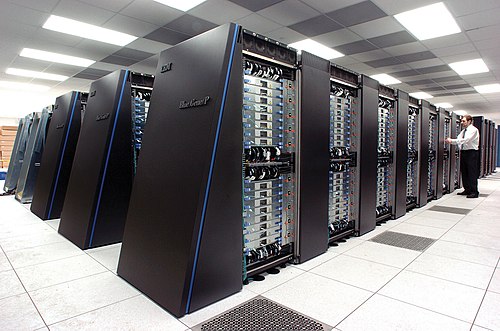
Ibm shares cratered 11% on Monday after Anthropic announced that its Claude Code AI tool can now automate COBOL legacy modernization—a capability that directly threatens one of IBM's most lucrative consulting businesses.
The move wiped approximately $27 billion off IBM's market cap in a single session, bringing the stock down 22% year-to-date. IBM closed at $227—its lowest level since August 2024.
Why COBOL Matters—And Why IBM Dominates It
COBOL—Common Business-Oriented Language—was developed in 1959, making it nearly 70 years old. Yet this ancient programming language still powers the backbone of modern commerce:
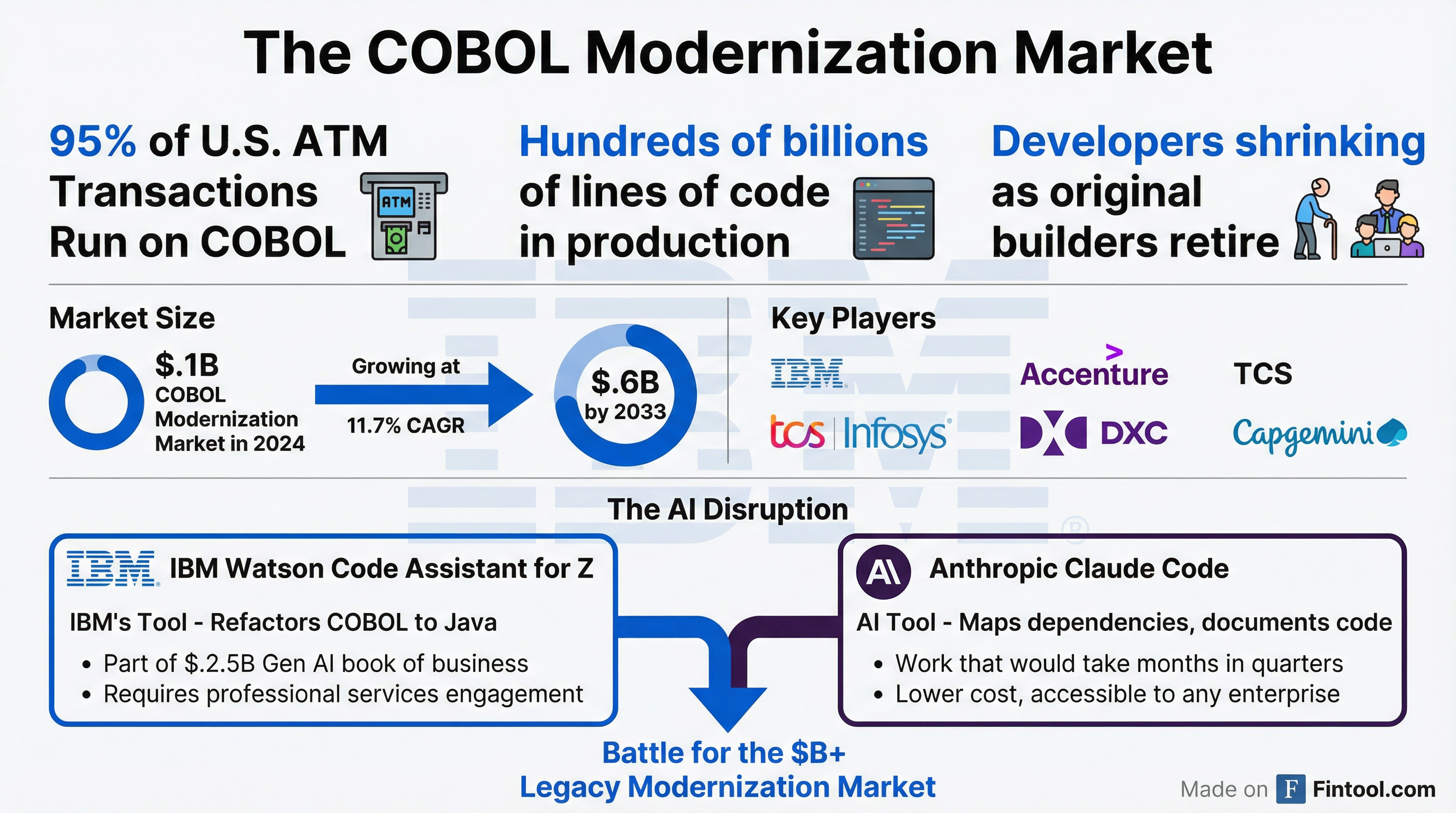
- 95% of ATM transactions in the United States run on COBOL
- Hundreds of billions of lines of COBOL code run in production daily
- Critical systems in finance, airlines, and government depend on COBOL mainframes
The problem: the developers who understand COBOL are retiring and dying. The number of COBOL-literate programmers shrinks every year, creating a chronic labor shortage that has kept modernization costs extraordinarily high—and extraordinarily profitable for the consultants who specialize in it.
IBM has long been the dominant player in this market, combining its z-series mainframe hardware (where most COBOL runs), its Watson Code Assistant for Z software, and its massive consulting practice into an end-to-end COBOL modernization franchise.
What Anthropic Announced
In a Monday blog post, Anthropic unveiled Claude Code's new COBOL capabilities. The AI tool can now:
- Map dependencies across thousands of lines of legacy COBOL code
- Document workflows and business logic embedded in decades-old systems
- Identify migration risks that would take human analysts months to surface
- Accelerate modernization timelines from years to quarters
"Legacy code modernization stalled for years because understanding legacy code cost more than rewriting it," Anthropic wrote. "AI flips that equation."
The announcement strikes directly at the heart of why COBOL modernization projects are so expensive: the exploration and analysis phase. Before any code can be migrated, consultants must spend months—sometimes years—simply understanding what the legacy system does, how its components interact, and what could break if anything changes.
This is precisely what IBM charges enterprise clients millions of dollars to do. And it's now being commoditized by an AI that anyone can access.
 Ask Fintool AI Agent
IBM's COBOL Business at Risk
IBM's Consulting segment generated $21.1 billion in revenue in FY 2025—31% of the company's total. While the company doesn't break out COBOL-specific revenue, multiple threads tie the segment to legacy modernization:
| Metric | Q4 2025 | FY 2025 |
|---|---|---|
| Consulting Revenue | $5.3B | $21.1B |
| Consulting Growth (cc) | +1.0% | +0.4% |
| Consulting Profit Margin | 12.3% | 11.7% |
Source: IBM Q4 2025 earnings
Notably, IBM's Consulting segment was already the weakest performer in Q4, growing just 1% at constant currency while Software grew 11% and Infrastructure grew 17%. The Anthropic announcement adds disruption pressure to a business that was already stagnating.
CEO Arvind Krishna has been positioning IBM's own AI tools as the solution. On the January earnings call, he touted Watson Code Assistant for Z: "The Gen AI tools we have provided with the Watson Code Assistant for Z really takes that onus away. It can refactor COBOL into Java. It can help people understand code that is already running on the platform."
But investors now question whether IBM's proprietary AI tool can compete against Anthropic's general-purpose Claude, which is rapidly developing capabilities across every software domain.
The $8 Billion Market Up for Grabs
The COBOL modernization services market reached $3.1 billion in 2024 and is projected to grow at 11.7% CAGR to $8.6 billion by 2033, according to Dataintelo research. IBM is the market leader, followed by Accenture, Infosys, TCS, Cognizant, and DXC Technology.
The irony is sharp: IBM has been selling AI as a productivity tool for COBOL modernization, but AI may ultimately commoditize the modernization work that generates IBM's consulting fees.
IBM's broader generative AI book of business now stands at $12.5 billion, with consulting representing over $10.5 billion of that total. But that book of business depends on clients hiring IBM to implement AI solutions. If clients can simply use Claude Code directly, IBM's role as intermediary diminishes.
Ask Fintool AI AgentBroader AI Carnage Continues
IBM's 11% drop came amid a broader market selloff driven by tariff uncertainty and AI disruption fears. The S&P 500 fell 1.1% and the Dow dropped 800 points on Monday.
The IBM selloff follows a pattern established earlier this month:
- Feb 20: Claude Code Security announced → Cybersecurity stocks fell 5-7%
- Feb 23: Claude COBOL capabilities announced → IBM fell 11%
Each Anthropic announcement triggers a targeted selloff in whatever industry its AI is disrupting. The question investors are asking: which sector is next?
IBM's Bull Case
Not everyone is selling. IBM's infrastructure business remains strong:
- z17 mainframes posted the strongest start in three quarters
- Infrastructure revenue grew 21% in Q4, driven by robust mainframe adoption
- IBM announced partnerships with Anthropic (along with OpenAI, AWS, and Microsoft) to integrate AI into its platform
Krishna has argued that enterprise AI "depends on" workflow orchestration rather than replacing it—a similar argument to ServiceNow's Bill McDermott, who defended his company against AI disruption fears last month.
The bull thesis: Even if AI commoditizes the analysis phase of COBOL modernization, someone still needs to execute the migration, integrate the new systems, and provide ongoing support. IBM's deep relationships with Fortune 500 IT departments could protect its consulting franchise even as AI automates portions of the work.
What to Watch
- IBM investor day (expected Q2): Will management address the Claude COBOL threat directly?
- Consulting segment trends: Q1 2026 results will show if enterprise clients are pulling back modernization projects
- Accenture, Infosys earnings: Peer commentary on AI disruption in legacy modernization
- Anthropic's next move: What capability announcement triggers the next sector selloff?