IDEX CEO Sees Data Center 'Flywheel' Driving HST Momentum at Citi Industrial Conference
February 17, 2026 · by Fintool Agent

Idex Corporation CEO Eric Ashleman delivered a bullish message at the Citi Industrial Conference today: the company's Health & Science Technologies segment is firing on all cylinders, and data center demand has created a "flywheel effect" that allows IDEX to reinvest growth back into margin improvement.
Speaking alongside new CFO Sean Gillen—who joined from Aar Corp. in January—Ashleman revealed that HST entered 2026 with over $100 million more backlog than a year ago, roughly half of it tied to data center applications. The segment posted 34% organic order growth in Q4 2025, a record that positions HST to lead IDEX's portfolio this year.
"We're probably about halfway through" IDEX's Phase 3 strategic evolution, Ashleman told Citi's Vlad Bystricky. "When this source code starts to really, really fire, where does it lead?"
Shares of IDEX traded at $209.19, down 0.6% on the day, though the stock sits near 52-week highs following its Q4 earnings beat earlier this month.
The HST Story: From Acquisitions to AI Infrastructure
IDEX's transformation centers on HST, which the company has built through acquisitions including Mott Corporation (nanofiltration) and Muon (ceramics and material science). These businesses, originally developed for semicon and industrial applications, have found new growth in AI infrastructure.
"There's not a single technology that we have that was originally developed, designed, or sold as a data center part," Ashleman explained. "What we are doing is we're doing the jobs we've long done, but we're finding applications for them in the data center infrastructure."
The applications span thermal management, optical connectivity, and leak-proof valve solutions—all critical for hyperscale data centers. Ashleman noted that customers are placing orders covering multiple quarters to secure supply.
 Ask Fintool AI Agent
Capital Allocation: Bolt-Ons, Buybacks, and Patience
New CFO Sean Gillen outlined a capital deployment strategy that prioritizes bolt-on M&A while maintaining elevated share repurchases. The company repurchased $248 million of stock in FY2025 and expects to continue at roughly $75 million per quarter in 2026.
"We're not here to just be a share repurchase machine," Gillen noted. "Longer term, that'll more naturally go towards M&A... bolt-on in nature, maybe a little bit bigger."
The company's 2025 acquisition of Micro-LAM serves as a template for near-term deals. Management has identified multiple "landing spots" around the Material Science Solutions platform that Mott and Muon anchor.
| Metric | FY2025 Actual | FY2026 Guidance |
|---|---|---|
| Organic Growth | +1% | +1% to +2% |
| Adjusted EPS | $7.95 | $8.15 - $8.35 |
| Free Cash Flow | $617M (103% conversion) | Strong cash generation expected |
| Share Repurchases | $248M | $300M (at $75M/quarter) |
Values retrieved from S&P Global and company guidance
Segment Breakdown: HST Leads, Industrial Awaits Recovery
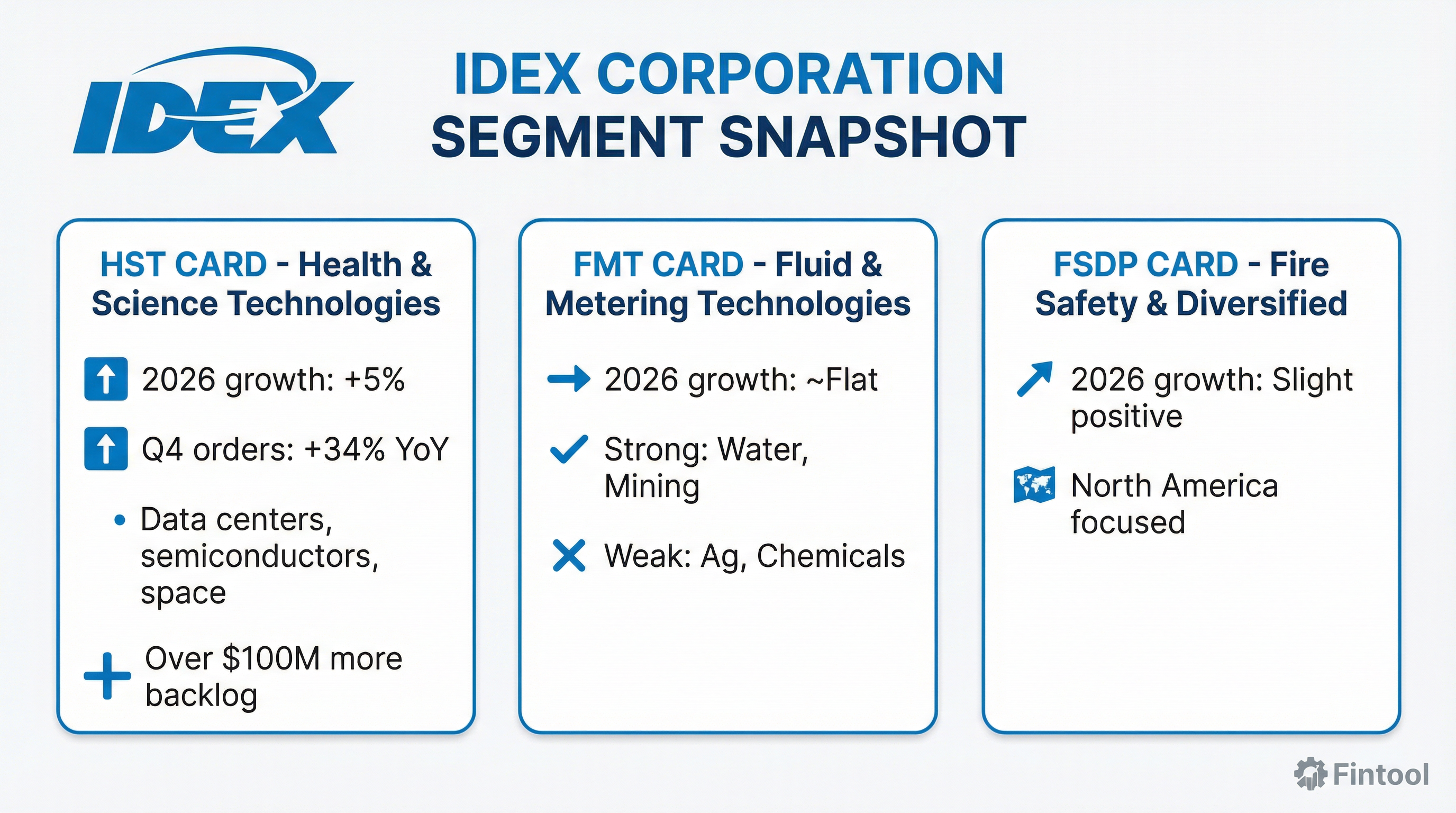
Health & Science Technologies (HST): +5% Organic Growth Expected
Beyond data centers, HST draws strength from semiconductors, space and defense, and optics. Ashleman noted the segment is "broad-based," though data center applications account for about half of the backlog build.
Life sciences remains a headwind, with the vertical "down around low single digits." International softness—particularly China's post-pandemic underperformance—and NIH funding uncertainty are weighing on demand.
The margin story is equally important. Management is deploying IDEX's 80/20 simplification playbook to push HST margins back toward the company's target of 30%+. Mott, the largest acquisition, "still is not at the margin position of kind of overall HST," Ashleman said, signaling room for improvement.
Fluid & Metering Technologies (FMT): Flat, Waiting on Industrial
FMT faces mixed conditions. Water infrastructure—where IDEX provides robot crawlers, flow monitoring, and analytics for wastewater systems—delivered double-digit growth in Q4 and should continue at high single digits. Mining (precious metals) also remains strong.
The offsets: agriculture is pressured by weak farm income and trade policy uncertainty, while chemical exposure (skewed toward Europe) is soft. Energy, which follows oil price trends, is "a little depressed with oil somewhere around $60."
Fire & Safety / Diversified Products (FSDP): Stable, North America Focused
FSDP is a predominantly North American business, with fire and rescue equipment driving growth. International markets (Europe, China) have been volatile but represent a smaller portion of the segment.
Dispensing faces a predictable 7-year retail capital cycle; the company is currently "between those mountaintops" while filling gaps with emerging market expansion.
Ask Fintool AI AgentThe Industrial Recovery Question
Despite PMI crossing above 50 for the first time in years, Ashleman said IDEX hasn't yet seen the order inflection in its short-cycle industrial businesses.
"When we talk to small business owners, distributors, you still see—they're still talking about economics and economic forces as a bit of an abstraction," he said. "They haven't clicked together yet."
The CEO identified variable reduction—not necessarily positive movement—as the key catalyst: "I don't know that they even need to move in massively positive directions, but get to a place where they're somewhat predictable, and you can just say: 'Well, there's the playing field. I think we understand it. Let's get to work.'"
Phase 3: Halfway Through a Decade of Platform Building
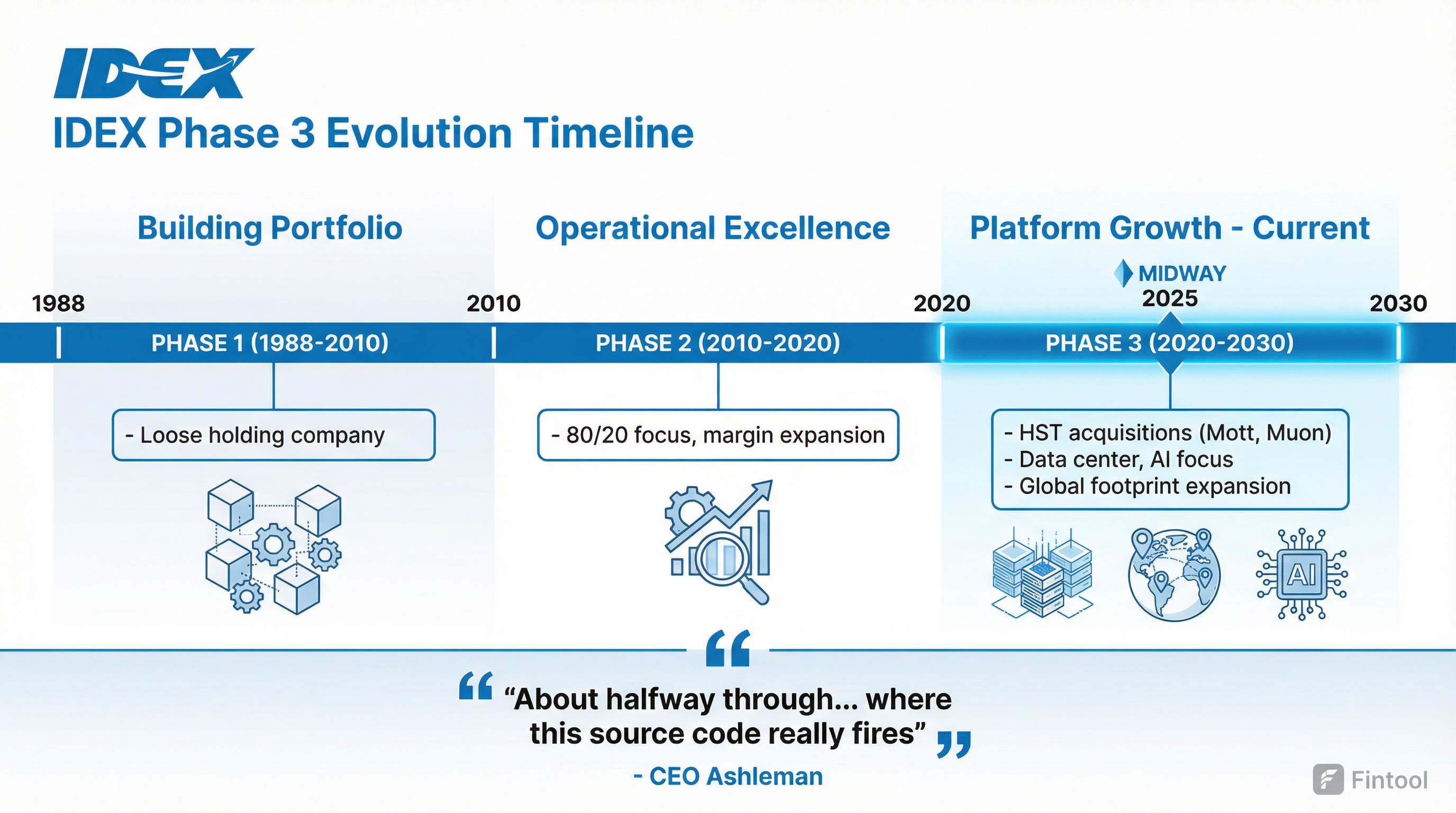
Ashleman framed IDEX's journey in three phases:
- Phase 1 (1988-2010): Loose holding company structure
- Phase 2 (2010-2020): 80/20 operational excellence, significant margin expansion
- Phase 3 (2020-2030): Platform growth through HST acquisitions and technology integration
The current phase is "about halfway through," with management focused on deploying acquired technologies into high-growth end markets while extracting synergies. The Muon turnaround—where IDEX shifted capacity from disrupted semicon business to data centers while cutting costs—serves as the template.
"Having the momentum of growth here really does allow us to do it in ways where it's frankly more transparent on the outside," Ashleman said of margin improvement efforts. "It's not as disruptive because we're able to fund the top line, and you'll see the margin additive benefits on the bottom line."
AI Inside IDEX: Four Pilots Running
Beyond selling into AI infrastructure, IDEX is deploying AI internally across four areas:
- External market analysis: Studying competitors, markets, and investment alternatives
- Internal data mining: Parsing decades of customer data across decentralized franchises (some 100+ years old) to identify solution intersections
- Product development: Structural analysis, flow dynamics simulation
- Quality assurance: Intelligent machine vision for validation
The internal data mining is particularly intriguing. IDEX's decentralized structure means customer and solution data sits in "disparate databases" that were never unified around a central ERP. AI offers a shortcut: "You don't have to have as rational data as you're used to," Ashleman said.
Ask Fintool AI AgentWhat to Watch
Near-term catalysts:
- Q1 2026 results (~May 2026): Will HST backlog convert as expected?
- Industrial recovery signals: March order patterns will "tell us something about the year"
- NIH funding clarity: Could unlock life sciences growth in HST
Risks:
- Industrial markets remain flat-to-down, limiting FMT upside
- HST order timing mismatches—Q4 orders covered multiple quarters
- Valuation stretched after strong run (stock up 36% from 52-week lows)
M&A watch:
- Bolt-on targets around Material Science Solutions platform
- Management signaling appetite for "maybe a little bit bigger" deals beyond 2026
The Bottom Line
IDEX is a tale of two portfolios. HST is firing, with data center demand creating the growth visibility that's been elusive for industrials. FMT and FSDP need an industrial recovery that hasn't materialized despite improving PMI data. New CFO Gillen brings M&A expertise that could accelerate Phase 3, but for now, capital deployment leans toward buybacks.
The conference message was clear: IDEX isn't waiting for a cyclical turn. It's building a technology-led growth engine within the HST segment while keeping the industrial core positioned for upside when—and if—the recovery arrives.
Related