India Forces Quick Commerce Giants to Abandon 10-Minute Delivery Promise in $11.5B Market Shakeup
January 18, 2026 · by Fintool Agent

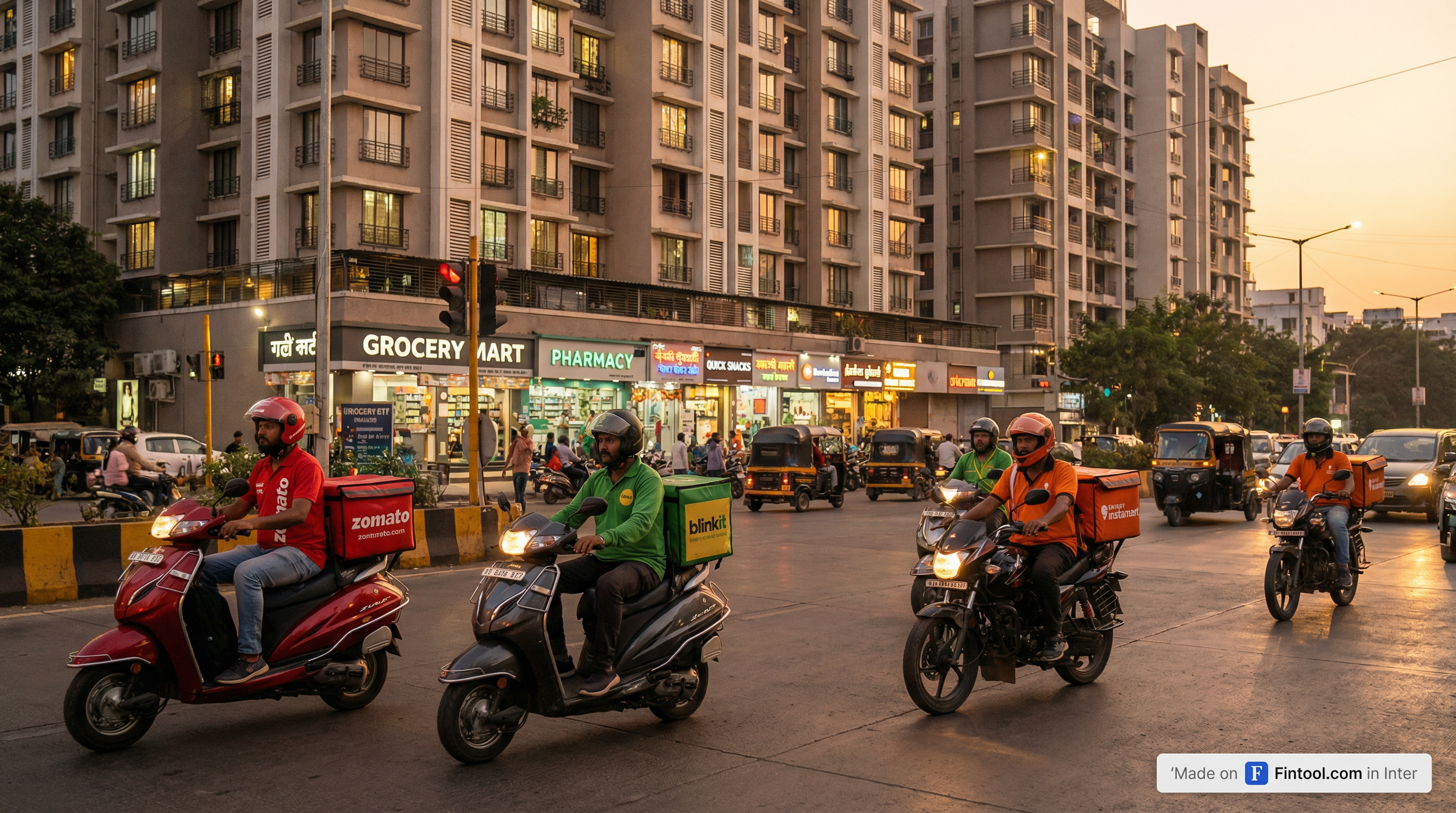
India's Labour Ministry has ordered the country's leading quick commerce platforms to drop their signature "10-minute delivery" marketing promise, a major regulatory intervention in a $11.5 billion market that has transformed urban shopping habits in Asia's third-largest economy.
The directive, issued following closed-door discussions between Labour Minister Mansukh Mandaviya and executives from Blinkit, Swiggy, and Zepto, came in the wake of a nationwide strike by approximately 200,000 gig workers on New Year's Eve demanding safer working conditions, fair wages, and an end to algorithmic control over their livelihoods.
Within days of the government's request, all major platforms—including Walmart's Flipkart—have complied by removing the aggressive delivery time commitments from their apps and marketing materials.
The Players and the Stakes
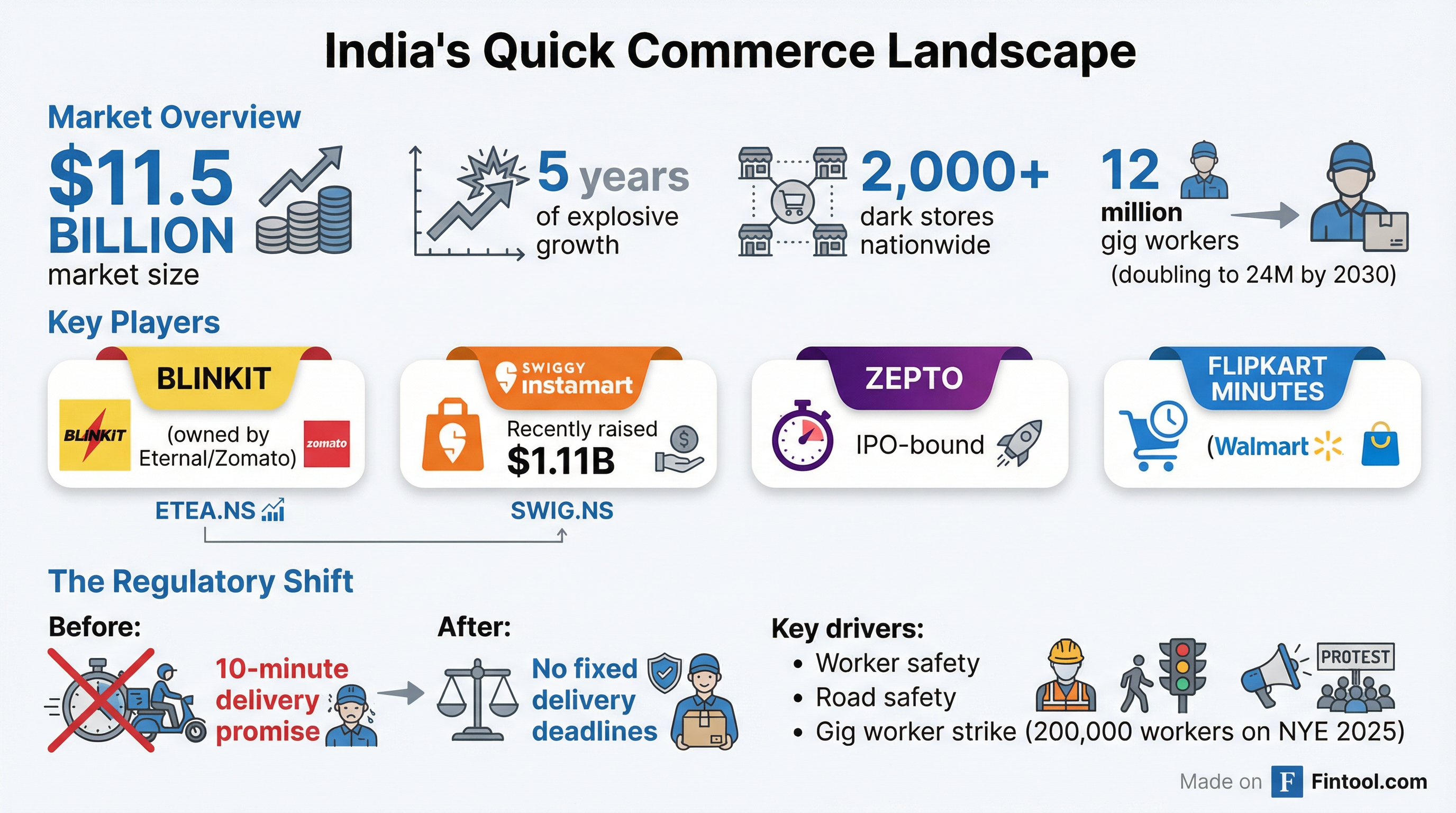
India's quick commerce sector has grown from virtually nothing to $11.5 billion in just five years, powered by dense urban populations, a young digital-native consumer base, and venture capital enthusiasm. The model relies on a network of over 2,000 "dark stores"—neighborhood micro-warehouses—that enable deliveries measured in minutes rather than days.
Key market participants:
| Company | Parent/Owner | Ticker | Recent Developments |
|---|---|---|---|
| Blinkit | Eternal (Zomato) | ETEA.NS | First to remove 10-min branding |
| Swiggy Instamart | Swiggy | SWIG.NS | Raised $1.11B in Dec from BlackRock, Temasek, Fidelity |
| Zepto | Independent | IPO-bound | Removed 10-min promise following govt order |
| Flipkart Minutes | Walmart | WMT | Complied with branding removal |
The sector has attracted billions in foreign investment. Swiggy's December capital raise from institutional investors including BlackRock, Temasek, and Fidelity was earmarked to bolster cash reserves and fund "new experiments" in quick commerce and food delivery.
 Ask Fintool AI Agent
Optics or Operational Change?
The critical question for investors: does removing the marketing promise actually change the business model?
The short answer is no—at least not immediately.
"The removal of the 10-minute delivery catchline is largely optics-driven rather than business-altering," Karan Taurani, executive vice president at securities firm Elara Capital, told Reuters.
Despite the branding change, platforms can still offer rapid delivery. On the day Blinkit removed its 10-minute promise, its app was showing eight-minute delivery times in parts of Delhi.
Eternal, which owns both Zomato and Blinkit, filed a stock exchange clarification stating there was "no change in the business model" for its quick commerce platform.
However, the regulatory pressure signals a shifting environment. The government's intervention addresses years of criticism over:
- Rash driving: Delivery riders rushing through traffic to meet tight deadlines
- Low pay: Workers penalized financially for failing to complete orders within promised timeframes
- Algorithmic control: Lack of transparency in how ratings and contract terminations are determined
The Bigger Picture: Labor Codes and Compliance Costs
The 10-minute branding directive is just the opening move. India's Union government has also announced that four new labor codes will come into immediate effect—representing the most significant reform of the country's 29 existing labor laws in decades.
For the first time, India's labor laws formally define "gig workers," "platform workers," and "aggregators." The new rules require platforms like Swiggy, Zomato, and Flipkart to contribute 1-2% of their annual turnover—capped at 5% of payments made to gig workers—toward a government-managed social security fund.
Analyst Estimates on Cost Impact
| Brokerage | Est. Cost Per Order | EBITDA Impact | View |
|---|---|---|---|
| JM Financial | ₹2.1-2.5 | 4-10% | Pass-through to customers likely |
| Morgan Stanley | ₹1.5-2.5 | 4-10% | Most companies to pass on costs |
| Bernstein | N/A | 25-70 bps | Quick commerce more exposed than food delivery |
| Elara Securities | ₹1-2 | Limited | Existing insurance coverage offsets some costs |
JM Financial estimates that at a 2% contribution rate, the effective cost for Eternal would be approximately ₹4.3 billion and for Swiggy around ₹2.6 billion on an FY26 basis. Both are expected to pass most of this through to customers—a ₹2-3 increase per order that analysts believe is unlikely to materially affect user behavior.
Ask Fintool AI AgentMarket Reaction
Stock prices have reflected the regulatory uncertainty:
Swiggy (SWIG.NS) has fallen approximately 15% over the past month, trading below its IPO price despite continued analyst support. Global funds that invested in the company's December capital raise are sitting on paper losses.
Eternal (ETEA.NS), owner of Zomato and Blinkit, has traded largely flat during the same period—potentially benefiting from diversification across food delivery (which is not subject to time-based promises) and quick commerce.
Despite the near-term pressure, analysts remain broadly positive:
- Elara Capital maintains upside targets of 41% for Swiggy and 30% for Eternal
- The structural growth story—rising urbanization, digital adoption, and consumer convenience expectations—remains intact
- Both Swiggy and Eternal already have profitable or near-profitable order-level economics
Global Implications
India's regulatory action offers a potential template for other markets grappling with the gig economy's externalities. The quick commerce model—which collapsed in Western markets due to unsustainable unit economics—has thrived in India thanks to dense urban populations, habitual top-up buying patterns, and lower last-mile labor costs.
But as the workforce balloons from 12 million today to a projected 23.5 million by 2030 (according to government think tank NITI Aayog), the pressure to formalize worker protections will only intensify.
For global investors with exposure to gig economy platforms—from Uber and DoorDash in the US to Delivery Hero in Europe and Grab in Southeast Asia—India's regulatory evolution provides a roadmap of what may come.
What to Watch
Near-term catalysts:
- Compliance status across all platforms with new labor code contributions
- Any government clarification on penalties for non-compliance with branding directive
- Swiggy and Eternal's next quarterly results for order volume trends post-regulation
- Zepto's IPO timing and pricing, which will provide a market valuation benchmark
Longer-term questions:
- Whether the 10-minute promise's removal affects consumer behavior and order frequency
- How aggressively platforms will pass through labor code costs to customers
- The potential for additional regulatory intervention on delivery partner classification
Ask Fintool AI AgentRelated
- Walmart - Owner of Flipkart, India's largest e-commerce platform