India's Supreme Court Rules Tiger Global Must Pay Tax on $1.6B Flipkart Exit—A Watershed Moment for Foreign Investors
January 15, 2026 · by Fintool Agent

India's Supreme Court on Thursday delivered a landmark ruling against Tiger Global, holding that the U.S. investment firm's $1.6 billion stake sale in Flipkart to Walmart is subject to Indian capital gains tax. The verdict, which overturns a Delhi High Court decision favoring Tiger Global, sends a powerful signal to global investors: offshore treaty structures designed primarily for tax benefits will face heightened scrutiny in one of the world's fastest-growing consumer markets.
"This is a judgment which is now watched today all over the world, not just domestically," said N. Venkataraman, India's Solicitor General, in court following the decision.
The $16 Billion Deal That Sparked a Tax Battle
The dispute traces back to Walmart's blockbuster $16 billion acquisition of Flipkart in 2018—the largest e-commerce deal in history at the time. Tiger Global, which had built its position in the Indian e-commerce pioneer starting with a $9 million investment in 2009 and growing to approximately $1.2 billion across multiple funding rounds, sold its 17% stake to Walmart for roughly $1.6 billion.
The core question: Could Tiger Global use its Mauritius-based holding entities to claim exemption from Indian capital gains tax under the India-Mauritius Double Taxation Avoidance Agreement (DTAA)?
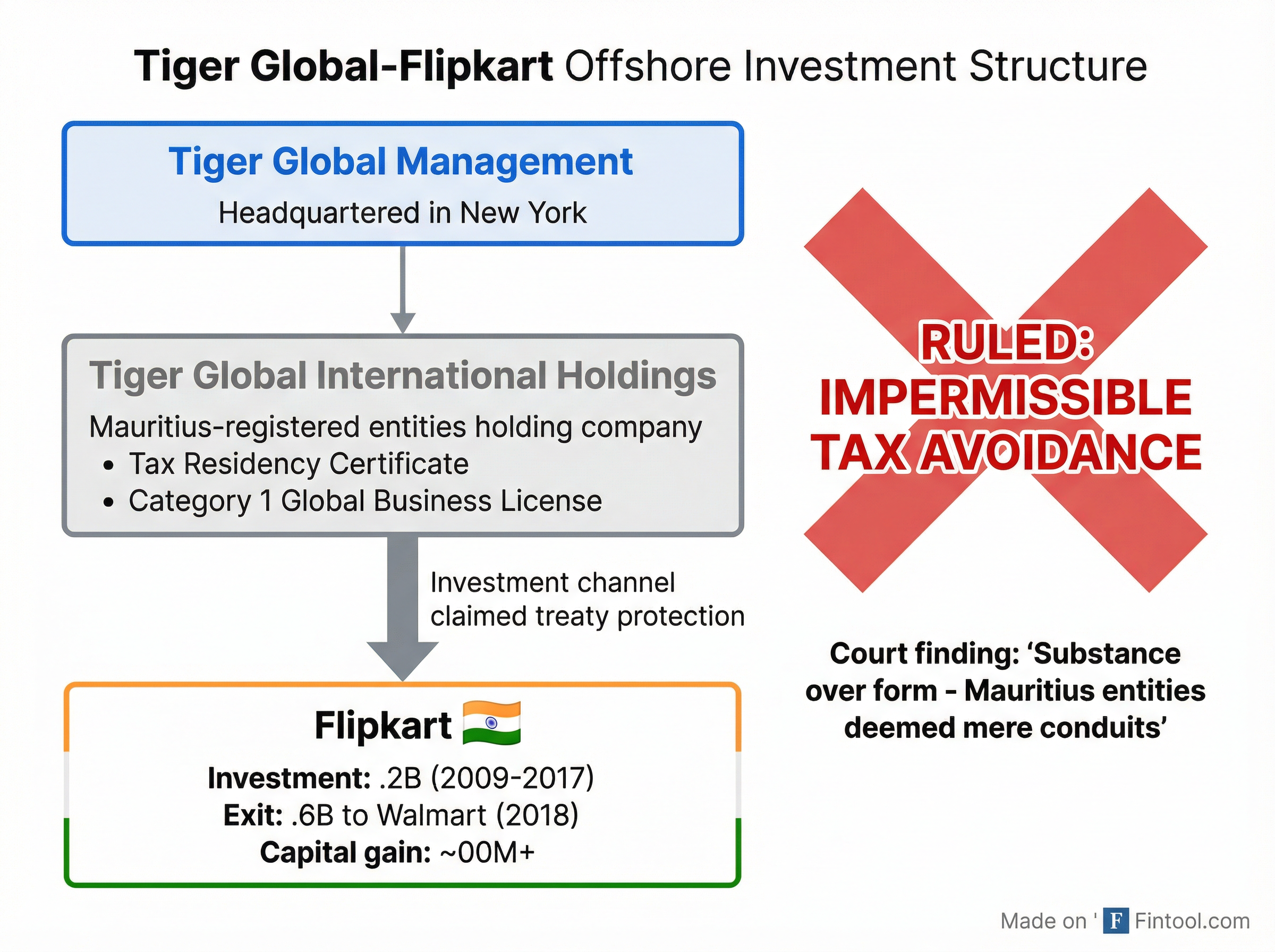
Tiger Global argued its investments were "grandfathered" under the treaty—made before the April 1, 2017 cutoff when India amended the agreement to allow taxation of capital gains. The firm held Tax Residency Certificates and Category 1 Global Business Licenses from Mauritius, standard documentation for claiming treaty benefits.
Indian tax authorities disagreed, arguing the Mauritius entities were mere "conduits" with no real economic substance—shells designed to route investment from Tiger Global's New York headquarters through a tax-friendly jurisdiction.
"Impermissible Tax Avoidance"
In a pointed ruling, Supreme Court Justice R. Mahadevan declared Tiger Global's transaction "an impermissible tax avoidance arrangement." The bench, which also included Justice J.B. Pardiwala, emphasized that India's sovereign right to tax income arising within its borders cannot be circumvented through "artificial arrangements."
"Taxing an income arising out of its own country is an inherent sovereign right of that country," the court stated. "Any dilution of this power through artificial arrangements is a direct threat to its sovereignty and long-term national interest."
The ruling sets aside an August 2024 Delhi High Court judgment that had gone in Tiger Global's favor, finding no wrongdoing. The high court had held that Tax Residency Certificates and satisfaction of Limitation-of-Benefits conditions were "sacrosanct" absent fraud.
The Supreme Court disagreed: possessing a TRC alone does not preclude deeper inquiry when intermediary entities are alleged to be conduits.
 Ask Fintool AI Agent
Timeline: From $9 Million to Tax Court
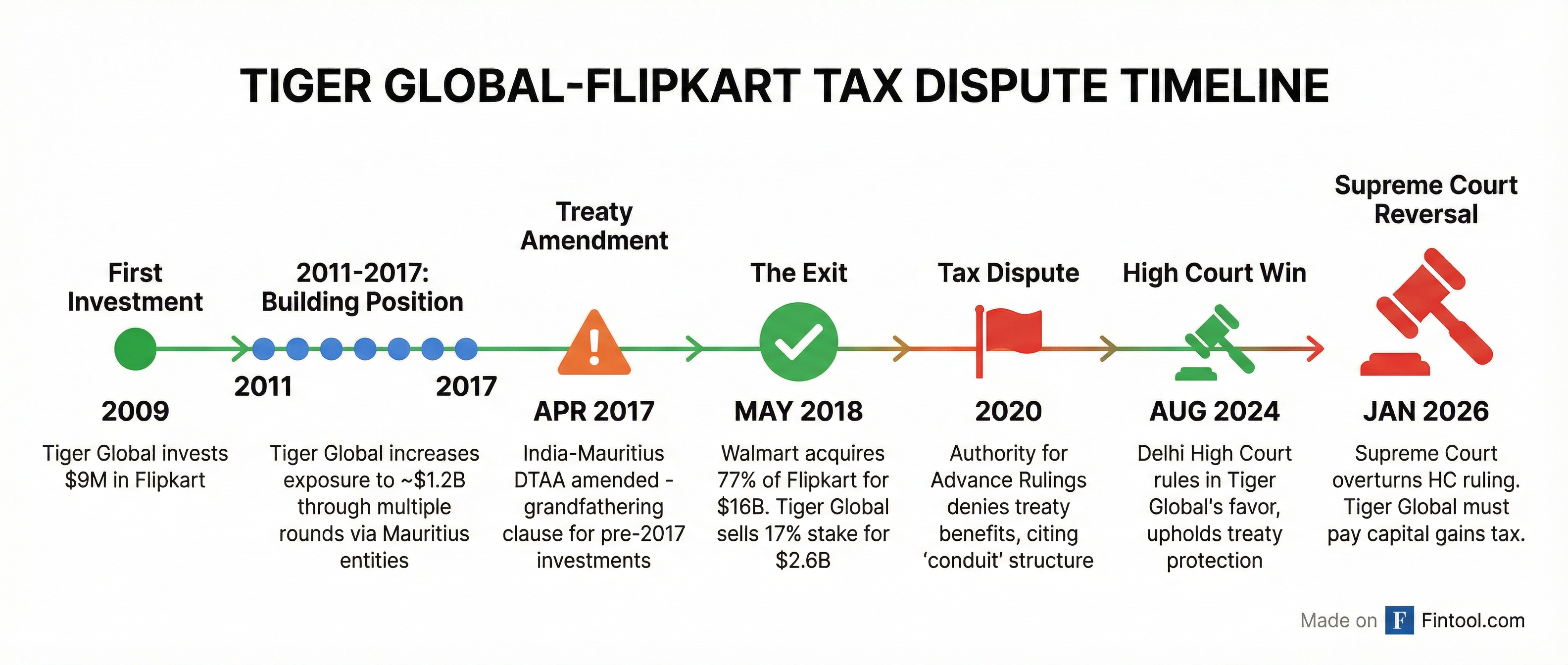
| Year | Event |
|---|---|
| 2009 | Tiger Global invests initial $9M in Flipkart |
| 2011-2017 | Tiger Global increases exposure to $1.2B via Mauritius entities |
| April 2017 | India-Mauritius DTAA amended; grandfathering for pre-2017 investments |
| May 2018 | Walmart acquires 77% of Flipkart for $16B; Tiger Global exits for $1.6B |
| 2020 | Authority for Advance Rulings denies treaty benefits |
| August 2024 | Delhi High Court rules in Tiger Global's favor |
| January 2026 | Supreme Court reverses, rules Tiger Global must pay tax |
What This Means for Foreign Investors
The ruling carries profound implications for global private equity, venture capital, and institutional investors with India exposure. Mauritius has historically been the single largest source of foreign direct investment into India, accounting for 25% of cumulative FDI inflows between 2000 and 2024—hundreds of billions of dollars channeled through the island nation's treaty-friendly structures.
Tax experts say the verdict establishes a new paradigm: substance over form.
"The decision marks a watershed moment in Indian taxation paradigm," said Tarun Jain, a Supreme Court tax lawyer. "It will put the onus upon the taxpayers to demonstrably engage only in genuine and bona fide deals, which are not motivated by tax considerations."
Sandeepp Jhunjhunwala, Partner at Nangia Global, warned the ruling could alter deal structuring: "This verdict sets out a clear prompt for investors to reassess holding structures and exit strategies. It could alter how future India-inbound M&A transactions are structured and may have a dampening effect on foreign investment appetite."
Ask Fintool AI AgentFlipkart Today: A $37B Business on Path to Profitability
Ironically, the Flipkart investment that sparked this tax battle has proven enormously successful for Walmart. The company remains one of Walmart's crown jewels in its international portfolio.
Flipkart is now on track to profitability, with its core business already profitable in certain categories. The company has expanded aggressively into quick commerce, with 250 fulfillment centers capable of delivering orders in as little as 3 minutes in some markets.
"India is a market, 1.4 billion people. The addressable opportunity is like $1 trillion and e-commerce is only about 9% penetrated," said Kathryn McLay, President and CEO of Walmart International, at a recent investor event. "We see huge opportunity in that market."
Walmart International posted constant-currency net sales of $32.7 billion in Q2 FY2026, up 10.5% year-over-year, with growth led by China, Mexico, and Flipkart.
What's Next for Tiger Global?
The exact tax liability Tiger Global now faces remains unclear. Based on the $1.6 billion exit against an estimated $1.2 billion cost basis, capital gains could range from $200-400 million, subject to India's short-term or long-term capital gains tax rates plus potential penalties and interest for the years since 2018.
Tiger Global did not immediately respond to requests for comment. The firm could petition for a review of the Supreme Court's verdict, though such requests historically have low success rates.
The Bigger Picture
For a country courting foreign capital to fuel its economic growth ambitions, the ruling presents a delicate balance. India needs foreign investment; it also wants to ensure it captures its fair share of tax revenue from transactions involving Indian assets.
The verdict should be read as "a caution against aggressive tax planning rather than a wholesale dismantling of the India–Mauritius treaty framework," wrote tax expert Ajay Rotti. "It reinforces a broader shift toward 'substance over form,' signaling treaty protection may not apply automatically where offshore entities lack real commercial activity."
For global investors, the message is clear: India is open for business—but the days of using paper entities to avoid tax are over.
Ask Fintool AI AgentRelated Companies: Walmart Inc.