Indonesia Faces Worst Market Rout Since 1998 as MSCI Puts Nation on Probation
January 28, 2026 · by Fintool Agent

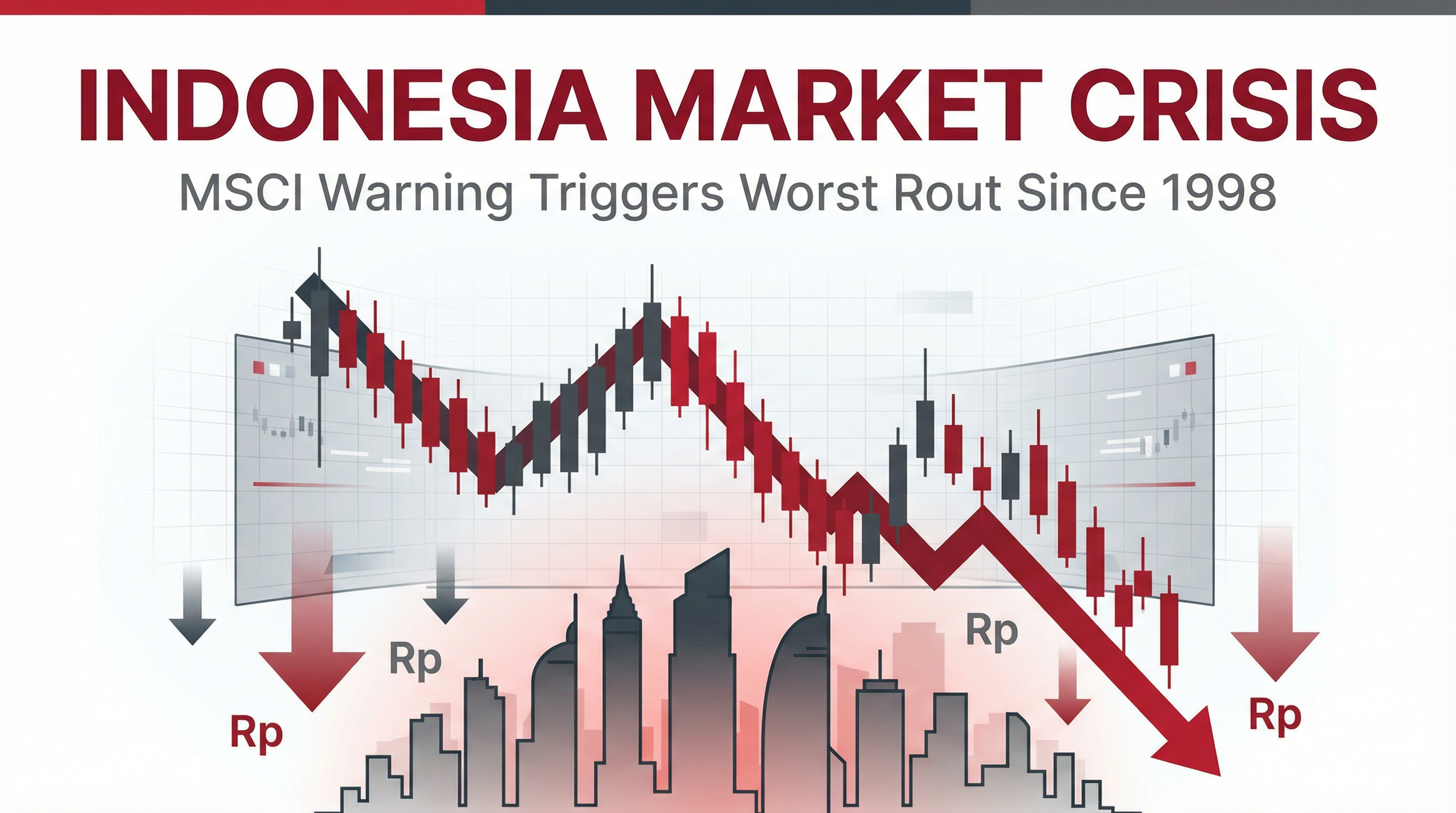
Indonesian equities are experiencing their worst two-day rout in nearly three decades after Msci Inc. flagged "fundamental investability issues" and warned it could demote Southeast Asia's largest market to frontier status.
The benchmark Jakarta Composite Index (JCI) crashed 7.4% on Wednesday—its largest single-day drop in nine months—before plunging another 8% at Thursday's open, triggering an emergency 30-minute trading halt. The combined two-day decline marks the worst selloff since the 1998 Asian Financial Crisis.
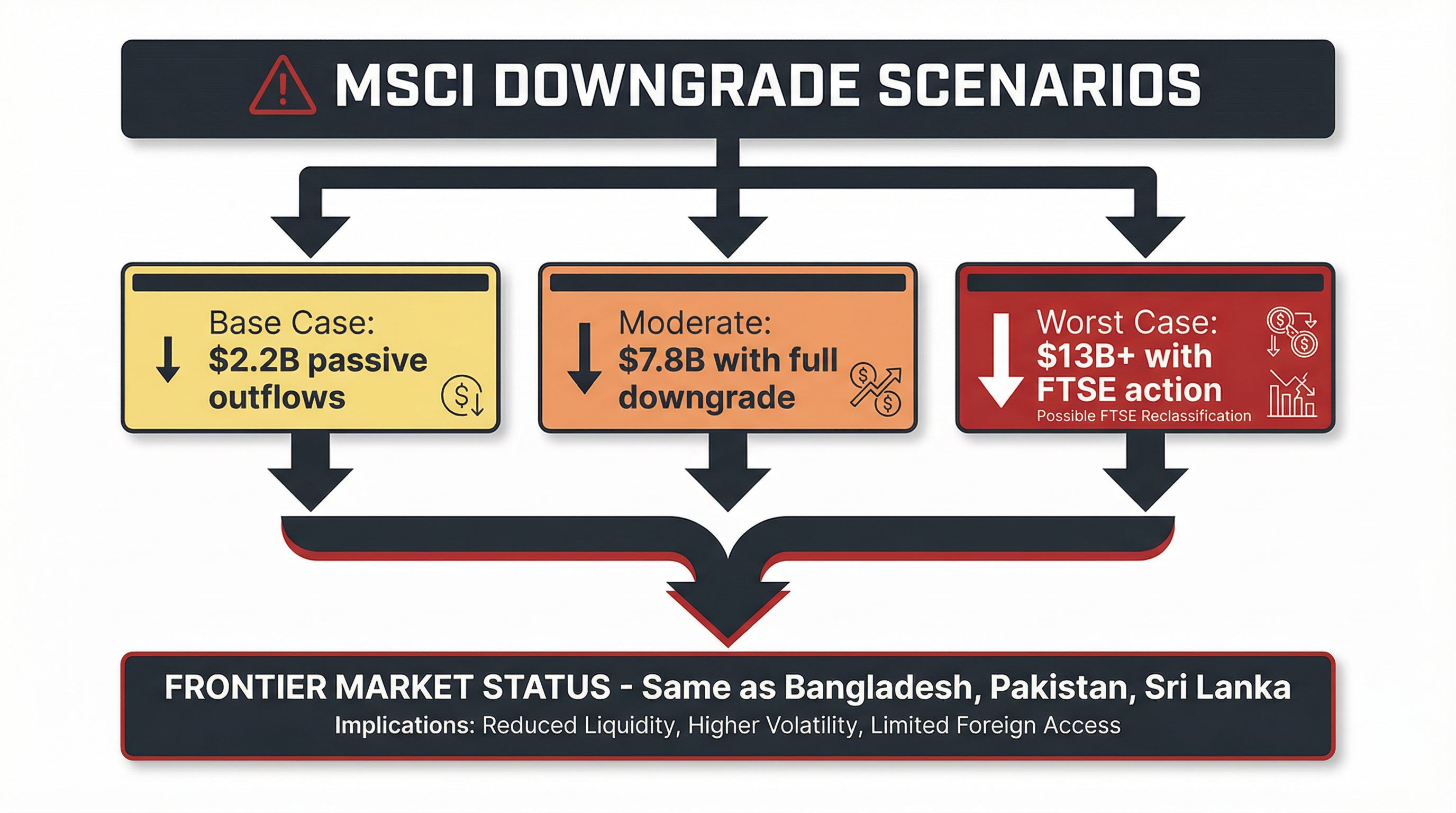
Goldman Sachs immediately cut Indonesian equities to "underweight" and warned that outflows between $2.2 billion and $7.8 billion are possible, with total capital flight potentially exceeding $13 billion if other index providers follow suit.
 Ask Fintool AI Agent
What MSCI Said
MSCI's Tuesday evening announcement sent shockwaves through global emerging market portfolios. The index provider cited three critical concerns:
- Limited transparency in share ownership structures — Many Indonesian companies have tightly held ownership with limited free float data reliability
- Concerns about coordinated trading behavior — MSCI flagged potential market manipulation that "undermines proper price formation"
- Inadequate free float data — The shareholder classification data from Indonesia's central securities depository (KSEI) is "not yet sufficiently reliable"
Effective immediately, MSCI has frozen all positive index-related changes for Indonesian stocks:
- No increases to Foreign Inclusion Factor (FIF) weightings
- No additions of Indonesian stocks to MSCI Investable Market Indexes (IMI)
- No reclassifications from Small Cap to Standard
- The freeze extends through the February 2026 rebalancing period
"MSCI will await significant changes from Indonesia until May 2026," the firm stated. If no material progress is made, Indonesia's weighting in the MSCI Emerging Markets Index will be reduced—and full reclassification to frontier market status remains on the table.
The Stakes for Investors
MSCI is one of the world's most influential index providers—its benchmarks are tracked by trillions of dollars in passive investments globally. A downgrade to frontier market status would have cascading effects:
Passive Funds: ETFs and index funds tracking MSCI Emerging Markets would be forced to sell Indonesian holdings mechanically. Goldman Sachs estimates $2.2 billion in passive outflows in the base scenario, rising to $7.8 billion in a full downgrade.
Active Managers: Fund managers benchmarked against MSCI EM would likely need to reduce Indonesian exposure to avoid tracking error against the new benchmark composition.
FTSE Russell Risk: If FTSE Russell—another major index provider—reassesses Indonesia's free-float methodology and market status, Goldman estimates an additional $5.6 billion in outflows, bringing the worst-case total above $13 billion.
"We expect the market to remain under pressure and do not view this as an entry point," Goldman strategists led by Timothy Moe wrote, citing "macro challenges including soft private consumption, slowing credit growth, and a rising fiscal deficit close to the legal 3% of GDP limit."
Ask Fintool AI AgentPolitical Context: A Crisis of Confidence
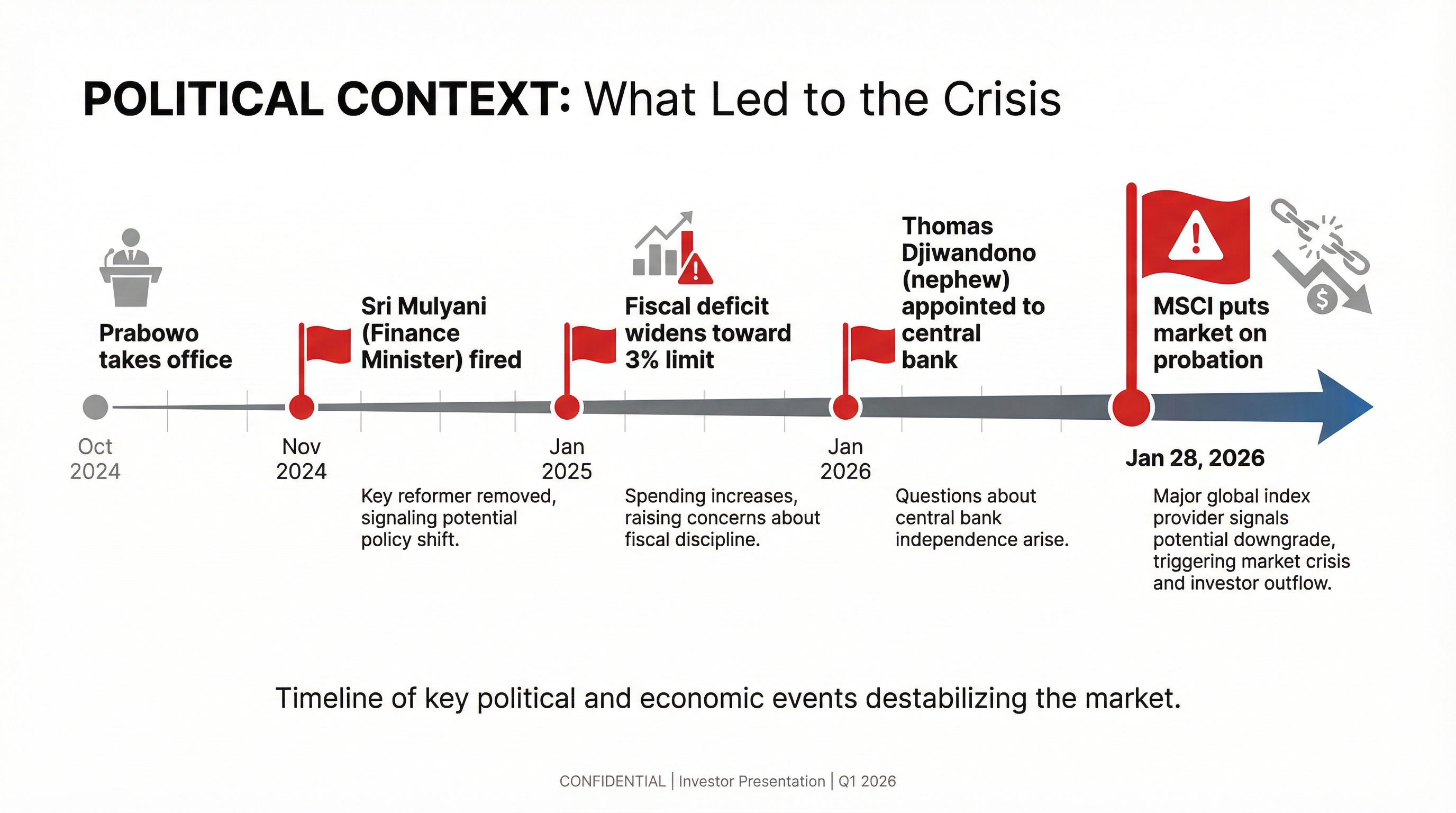
The MSCI warning arrives amid a broader erosion of investor confidence in Indonesian governance under President Prabowo Subianto. Since taking office in October 2024, Prabowo has made a series of moves that have rattled markets:
Finance Minister Fired: The abrupt sacking of respected Finance Minister Sri Mulyani Indrawati—a former World Bank managing director—sent the first warning signal about fiscal stewardship.
Nepotism Concerns: This month, Prabowo appointed his nephew, Thomas Djiwandono, to a senior position at Bank Indonesia, the central bank. The move raised concerns about independence of monetary policy institutions.
Fiscal Deficit Widening: The government has expanded the fiscal deficit toward the constitutional 3% of GDP limit, with the state ramping up involvement in financial markets through various interventions.
Record Rupiah Weakness: The Indonesian rupiah has fallen to record lows against the dollar, reflecting foreign investor anxiety about the country's trajectory.
"The warning by MSCI and any future action could have a broader negative impact on the economy if it makes capital raising more difficult or more costly," said Rahul Ghosh, portfolio specialist at T. Rowe Price in Singapore. "Thus raising the risk of a negative feedback loop—hence some market participants may de-risk in advance."
Market Mechanics: Why Free Float Matters
At the heart of MSCI's concerns is the "free float"—the portion of a company's shares actually available for public trading. When ownership data is opaque, the "investable" market cap becomes unreliable.
Many Indonesian blue chips are controlled by a handful of wealthy families, with 80% or more of shares held tightly and unavailable for trading. This concentrated ownership creates several problems:
- Exit Risk: When large funds need to sell, there aren't enough buyers to absorb the flow without crashing prices
- Information Asymmetry: International investors become wary of trading against hidden insiders, demanding wider bid-ask spreads
- Liquidity Bottlenecks: Even moderate sell orders can move prices by double digits
Several stocks that were candidates for MSCI index inclusion hit "auto reject bawah" (ARB) limit-down circuit breakers during the Wednesday selloff—a sign of exactly the liquidity dysfunction MSCI was warning about.
What Comes Next
Indonesian regulators and the stock exchange have pledged to work with MSCI to address its concerns. The Indonesia Stock Exchange (IDX) said it would "promptly follow up" and acknowledged that "concrete corrective measures are needed beyond normative statements."
The Financial Services Authority (OJK) has committed to improving monthly disclosure of free-float data and enhancing transparency requirements for listed companies.
However, investors appear skeptical that meaningful reform can happen quickly enough to satisfy MSCI's May deadline. Overseas investors sold 13.96 trillion rupiah ($834 million) worth of Indonesian shares in 2025—the worst year of outflows since 2020—and the selling has accelerated in January 2026.
Some analysts remain cautiously optimistic. Maybank Sekuritas maintains its year-end 2026 target for the JCI at 9,250, arguing that commodity prices remain supportive and the growth outlook is solid if governance improves.
"Given that capital-market regulators are making efforts to improve disclosure, he thinks they will meet MSCI's requirements, avoiding a downgrade," said Jeffrosenberg Chen Lim, head of research at Maybank Sekuritas.
But for now, the message from global capital is clear: transparency isn't optional—it's the price of admission to emerging market status.
Ask Fintool AI AgentRelated
Photo: Jakarta financial district skyline