Infineon Raises Investment to €2.7B as AI Data Center Demand Surges
February 4, 2026 · by Fintool Agent


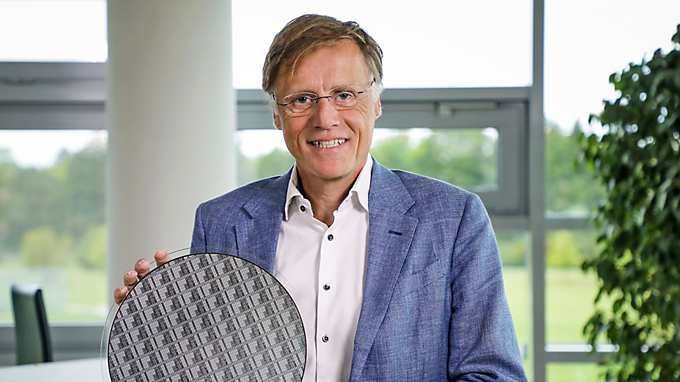
Infineon Technologies-2.43%, Europe's largest semiconductor maker, is betting bigger on artificial intelligence. The German chipmaker announced Tuesday it will raise fiscal year 2026 investment to approximately €2.7 billion—up from €2.2 billion previously—with the extra €500 million dedicated to accelerating manufacturing capacity for AI data center power supplies.
The move marks a decisive pivot for a company that has long been defined by automotive chips. AI data center revenue is now Infineon's fastest-growing segment, and CEO Jochen Hanebeck is doubling down.
"Reaching €2.5 billion in data center revenue by 2027 would equal a tenfold increase in our AI sales within just three years," Hanebeck said on the company's earnings call.
Q1 Beats Expectations
Infineon's fiscal Q1 2026 results exceeded analyst forecasts across key metrics:
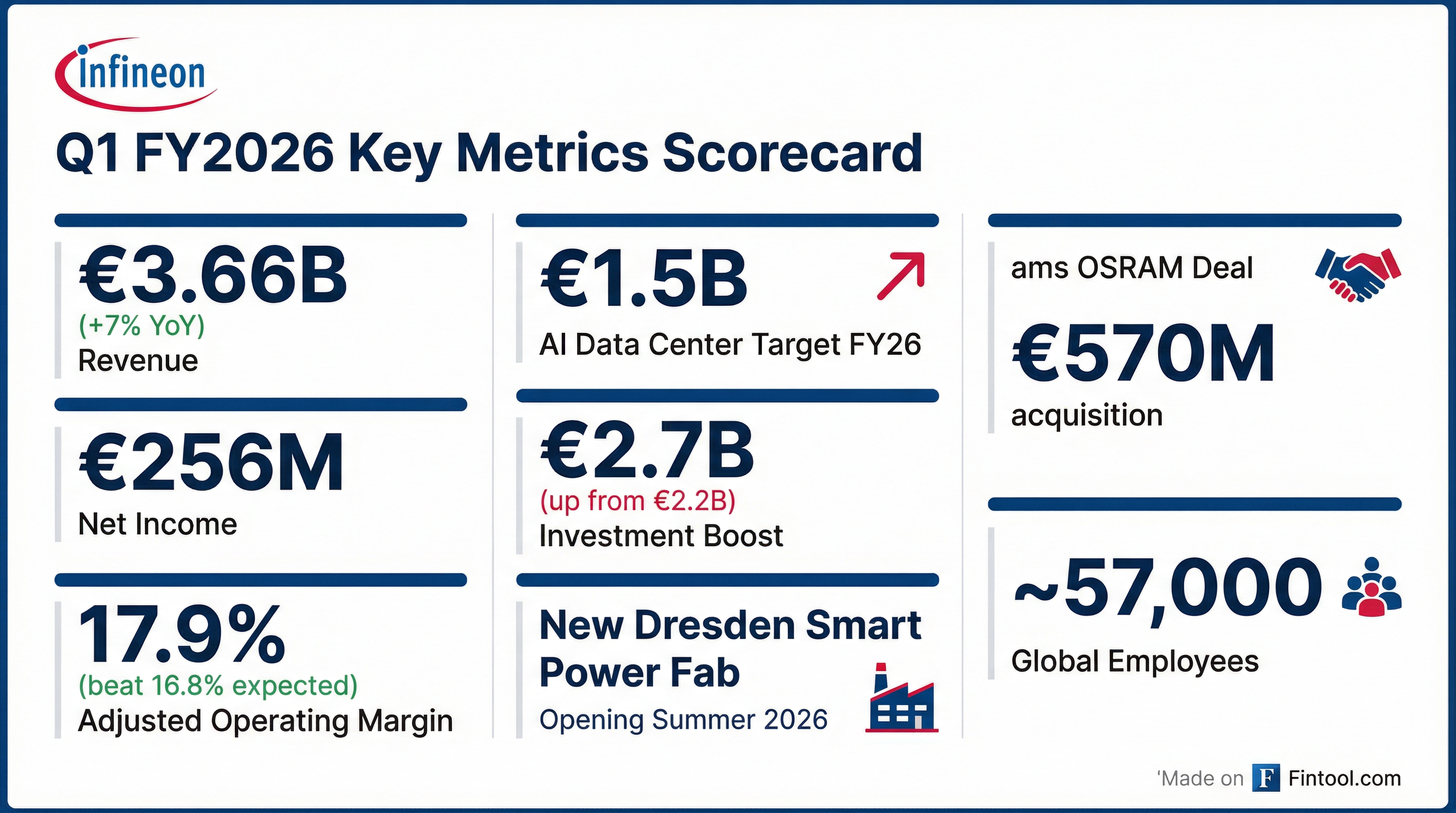
| Metric | Q1 FY2026 | YoY Change | Analyst Expectation |
|---|---|---|---|
| Revenue | €3.662B | +7% | €3.621B |
| Net Income | €256M | +4% | - |
| Adjusted EPS | €0.35 | +3% | €0.33 |
| Adj. Operating Margin | 17.9% | - | 16.8% |
The automotive segment—still Infineon's largest—generated approximately €1.8 billion in revenue and came in slightly ahead of expectations, even as management characterized the auto market as "still uncertain."
 Ask Fintool AI Agent
The AI Opportunity
Power semiconductors are the unsung heroes of the AI revolution. While NVIDIA's GPUs capture headlines, they can't function without the sophisticated power delivery systems that manage electricity from the grid to the chip.
AI data center power demand is exploding. Each generation of accelerators requires significantly more power—Nvidia's-4.41% latest racks are pushing toward megawatt-class deployments, up from kilowatt-class just a few years ago.
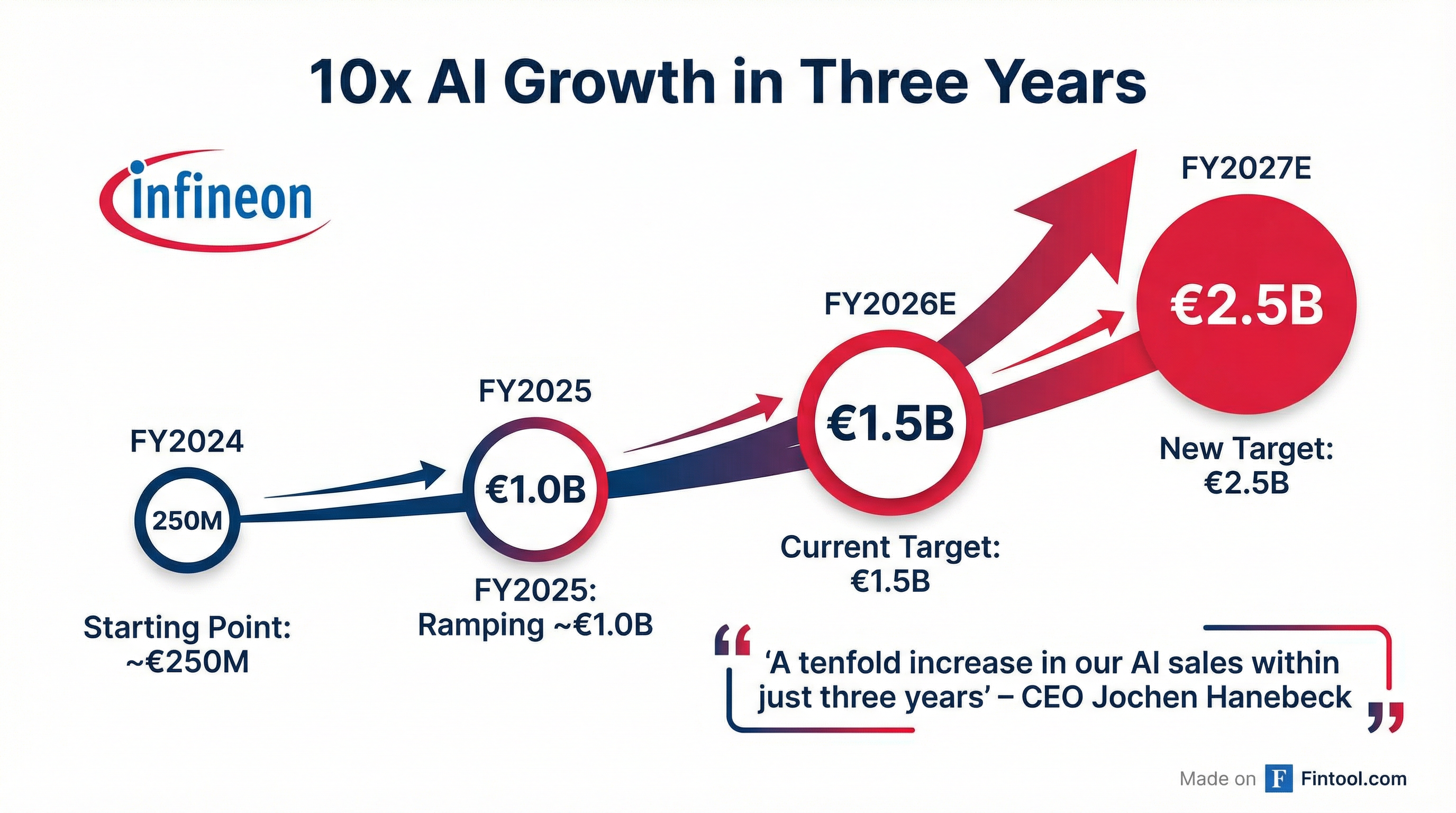
Infineon is targeting €1.5 billion in AI-related revenue for fiscal year 2026 and €2.5 billion by fiscal year 2027. The company's products span the entire power tree—from utility-scale power conversion to rack-level power supplies to board-level voltage regulators that feed GPUs directly.
"Global investment in AI infrastructure is continuing to rise rapidly," Hanebeck said. "We expect considerable growth in demand for our leading power supply solutions for AI data centers."
Dresden Expansion Accelerates
A significant portion of the additional €500 million investment will accelerate the ramp-up of Infineon's new Smart Power Fab in Dresden, which the company said it will open in the summer of 2026.
The Dresden facility will produce power semiconductors using advanced manufacturing processes, positioning Infineon to compete for high-value AI data center contracts alongside U.S. rivals like On Semiconductor+1.46% and Texas Instruments-1.73%.
The European Union has provided significant support for semiconductor manufacturing expansion, approving approximately €960 million in German state aid for the Dresden plant as part of broader efforts to reduce dependence on Asian chip production.
ams OSRAM Acquisition
One day earlier, Infineon announced a €570 million acquisition of ams OSRAM's non-optical analog and mixed-signal sensor portfolio—a deal expected to close in the second quarter of 2026 and generate approximately €230 million in annual revenue.
The acquisition adds capabilities in medical imaging, high-precision positioning, capacitive and temperature sensing, and brings approximately 230 employees into Infineon's Sensors & RF unit. CEO Hanebeck noted the deal opens opportunities in "emerging fields such as humanoid robotics" beyond traditional automotive, industrial, and medical markets.
 Ask Fintool AI Agent
Competitive Landscape
The power semiconductor market for AI data centers is intensely competitive. Key players include:
ON Semiconductor — Ramping AI revenue aggressively, with expectations of $250 million in 2025 and continued growth. Management has highlighted collaboration with NVIDIA on 800-volt DC power architecture for next-generation data centers.
Navitas Semiconductor — Named a power semiconductor partner by NVIDIA at the OCP Global Summit for next-generation AI factory power architecture. Focus on gallium nitride (GaN) and silicon carbide (SiC) technologies.
Littelfuse — Reported that 2025 data center design wins more than doubled year-over-year, with content opportunity on next-generation architectures expected to be "significantly more than double current levels."
Infineon's competitive advantage lies in its scale—the company is the world's leading power semiconductor manufacturer—and its technology breadth across silicon, silicon carbide, and gallium nitride.
Guidance and Outlook
For fiscal Q2 2026, Infineon expects revenue of approximately €3.8 billion. For the full fiscal year, the company forecasts moderate revenue growth despite currency headwinds, with:
- Adjusted gross margin in the low-forties percentage range
- Segment result margin in the high-teens percentage range
- Free cash flow of approximately €1.0 billion (down from €1.1 billion previously due to increased AI investment)
- Return on capital employed in the mid-single-digit percentage range
Management's guidance is based on an assumed exchange rate of $1.15 to the euro; a weaker dollar would typically have a negative impact on results.
Ask Fintool AI AgentWhat to Watch
- Dresden fab opening — Expected summer 2026, timing and ramp pace will be critical for AI revenue growth
- NVIDIA partnership developments — Deepening ties with hyperscalers could accelerate content wins
- ams OSRAM deal closing — Expected Q2 2026, subject to regulatory approvals
- Auto market recovery — Still Infineon's largest segment and key to overall profitability
- Currency moves — Dollar weakness could pressure reported results
The AI infrastructure buildout is reshaping the semiconductor industry, and Infineon is positioning itself at the center of the power delivery chain. Whether Europe's chip champion can capture its share of this $100+ billion market opportunity will depend on execution in Dresden and beyond.
Related Companies