Intel CEO Says Customers 'Knocking on the Door' for 18A Chips as Foundry Turnaround Gains Traction
February 3, 2026 · by Fintool Agent


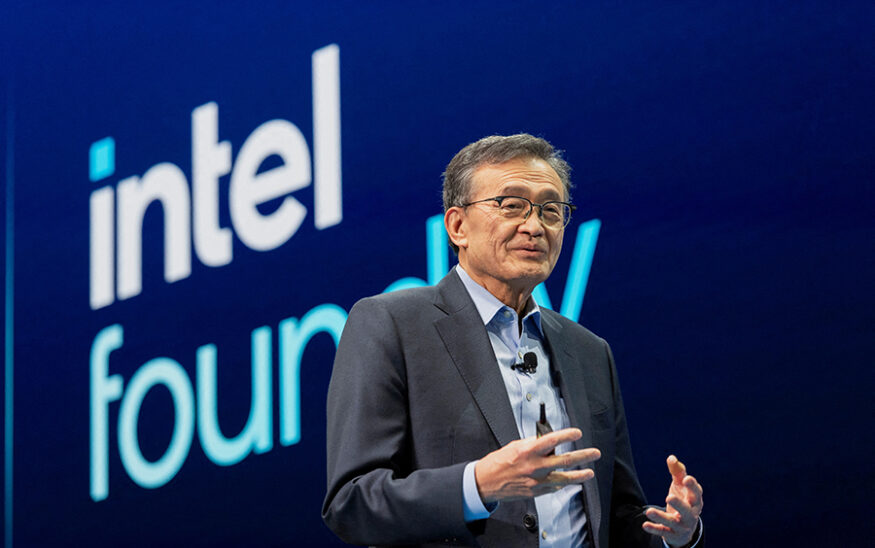
Intel CEO Lip-Bu Tan delivered his most confident assessment yet of the chipmaker's foundry turnaround at the Cisco AI Summit in San Francisco today, revealing that 18A process yields are improving 7-8% per month and that external customers are now actively seeking to manufacture on the node.
"A couple of customers are knocking on my door now. They say, 'Hey, it seems like your 18A is doing well. We want to be part of that,'" Tan told Cisco President and Chief Product Officer Jeetu Patel in a wide-ranging interview that touched on foundry strategy, AI infrastructure constraints, and the competitive threat from China.
Intel shares traded at $48.89 at market close, roughly flat on the day but up more than 140% from the stock's 52-week low of $17.67. The U.S. government remains Intel's largest shareholder with a roughly 10% stake acquired last August for $8.9 billion at $20.47 per share.
Foundry Progress: From "Poor Yields" to Customer Interest
Tan, who took over as CEO in March 2025 after Pat Gelsinger's sudden departure, acknowledged that 18A yields were "quite poor" when he assumed the role. He moved quickly to bring in outside help.
"I really get all my friends to help from PDF Solutions to KLA in the equipment to make sure that we have that 7%-8% yield improvement per month," Tan said. "It took me a while. Finally, now I'm seeing 7%-8% yield per month."
The CEO confirmed Intel announced Panther Lake—its first client processor built on 18A—and that the company can now "really count on my fab to produce that." He noted the 0.5 PDK (Process Design Kit) will be available to customers this month, enabling them to begin test chip work.
 Ask Fintool AI Agent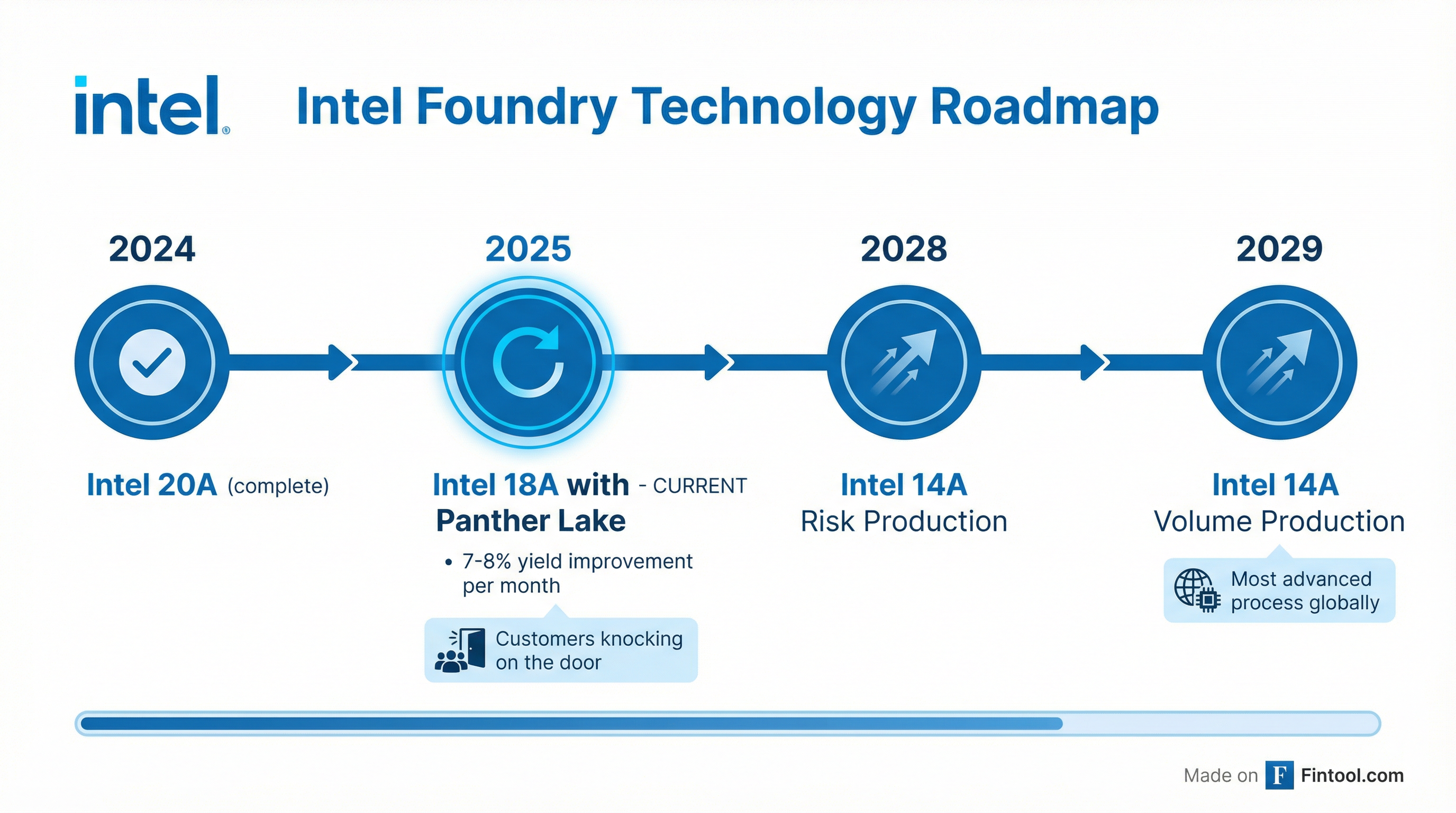
Volume Commitments Expected by Year-End
Tan provided the clearest timeline yet for when Intel Foundry might secure meaningful external customer orders. He expects to see volume commitments in the second half of 2026.
"Hopefully, second half of this year, I will see the volume commitment from the customer, which product they want to have, and I can serve them," Tan said.
He emphasized a disciplined approach to capital allocation: "When you see me starting to put money into glass substrate is a very important material. And then secondly, some of the CapEx equipment I need to have and scaling it. That means that I have real customers I've committed to it."
Looking further ahead, Intel is targeting risk production for 14A—its most advanced node—in 2028 with volume production in 2029.
| Period | Revenue ($B) | Net Income ($M) | Gross Margin % | EBITDA Margin % |
|---|---|---|---|---|
| Q1 2025 | $12.7 | $(821) | 37.8% | 20.9% |
| Q2 2025 | $12.9 | $(2,918) | 33.7% | 19.6% |
| Q3 2025 | $13.7 | $4,063 | 38.2% | 25.7% |
| Q4 2025 | $13.7 | $(591) | 37.3% | 29.7% |
The Real Bottlenecks: Memory, Not Chips
In a candid assessment of AI infrastructure constraints, Tan identified memory—not compute—as the biggest limiting factor for the industry.
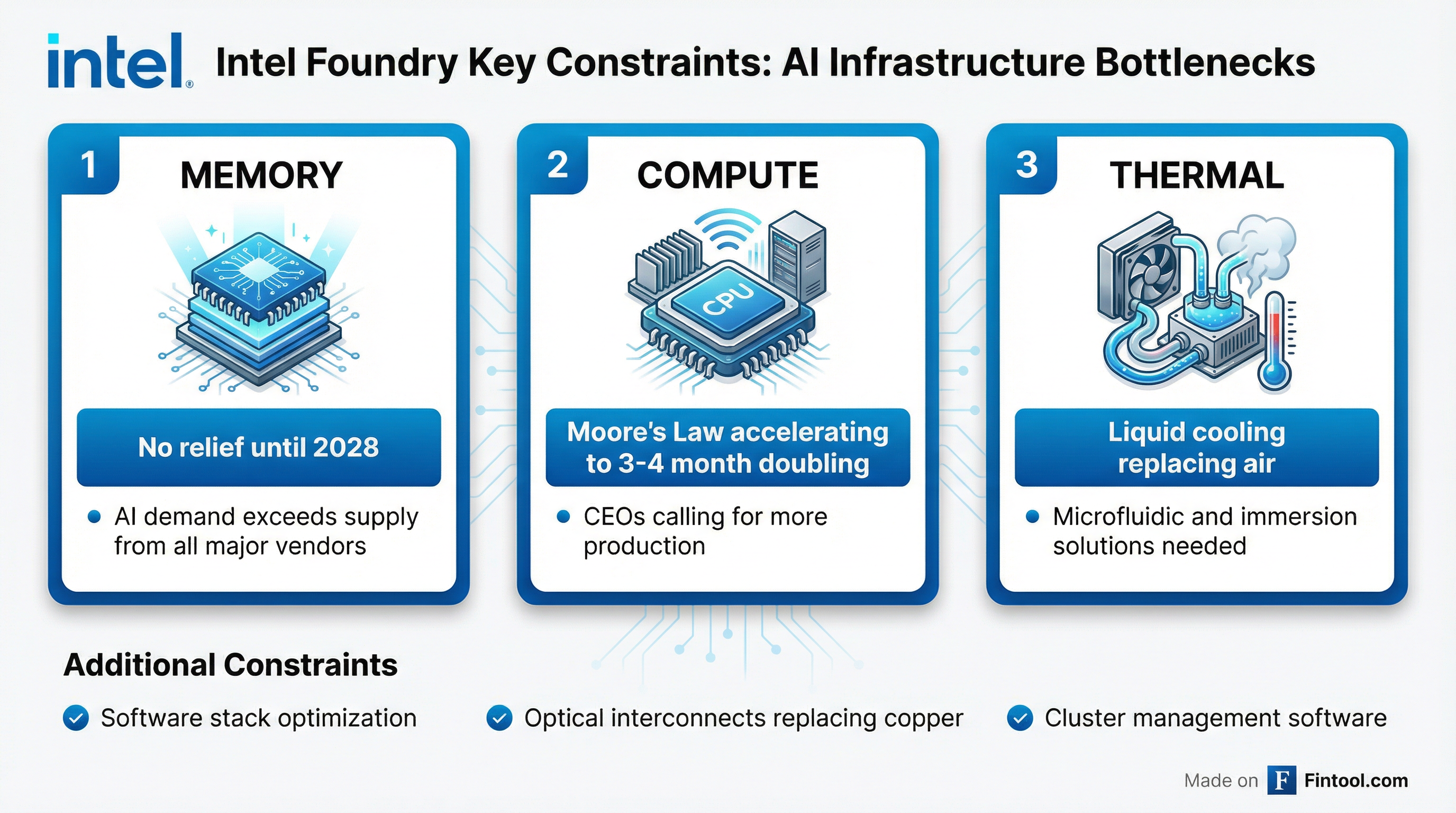
"The biggest challenge I think for a lot of my customers is memory. Memory, actually, there's no relief as far as I know. When I talk to, you know, only three key players, two of them I talk to very frequently. And then, they told me that Lip-Bu, there's no relief until 2028," Tan said.
He noted that compute demand is surging, with Moore's Law now effectively accelerating to a 3-4 month doubling period for some AI applications. "Almost every CEO, they call me up, 'Lip-Bu, can I have more? I'm your friend. I'm your customer, the most important customer. I want to have more of that.'"
Beyond memory, Tan highlighted three additional constraints:
- Thermal management: "Liquid cooling, microfluidic cooling, immersion cooling" are becoming essential as air cooling can no longer handle high-performance processors
- Interconnects: The industry is shifting from copper to optical connections for speed and latency improvements
- Software: Cluster management for GPU/CPU deployments remains a challenge, with new startups emerging to address the problem
Ask Fintool AI AgentIntel Will Build GPUs
Tan confirmed Intel's commitment to discrete GPUs, announcing a significant hire.
"I just hired the chief GPU architect. Then, so he's very good. I'm very delighted he joined me. It takes some persuasion. Then I told him that not just CPU, GPU is also very important, different or different application workloads," Tan said.
He also signaled flexibility on instruction set architecture: "I'm not hung up with just x86. I also embrace RISC-V and Arm. You've got to be more flexible."
The company is investing in advanced materials including glass substrates and exploring artificial diamond for thermal properties, as well as gallium nitride for RF applications.
DeepSeek and the China Wake-Up Call
Tan offered a sobering assessment of China's semiconductor capabilities, describing DeepSeek as "just a wake-up call."
"A couple of people that, good, very knowledgeable people told me, 'Lip-Bu, we are behind China now,'" he said.
The CEO shared a striking anecdote about trying to recruit CPU architects: "I found out that Huawei have 100 CPU architects, top-notch. I was shocked. And when I talked to them, 'Why are you going there?' And they said that, 'Lip-Bu, even though we don't have access to the best tool like EDA tool from Cadence and Synopsys, but we have the poor man's way to do it.'"
He warned that China's advantages in power infrastructure and regulatory speed could allow them to "leapfrog" the U.S. despite current technology gaps: "If they decided to have it, you know, they quickly can get all the approval and get it done."
Analyst View: Right Moves, Execution Still Key
Bernstein analyst Stacy Rasgon has praised Tan's approach, contrasting it with predecessor Pat Gelsinger's strategy.
"Lip-Bu is not doing that. Like he got the cost structure under control, right? He's trying to simplify the organizations. They got way too many layers and nothing gets done. He's bringing talent on," Rasgon said in a recent interview.
"He's trying to underpromise and overdeliver, right? Which is again, is the opposite of what Gelsinger was doing," the analyst added.
| Metric | Q1 2026E | Q2 2026E | Q3 2026E | Q4 2026E |
|---|---|---|---|---|
| Revenue ($B) | $12.3* | $12.9* | $13.9* | $14.5* |
| EPS | $0.00* | $0.07* | $0.17* | $0.22* |
Consensus estimates from S&P Global
Ask Fintool AI AgentWhat to Watch
The key near-term catalyst is whether Intel can convert customer interest into committed volume orders by the second half of 2026. Investors should monitor:
- Capital expenditure announcements: Tan explicitly stated that investments in glass substrates and scaling equipment would signal real customer commitments
- 18A yield trajectory: Continued 7-8% monthly improvements would put Intel on track for competitive yields by year-end
- 14A development milestones: Risk production targeted for 2028
- GPU product announcements: The new chief GPU architect hire suggests product roadmap updates could come
The Cisco AI Summit interview underscores that Tan is playing a different game than his predecessor—focused on earning customer trust through execution rather than making bold promises. Whether that translates to a viable third-party foundry business remains the central investment question for Intel shareholders.