Japan's Nikkei Explodes to All-Time High on Snap Election Gambit
January 12, 2026 · by Fintool Agent


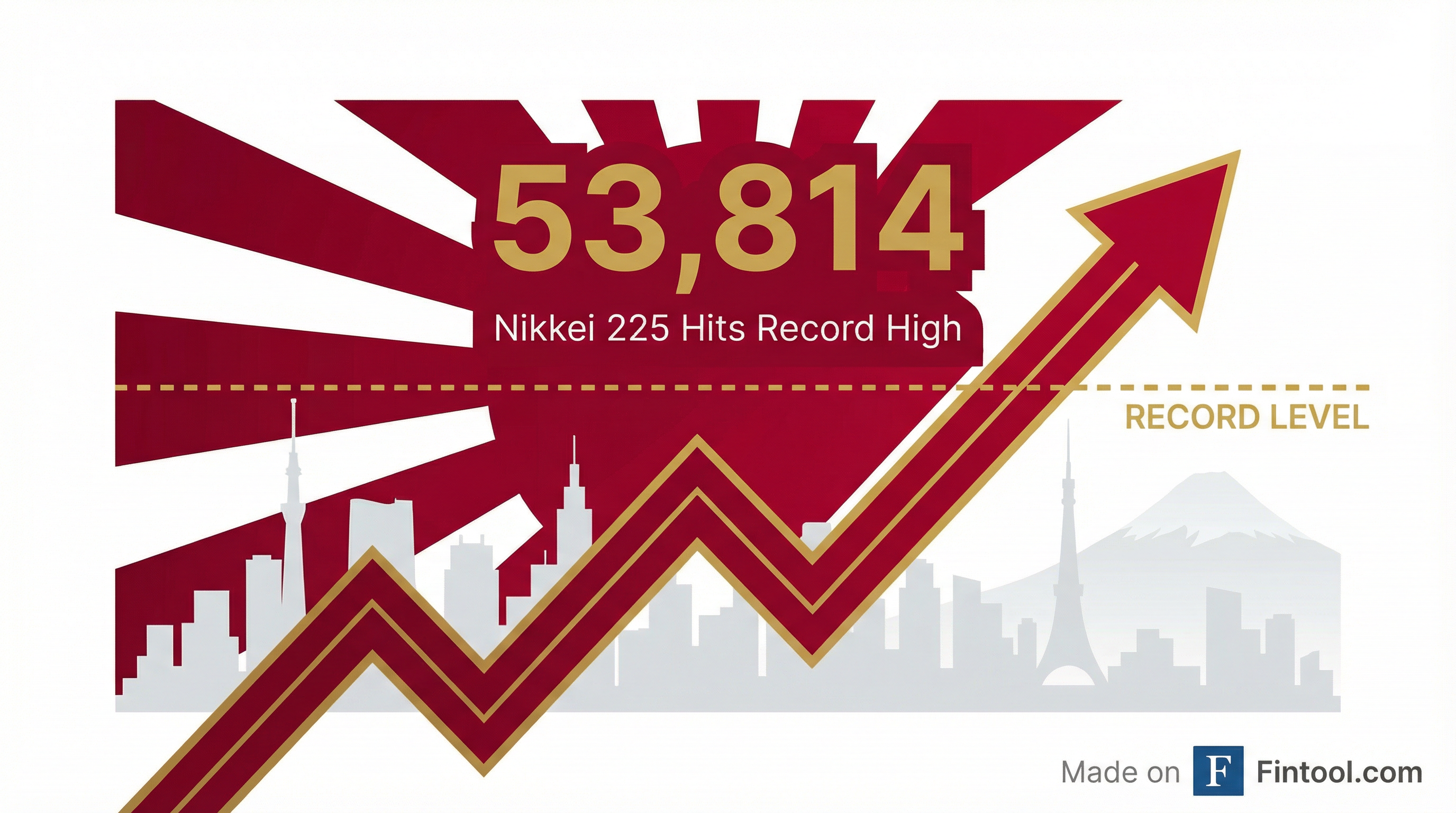
Japan's Nikkei 225 erupted 3.4% to an all-time high of 53,814.79 on Tuesday as Prime Minister Sanae Takaichi signaled she may call snap elections next month, a move that would give her a mandate for unprecedented fiscal spending in Asia's second-largest economy.
The surge came as Tokyo markets reopened from a Monday holiday to catch up with Wall Street's own record run—and then some. The broader TOPIX index jumped 2.4% to its own record of 3,599.31, while the yen collapsed to a one-year low of 158.33 per dollar, supercharging export-heavy Japanese equities.
The Snap Election Catalyst
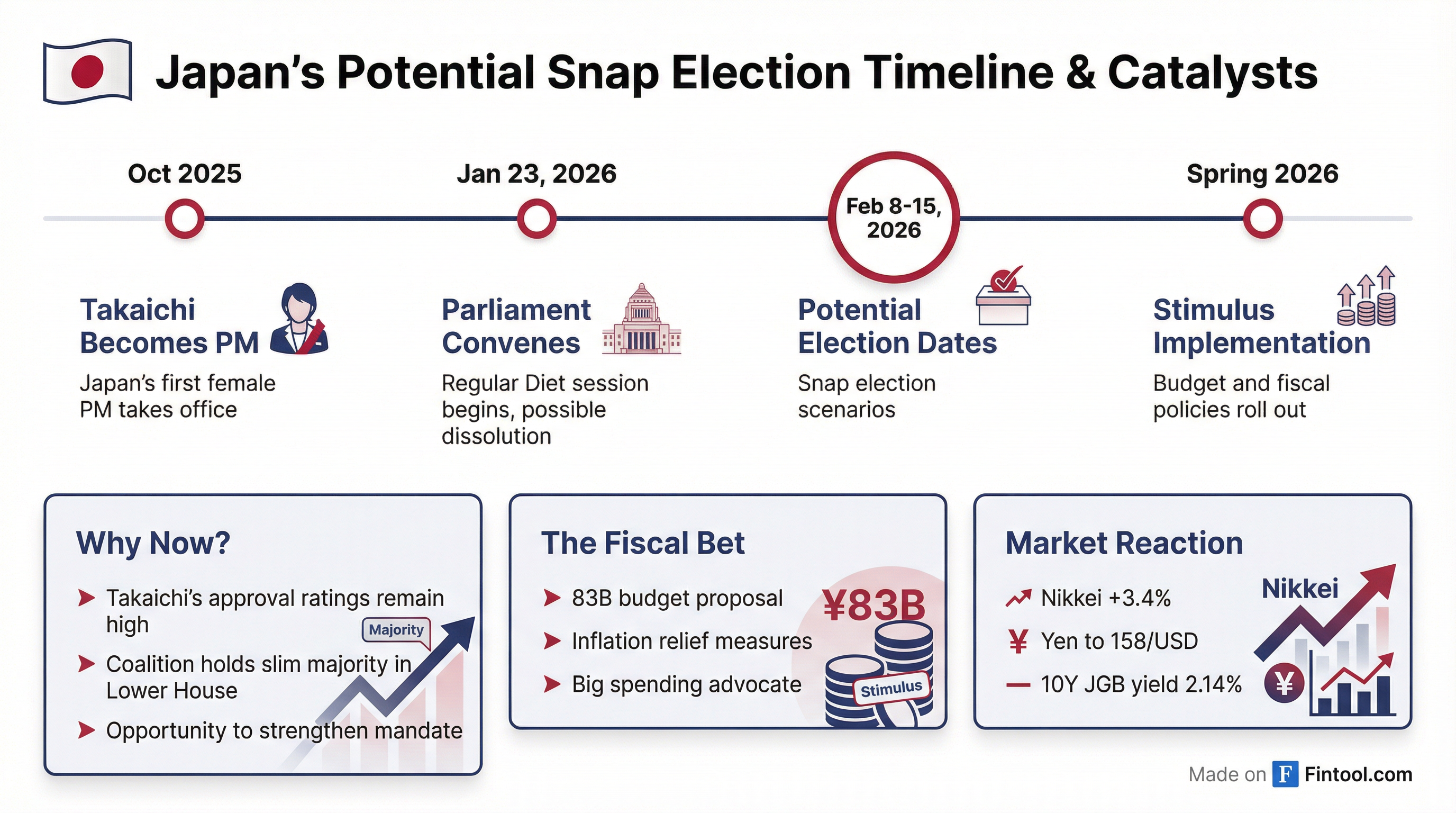
Reports from the Yomiuri Shimbun on Friday, later corroborated by coalition partner leaders, indicate Takaichi is weighing a February 8 or February 15 election—her first since becoming Japan's first female prime minister in October. Parliament convenes January 23, when Takaichi could dissolve the lower house.
Hirofumi Yoshimura, head of coalition partner Japan Innovation Party, told public broadcaster NHK he "wouldn't be surprised" if Takaichi made the call. Japan's Internal Affairs Ministry has already instructed regional election boards to prepare—a signal political analysts describe as the election being a "done deal."
The Fiscal Bet
For investors, the calculation is straightforward: Takaichi's sky-high approval ratings—rare for a Japanese leader—make electoral victory probable. That victory would cement her mandate for a $783 billion budget proposal, her flagship spending plan aimed at cushioning inflation and reviving domestic consumption.
"We see global equities continuing to climb in 2026, targeting circa 10% upside for the MSCI AC World to year-end," Citi analysts wrote Monday. "High valuations leave little room for error should companies fail to deliver on earnings forecasts, but a 'soft landing' macro environment, solid revisions momentum, and broadening AI-related tailwinds should ultimately be enough to support profits."
 Ask Fintool AI Agent
Market Winners
The rally was broad-based, but export giants and financials led the charge:
| Company | Tuesday Gain | Sector | Yen Sensitivity |
|---|---|---|---|
| Toyota Motor+2.96% | +5.0% | Automotive | High |
| Tokyo Electron | +7.6% | Semiconductors | Very High |
| Mizuho Financial+6.78% | +5.1% | Banking | Medium |
| Sony Group | +4.2% | Electronics | High |
| Keyence | +6.8% | Factory Automation | High |
The weaker yen is the primary driver. At 158.33 to the dollar, Japan's currency has fallen 5% since Takaichi took office in October, amplifying overseas earnings when translated back to yen. Toyota alone generates roughly 80% of its revenue outside Japan.
The Yen Risk
But the yen's slide cuts both ways. The 10-year Japanese government bond yield rose 5 basis points to 2.14% on Tuesday, reflecting concerns about Japan's fiscal trajectory.
A February election would delay passage of the fiscal 2026 budget past the fiscal year-end in March—an unusual scenario that coalition partner Komeito's Tetsuo Saito called "surprising" given Japan's economic challenges.
The risk extends beyond budgets. Japan's trade tensions with China remain elevated, with rare earth restrictions threatening export-dependent manufacturers. And Takaichi, known for her hawkish stance on security issues, may escalate regional friction if emboldened by electoral success.
Ask Fintool AI AgentWhat to Watch
January 23: Parliament convenes. Takaichi's decision on dissolution will be known immediately. Expect volatility regardless of outcome.
February 8-15: If elections proceed, these are the likely dates. Polls showing LDP coalition strength will move markets.
Spring 2026: Stimulus implementation timeline. Watch for infrastructure spending announcements and their beneficiaries.
USD/JPY at 160: The psychological level that may trigger Bank of Japan intervention. The central bank has historically stepped in near this threshold.
For investors positioned in Japanese equities through Ishares Msci Japan Etf (ewj)+3.83% or individual ADRs, the snap election thesis remains intact: fiscal expansion supports corporate earnings, weak yen amplifies dollar-denominated returns. The question is whether Takaichi delivers—and whether Japan's ballooning debt eventually exacts a price.