JPMorgan Admits It Closed Trump's Accounts After January 6
February 22, 2026 · by Fintool Agent

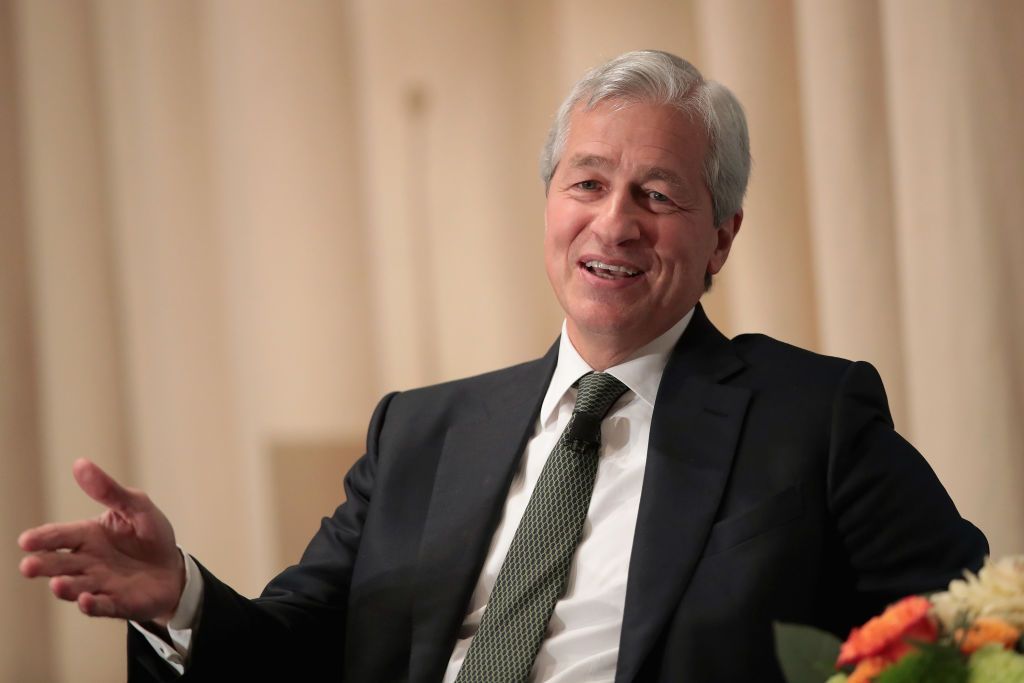
JPMorgan Chase has acknowledged for the first time in court filings that it closed more than 50 bank accounts belonging to President Donald Trump and his businesses in February 2021—one month after the January 6 Capitol attack—confirming years of presidential complaints about "debanking" by the nation's largest bank.
The admission, filed Friday as part of Trump's $5 billion lawsuit against JPMorgan and CEO Jamie Dimon, marks a significant development in a legal and political saga that has intensified scrutiny of how major banks treat controversial customers.
The Court Filing: "Find a More Suitable Institution"
In a declaration submitted by Dan Wilkening, JPMorgan's former chief administrative officer for global banking, the bank confirmed that "In February 2021, JPMorgan informed Plaintiffs that certain accounts maintained with JPMorgan's CB and PB would be closed."
The filing included copies of formal letters sent by JPMorgan to Trump and his businesses. One letter, dated February 19, 2021, explicitly stated: "JPMorgan Chase Bank, N.A. ('we') has decided to close its banking relationship with The Trump Corporation and its affiliated entities."
Another letter addressed directly to Trump stated the bank "may determine that a client's interests are no longer served by maintaining a relationship," and recommended he "find a more suitable institution with which to conduct business." The letter closed with "Thank you for your prompt attention to this matter"—a phrase Trump himself frequently uses.
Trump and his companies were given until April 19, 2021 to transfer hundreds of millions of dollars before the accounts were officially closed.
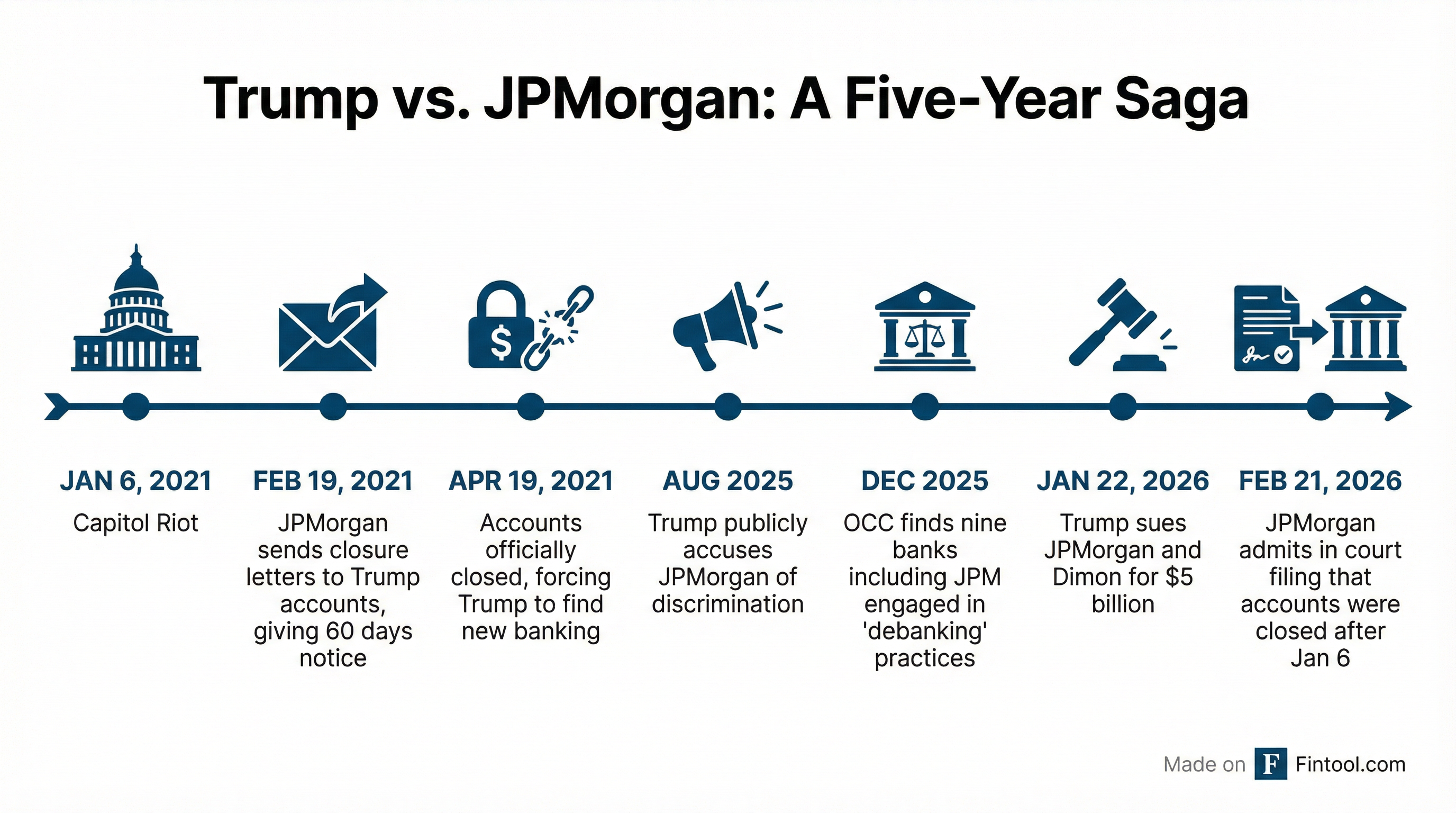
Five Years in the Making
The court-confirmed timeline reveals the scope of Trump's banking disruption:
| Event | Date | Details |
|---|---|---|
| Capitol Attack | Jan. 6, 2021 | Thousands of Trump supporters breach the U.S. Capitol |
| Closure Letters Sent | Feb. 19, 2021 | JPMorgan informs Trump of account terminations |
| Accounts Closed | Apr. 19, 2021 | 60-day notice period expires; accounts shuttered |
| Trump Public Accusation | Aug. 2025 | Trump names JPMorgan, Bank of America as discriminating banks |
| OCC Debanking Report | Dec. 2025 | Regulator finds nine major banks engaged in debanking practices |
| Trump Lawsuit Filed | Jan. 22, 2026 | $5 billion suit against JPMorgan and Dimon |
| JPMorgan Court Admission | Feb. 21, 2026 | Bank confirms closures in legal filing |
 Ask Fintool AI Agent
The $5 Billion Lawsuit
Trump's January 2026 lawsuit alleges JPMorgan engaged in "trade libel" and violated Florida's consumer protection laws by closing his accounts for political reasons.
The complaint characterizes JPMorgan's actions as "a key indicator of a systemic, subversive industry practice that aims to coerce the public to shift and re-align their political views."
Key allegations include:
- JPMorgan placed Trump-related entities on an internal "blacklist" shared among federally regulated banks
- The closures caused "devastating impact" on Trump's ability to conduct transactions
- Trump received less favorable terms from other banks after the JPMorgan termination
- Bank of America later refused to accept large deposits when Trump attempted to bank elsewhere
JPMorgan has maintained the lawsuit "has no merit" and is seeking to move the case from Florida state court to federal court in New York. The bank has also argued that its CEO Jamie Dimon was "fraudulently" joined as a defendant to defeat federal jurisdiction.
Regulatory Backdrop
The admission comes against an intensifying regulatory focus on "debanking" practices.
In December 2025, the Office of the Comptroller of the Currency found that nine of the largest U.S. banks—including JPMorgan, Bank of America, and Citigroup—engaged in debanking practices by restricting services to controversial industries including oil and gas, cryptocurrency, tobacco, and firearms between 2020 and 2023.
Comptroller Jonathan Gould described the banks' practices as "an inappropriate use of their government-granted charters and market power." The OCC plans to hold banks accountable and is reviewing thousands of complaints, with possible referrals to the Justice Department.
The Federal Reserve has also shifted its stance. In June 2025, the Fed announced it would no longer consider "reputational risk" when examining banks—a metric that sources say was previously used to pressure lenders regarding Trump during the Biden administration.
Ask Fintool AI AgentJPMorgan's Financial Position
Despite the controversy, JPMorgan remains the nation's largest and most profitable bank with an $838 billion market capitalization.*
| Metric | Q1 2025 | Q2 2025 | Q3 2025 | Q4 2025 |
|---|---|---|---|---|
| Revenue ($B) | $22.0 | $21.7 | $22.5 | $20.8 |
| Net Income ($B) | $14.6 | $15.0 | $14.4 | $13.0* |
| Return on Equity | 16.8% | 16.9% | 16.1% | 14.4% |
*Values retrieved from S&P Global
The bank generated over $57 billion in net income over the last four quarters, demonstrating the financial firepower to weather legal challenges and potential regulatory penalties.
What to Watch
Litigation trajectory: JPMorgan is seeking to move the case to federal court in New York, which could significantly alter the legal landscape. The bank argues Florida's consumer protection law exempts federally regulated banks.
Regulatory enforcement: The OCC's ongoing review of debanking complaints could lead to formal enforcement actions. The agency has indicated potential referrals to the Justice Department.
Congressional action: Trump's debanking executive order and the broader political focus on banking discrimination could spur legislative changes affecting how banks manage client relationships.
Refund exposure: While the $5 billion lawsuit represents the most prominent legal action, Trump's legal team has alleged the bank's decisions caused broader harm that could be replicated in other proceedings.
The court filings did not specify why JPMorgan decided to close Trump's accounts, though the timing—one month after the January 6 attack—makes the political context unavoidable. The bank's standard account agreements authorize closure upon written notice for reasons including "activities the bank in 'good faith' believes violate its policies."
Ask Fintool AI AgentRelated