JPMorgan Drops ISS and Glass Lewis, Bets $7 Trillion on Proprietary AI Voting System
January 8, 2026 · by Fintool Agent


JPMorgan Chase's asset and wealth management division is severing ties with the proxy advisory industry's two dominant players—Institutional Shareholder Services (ISS) and Glass Lewis—and replacing them with a proprietary AI-powered platform called "Proxy IQ" . The move affects approximately $7 trillion in assets under management and marks the most significant challenge yet to the proxy advisory duopoly that has shaped corporate governance for decades.
The decision follows years of public criticism from CEO Jamie Dimon, who has repeatedly called the proxy advisory firms "incompetent" and questioned the quality of their analysis .
Breaking the Proxy Advisory Duopoly
ISS and Glass Lewis together control more than 90% of the proxy advisory market—a duopoly that has faced mounting criticism from corporate executives and, more recently, federal regulators.
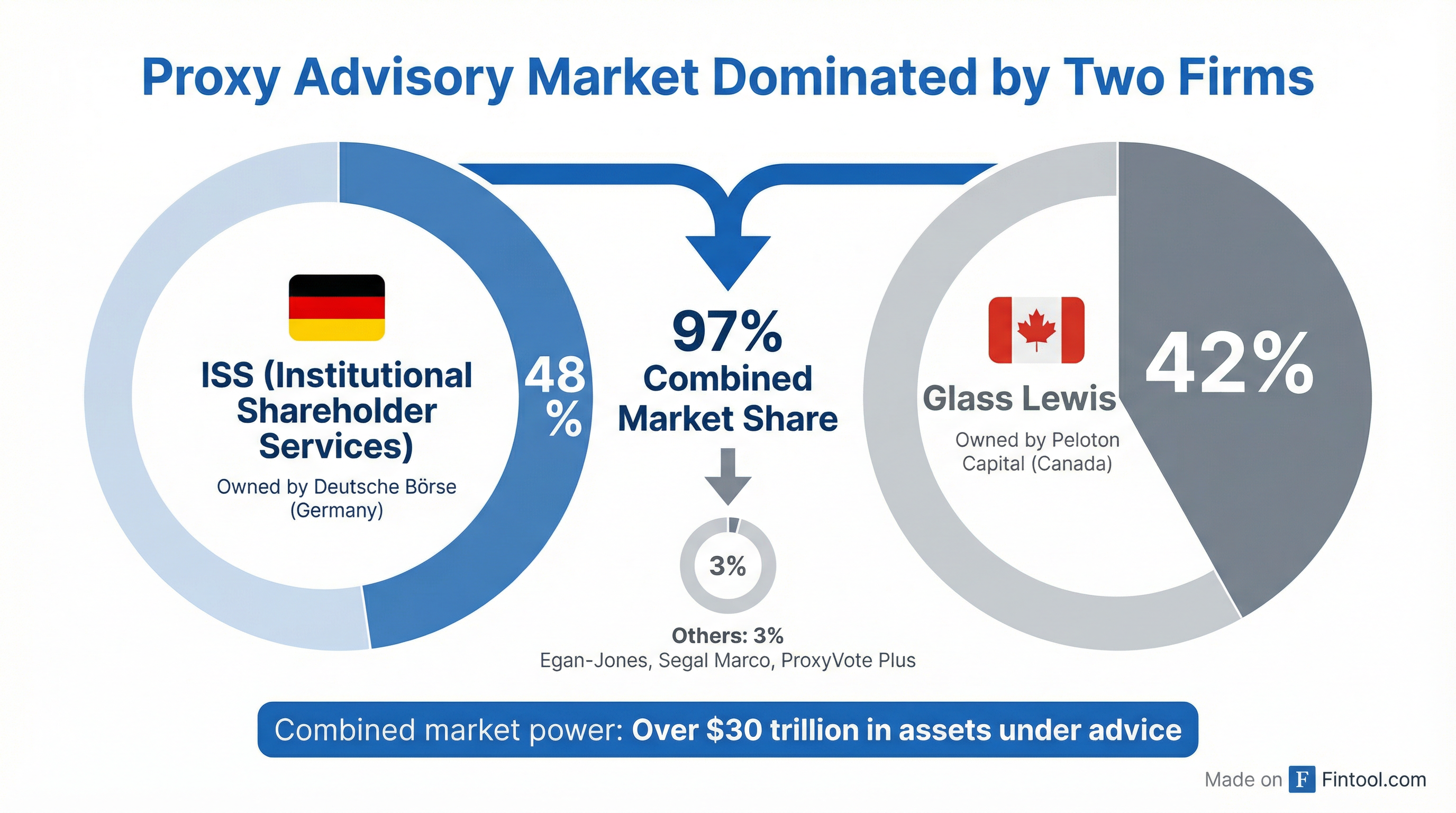
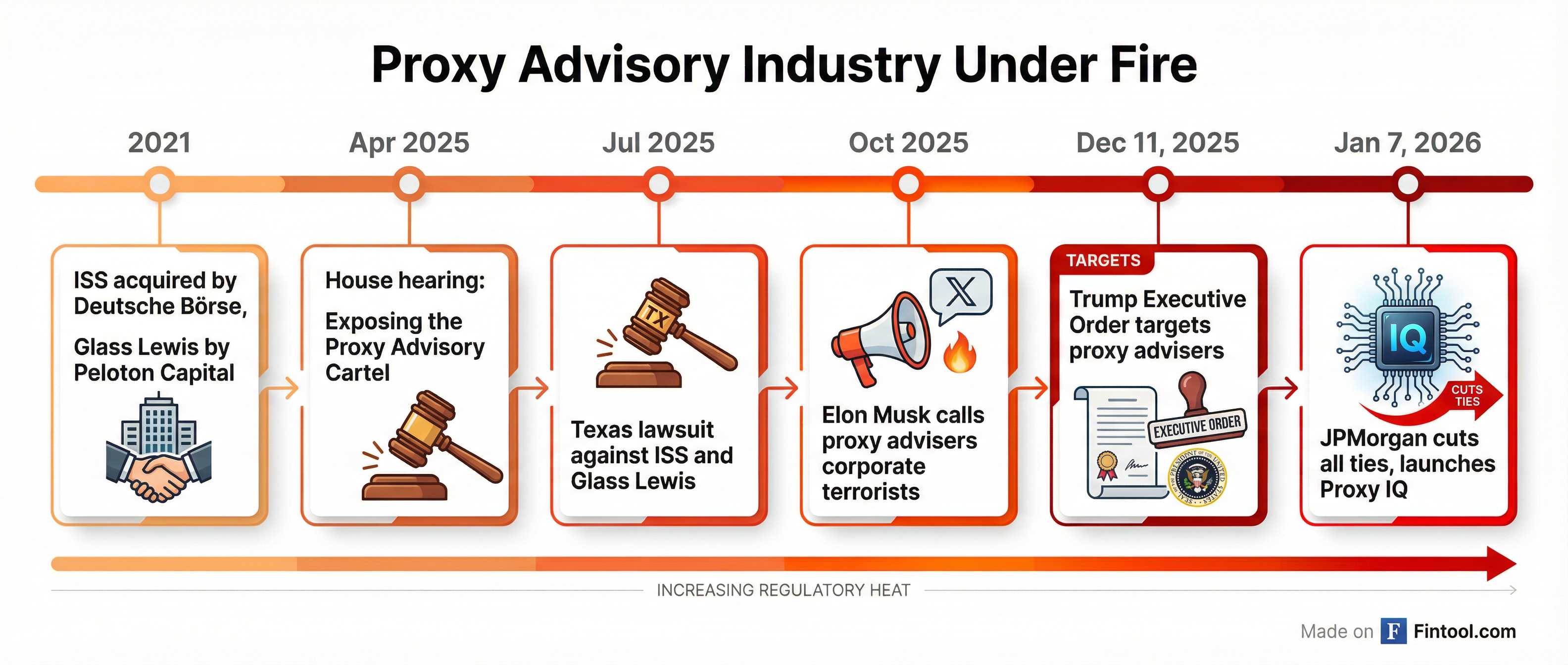
The timing is notable. JPMorgan's announcement comes less than a month after President Trump signed an executive order in December 2025 directing federal agencies to increase oversight of proxy advisory firms. The order cited concerns over their concentrated influence, foreign ownership structures, and alleged promotion of ESG and DEI-related agendas .
 Ask Fintool AI Agent
What Is Proxy IQ?
JPMorgan's Proxy IQ platform will aggregate data and generate voting recommendations for the firm's asset management teams to use when voting proxies on U.S. shareholder matters . While details on the technology remain limited, the system represents a significant bet on in-house AI capabilities over third-party advisory services.
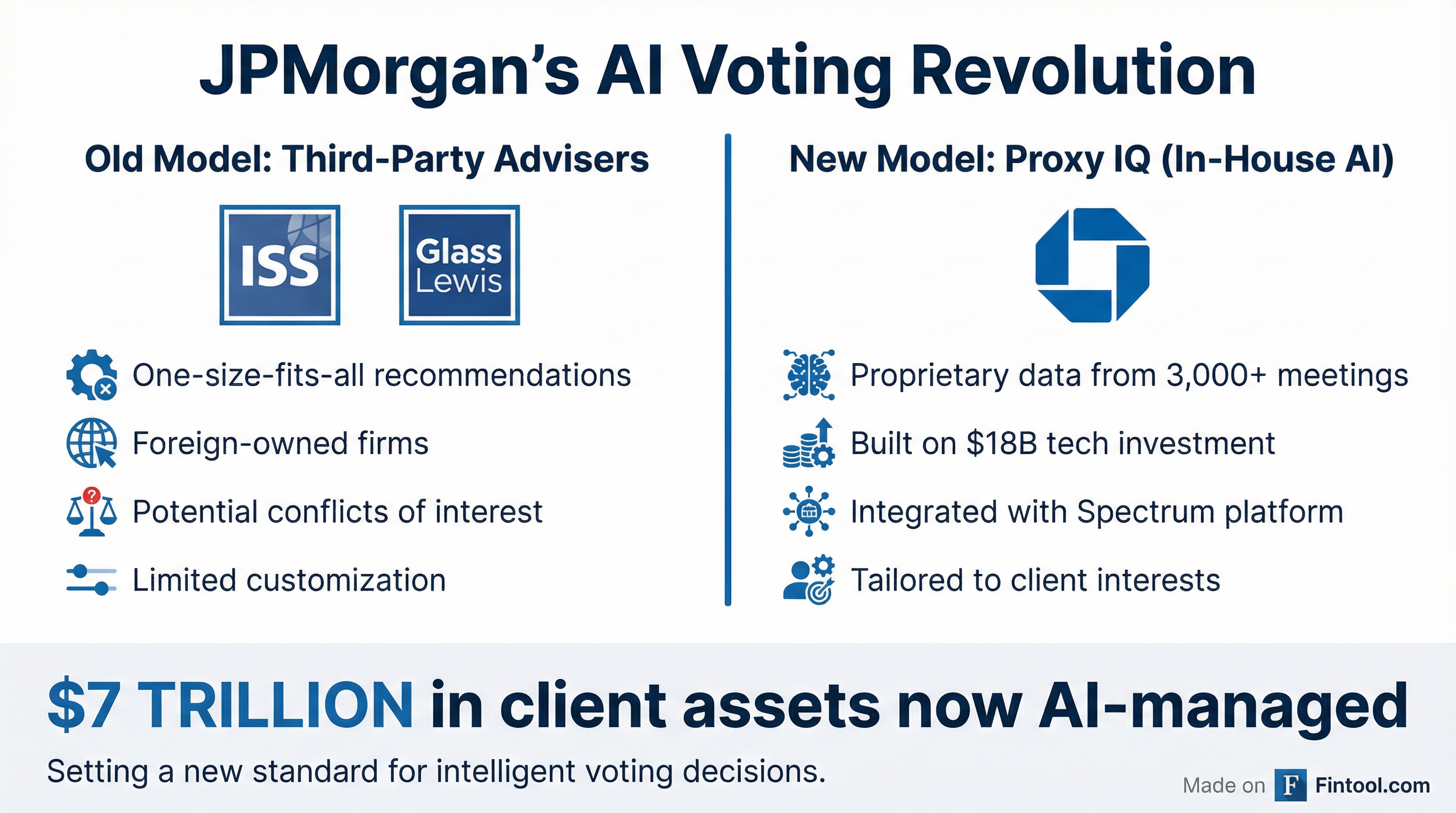
The shift aligns with management's broader technology strategy. In recent earnings calls, Dimon has consistently emphasized that the bank will continue investing heavily in technology and AI regardless of economic conditions, categorizing such spending as "good expenses" essential for long-term competitiveness .
Notably, Dimon has articulated a pragmatic approach to AI adoption: JPMorgan will "use LLMs but not own one," preferring to leverage external AI capabilities rather than building foundation models from scratch .
Why This Matters for Investors
1. A $7 Trillion Experiment
JPMorgan Asset Management is one of the world's largest institutional investors. How it votes on proxy matters—executive compensation, board elections, shareholder proposals—carries significant weight in corporate boardrooms. Replacing human analysts at ISS and Glass Lewis with proprietary AI introduces both opportunity and risk.
2. Potential Industry Cascade
If Proxy IQ proves effective, other large asset managers may follow suit. This could fundamentally reshape the corporate governance ecosystem, shifting power from centralized advisory firms back to individual asset managers—potentially fragmenting the voting landscape that companies have learned to navigate.
3. Political Tailwinds
The Trump administration's executive order signals regulatory momentum against the proxy advisory status quo. JPMorgan's timing positions the bank favorably with the incoming regulatory environment while also aligning with Dimon's longstanding criticisms .
 Ask Fintool AI Agent
JPMorgan's Financial Foundation
The bank has the financial firepower to support ambitious technology initiatives. Here's a snapshot of recent performance:
| Metric | Q4 2024 | Q1 2025 | Q2 2025 | Q3 2025 |
|---|---|---|---|---|
| Revenue ($B) | $17.6 | $17.5 | $18.1 | $22.5 |
| Net Income ($B) | $11.4 | $14.8 | $18.2 | $14.4 |
| Diluted EPS | $3.86 | $5.07 | $6.15 | $5.07 |
With $4.56 trillion in total assets and a management team committed to technology investment over buybacks at current valuations , JPMorgan has ample resources to develop and scale Proxy IQ.
Ask Fintool AI AgentWhat to Watch
Near-term (Q1 2026):
- Implementation details and timeline for Proxy IQ rollout
- Reaction from ISS and Glass Lewis—potential legal or regulatory challenges
- Response from other large asset managers (BlackRock, Vanguard, State Street)
Medium-term (2026 proxy season):
- First large-scale test of Proxy IQ during spring proxy season
- Whether JPMorgan's voting patterns diverge materially from ISS/Glass Lewis recommendations
- Corporate issuer reactions to potentially more fragmented voting outcomes
Longer-term:
- Regulatory action following Trump's executive order
- Competitive response from proxy advisors—do they develop their own AI tools?
- Whether other asset managers build or license proprietary voting systems
The Bottom Line
JPMorgan's move to replace third-party proxy advisors with AI represents more than a technology upgrade—it's a strategic repositioning that could reshape corporate governance. With $7 trillion at stake, political tailwinds from the new administration, and Jamie Dimon's longstanding antipathy toward the proxy advisory establishment, Proxy IQ is a high-conviction bet that the bank can do governance analysis better than the incumbents.
For investors, the key question is whether proprietary AI voting will produce better outcomes than the standardized recommendations that have dominated for decades. The 2026 proxy season will be the first real test.
Related Companies: JPMorgan Chase