Trump Names Kevin Warsh as Fed Chair: A Wall Street Hawk Who's Found His Dovish Side
January 30, 2026 · by Fintool Agent


President Trump ended months of speculation Friday morning, announcing on Truth Social that he will nominate Kevin Warsh to become the 17th Chair of the Federal Reserve.
"I have known Kevin for a long period of time, and have no doubt that he will go down as one of the GREAT Fed Chairmen, maybe the best," Trump wrote. "On top of everything else, he is 'central casting,' and he will never let you down."
The selection of the 55-year-old former Fed governor—once known as a hawk who dissented against quantitative easing—marks Trump's most consequential economic policy appointment of his second term. Warsh will succeed Jerome Powell, whose term expires in May, pending Senate confirmation.
Markets React: Relief, Not Euphoria
The dollar strengthened 0.3% and Treasury yields rose modestly on the news—a muted reaction reflecting that markets had largely priced in Warsh's selection. Polymarket showed his odds surging to 94% overnight, up from 33% just a day earlier.
"He has the respect and credibility of the financial markets," said David Bahnsen, chief investment officer of The Bahnsen Group. "There was no person who was going to get this job who wasn't going to be cutting rates in the short term. However, I believe longer term he will be a credible candidate."
The initial hawkish read—Warsh favors fewer rate cuts than Rick Rieder or Kevin Hassett would have—was tempered by his recent dovish comments on short-term rates. The two-year Treasury yield, which best captures Fed policy expectations, actually softened after the headline.
 Ask Fintool AI Agent
The Reinvented Hawk
What makes this appointment fascinating is Warsh's ideological evolution. During his Fed tenure from 2006 to 2011, he was an outspoken skeptic of aggressive monetary stimulus.
At the November 2010 FOMC meeting, with unemployment near 10%, Warsh told colleagues he would only vote for QE2 "out of respect for Chairman Bernanke." He added: "If I were in your chair, I would not be leading the Committee in this direction." Weeks later, he wrote a Wall Street Journal op-ed expressing reservations about the very policy he'd just voted for. A few months after that, he resigned.
But Warsh 2026 is not Warsh 2011. In recent months, he has argued that current rates are "too high," that the Fed's approach is holding back economic growth, and that borrowing costs should come down.
"Economic growth in the U.S. is poised to boom, but it's being held down by bad economic policies coming from the central bank," Warsh said on Larry Kudlow's Fox Business program last summer. "Interest rates should be lower. The balance sheet should be smaller."
That combination—lower short-term rates paired with a smaller balance sheet—could lead to a steeper yield curve if Congress doesn't rein in deficits.
Who Is Kevin Warsh?
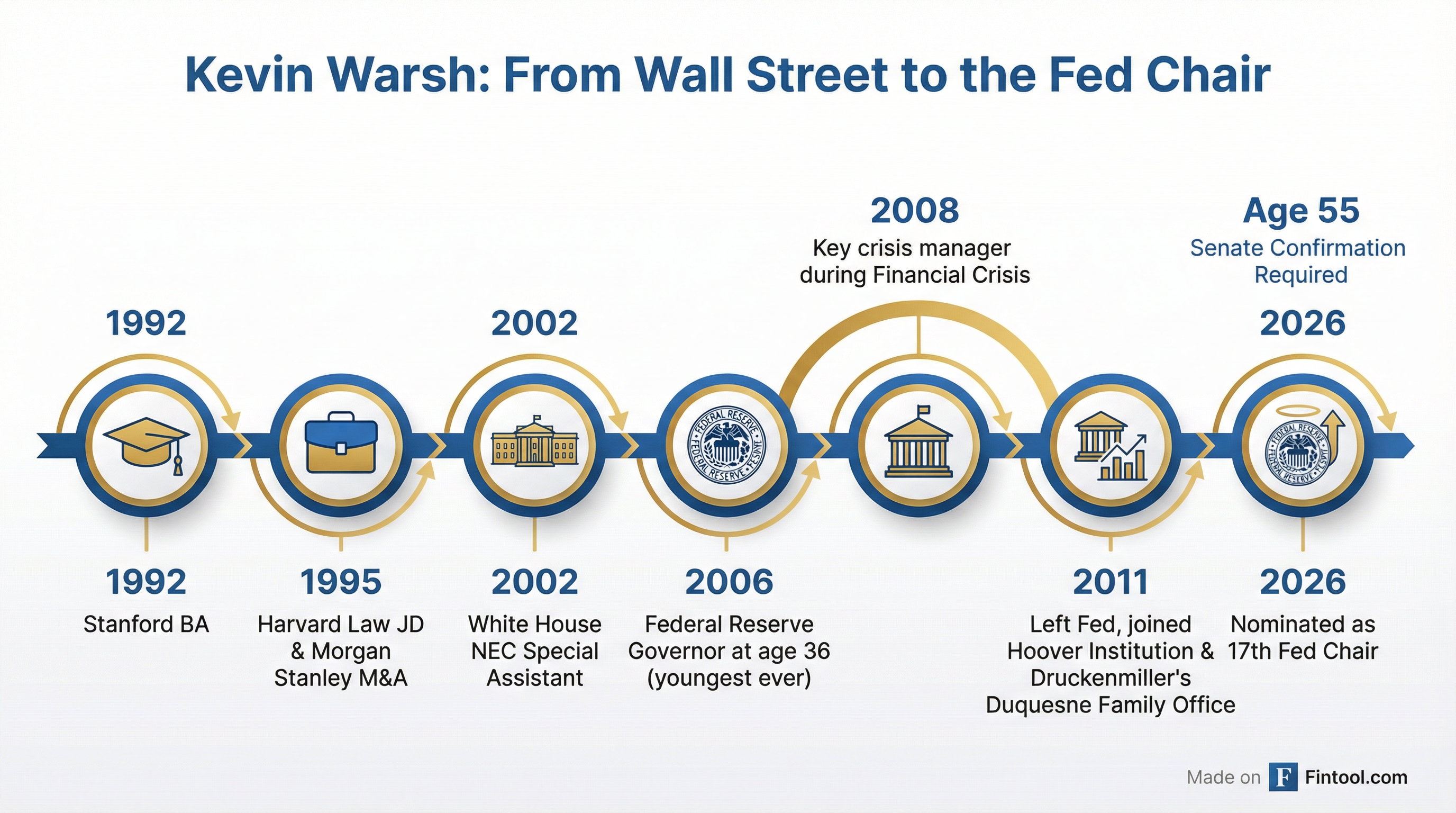
Warsh's résumé reads like a masterclass in elite credentialing:
| Period | Role | Highlights |
|---|---|---|
| 1992 | Stanford BA | Public policy with economics emphasis |
| 1995 | Harvard Law JD | Also coursework at Harvard Business School and MIT Sloan |
| 1995-2002 | Morgan Stanley M&A | Rose to VP and Executive Director |
| 2002-2006 | White House NEC | Special Assistant to President Bush for Economic Policy |
| 2006-2011 | Federal Reserve Governor | Youngest ever at 36; crisis manager during 2008 |
| 2011-Present | Hoover Institution Fellow | Also partner at Stanley Druckenmiller's Duquesne Family Office |
He sits on the boards of Ups and Korean e-commerce giant Coupang, and is married to Jane Lauder—granddaughter of Estée Lauder founder, with a net worth Forbes estimates at $2.5 billion. His father-in-law, billionaire Ronald Lauder, is a longtime Trump ally and GOP megadonor.
During the 2008 financial crisis, Warsh was part of Ben Bernanke's inner circle. He was granted a waiver to deal with his former employer Morgan Stanley, which was converted into a bank holding company overnight to access Fed lending—in effect saving the firm.
Ask Fintool AI AgentThe Race That Was
Trump's selection process resembled a months-long audition, with candidates appearing regularly on television to showcase their views. The finalists presented starkly different approaches to monetary policy.
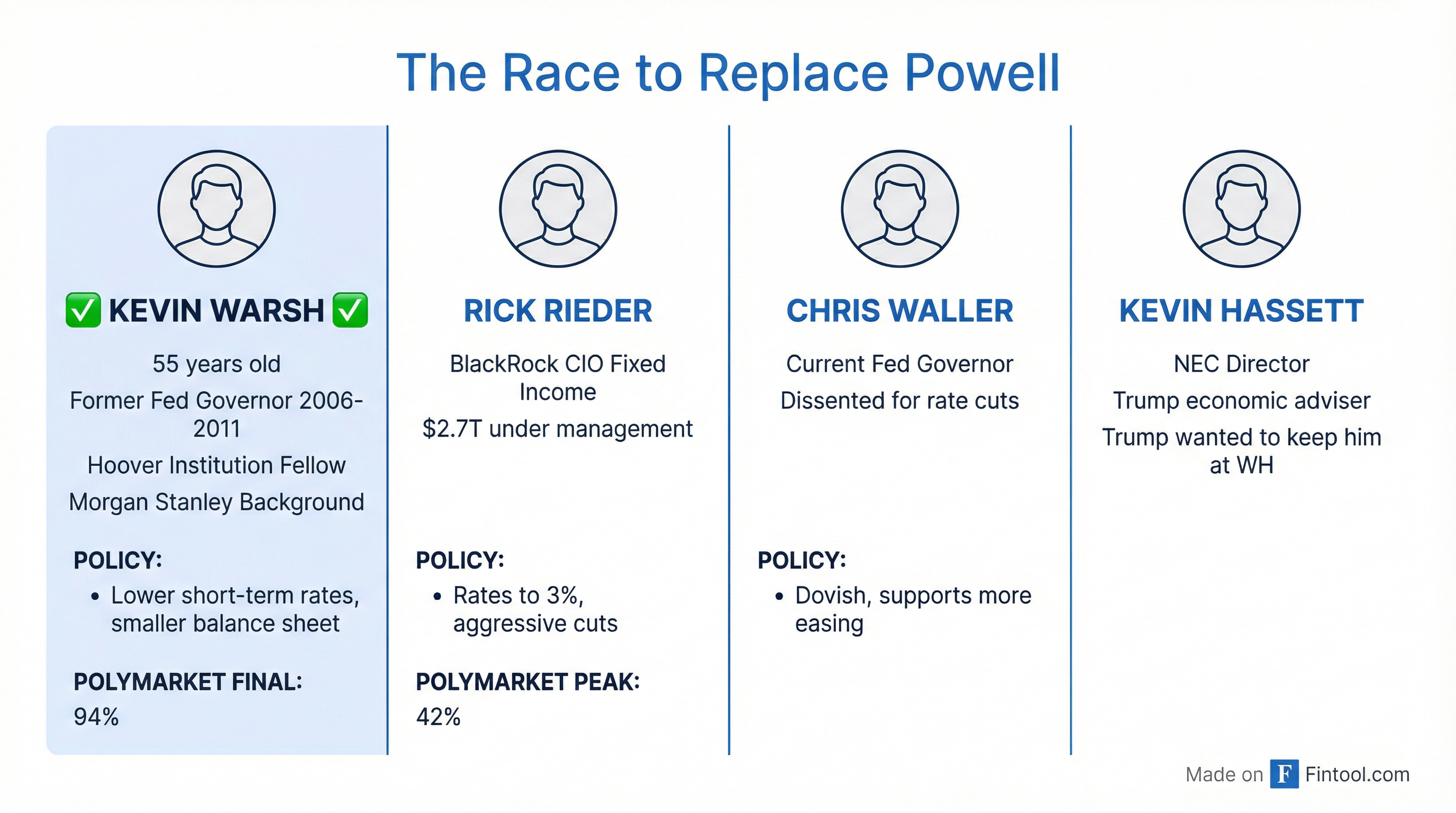
Treasury Secretary Scott Bessent led the search, presenting Trump with four finalists. Warsh's selection represents a middle ground—less radical than the ultra-dovish Rieder or Hassett, but more aligned with Trump's rate-cutting preferences than Fed insider Chris Waller.
Notably, Trump appeared to rule out Hassett, saying he would "hate to lose him" from his NEC Director role. "It's a serious concern for me," Trump said at a White House event.
What to Expect From Warsh
Warsh walks into a minefield. Trump has persistently hectored the Fed to slash rates, launching a criminal investigation into Powell's congressional testimony about the Fed's $2.5 billion headquarters renovation—widely seen as pressure to accelerate cuts.
Key questions for the confirmation hearing:
On Independence: How will Warsh handle Trump's demands for lower rates? Trump told the Wall Street Journal in December that Warsh "thinks you have to lower interest rates. And so does everybody else that I've talked to."
On the Balance Sheet: Warsh has long argued the Fed's $6.6 trillion pile of assets has distorted markets. Shrinking it could push long-term rates higher—even as he cuts short-term rates. "His view on the balance sheet suggests the yield curve could steepen further as short rates fall, while longer-term rates stay sticky or drift higher," said Elias Haddad at Brown Brothers Harriman.
On Data Dependency: Warsh has criticized the Fed for being too focused on backward-looking data. He may push for a more forward-looking approach to policy-making.
What to Watch
Senate Confirmation: Warsh will need Senate approval. Key Republican senators have grown increasingly vocal about defending Fed independence amid the Powell investigation. His ties to Wall Street and the Lauder family fortune will likely draw scrutiny.
The Powell Handoff: Powell's term ends in May. The transition will be closely watched for any policy signals.
First FOMC Meeting: How Warsh navigates the committee—which includes members less aligned with rate cuts—will set the tone. The Fed is a committee, not a dictatorship.
Balance Sheet Strategy: Watch for any changes to the current "quantitative tightening" pace, which has been slowly reducing the Fed's holdings.
"At the end of the day, the Fed has to remain data dependent and it has to remain independent. And I don't think that will change under Kevin Warsh," said Fiona Cincotta of City Index. "Although we're talking about a change at the head of the Fed, this is a committee and if the data doesn't show the need to be adopting a more dovish stance, then it's going to be very difficult for one person to drive that change."
Ask Fintool AI Agent