Las Vegas Sands Stock Crashes 14% Despite Singapore's 'Greatest Quarter in Casino History'
January 29, 2026 · by Fintool Agent


Las Vegas Sands stock plunged 14% to $52.71 on Wednesday despite reporting Q4 2025 earnings that beat Wall Street estimates, as investors zeroed in on Macau's margin deterioration and management's uncharacteristic admission of disappointment with its flagship Asian market.
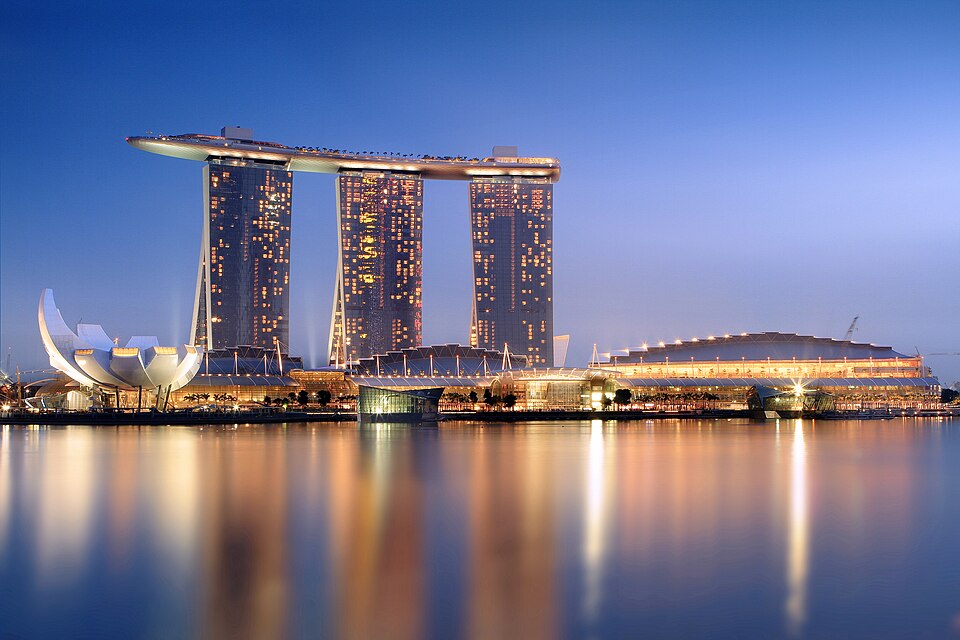
The $5.9 billion single-day market cap loss came even as CEO Rob Goldstein declared Marina Bay Sands had delivered "simply the greatest quarter in the history of casino hotels"—a stark dichotomy that underscores the growing gap between LVS's Singapore powerhouse and its struggling Macau portfolio.
The Singapore Miracle vs. The Macau Problem
Marina Bay Sands generated $806 million in EBITDA at a 50.3% margin, shattering records and producing full-year EBITDA of $2.9 billion. Mass gaming revenue hit $951 million in the quarter—up 118% from Q4 2019 and 27% year-over-year—driven by wealthy customers from across Asia who continue to flock to what Goldstein called "the best product in that region."
But Macau told a different story. The five-property portfolio delivered $608 million in EBITDA—a number management explicitly said it was "disappointed" with and well below their $700 million quarterly target. More troubling for investors: adjusted margins fell 390 basis points year-over-year to 28.9%, squeezed by a toxic combination of factors.
| Metric | Singapore (MBS) | Macau (5 Properties) |
|---|---|---|
| Q4 EBITDA | $806M | $608M |
| EBITDA Margin | 50.3% | 28.9% |
| YoY Revenue Change | +40% | +16% |
| Management Assessment | "Greatest quarter in history" | "Disappointed" |
 Ask Fintool AI Agent
Premium Segment Pressure
Sands China CEO Grant Chum attributed the margin compression to a fundamental shift in Macau's customer mix. "The market is driven by the premium segments, both in rolling and non-rolling, and that's where we are getting most of our growth," Chum explained. But premium customers demand higher reinvestment—promotional credits, comps, and event perks—that erode profitability.
Rolling chip volume surged 60% year-over-year as LVS captured foreign VIP play from across Asia, but this lower-margin business diluted overall returns. Meanwhile, the base mass segment—historically the highest-margin business in Macau—has stagnated. Property visitation approached 100 million in 2025, matching pre-pandemic levels, but per-visitor gaming spend has fallen.
"The spend per head has been on a declining trend versus pre-COVID," Chum acknowledged. "The base mass gaming is just not growing as fast as the premium segments."
Adding pressure, Sands invested heavily in events—including hosting NBA China Games Week, the company's largest entertainment activation ever—while increasing table hours and staffing to compete for high-value customers. These costs hit margins directly.
Beat Estimates, Lost Billions
The market's reaction defied the headline numbers. LVS reported Q4 revenue of $3.65 billion and adjusted EPS of $0.85, beating consensus estimates of $3.34 billion and $0.77, respectively.
| Metric | Q4 2025 Actual | Consensus Estimate | Beat/Miss |
|---|---|---|---|
| Revenue | $3.65B | $3.34B | +9.2% |
| Adjusted EPS | $0.85 | $0.77 | +10.4% |
| Consolidated EBITDA | $1.41B | $1.31B | +7.6% |
But investors read through to Macau's trajectory. COO Patrick Dumont guided investors to expect Macau as "a low 30s margin business" given the current customer mix—a significant reset from pre-pandemic profitability levels. He noted margins could improve "if the base mass comes back in some way, like it existed pre-pandemic," but offered no catalyst for when that might occur.
The promotional environment "remains intense," Chum said, though he expressed hope that reinvestment levels had stabilized and could be optimized in 2026.
Ask Fintool AI AgentGoldstein Era Ends
The earnings call also marked Rob Goldstein's farewell as CEO after 30 years with the company—a tenure that spanned the transformation of a Las Vegas-based casino operator into Asia's dominant integrated resort company. Goldstein will transition to a senior advisor role for the next two years.
"Rob served in many important leadership roles for LVS," Dumont said. "There are not many individuals who have given more to this industry than he has."
In classic Goldstein fashion, his final message was characteristically blunt: "Promise better margins in Macau. Stay the course."
Capital Returns Remain Robust
Despite Macau's challenges, LVS's cash generation supported significant shareholder returns. The company repurchased $500 million of stock during the quarter, paid its $0.25 per share quarterly dividend, and purchased $66 million of Sands China stock to increase its ownership stake to 74.8%.
The dividend increases to $0.30 per share starting February 2026—a 20% bump that signals management's confidence in underlying cash flow. The company ended the quarter with $3.84 billion in unrestricted cash.
What to Watch
Chinese New Year: The critical holiday season for Macau is underway. Management declined to comment on current quarter trends but noted encouraging signs in market liquidity and patron value.
Base Mass Recovery: The key to Macau margin improvement. Management sees no near-term catalyst but believes LVS will "excel when that day comes."
IR2 Singapore: LVS is building a second integrated resort in Singapore with a delayed draw facility of $4.84 billion available. This represents the company's most significant growth investment.
Promotional Rationalization: Chum expressed hope that 2026 could bring "headroom to optimize on the reinvestment front" as competitive dynamics stabilize.
At $52.71, LVS now trades at roughly 8.5x forward EBITDA and 25% below its 52-week high. The question for investors: Is the Macau problem temporary or structural?
Ask Fintool AI AgentRelated Companies: