Lazard CEO Orszag Touts 'Contextual Alpha' at BofA Conference, Stock Hits 52-Week High
February 10, 2026 · by Fintool Agent


Lazard CEO Peter Orszag struck a bullish tone at the Bank of America Financial Services Conference today, outlining the firm's transformation under his "Contextual Alpha" framework and reiterating confidence in accelerating M&A activity despite geopolitical uncertainty. The stock touched a 52-week high of $58.75 during the session, capping a 92% gain since Orszag took the helm in October 2023.
The Investment Case in 60 Seconds
Orszag's thesis is straightforward: corporate performance dispersion has widened dramatically, creating a bifurcated opportunity. Frontier firms with strong returns on invested capital are incentivized to acquire underperformers, while struggling companies need restructuring and liability management help. Unlike past cycles, both can accelerate simultaneously.
"The 95th percentile firm in the U.S. had a return on invested capital that was 10 times the 10th percentile 20 years ago. Today, that ratio is 25 times," Orszag noted. "That creates a massive incentive for the frontier firm to be buying other firms."
The regulatory environment helps too. "It's more accommodating than it had been under the biggest bad crowd," Orszag said, while cautioning it's also "more political"—requiring a "White House or Cabinet-level strategy" to get deals done.
Record Advisory Revenue, Elevated Productivity
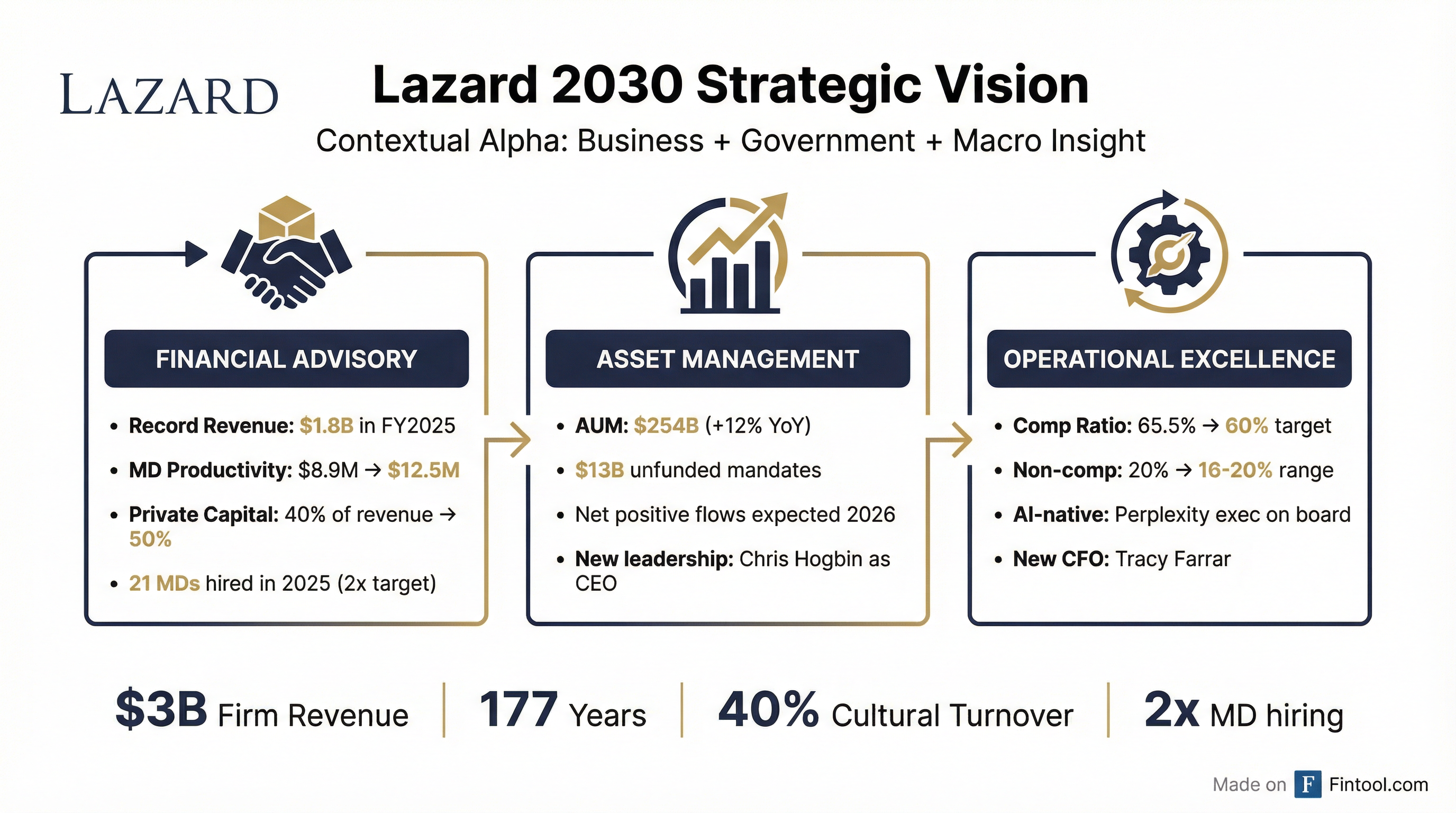
Lazard's Financial Advisory business posted record revenue of $1.8 billion in 2025, driven by marquee transactions including Mars's $35.9 billion acquisition of Kellanova, Constellation Energy's $26.6 billion acquisition of Calpine, and AkzoNobel's $25 billion combination with Axalta.
Managing Director productivity reached $8.9 million in 2025, up $2.5 million since 2023—despite the firm adding 21 MDs last year, more than double its target range of 10-15 net additions.
"We had an exceptional number of really high-quality people that were eager to join Lazard in 2025," Orszag explained. The aggressive hiring creates what he calls a "hidden productivity enhancer"—as the share of MDs new to the platform normalizes from 40% to 30%, productivity should rise an additional $1 million per MD even without other improvements.
The firm has now set a formal target of $12.5 million revenue per MD by 2030.
Cultural Transformation: "Commercial and Collegial"
Perhaps the most striking element of Orszag's tenure has been the cultural overhaul. Out of 200 Managing Directors at the end of 2022, Lazard parted company with 80—a 40% turnover rate—and has more than replaced them.
"The part that probably needed a bit of work was the sense that Lazard was a tough place to work, that it was not as collegial and collaborative as it could have been," Orszag acknowledged. "In our recruiting discussions, that would come up: 'Why do I want to go to a place where people are fighting with one another?' That is gone."
Orszag was blunt about the change: "When I talk about collegial, that doesn't just mean everyone's nice people. Some of the people that we had to part company with were very nice people, but they weren't productive... The point here is not someone that everyone wants to have beers with, but rather almost a SEAL team in which everyone is fighting for the same objective."
 Ask Fintool AI Agent
Private Capital: From 25% to 40%, Targeting 50%
A key strategic shift has been Lazard's increased connectivity with private capital. Advisory revenue associated with private equity, restructuring, and liability management has grown from 25% five years ago to 40% today.
"We have line of sight to how we're going to build that out to 50% of a larger pie, because we'll also be reinvesting in the public company work," Orszag said.
On the Q4 earnings call, Orszag elaborated on the dynamics: "2026 is likely to be the year in which PE activity occurs. LPs are getting increasingly desirous of some cash return... along with the narrowing of the bid-ask spread on expectations around valuations."
The firm sees restructuring and M&A as complementary rather than competing: "The coexistence of M&A and restructuring and liability management, with a different pattern than may have been the case historically," is driven by the widening gap in corporate performance.
Asset Management: Inflection Point
After years of headwinds, Lazard's Asset Management business is showing signs of stabilization. AUM reached $254 billion at year-end, up 12% year-over-year, with record gross inflows exceeding $50 billion in 2025.
The firm enters 2026 with $13 billion in won-but-not-yet-funded mandates, higher than a year ago, leading management to project net positive flows for the year.
"The repositioning of our business is well underway," Orszag said at the conference, pointing to strength in quantitative/systematic strategies, emerging markets equity, and customized solutions.
New CEO Chris Hogbin, who joined in December from AllianceBernstein, is tasked with execution. "First priority is delivering investment performance for clients, but the second is really around growing. The most important thing we can do there is to scale our existing products," Hogbin said on the earnings call.
The firm has also launched seven active ETFs in the U.S. with over $800 million in AUM, providing a new distribution channel.
AI: "The Only Wall Street Firm with an AI Native on the Board"
Lazard's AI strategy was a prominent theme. The firm has appointed Dmitry Shevelenko, the Deputy of Perplexity, to its board—what Orszag calls "the only Wall Street firm that has an AI native on our board."
Orszag provided concrete examples of how he personally uses AI:
- Daily briefings: "My daily briefing is now increasingly done in the first instance with artificial intelligence, and then supplemented by humans"
- Meeting preparation: "I loaded [the presentation deck] into an LLM, and I was querying it in terms of how will the board respond to this? What's new here that the CEO hasn't spoken about publicly?"
- AI avatar: "I actually have an AI avatar that I've interviewed. It can now speak every language in a way that I can't"
- Branding: "The terminology 'Contextual Alpha' actually comes from an LLM"
The operational impact? "Deal teams that are smaller in the future... two or three years out. So the non-managing director to managing director ratios will probably change," Orszag predicted.
Ask Fintool AI AgentFinancial Performance
Lazard beat Q4 estimates with adjusted EPS of $0.80 versus the $0.69 consensus, on revenue of $907 million versus $822 million expected.
| Metric | Q4 2024 | Q1 2025 | Q2 2025 | Q3 2025 | Q4 2025 |
|---|---|---|---|---|---|
| Revenue ($M) | $811* | $625* | $769* | $734* | $929 |
| Net Income ($M) | $86 | $60 | $55 | $71 | $50 |
| Adj. Comp Ratio | 65.6% | — | — | 65.5% | 65.5% |
*Values retrieved from S&P Global
The compensation ratio of 65.5% is tracking toward the firm's 60% target, though Orszag acknowledged "timing dependent on market conditions."
Capital Allocation: Less Buybacks, More M&A Optionality
Orszag has deprioritized share repurchases compared to his predecessors. "The additional buybacks beyond [offsetting dilution] are not as high a priority as they were historically," he said.
Instead, the firm is preserving capacity for inorganic growth: "Look for inorganic opportunities at the right price, with the right culture that add to growth to either business... We've been very disciplined about looking. We have not jumped at opportunities where we would be overpaying."
New CFO Tracy Farrar, who was appointed alongside the Q4 results, has been tasked with finding "increased efficiencies" in corporate functions, which Orszag expects to contribute to operating leverage.
The U.S. Economy: "Strong But Fragile"
Orszag offered his macro assessment: "The U.S. economy actually looks pretty strong right now. But there's a but... It's really focused on two key pillars: the AI investment boom and then high-income consumers. And the high-income consumers are consuming in part because of the equity returns to the AI boom."
The interconnection creates vulnerability: "Strong but fragile, if those two things can kind of coexist."
On AI disruption risk—topical after last week's software stock selloff and insurance broker dislocation—Orszag noted the "raging debate" about whether LLMs will plateau. "We haven't seen it yet. Every new iteration of a new tool seems to be a significant improvement over the last one, at least in our experience."
What to Watch
Near-term catalysts:
- January AUM release showed continued positive momentum
- Healthcare services MD hires to be announced in coming weeks
- Large-cap public company league table performance (a stated 2026 priority)
Key risks:
- PE exit activity has been "Waiting for Godot"—2026 execution matters
- Asset Management net flows remain volatile quarter-to-quarter
- Elevated hiring may pressure productivity metrics short-term
Estimates:
| Metric | Q1 2026E | Q2 2026E | Q3 2026E |
|---|---|---|---|
| Revenue ($M) | $759* | $854* | $882* |
| EPS ($) | $0.73* | $0.76* | $0.90* |
*Values retrieved from S&P Global
Ask Fintool AI Agent