LyondellBasell Slashes Dividend 50% as Chemicals Downturn Extends Into Third Year
February 20, 2026 · by Fintool Agent


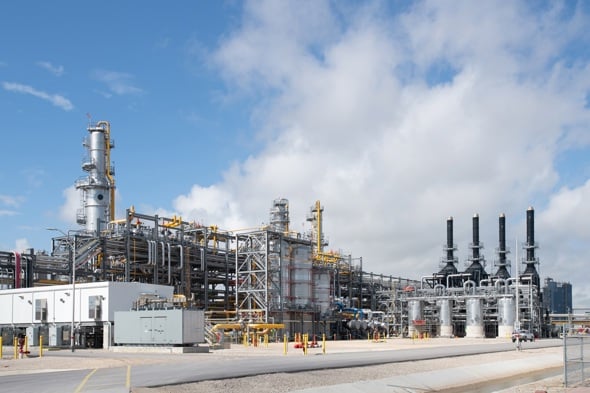
Lyondellbasell has cut its quarterly dividend by nearly 50%—from $1.37 to $0.69 per share—a stark acknowledgment that one of the worst downturns in the chemicals industry's history shows no signs of ending. The move, announced Friday, will save approximately $900 million annually as the $18 billion petrochemical giant prioritizes its investment-grade credit rating over shareholder returns.
"Despite one of the longest downturns in our industry, LYB was able to return approximately $2 billion to our shareholders from existing cash and operations in 2025," CEO Peter Vanacker said in a statement. "With markets expected to remain challenged, we have made the decision to recalibrate the dividend to better position the company to thrive once markets recover."
The dividend will be paid March 9, 2026, to shareholders of record as of March 2.
The Writing Was on the Wall
The cut didn't come as a complete surprise to close observers. On LyondellBasell's Q4 2025 earnings call just three weeks ago, Deutsche Bank analyst David Begleiter posed the uncomfortable question directly: with the company's yield at twice that of its closest peer and the stock trading at a full turn discount on EBITDA, why not just cut the dividend and invest the cash elsewhere?
Vanacker's response was telling. He acknowledged the company was "evaluating the balance between cash returns to shareholders and growth investments" at "the bottom of the cycle" and noted that "decisions on whether we recalibrate the dividend to maintain our investment-grade metrics... are regularly being reviewed during our scheduled board meetings, and the next one will take place in February."
That February board meeting has now concluded—and the decision is in.
 Ask Fintool AI Agent
The Financial Picture
LyondellBasell's financial trajectory tells the story of an industry in distress:
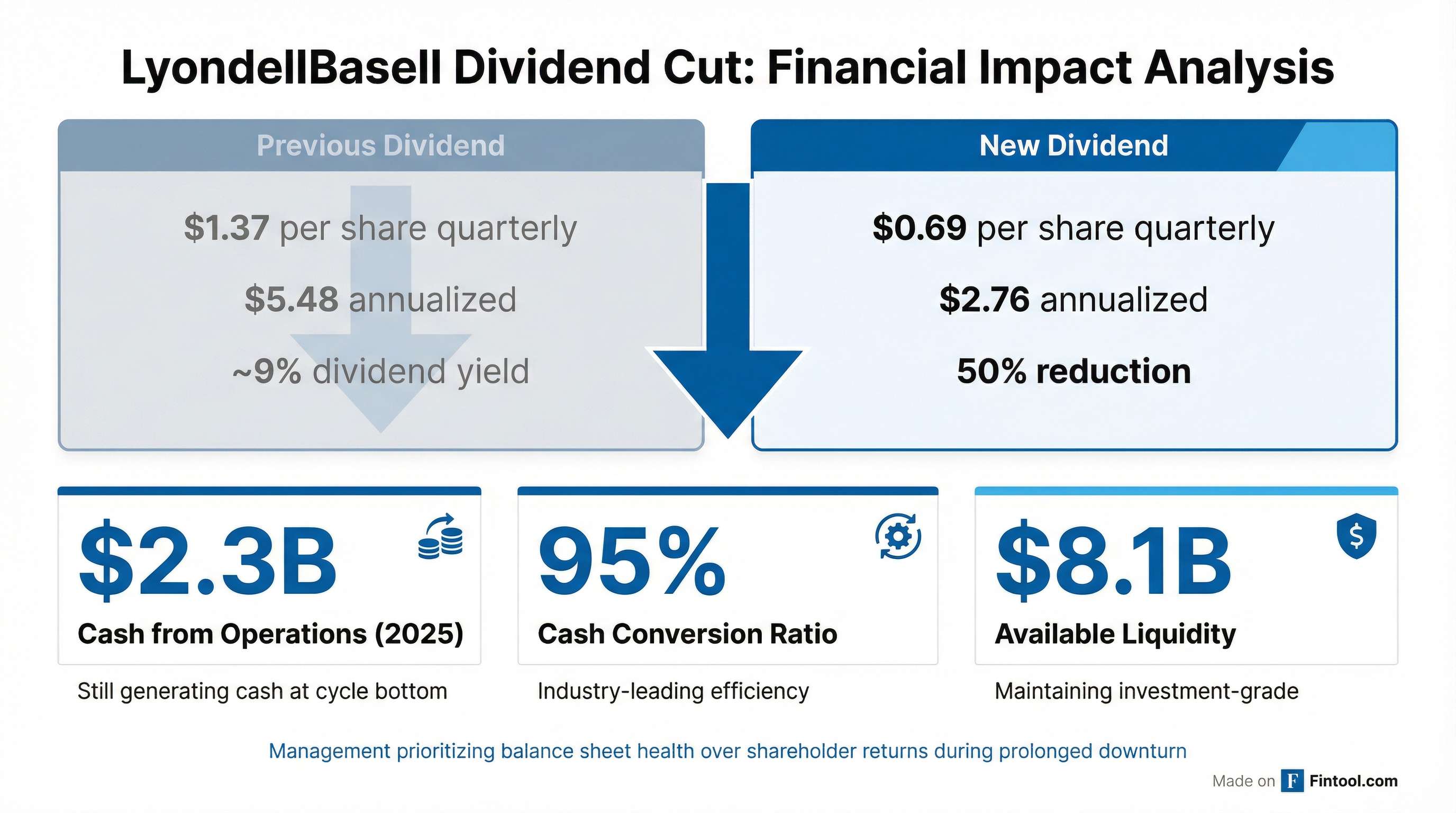
The company's EBITDA margin collapsed from 15.9% in Q2 2024 to just 5.9% in Q4 2024, before recovering slightly to 10.6% in Q3 2025.* Despite the margin compression, management has executed aggressively on cost controls:
| Metric | 2024 | 2025 | Change |
|---|---|---|---|
| Cash from Operations | $3.8B | $2.3B | -39% |
| Cash Conversion Ratio | 92% | 95% | +3pp |
| Workforce | 20,050 | 18,700 | -7% |
| CapEx | $1.8B | $1.2B (planned) | -33% |
| Available Liquidity | $7.5B | $8.1B | +8% |
*Values retrieved from S&P Global
The company has targeted an additional $500 million in cash improvements in 2026, bringing its cumulative Cash Improvement Plan target from $1.1 billion to $1.3 billion.
Industry in Crisis
LyondellBasell's dividend cut is emblematic of a broader reckoning across the global chemicals sector. According to Deloitte's 2026 Chemical Industry Outlook, the industry "is nearing the bottom of a capital cycle" and faces "overcapacity, soft demand and global uncertainty."

The numbers paint a grim picture:
- China now accounts for 46% of global chemical sales, up from just 15% two decades ago, and is building 70% of new capacity additions through 2027
- European production has declined significantly, with Germany down 18% and the UK down 30% between 2019 and mid-2025
- US chemical production is expected to grow just 0.3% in 2026, below the 0.7% in 2025
- Global demand forecasts dropped from 3.5% growth to just 1.9% for 2025 and 2% for 2026
Fitch Ratings has assigned a "deteriorating" outlook to the global chemicals sector for 2026, citing "prolonged bottom-of-cycle conditions" amid "persistent oversupply and heightened trade uncertainty."
Ask Fintool AI AgentManagement's Long Game
Despite the immediate pain, LyondellBasell's management struck an optimistic tone about eventual recovery. Vanacker noted on the earnings call that the company sees "clear evidence of reduced rates of capacity additions and rationalization of older assets being implemented globally that should help to accelerate a recovery."
The company has delayed several major growth projects—including Flex 2 and MoReTec-2—but continues advancing its MoReTec-1 recycling facility and cost-advantaged investments in Saudi Arabia.
"Another way to look at this prolonged downturn is as follows," Vanacker said. "The longer we are at the bottom of the cycle, the closer we get back to an upcycle, and LYB will be ready to capture value accordingly."
What to Watch
The dividend cut raises important questions for the chemicals sector more broadly:
-
Peer response: Will Dow, Celanese, Eastman Chemical, and Westlake face similar pressure to cut dividends?
-
Capacity rationalization: European and Asian plant closures are accelerating, but are they happening fast enough to restore industry balance?
-
China wildcard: With Chinese producers prioritizing market share over profits, pricing power may not return even as Western capacity exits.
-
Recovery timing: The American Chemistry Council expects a recovery emerging "mid-year of 2026," but industry executives remain more cautious, looking for flat growth at best.
For now, LyondellBasell's message to shareholders is clear: in a downturn this severe, balance sheet strength trumps dividend payouts. The question is whether this is the beginning of broader capitulation across the sector—or a sign that the worst may finally be ending.
Ask Fintool AI AgentRelated: