Maersk Returns to Suez After 800 Days—But Warns of 50% Earnings Crash Ahead
February 5, 2026 · by Fintool Agent


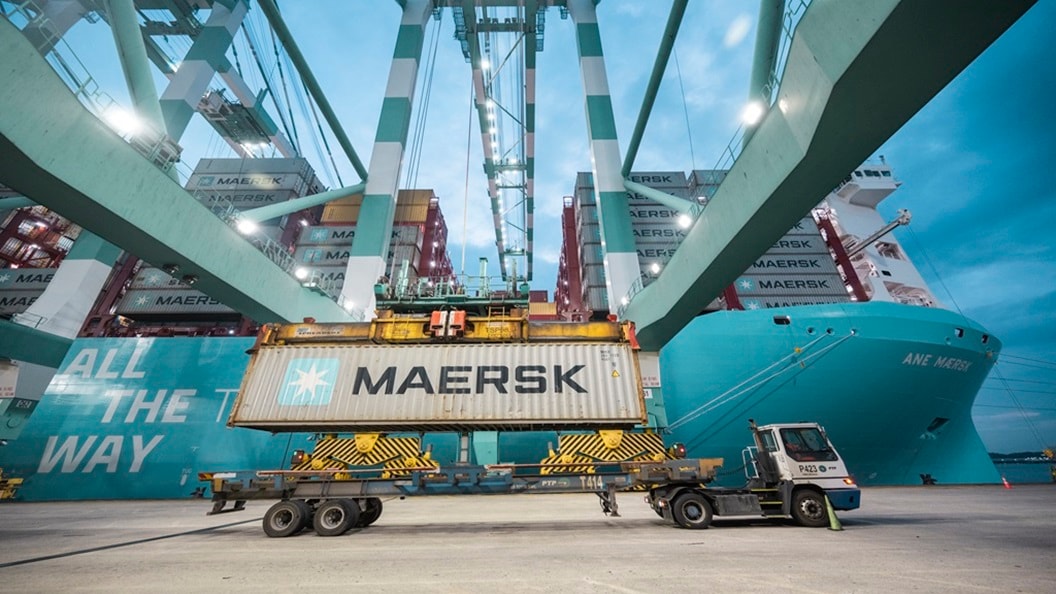
The world's second-largest container shipping company is returning to the Red Sea after nearly 800 days of diversions—but the historic move comes with a stark warning: profits are set to collapse in 2026.
A.P. Møller-Maersk reported Q4 results Thursday that capture the industry's paradox: record 2025 performance built on disruption, followed by guidance suggesting earnings could be cut in half as the disruption ends. Shares fell 5.5% in Copenhagen trading.
The Numbers: From Record Year to Potential Loss
Maersk delivered a strong 2025, hitting the top end of guidance with $54 billion in revenue, $9.5 billion in EBITDA, and $3.5 billion in EBIT. Container volumes grew 4.9%, in line with the global market.
But the Q4 results reveal what's coming. The Ocean division—Maersk's core business—swung to an EBIT loss of $153 million, down from a $567 million profit in Q3 and $1.6 billion a year earlier. It's the first quarterly operating loss in years, driven by persistent freight rate pressure.
The 2026 outlook is sobering:
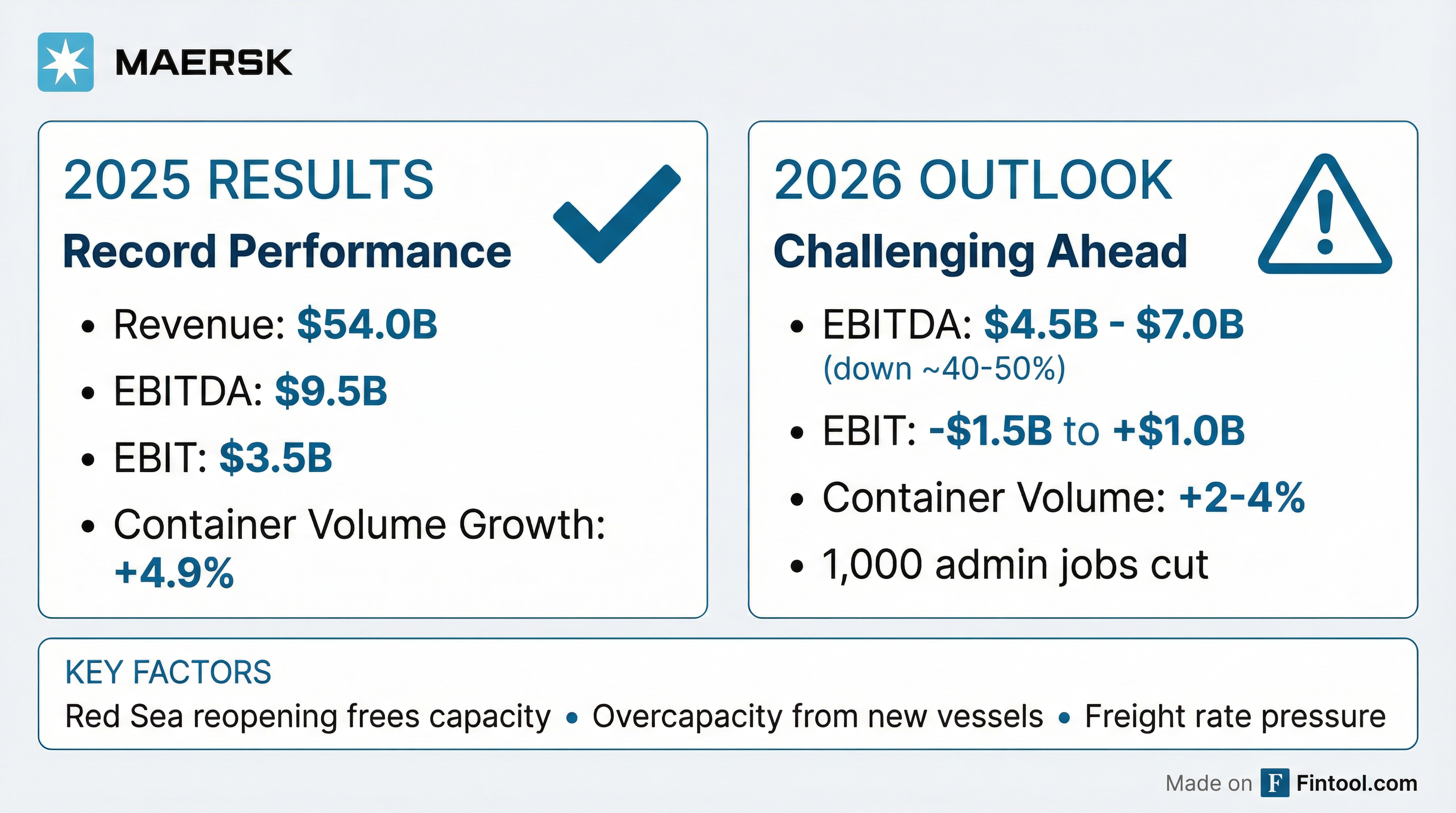
| Metric | 2025 Actual | 2026 Guidance | Change |
|---|---|---|---|
| EBITDA | $9.5B | $4.5B - $7.0B | -27% to -53% |
| EBIT | $3.5B | -$1.5B to +$1.0B | Potential loss |
| Container Volume | +4.9% | +2% to +4% | Slowing |
| Buybacks | $2B | $1B | -50% |
"New ships are coming in, and at the same time, shipping through the Red Sea is likely to reopen, which will free up ship capacity. All of this will put pressure on freight rates this year," CEO Vincent Clerc said at a press conference.
 Ask Fintool AI Agent
The Red Sea Return: 800 Days in the Making
The announcement that Maersk and Hapag-Lloyd will resume Suez Canal transits marks a watershed moment for global shipping. From mid-February, their Gemini Cooperation's ME11 service—connecting India and the Middle East with the Mediterranean—will transit the Red Sea under naval escort.
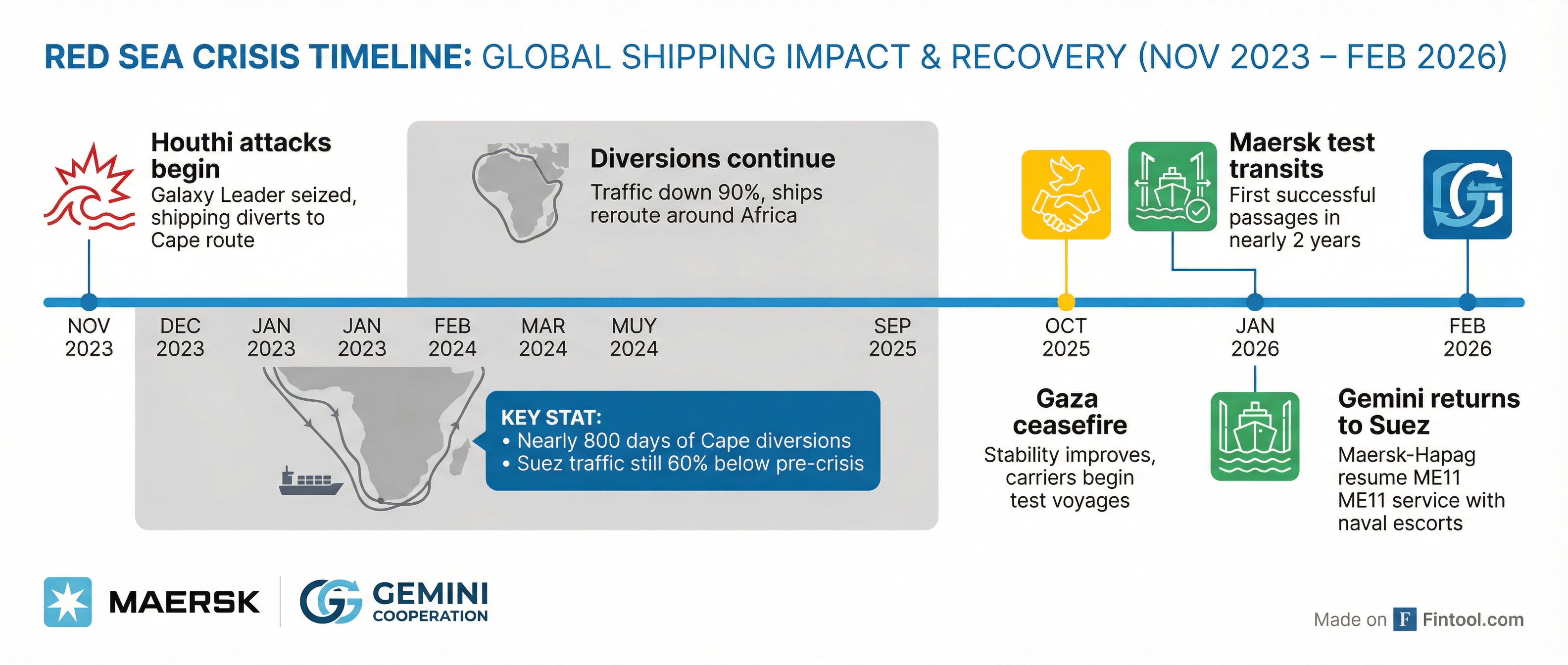
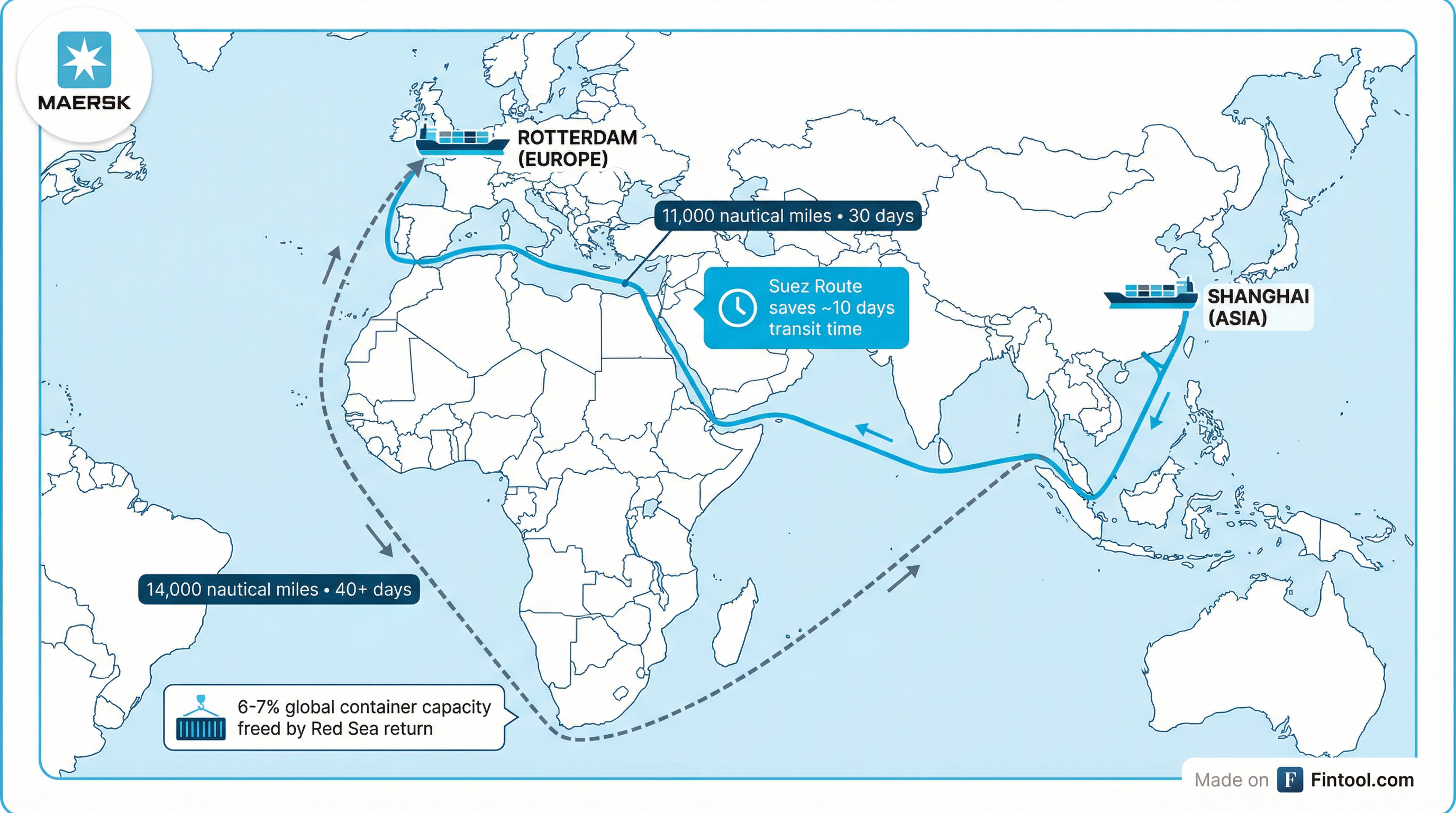
The crisis began in November 2023 when Yemen's Houthi rebels seized the Galaxy Leader cargo ship, triggering attacks on commercial vessels that forced a near-total collapse in Suez traffic. At the peak of the crisis, container transits through the canal dropped 90%, as the industry's largest carriers rerouted around the Cape of Good Hope—adding 3,000+ nautical miles and roughly 10 days to Asia-Europe voyages.
The October 2025 Gaza ceasefire opened the door for cautious returns. Maersk completed its first successful Red Sea passage in nearly two years in December, and traffic has slowly improved—though it remains 60% below pre-crisis levels.
"The highest possible security precautions will be undertaken, as the safety of the crew, the vessels, and the customers' cargo remains the highest priority," Maersk said. Plans for two additional services (SE1 and SE3) to return via Suez will be considered later.
Why the Return Is Bad News for Profits
Here's the industry's uncomfortable truth: the Red Sea crisis was good for earnings. By forcing ships around Africa, the diversions absorbed 6-7% of global container capacity—creating an artificial tightness that propped up freight rates even as new vessels flooded the market.
Resuming Suez transits will release that capacity just as the industry faces a "structural overcapacity" crisis. Key pressure points:
Supply surge: New vessel capacity is projected to grow 36% from 2023 to 2027. In 2026 alone, new deliveries will increase capacity by 5%.
Scrapping halt: Maersk is extending vessel lifespans from 20 to 25 years, reducing demolition and adding further supply. Only 6,900 TEU was scrapped in H1 2025 vs. 79,200 in H1 2023.
Rate collapse: Spot rates have already "round-tripped," giving back all gains from the Red Sea crisis. The Shanghai-US West Coast index has dropped to $1,460/FEU, its lowest since before the Houthi attacks.
Demand softening: Maersk expects global container volume growth of just 2-4% in 2026, down from 5% in 2025, citing "recession risks in the global economy."
Ask Fintool AI AgentCost Cuts and Buyback Reduction
To navigate the downturn, Maersk is pulling multiple levers:
- 1,000 jobs cut: A 15% reduction in the 6,000-person administrative workforce, saving $180 million annually
- Halved buybacks: The share repurchase program drops to $1 billion from $2 billion
- Dividend maintained: The board will propose DKK 480/share (~$1.1 billion), a 40% payout ratio
- Extended vessel life: Raising operational lifespan from 20 to 25 years will reduce depreciation by ~$700 million in 2026
Industry-Wide Implications
Maersk isn't alone. The entire container shipping sector faces a "tough 2026," according to Bloomberg:
- Hapag-Lloyd is expected to report weaker earnings and may be pushed into losses if Red Sea returns accelerate
- Ocean Network Express (ONE) already reported a Q3 net loss of $88 million
- Zim Integrated Shipping-5.57% may see takeover activity—Hapag-Lloyd has made a formal acquisition offer, though Israeli political considerations could block it
HSBC analyst Parash Jain warned that faster-than-expected Red Sea returns could trigger an additional 10% decline in freight rates beyond base-case forecasts, "pushing Maersk and Hapag-Lloyd into losses."
For U.S.-listed shipping plays, the outlook is similarly challenging. Zim-5.57%, Matson-1.70%, Star Bulk-0.31%, and Danaos-0.51% all face exposure to softening freight markets, though relative strength in regional trades may provide some cushion.
Ask Fintool AI AgentWhat to Watch
The next few months will determine whether this is an orderly normalization or a chaotic overcapacity crash:
- Red Sea traffic recovery: Currently at ~60% below pre-crisis levels. A rapid return could accelerate rate declines; a slow return keeps some capacity absorbed
- Geopolitical stability: The Gaza ceasefire remains fragile. Any escalation—or Iranian tensions—could reverse carrier decisions overnight
- Carrier discipline: With liquidity still high from the 2024 boom, will carriers accept losses or launch price wars?
- Tariff impacts: U.S.-China trade tensions could further disrupt demand patterns
As ING analyst Rico Luman put it: "A return to the Red Sea would first lead to congestion in European ports, which would be followed by intensified rate pressures."
For global supply chains, Maersk's move represents cautious optimism that the worst of the Red Sea crisis is behind us. For Maersk's shareholders, it represents the end of crisis-fueled profits—and the beginning of a very different 2026.