Meta Becomes Largest Corporate Nuclear Buyer With $6.6 Billion Energy Bet
January 10, 2026 · by Fintool Agent


Meta Platforms announced landmark nuclear energy agreements with three partners—Vistra Corp., Oklo, and privately-held TerraPower—that together will support up to 6.6 gigawatts of nuclear capacity by 2035, making the social media giant one of the most significant corporate purchasers of nuclear energy in American history.
Vistra stock surged 10.5% to close at $166.37 on the news, while Oklo opened 17% higher before settling up 7.9% at $105.31. The deals underscore Big Tech's aggressive pivot toward nuclear power as artificial intelligence workloads strain the electrical grid and drive unprecedented demand for 24/7 carbon-free baseload power.
"These projects are going to create thousands of skilled jobs in Ohio and Pennsylvania, add new energy to the grid, extend the life of three existing nuclear plants, and accelerate new reactor technologies," said Joel Kaplan, Meta's Chief Global Affairs Officer.
The Deal Structure
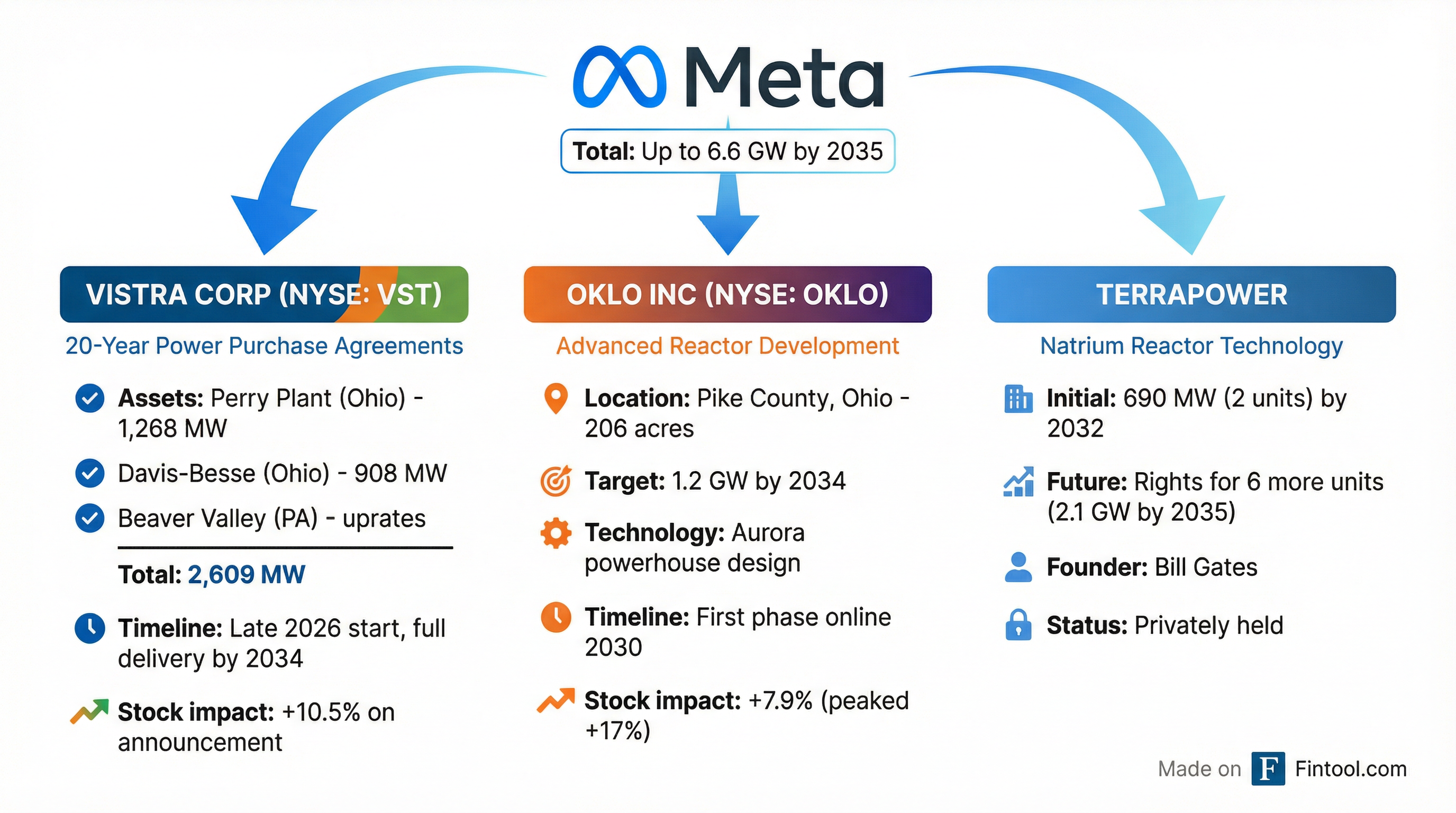
Meta's nuclear portfolio spans three distinct partnerships targeting different technology maturity levels:
Vistra: Extending Existing Nuclear Fleet
Under 20-year power purchase agreements, Meta will purchase 2,609 MW from Vistra's PJM nuclear fleet:
| Plant | Location | Operating Capacity | Uprate Capacity |
|---|---|---|---|
| Perry | Ohio | 1,268 MW | 213 MW |
| Davis-Besse | Ohio | 908 MW | 80 MW |
| Beaver Valley | Pennsylvania | — | 140 MW |
| Total | 2,176 MW | 433 MW |
The 433 MW of uprates represent "the largest nuclear uprates supported by a corporate customer in the United States," according to Vistra. Deliveries begin late 2026, with full capacity online by 2034.
Vistra expects the PPAs to generate 8-10% incremental Adjusted Free Cash Flow accretion from operating capacity, plus an additional 5-7% from uprate capacity at full delivery. The uprates are projected to exceed Vistra's mid-teens levered return target.
Oklo: Advanced Reactor Development
Oklo will develop a 1.2 GW nuclear campus in Pike County, Ohio on 206 acres of land formerly owned by the Department of Energy. Meta's prepayment enables Oklo to secure nuclear fuel and advance Phase 1 development.
The project timeline targets:
- 2026: Pre-construction and site characterization begins
- 2030: First phase online (as early as)
- 2034: Full 1.2 GW capacity operational
"Meta's funding commitment in support of early procurement and development activity is a major step in moving advanced nuclear forward," said Jacob DeWitte, Oklo's co-founder and CEO.
TerraPower: Next-Generation Natrium Reactors
Meta is funding Bill Gates-founded TerraPower's commercialization of its Natrium reactor design:
- Initial commitment: 690 MW from two units, delivery as early as 2032
- Options: Rights for six additional Natrium units capable of 2.1 GW by 2035
 Ask Fintool AI Agent
Market Impact
The market reaction reflects the transformative nature of these agreements for nuclear operators:
| Company | Friday Close | Change | 52-Week Range |
|---|---|---|---|
| Vistra (VST) | $166.37 | +10.5% | $98 - $218 |
| Oklo (OKLO) | $105.31 | +7.9% | $20 - $174 |
| Meta (META) | $653.06 | +1.2% | $485 - $790 |
Vistra's nuclear plants—Perry, Davis-Besse, and Beaver Valley—were "on a path to retirement" as recently as 2020 before Vistra acquired them in 2023. The Meta deal secures their operation through at least mid-century.
Oklo has been a standout performer, up 382% over the past year as investor enthusiasm for advanced nuclear developers has intensified. The Meta deal provides commercial validation for Oklo's untested Aurora powerhouse design.
Vistra's Financial Trajectory
The Meta agreements build on Vistra's remarkable transformation. The company's recent financial performance underscores why data center customers are eager partners:
| Metric | FY 2022 | FY 2023 | FY 2024 |
|---|---|---|---|
| Revenue | $13.7B | $14.8B | $17.2B* |
| EBITDA | $0.9B | $4.6B | $6.8B* |
| EBITDA Margin | 6.6% | 31.4% | 39.3%* |
| Net Income | -$1.2B | $1.5B | $2.7B* |
*Values retrieved from S&P Global
CEO Jim Burke highlighted the opportunity during Vistra's Q3 2025 earnings call: "The activity level is the highest that it's been... the customers are doing longer-term planning."
The company introduced 2026 EBITDA guidance of $6.8-$7.6 billion and 2027 midpoint opportunity of $7.4-$7.8 billion before the Meta deal was announced.
Big Tech's Nuclear Race
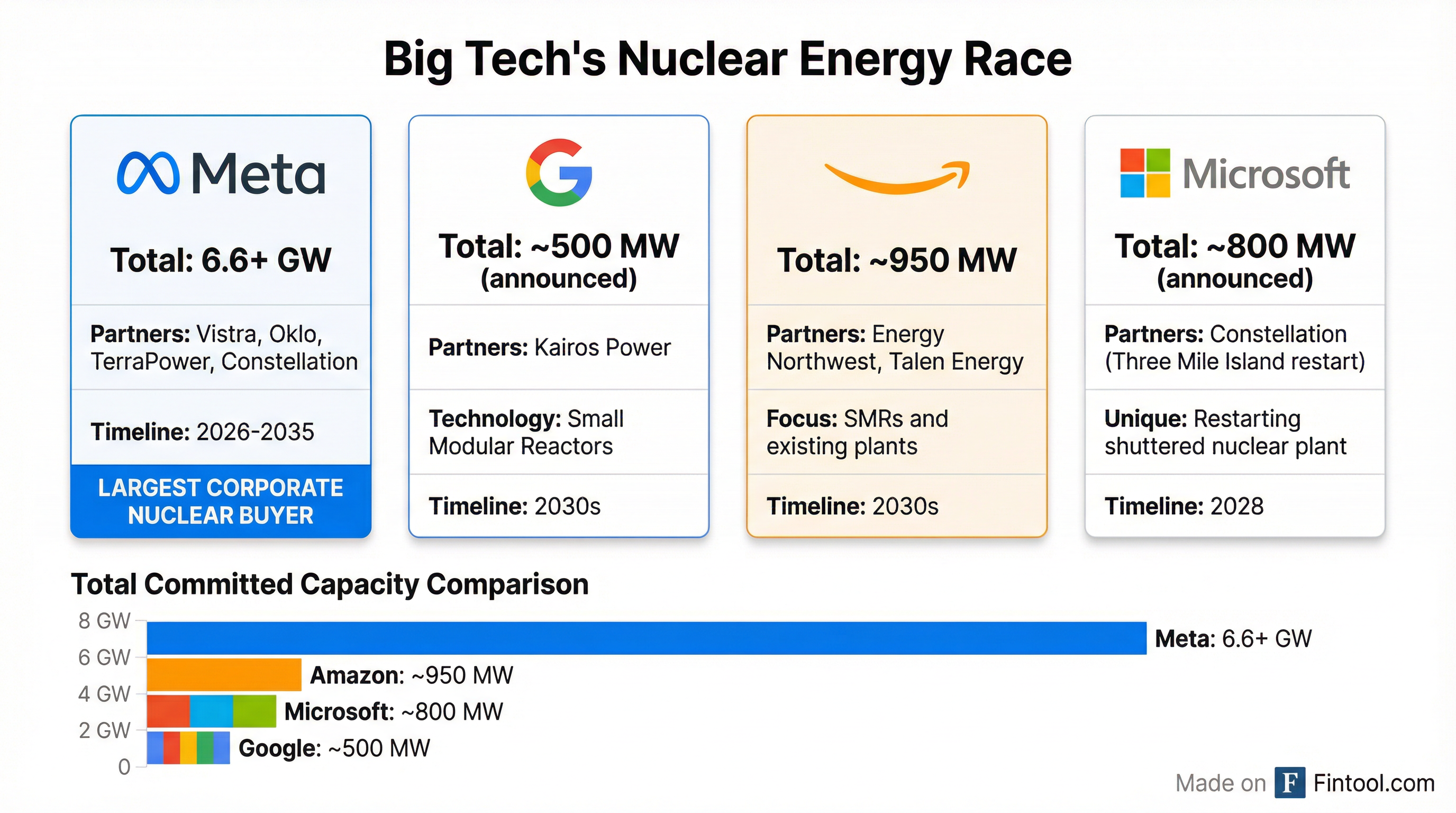
Meta's aggressive nuclear positioning significantly outpaces peers in total committed capacity:
| Company | Total Nuclear Commitment | Key Partners | Timeline |
|---|---|---|---|
| Meta | 6.6+ GW | Vistra, Oklo, TerraPower, Constellation | 2026-2035 |
| Microsoft | 800 MW | Constellation (TMI restart) | 2028 |
| Amazon | 950 MW | Energy Northwest, Talen Energy | 2030s |
| 500 MW | Kairos Power | 2030s |
Google's Sundar Pichai noted during Q3 2024 earnings that the company made "bold clean energy investments, including the world's first corporate agreement to purchase nuclear energy from multiple small modular reactors, which will enable up to 500 megawatts of new 24/7 carbon-free power."
Microsoft took a different approach by partnering with Constellation to restart the shuttered Three Mile Island Unit 1, betting on proven technology over advanced reactor development.
Ask Fintool AI AgentWhy Nuclear?
The shift toward nuclear reflects the unique demands of AI infrastructure:
1. Baseload Requirements: AI data centers operate continuously, requiring 24/7 power that intermittent renewables cannot reliably provide. Nuclear plants run at 90%+ capacity factors.
2. Scale: A single AI supercluster can consume hundreds of megawatts—equivalent to a small city. Vistra's Q3 call noted data center announcements in their core markets (PJM and ERCOT) have "more than doubled" year-over-year.
3. Clean Energy Mandates: Tech companies have aggressive carbon neutrality goals. Nuclear provides zero-carbon baseload power without the intermittency challenges of solar and wind.
4. Grid Constraints: New renewable generation requires years of interconnection queue delays. Existing nuclear plants offer immediate, reliable capacity. As Vistra noted, "there is excess capacity on the system in most markets today... to meet most of the load growth during these non-super peak hours."
What to Watch
Near-term catalysts:
- Vistra's capital expenditure guidance for nuclear uprates (expected within months)
- Oklo's NRC licensing progress for Aurora powerhouse design
- Meta's Q4 2025 earnings commentary on AI infrastructure spending
Longer-term signals:
- PJM capacity auction results for 2027-2028 (pricing power for nuclear assets)
- Additional data center announcements in Ohio (Prometheus supercluster expansion)
- TerraPower's Natrium demonstration project progress
The deals represent a multi-decade commitment that fundamentally reshapes the economics for nuclear operators while positioning Meta's AI infrastructure for the scale Zuckerberg envisions. With hyperscalers signaling "expanded investments in AI and data infrastructure" , the nuclear energy race is just getting started.
Ask Fintool AI Agent