Meta Wants to Double Ray-Ban AI Glasses Output to 20 Million Units by Year End
January 13, 2026 · by Fintool Agent

Meta Platforms and EssilorLuxottica are in talks to double annual production of their AI-powered Ray-Ban smart glasses to 20 million units by the end of 2026—and potentially more than 30 million if demand holds—according to Bloomberg.
The move would mark Meta's most aggressive bet yet that smart glasses, not VR headsets, will deliver the hardware growth that has eluded its Reality Labs division. EssilorLuxottica, the world's largest eyewear maker, is already nearing its current production target of 10 million pairs and would need to significantly expand capacity.
No final decision has been made, and representatives for both companies declined to comment.
Meta shares fell 1.7% on Tuesday to $641.97, while EssilorLuxottica rose as much as 2% in Paris trading following the report.
Demand Outstrips Supply
The production talks come as Meta struggles to meet surging demand for its AI glasses.
Last week at CES, Meta announced it was pausing international expansion of the $799 Ray-Ban Meta Display glasses—which feature text displayed directly on the lens—to the UK, France, Italy, and Canada. The reason: "unprecedented demand and limited inventory" in the US, where waitlists now extend well into 2026.
"The growth of Ray-Ban Meta sales accelerated in Q2 with demand still outstripping supply for the most popular SKUs despite increases to our production earlier this year," CFO Susan Li said on Meta's Q2 2025 earnings call. "We're working to ramp supply to better meet consumer demand later this year."
Reality Labs revenue jumped 74% year-over-year in Q3 2025, driven primarily by AI glasses sales. That's a notable bright spot in a division that has bled over $60 billion since 2020.
| Period | Reality Labs Revenue | YoY Change |
|---|---|---|
| Q3 2025 | $470M | +74% |
| Q2 2025 | $370M | +5% |
| Q1 2025 | $412M | — |
| Q4 2024 | $500M | — |
 Ask Fintool AI Agent
The AI Glasses Bet
CEO Mark Zuckerberg has increasingly positioned AI glasses—not VR headsets—as Meta's hardware future.
"I think AI glasses are gonna be the main way that we integrate superintelligence into our day-to-day lives," Zuckerberg said on the Q2 2025 earnings call.
The contrast with VR is stark. Quest headset sales declined 6% year-over-year in Q1 2025, and Meta Announced Layoffs of Roughly 10% of Reality Labs Employees just yesterday—cuts concentrated on VR and metaverse teams rather than wearables.
Meta deepened its manufacturing partnership last year by acquiring approximately 3% of EssilorLuxottica, gaining closer access to the eyewear giant's production capabilities and retail network spanning Ray-Ban, Oakley, Sunglass Hut, and LensCrafters.
The partnership dates back to 2019, with the first Ray-Ban branded smart glasses launching in 2021. The second-generation Ray-Ban Meta glasses, released in late 2023, broke through where the original "Ray-Ban Stories" failed, doing over 900,000 units in Q4 2024 alone.
Dominating an Exploding Market
Meta commands a dominant position in what analysts see as one of the fastest-growing consumer electronics categories.
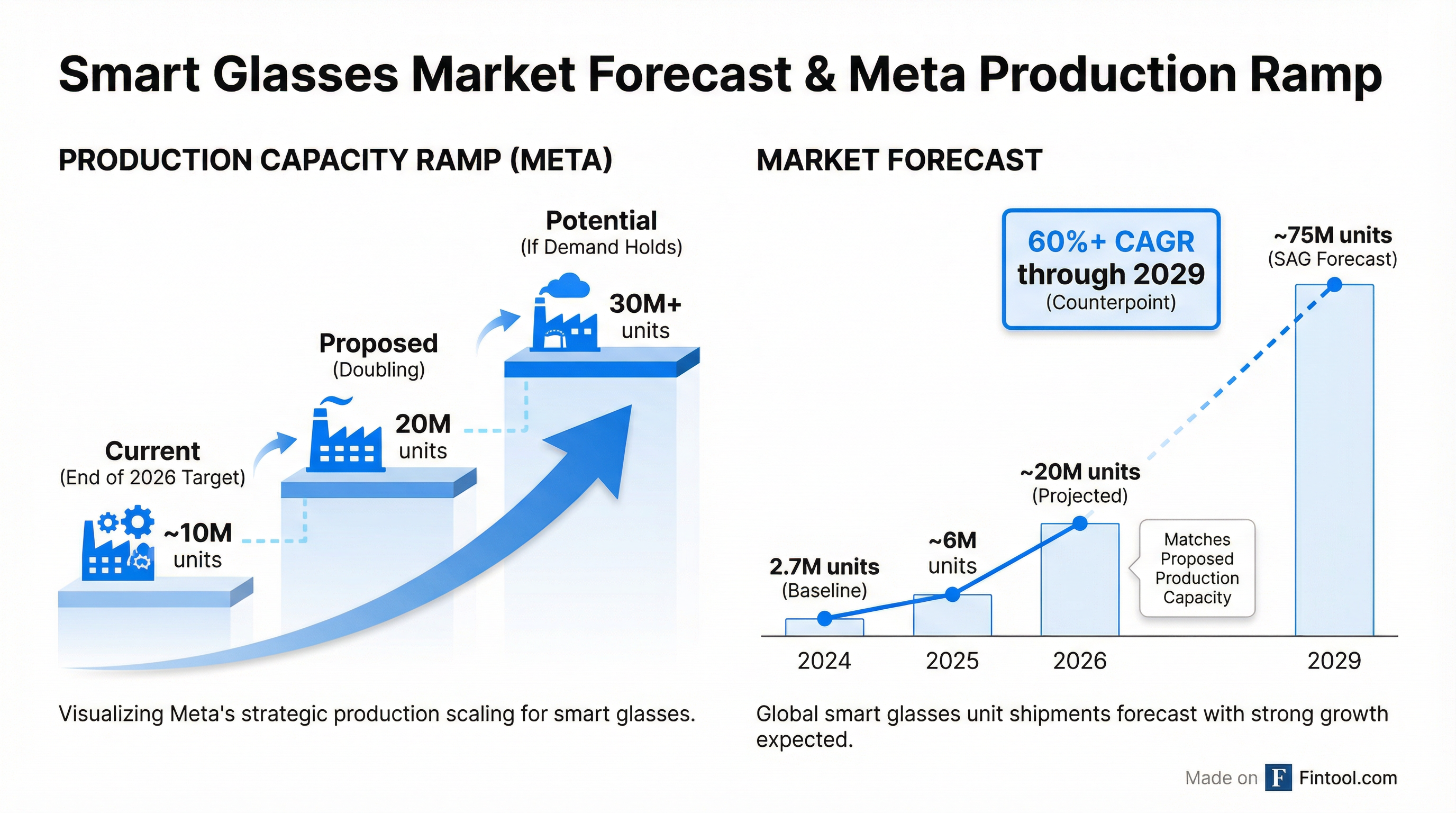
The global smart glasses market grew 110% year-over-year in H1 2025, with Meta capturing 73% market share, according to Counterpoint Research. AI-enabled glasses specifically grew over 250%, accounting for 78% of all smart glasses shipped—up from 46% a year earlier.
Counterpoint forecasts a compound annual growth rate exceeding 60% through 2029. Smart Analytics Global projects even more aggressive growth: from 6 million units and $1.2 billion in 2025 to 20 million units and $5.6 billion in 2026—a quadrupling in a single year. By 2030, SAG expects 75 million units shipped annually with revenues reaching $29 billion.
| Year | Units (SAG) | Revenue (SAG) |
|---|---|---|
| 2025 | 6M | $1.2B |
| 2026E | 20M | $5.6B |
| 2030E | 75M | $29B |
Ask Fintool AI AgentRivals Are Circling
Meta's success has drawn big tech competitors into the arena.
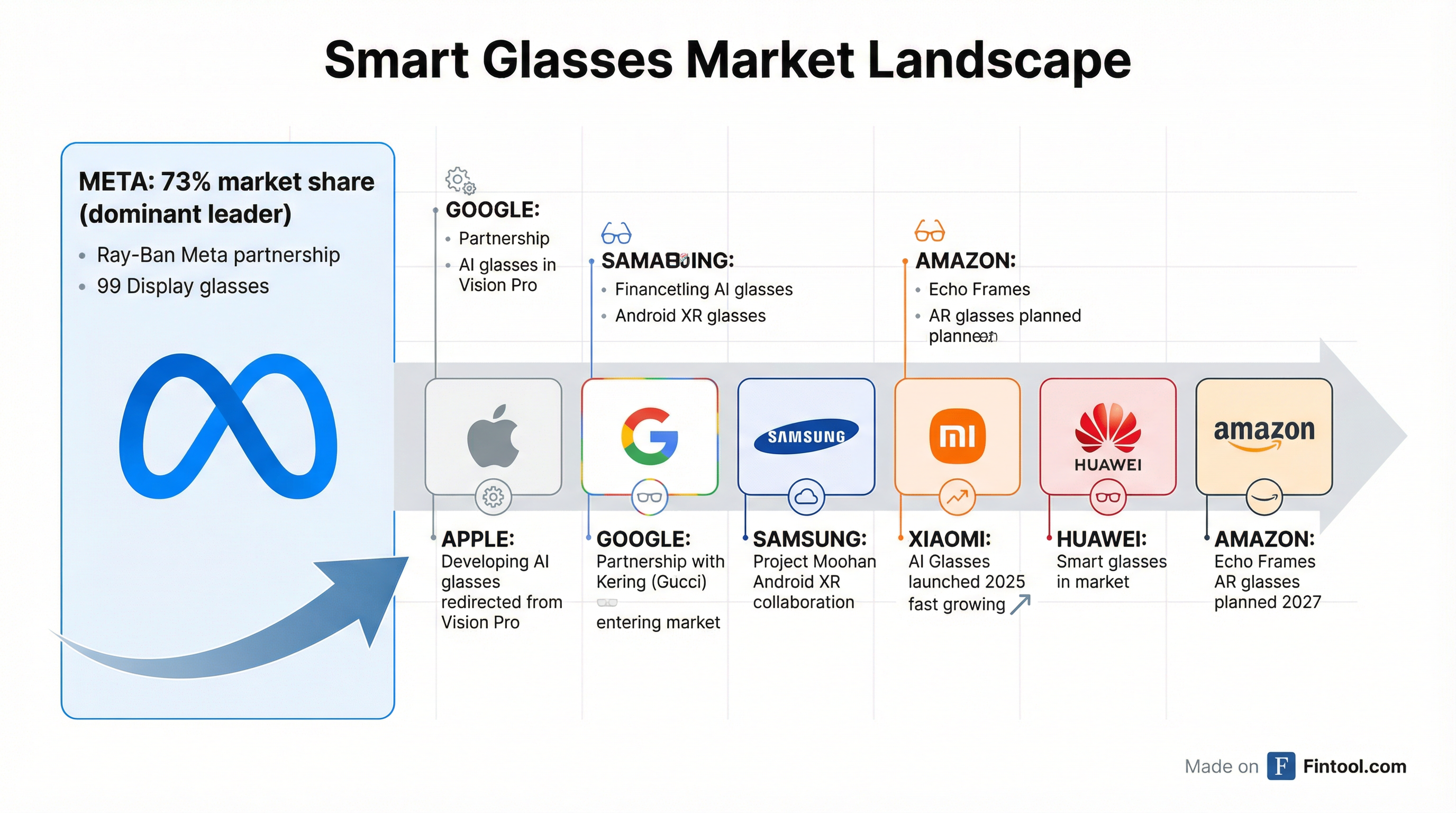
Apple has redirected resources toward AI-powered glasses after scaling back work on its Vision Pro headset. The company is widely expected to announce its first smart glasses, positioning them as a more accessible complement to its spatial computing strategy.
Google formed a smart-glasses partnership with Kering's eyewear division (owner of Gucci) in May 2025, signaling a return to the category after the failure of Google Glass. Google, Samsung, and Qualcomm have also collaborated on Android XR, an operating system designed specifically for smart glasses and AR/VR devices.
Samsung showcased prototype smart glasses and is developing its Project Moohan AR headset, laying R&D groundwork for consumer smart eyewear.
Chinese competitors including Xiaomi and Huawei have launched their own AI glasses, with Xiaomi's debut being the most anticipated industry event outside Meta's releases in 2025.
Amazon is developing AR glasses with a monocular display expected to launch in late 2026 or early 2027, building on its existing Echo Frames product line.
Manufacturing Challenges
A production ramp to 20 million or more units would stress EssilorLuxottica's manufacturing capacity and margins.
RBC Capital Markets analysts note that Ray-Ban Meta smart glasses generate "substantially lower gross margins" than EssilorLuxottica's traditional eyewear, creating near-term pressure even as the category grows. Higher volumes and improved component costs should ease the strain over time.
EssilorLuxottica CFO Stefano Grassi said in October that the company expects to reach its 10 million unit capacity target earlier than the original end-of-2026 timeframe, adding that EssilorLuxottica has "the capability to do it in-house or outsource."
CEO Francesco Milleri has positioned smart glasses as central to EssilorLuxottica's long-term strategy, telling Bloomberg in October that he foresees smart glasses "potentially replacing smartphones over time."
Analysts will likely press for details on Meta partnership production plans when EssilorLuxottica reports annual results in early February.
What to Watch
Q4 2025 earnings. Meta reports in late January. Watch for updated Reality Labs guidance and any official comments on production expansion.
EssilorLuxottica results. The French-Italian eyewear giant reports in early February. Manufacturing capacity and margin impact from Meta partnership will be key questions.
Apple's entry. Industry watchers expect Apple to announce AI glasses in 2026. The timing and positioning could reshape competitive dynamics.
International expansion. When Meta resumes Ray-Ban Meta Display rollout to the UK, France, Italy, and Canada will signal supply chain progress.
Ask Fintool AI AgentRelated Companies: Meta Platforms