Meta's Stablecoin Redemption: Zuckerberg Takes Another Shot at Crypto Payments—This Time at Arm's Length
February 24, 2026 · by Fintool Agent

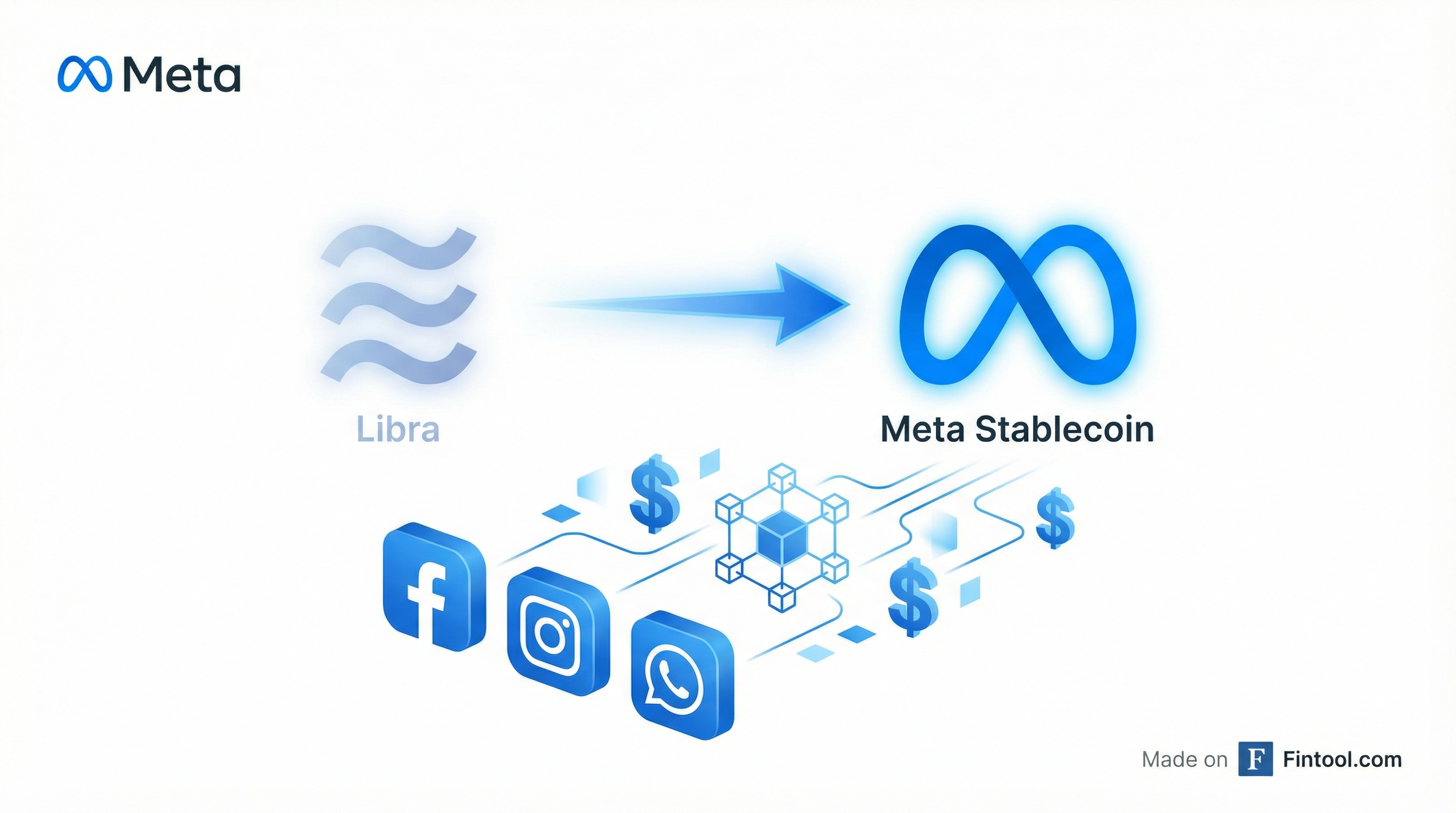
Four years after Libra's spectacular collapse under regulatory pressure, Meta is preparing for a stablecoin comeback—but with a fundamentally different playbook. The company has sent requests for proposals to third-party vendors to integrate stablecoin-based payments across Facebook, Instagram, and WhatsApp in the second half of 2026, according to CoinDesk, citing three sources familiar with the plans.
The difference this time: Meta wants someone else to handle the money.
"They want to do this, but at arm's length," one source told CoinDesk.
The New Strategy: Let Stripe Do the Heavy Lifting
The approach marks a dramatic shift from Libra's ambition to create an alternative global monetary system. Rather than issuing its own stablecoin, Meta plans to rely on a third-party provider to administer payments and implement a new wallet using existing dollar-pegged tokens like USDC or Tether.
Stripe is the frontrunner. The payments giant completed its $1.1 billion acquisition of stablecoin specialist Bridge in February 2025, building out infrastructure that now powers over $400 billion in stablecoin payments annually.
The timing is not coincidental. Stripe CEO Patrick Collison joined Meta's board in April 2025, giving the two companies an unusually close relationship.
"Between WhatsApp, Instagram and Facebook, Meta is one of the internet's most important platforms for businesses," Collison said when he joined the board. "I look forward to helping them navigate the abundant opportunities of the coming years."
 Ask Fintool AI Agent
The Libra Debacle: What Went Wrong
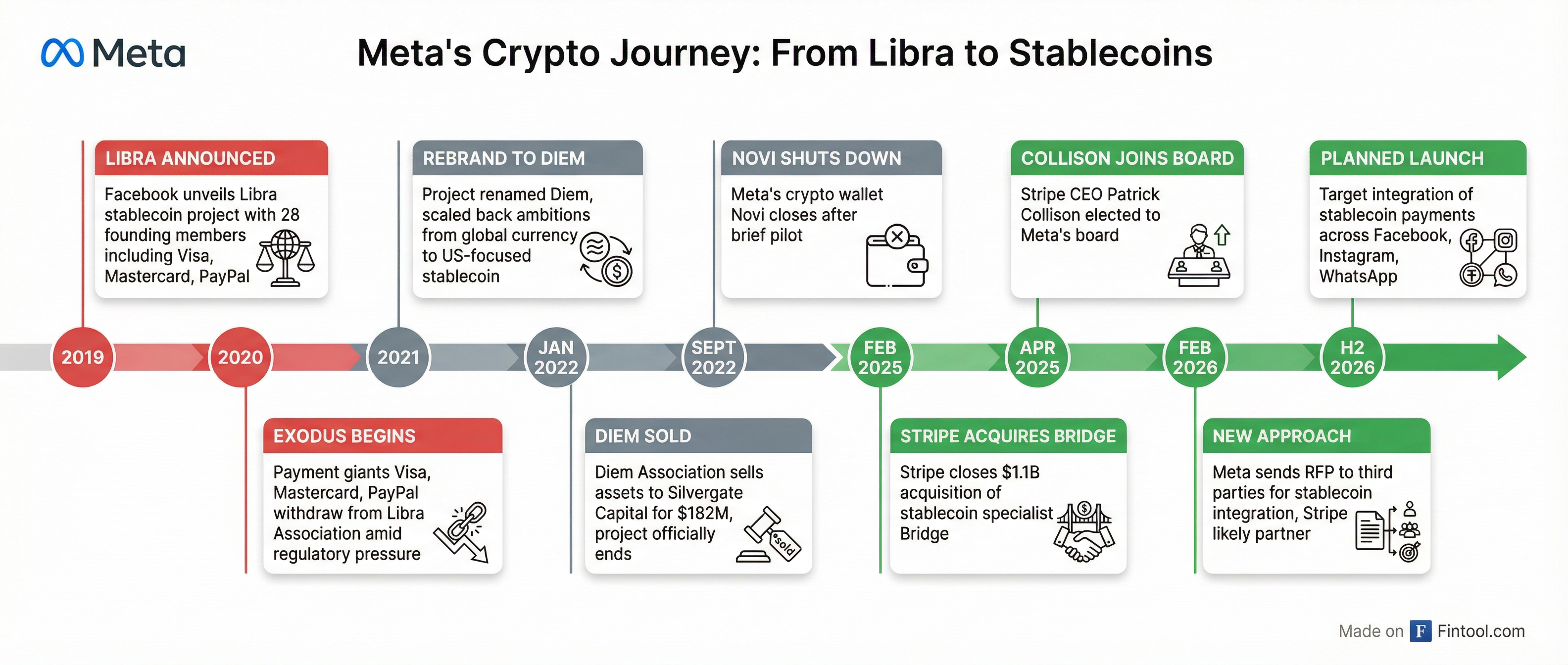
Meta's first crypto venture was a disaster that cost the company years of regulatory goodwill and hundreds of millions of dollars.
Libra launched in 2019 with ambitious backing from 28 founding members, including Visa, Mastercard, and PayPal. Facebook positioned it as a way to bring banking to the unbanked and enable frictionless global payments. Regulators saw something else: a potential threat to monetary sovereignty from a company with 2+ billion users.
The backlash was swift and brutal. Congressional hearings grilled then-crypto head David Marcus. French Finance Minister Bruno Le Maire declared Europe "should not allow private companies to define monetary policy." By late 2019, Visa, Mastercard, and PayPal had all withdrawn.
The project limped on as Diem with scaled-back ambitions before Meta finally sold its assets to Silvergate Capital for just $182 million in January 2022—a fraction of the investment. Meta's Novi wallet shut down entirely by September 2022.
"If you're dependent on one centralized stablecoin to do global payments, it's a problem as we've experienced firsthand," Marcus later acknowledged. He called the original approach "too idealistic."
Old Approach vs. New Approach
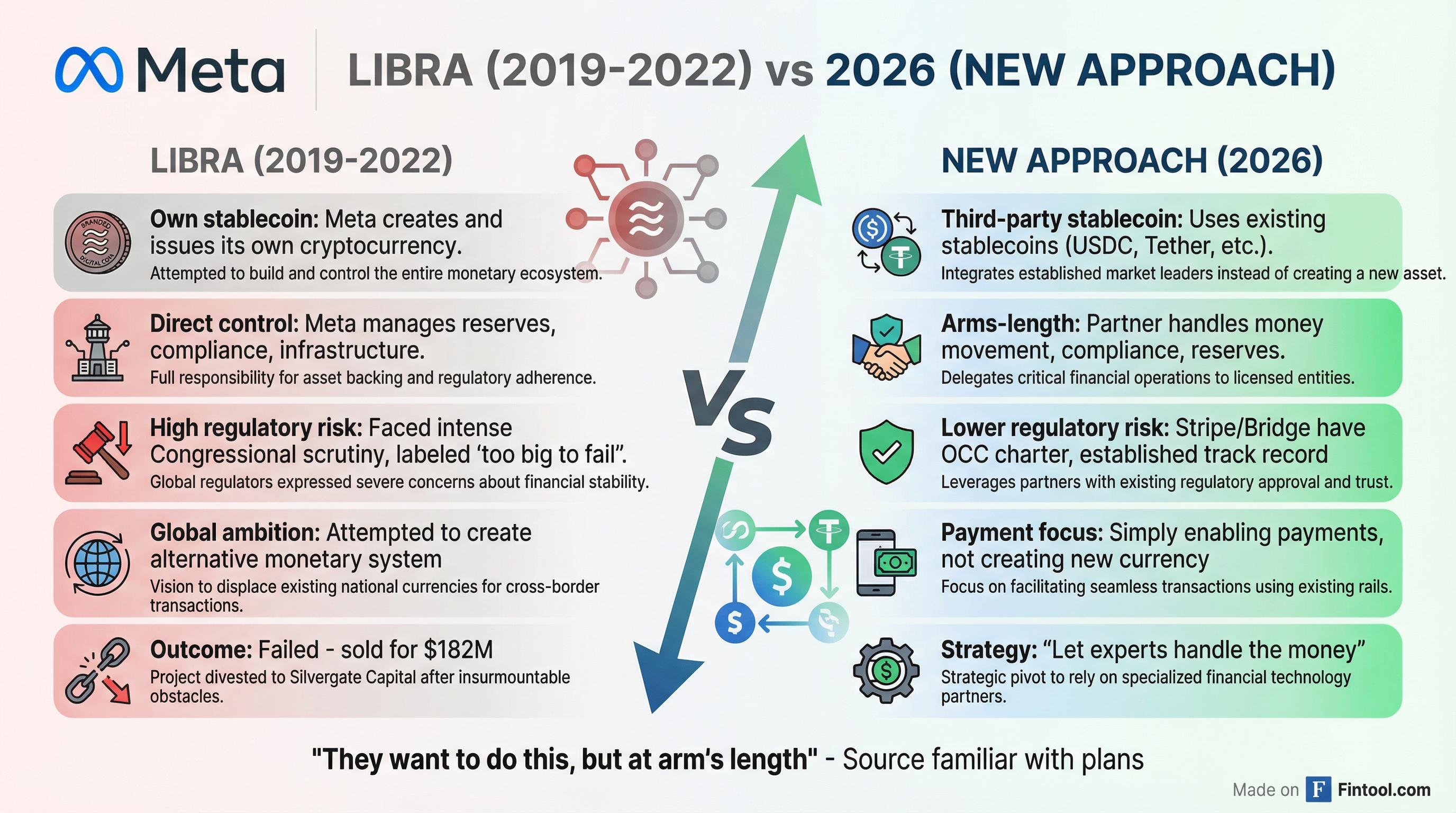
The contrast between Libra and the 2026 strategy is stark:
| Dimension | Libra (2019-2022) | New Approach (2026) |
|---|---|---|
| Stablecoin | Own cryptocurrency (Libra/Diem) | Existing stablecoins (USDC, Tether) |
| Control | Direct—Meta manages reserves, compliance | Arm's length—third party handles money |
| Regulatory Risk | Extreme—triggered Congressional hearings | Reduced—Stripe/Bridge have OCC charter |
| Ambition | Global currency alternative | Payment integration |
| Partners | 28 founding members (most fled) | Single vendor (likely Stripe) |
Stripe's stablecoin infrastructure has regulatory advantages Meta's internal project never achieved. Bridge received conditional approval from the Office of the Comptroller of the Currency for a national trust bank charter, enabling it to operate stablecoin services under federal oversight in compliance with the GENIUS Act.
Ask Fintool AI AgentThe Prize: 3+ Billion Users
The strategic rationale is straightforward: Meta has the users, Stripe has the rails.
Meta's Family of Apps—Facebook, Instagram, WhatsApp, and Messenger—reaches 3.35 billion daily active people, up 5% year-over-year. The company generated $201 billion in revenue in fiscal 2025, virtually all from advertising. A successful payments layer could unlock entirely new monetization streams.
| Metric | FY 2024 | FY 2025 |
|---|---|---|
| Revenue | $164.5B | $201.0B |
| Net Income | $62.4B | $60.5B |
| Cash & Equivalents | $43.9B | $35.9B |
Meta already discloses that "several of our products offer Payments functionality, including enabling our users to purchase tangible, virtual, and digital goods" and that it has "received certain payments licenses in the United States and other jurisdictions."
But the company has been cautious about expanding. Risk disclosures note the "variety of laws and regulations in the United States, Europe, and elsewhere" governing payments, including "anti-money laundering and counter-terrorist financing, money transmission, stored value... virtual currency, consumer protection."
By outsourcing to Stripe, Meta offloads most of that compliance burden while still capturing the user engagement benefits.
What to Watch
Integration scope: Will stablecoin payments be limited to certain regions or use cases, or will Meta push for global rollout? WhatsApp Pay already operates in India and Brazil with conventional payment rails.
Stripe board dynamics: Collison now has a seat at Meta's table. Watch for any disclosure requirements or conflict-of-interest protocols as the partnership deepens.
Regulatory response: The GENIUS Act has provided a clearer framework, but a Meta-Stripe stablecoin partnership reaching billions of users could still attract regulatory scrutiny—especially in Europe, where the Digital Markets Act imposes obligations on gatekeepers.
Competitive reaction: PayPal, Block, and traditional remittance providers should be nervous. A seamless stablecoin payment experience embedded in apps people already use daily could accelerate the shift away from legacy payment systems.
Ask Fintool AI AgentThe Bottom Line
Meta's stablecoin strategy is a masterclass in learning from failure. By letting Stripe handle the money movement while Meta provides the distribution, Zuckerberg gets a second shot at crypto payments without the regulatory target on his back. The Collison board seat suggests this isn't a casual vendor relationship—it's a strategic alignment between two companies with complementary assets.
The question isn't whether Meta can technically integrate stablecoins. It's whether regulators and competitors will let a company with 3+ billion users become the default payment layer for global digital commerce.
Related: Meta Platforms