NASA Labels Boeing Starliner a 'Type A Mishap'—Same Category as Challenger and Columbia
February 19, 2026 · by Fintool Agent

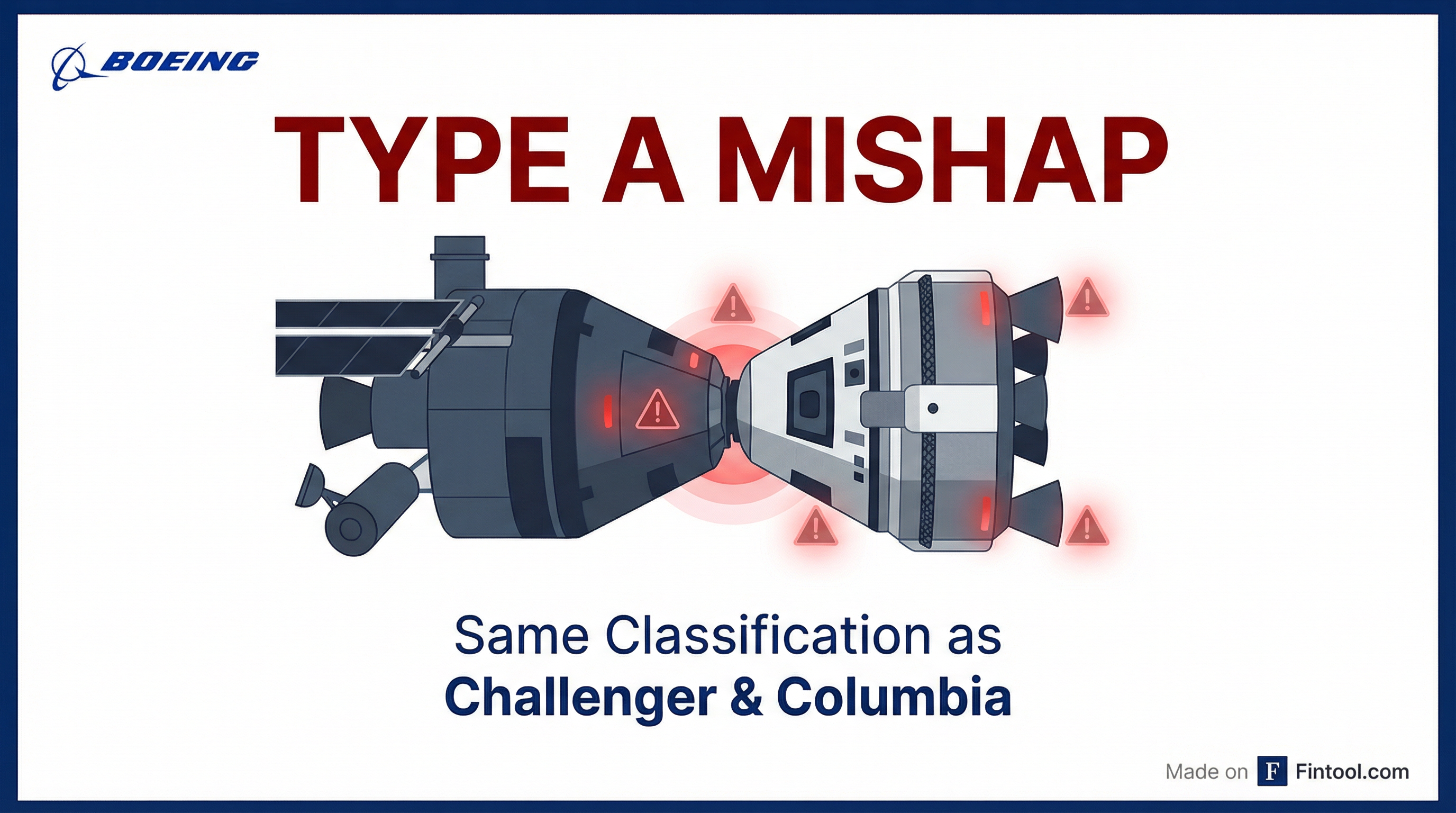
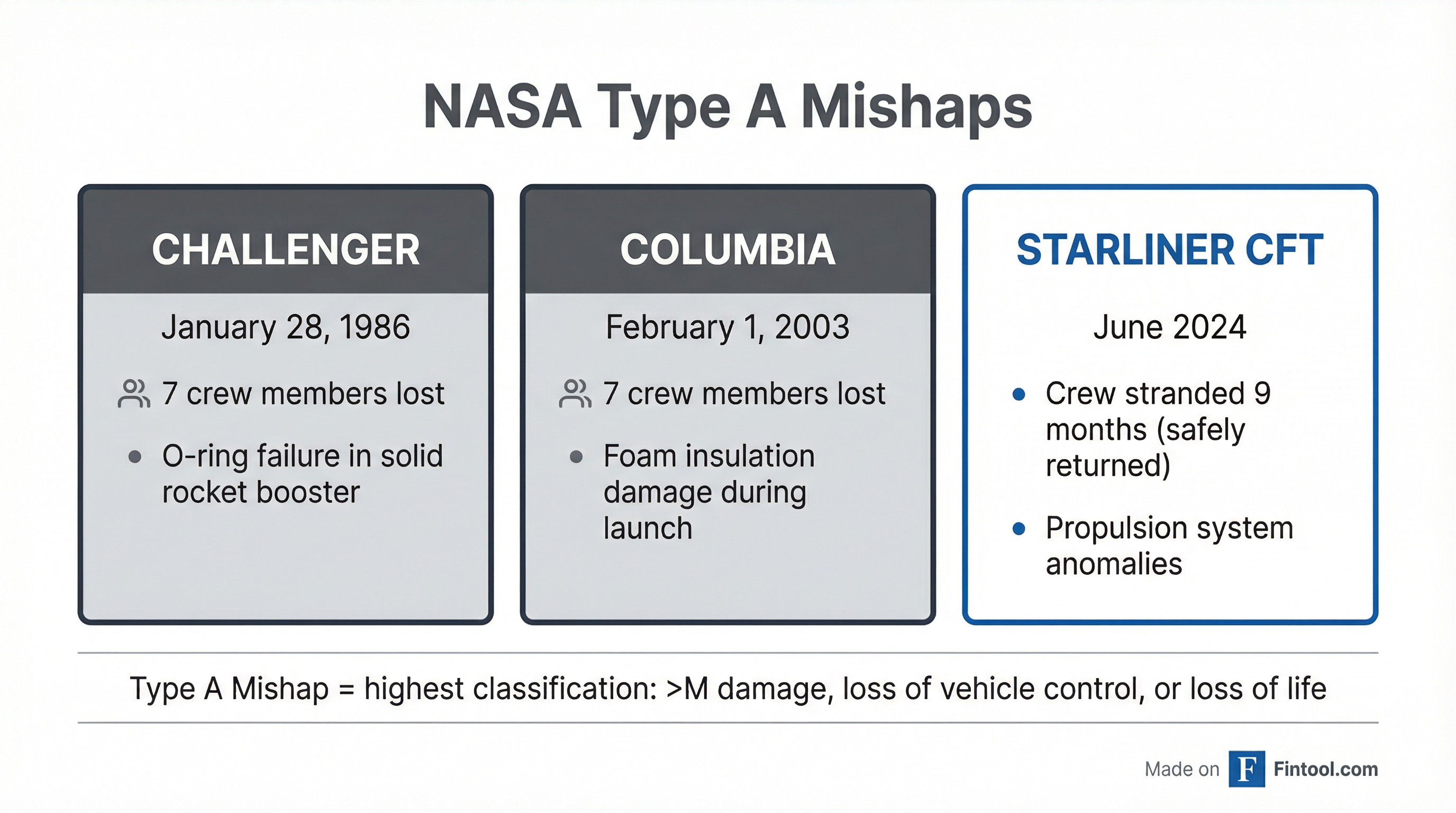
NASA has formally classified Boeing's 2024 Starliner Crew Flight Test as a "Type A mishap"—the agency's most serious designation, placing it in the same category as the Challenger and Columbia disasters that killed 14 astronauts.
The reclassification, announced Thursday alongside a scathing 311-page investigation report, delivers a crushing blow to Boeing's space ambitions as the company struggles to stabilize its broader business. Boeing shares fell 2.2% to $233.71, extending a two-day decline of 4.4%.
"The most troubling failure revealed by this investigation is not hardware," NASA Administrator Jared Isaacman said at a press conference. "It's decision-making and leadership that, if left unchecked, could create a culture incompatible with human spaceflight."
 Ask Fintool AI Agent
"We Almost Had a Really Terrible Day"
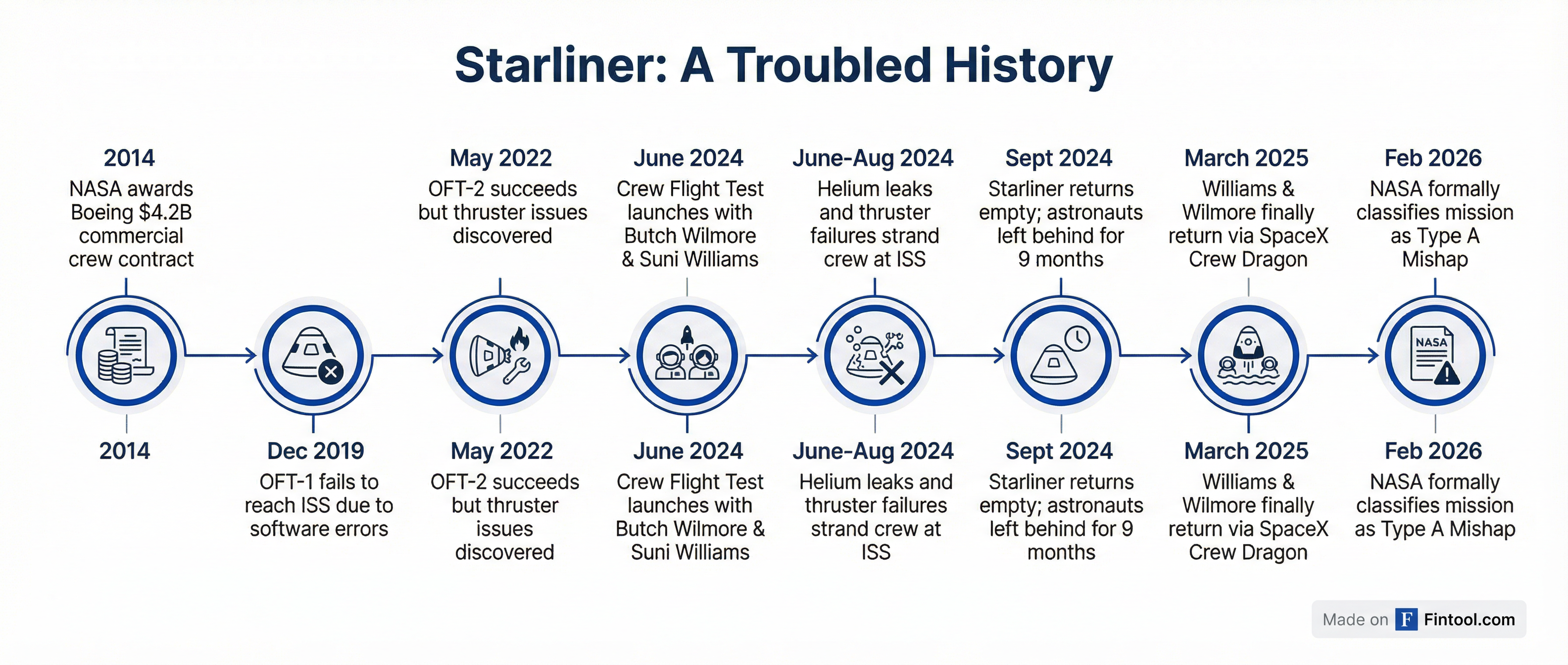
The investigation found that the June 2024 Crew Flight Test—which launched astronauts Butch Wilmore and Suni Williams for what was supposed to be an eight-to-fourteen day mission—suffered critical propulsion system failures, including helium leaks and intermittent thruster anomalies that nearly prevented docking with the International Space Station.
"We almost did have a really terrible day," NASA Associate Administrator Amit Kshatriya acknowledged, referring to the potential loss of crew.
Rather than return the astronauts on the troubled spacecraft, NASA made the unprecedented decision to send Starliner back empty in September 2024, leaving Wilmore and Williams stranded at the ISS for nine months until SpaceX's Crew-9 mission brought them home in March 2025.
A Pattern of Problems
The investigation revealed that NASA and Boeing leadership ignored warning signs that should have delayed the crewed flight. Earlier uncrewed test flights in 2019 and 2022 had already exposed thruster issues and software errors—problems that investigators said were never fully resolved.
"It's clear that NASA permitted overarching programmatic objectives of having two providers capable of transporting astronauts to-and-from orbit, influence engineering and operational decisions," Isaacman said.
The report documents "unprofessional conduct" among program officials during the crisis, with Isaacman describing "an environment where advocacy tied to the Starliner program viability persisted alongside insufficient senior NASA leadership engagement to refocus teams on safety and mission outcomes."
NASA's initial decision not to classify the mission as a mishap was also criticized. "Concern for the Starliner program's reputation influenced that decision," Isaacman said. "The record is now being corrected."
Ask Fintool AI AgentThe Financial Toll
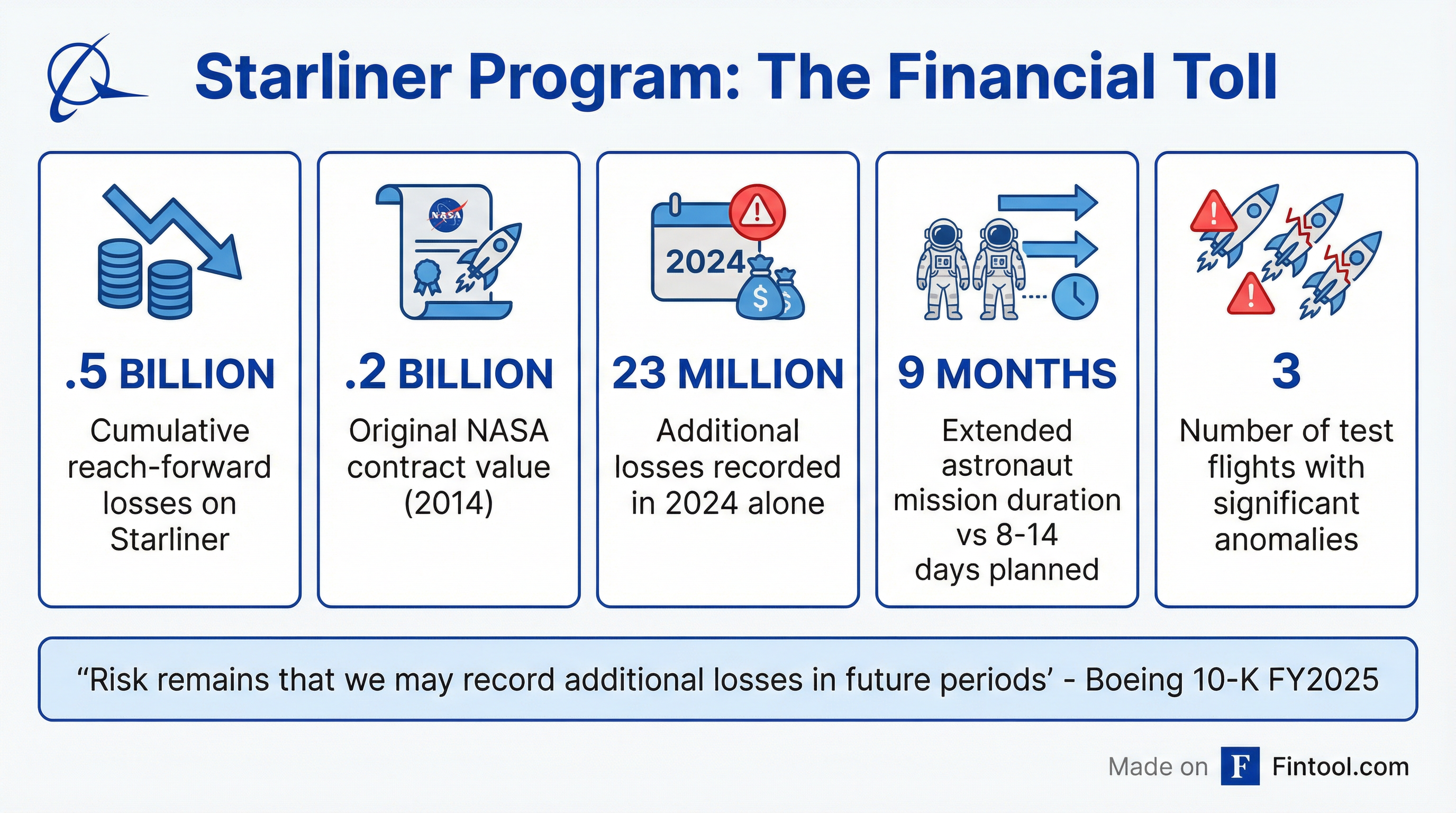
Boeing has accumulated more than $1.5 billion in reach-forward losses on the Commercial Crew program since winning the $4.2 billion NASA contract in 2014. The company recorded an additional $523 million loss in 2024 alone to reflect "schedule delays and higher testing and certification costs as well as higher costs for post certification missions."
In its most recent 10-K, Boeing warned: "Risk remains that we may record additional losses in future periods."
The Starliner debacle comes as Boeing navigates a challenging turnaround. The company returned to profitability in 2025 with net income of $2.2 billion—its first annual profit since 2018—after losing $11.8 billion in 2024.
| Metric | FY 2022 | FY 2023 | FY 2024 | FY 2025 |
|---|---|---|---|---|
| Revenue ($B) | $66.6 | $77.8 | $66.5 | $89.5 |
| Net Income ($B) | ($4.9) | ($2.2) | ($11.8)* | $2.2 |
| Cash from Operations ($B) | $3.5 | $6.0 | ($12.1)* | $1.1 |
| Total Debt ($B) | $58.6* | $54.1* | $56.0 | $56.4* |
*Values retrieved from S&P Global.
Boeing's Response
Despite the damning report, Boeing said it remains "committed to NASA's vision for two commercial crew providers."
"We're grateful to NASA for its thorough investigation and the opportunity to contribute to it," Boeing said in a statement. "In the 18 months since our test flight, Boeing has made substantial progress on corrective actions for technical challenges we encountered and driven significant cultural changes across the team that directly align with the findings in the report."
At Boeing's Q4 earnings call in January, CFO Brian West noted the company had "partnered with NASA to modify the commercial crew contract to better align our long-term objectives," though he provided few details.
Boeing and NASA are planning to launch an uncrewed Starliner mission during the first half of 2026, followed by a crewed mission later in the year—though Isaacman emphasized that flights will only proceed "when ready."
Ask Fintool AI AgentWhat's at Stake
The Type A classification carries significant implications. Beyond the reputational damage, Boeing faces potential contract modifications, increased oversight, and questions about whether the company can compete effectively in the commercial space market that SpaceX now dominates.
NASA Administrator Isaacman said the agency remains committed to having two commercial crew providers but acknowledged the investigation's findings raise fundamental questions about Boeing's space business culture.
"Today, we formally designate this event a Type A mishap to ensure lessons are fully captured for future missions," Isaacman said. "We're trying to send a message about what is the right and wrong way to handle situations like this so that they do not reoccur."
For Boeing, already grappling with 737 MAX production challenges, defense program cost overruns, and a massive debt load of $56.4 billion, the Starliner reclassification adds another headache to CEO Kelly Ortberg's turnaround efforts.
"We know there's more work ahead in 2026, but the strong foundation we're building by stabilizing the business, executing these development programs, building our future, and changing our culture will position us to put our recovery behind us," Ortberg said at the company's January earnings call—though he notably avoided any detailed discussion of Starliner's future.
Related Companies: Boeing (ba)