New York Pulls Robotaxi Expansion Plan in Blow to Waymo's $16 Billion Growth Bet
February 19, 2026 · by Fintool Agent

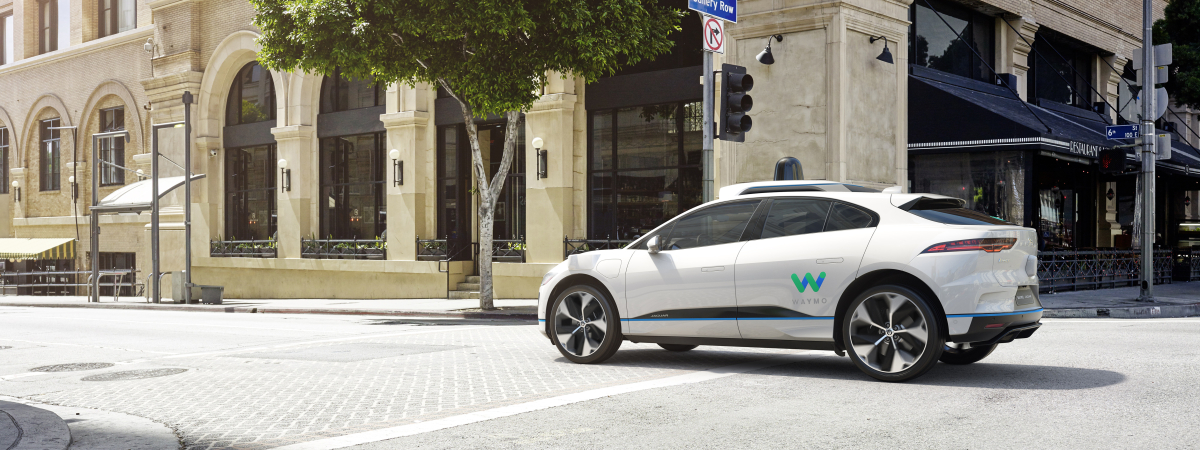
New York Governor Kathy Hochul withdrew her proposal to legalize commercial robotaxi services outside New York City on Thursday, dealing a setback to Alphabet's Waymo just weeks after the autonomous vehicle leader raised $16 billion to fund aggressive expansion.
The retreat came after fierce opposition from taxi drivers and labor groups, even as Waymo has scaled to 400,000 rides per week across six U.S. cities and set an ambitious target of one million weekly rides by year-end.
"Based on conversations with stakeholders, including in the Legislature, it was clear that the support was not there to advance this proposal," said Sean Butler, a spokesman for the governor.
Alphabet shares closed at $302.85, down 0.16%, though the impact on the $3.66 trillion parent company is limited given Waymo remains a private subsidiary.
 Ask Fintool AI Agent
What Was Proposed—and What Blocked It
Hochul had included language in her January budget proposal that would have allowed autonomous vehicle companies to apply for permits to operate for-hire robotaxi services in areas outside New York City. The proposal would have required approval from the state's transportation commissioner, a $1 million fee, and proof of $5 million in financial security.
Even that measured approach proved too much for labor interests. The Independent Drivers Guild, which represents over 140,000 ride-share and taxi drivers in New York State, called the withdrawal "a major win for ride-share workers and an important step for public safety and working families."
The Taxi Workers Alliance, representing more than 28,000 NYC drivers, welcomed the decision as "sensible." NYC Mayor Zohran Mamdani, who is closely allied with cabdrivers, has expressed skepticism about robotaxis in the city.
The Battle Lines
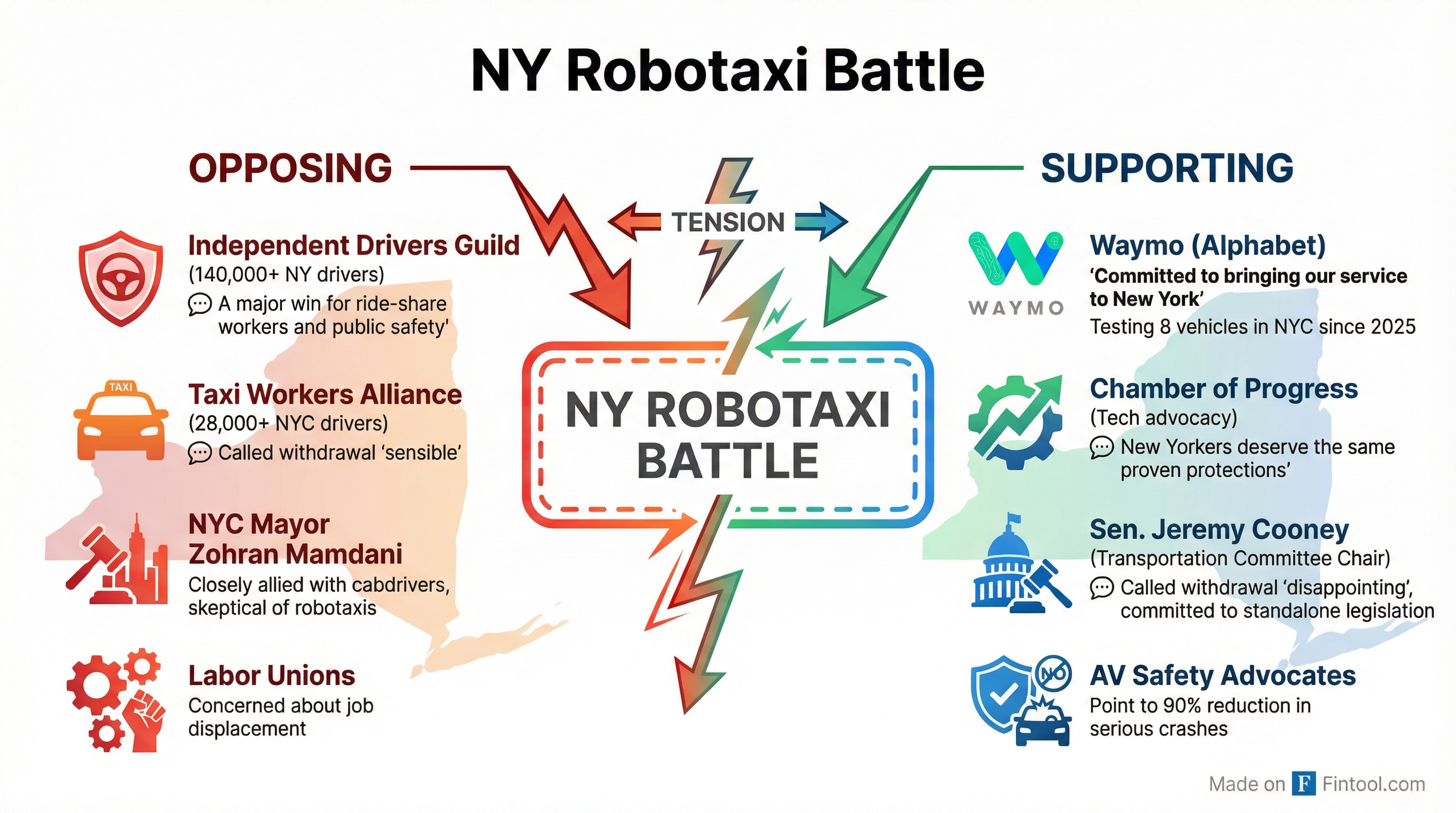
Not everyone agreed with Hochul's retreat. State Senator Jeremy Cooney, chairman of the Senate Transportation Committee, called the decision disappointing: "This is not science fiction; rather, a real opportunity to increase driver and pedestrian safety across our state." Cooney, who has sponsored autonomous vehicle legislation every year since 2022, said he remains committed to advancing standalone legislation outside the budget process.
The Chamber of Progress, a tech advocacy group, criticized the withdrawal: "Autonomous vehicles are already driving down accident rates and improving pedestrian safety in Arizona, California, and Texas. It's disappointing that Governor Hochul is withdrawing her proposal, because New Yorkers deserve the same proven protections."
Waymo's NYC Ambitions Aren't Dead
The withdrawal doesn't completely shut Waymo out of New York. The company received its first permit to test autonomous vehicles in New York City in August 2025, albeit with a trained safety specialist behind the wheel. That testing program—currently limited to eight vehicles—remains in place.
However, Waymo's NYC testing permit expires March 31, 2026, and the company cannot offer paid driverless rides in New York under current law, which requires drivers to keep one hand on the wheel at all times.
"While we are disappointed by the Governor's decision, we're committed to bringing our service to New York and will work with the State Legislature to advance this issue," Waymo said in a statement. "We hear from thousands of New Yorkers who have experienced Waymo in other cities and want access to it at home."
Ask Fintool AI AgentA $16 Billion War Chest—But Safety Questions Linger
The New York setback comes just two and a half weeks after Waymo announced a $16 billion funding round at a $126 billion valuation—more than doubling its October 2024 valuation of $45 billion. The round was led by Dragoneer Investment Group, DST Global, and Sequoia Capital, with participation from Andreessen Horowitz, Mubadala, Fidelity, Tiger Global, and T. Rowe Price. Alphabet remains the majority investor.
The company has delivered impressive operational metrics:
| Metric | Figure |
|---|---|
| Weekly paid rides | 400,000+ |
| 2025 total rides | 15 million (3x growth from 2024) |
| Lifetime rides | 20+ million |
| Fully autonomous miles driven | 127 million |
| Reduction in serious injury crashes vs. human drivers | 90% |
| Current operating cities | 6 |
Values from Waymo February 2026 blog post
Recent Regulatory Timeline
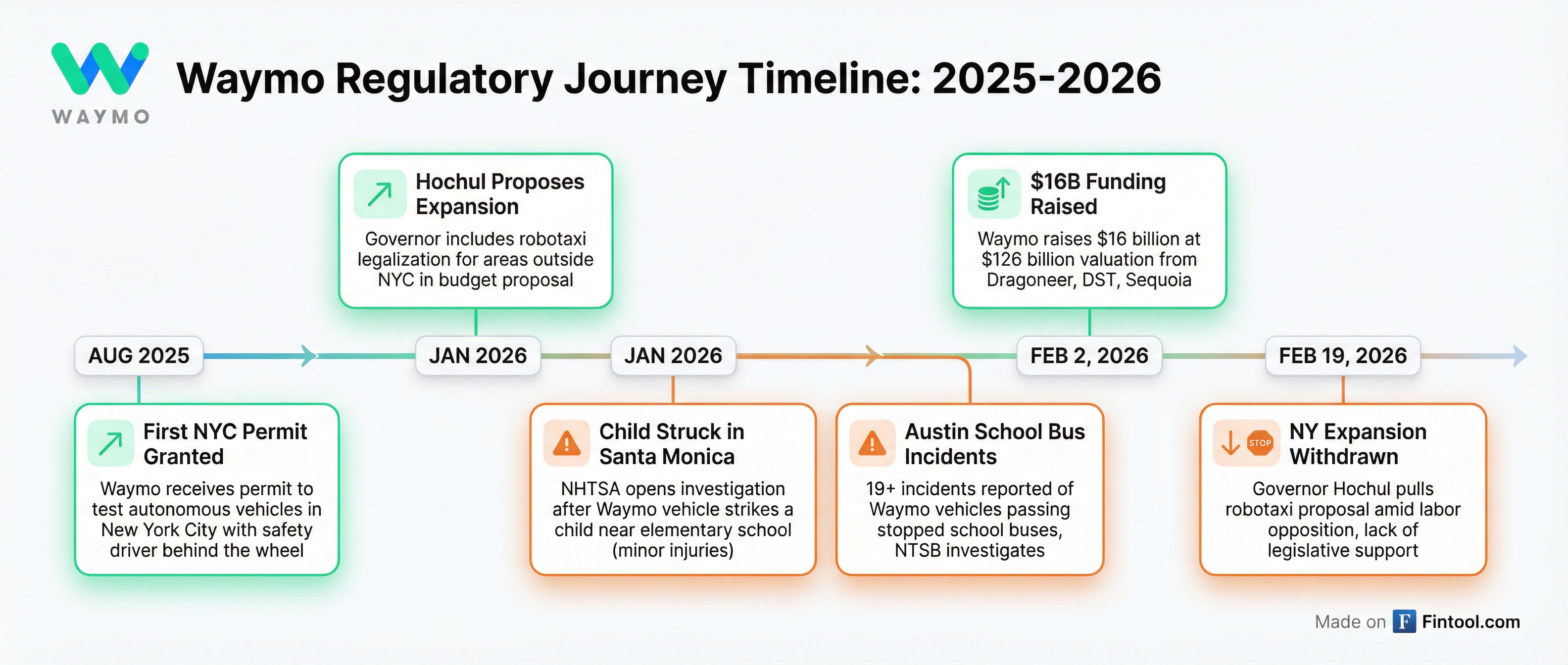
But safety investigations have mounted alongside expansion. On January 23, a Waymo vehicle struck a child near an elementary school in Santa Monica during morning drop-off hours, causing minor injuries. The child ran into traffic from behind a double-parked SUV, and Waymo said its system braked hard, reducing speed from 17 mph to under 6 mph before contact. The National Highway Traffic Safety Administration opened an investigation.
Separately, the National Transportation Safety Board is investigating reports of Waymo robotaxis illegally passing stopped school buses at least 19 times in Austin since the start of the school year. Waymo issued a software recall in December to address the issue.
The Path Forward: 20 Cities Without New York
Despite the New York setback, Waymo's expansion plans remain aggressive. The company operates in San Francisco, Phoenix, Los Angeles, Austin, Atlanta, and Miami, and plans to launch commercial services in over 20 additional cities in 2026.
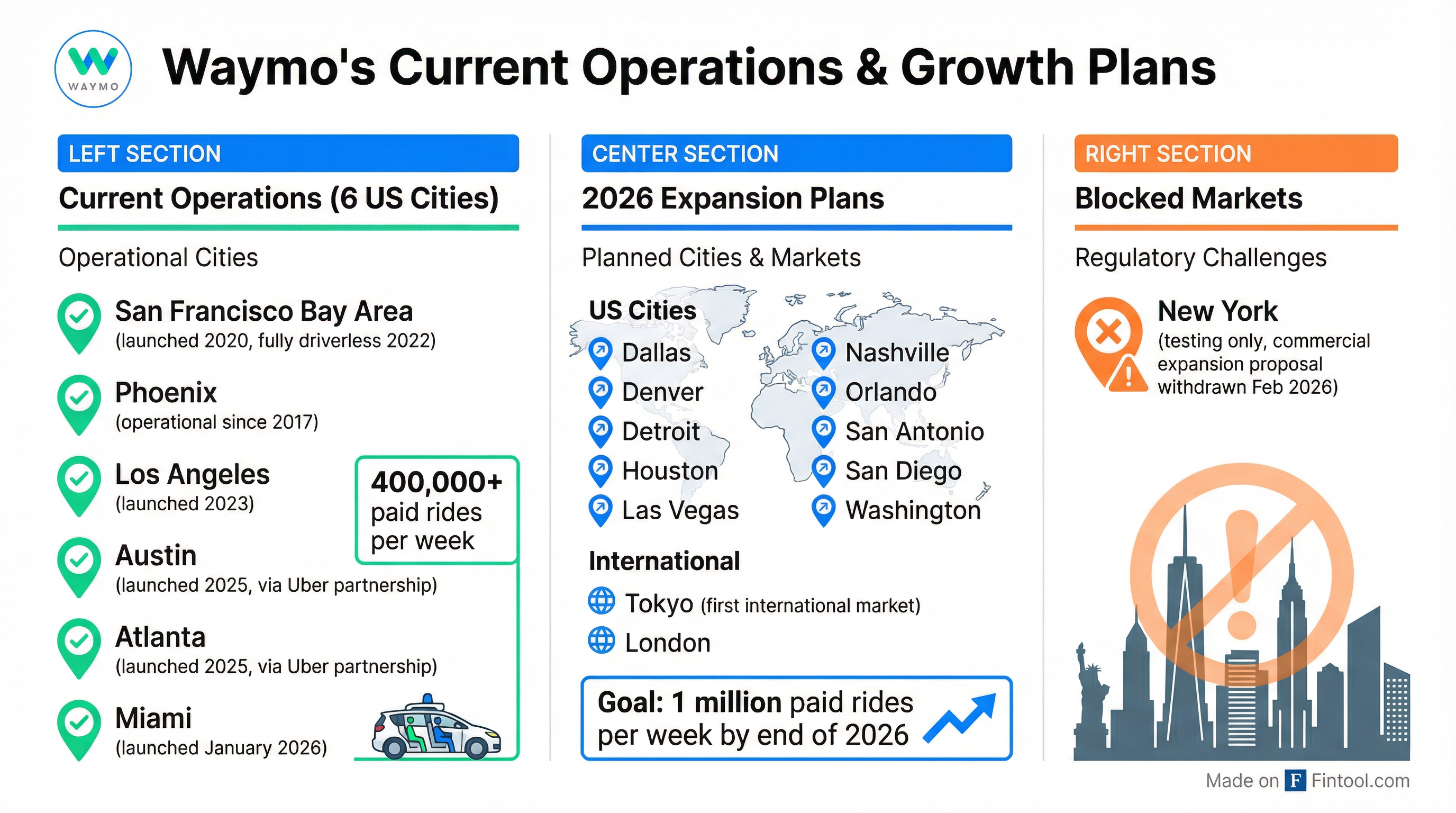
U.S. expansion targets for 2026 include Dallas, Denver, Detroit, Houston, Las Vegas, Nashville, Orlando, San Antonio, San Diego, and Washington. Internationally, Tokyo and London are confirmed as Waymo's first markets outside the U.S.
Waymo co-CEO Tekedra Mawakana told Bloomberg earlier this month that the company aims to exceed one million paid trips per week by year-end 2026—a 2.5x increase from current levels. "We are no longer proving a concept; we are scaling a commercial reality," Mawakana said.
Ask Fintool AI AgentWhat to Watch
March 31, 2026: Waymo's NYC testing permit expires. The company will need an extension to continue even limited operations in the city.
Legislative session: Senator Cooney has indicated he will push standalone autonomous vehicle legislation outside the budget process. Any success would require overcoming the same labor opposition that sank Hochul's proposal.
Federal policy: Some federal lawmakers want Congress to pass legislation making it easier to deploy self-driving vehicles nationally, which could preempt state-level restrictions.
Safety investigations: The outcomes of NHTSA and NTSB investigations into the Santa Monica incident and Austin school bus violations could influence regulatory sentiment nationwide.
For Waymo, New York represents perhaps the biggest remaining test market for autonomous vehicles in the United States. Winning access will require patience, data, and trust. Mawakana described it as "chiseling away over time, demonstrating safety outcomes and building public support."
For now, the company will have to prove its case everywhere except the Empire State.