NVIDIA and Eli Lilly Commit $1 Billion to Build First-of-Its-Kind AI Drug Discovery Lab
January 12, 2026 · by Fintool Agent


Nvidia+7.87% and Eli Lilly+3.66% announced a first-of-its-kind AI co-innovation lab at the J.P. Morgan Healthcare Conference, committing up to $1 billion over five years to tackle some of the most enduring challenges in pharmaceutical research. The lab, to be based in the San Francisco Bay Area, will co-locate scientists and engineers from both companies to build foundation models for biology and chemistry—a blueprint for the future of drug discovery.
"AI is transforming every industry, and its most profound impact will be in life sciences," said Jensen Huang, founder and CEO of NVIDIA. "NVIDIA and Lilly are bringing together the best of our industries to invent a new blueprint for drug discovery—one where scientists can explore vast biological and chemical spaces in silico before a single molecule is made."
Deal Structure
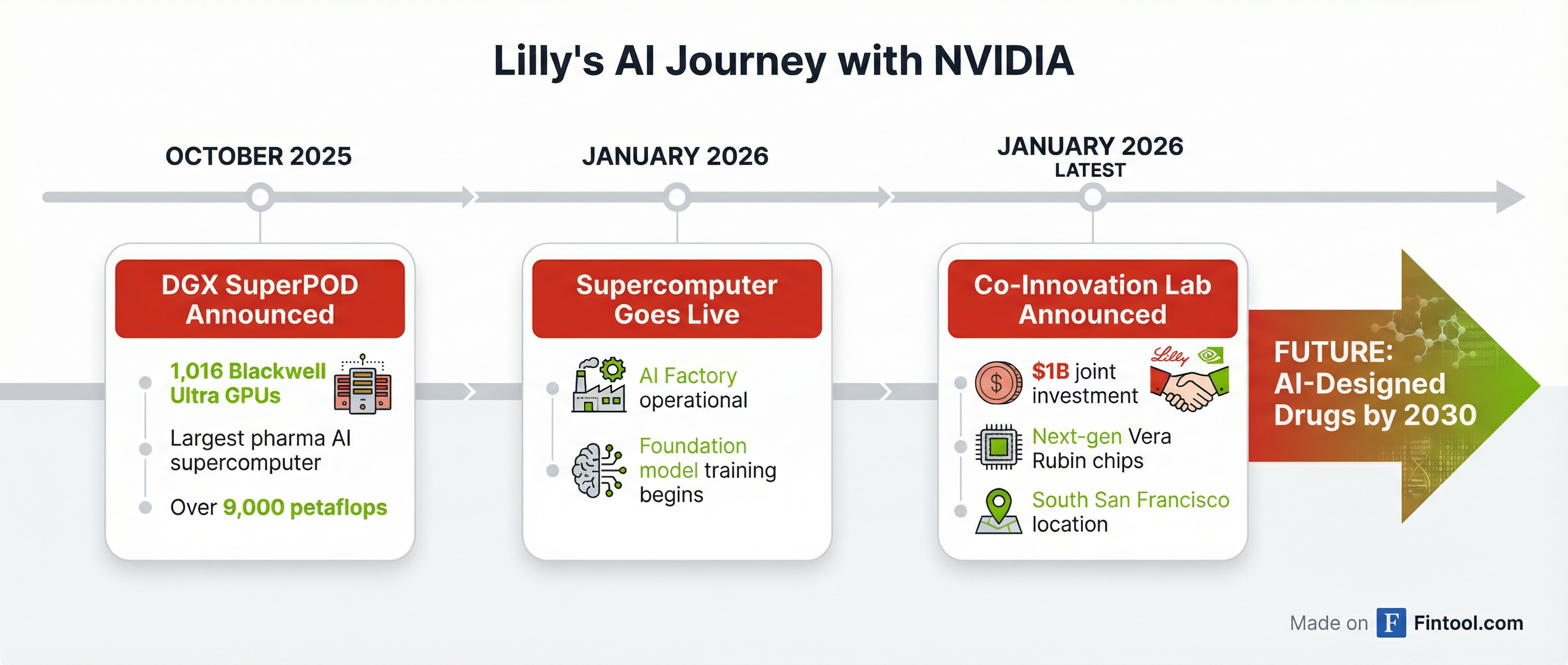
The partnership represents a significant escalation of the existing NVIDIA-Lilly relationship. In October 2025, Lilly announced it was building pharma's most powerful AI supercomputer—a DGX SuperPOD with 1,016 Blackwell Ultra GPUs delivering over 9,000 petaflops of AI performance. This new announcement goes further: a dedicated physical lab where multidisciplinary teams will work side by side to generate data and train models.
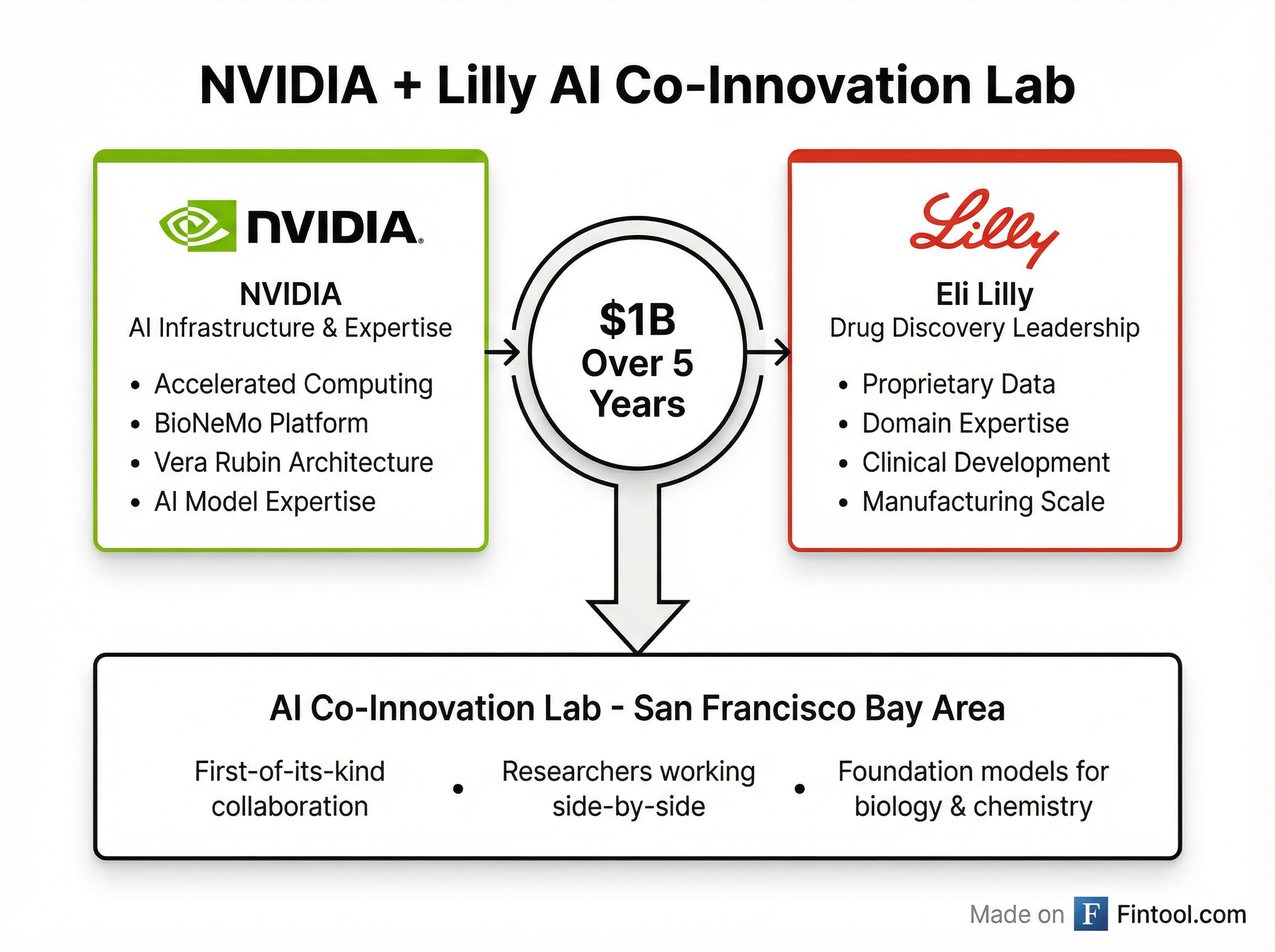
Key terms of the collaboration:
| Component | Details |
|---|---|
| Total Investment | Up to $1 billion over 5 years |
| Location | San Francisco Bay Area (specific site to be announced in March) |
| Timeline | Work expected to begin in South San Francisco early 2026 |
| Technology | NVIDIA BioNeMo platform, Vera Rubin architecture chips |
| Focus | Foundation and frontier models for biology and chemistry |
The companies did not disclose how the $1 billion investment will be split, nor whether NVIDIA's contribution would flow to Lilly and be used to purchase NVIDIA chips—a circular arrangement that has raised questions about other NVIDIA investments.
 Ask Fintool AI Agent
Why It Matters
The pharmaceutical industry has long struggled with the economics of drug development. The average drug takes about 10 years from first-in-human dosing to market launch, with costs often exceeding $2 billion per approved therapy. AI promises to compress those timelines by allowing researchers to explore billions of molecular possibilities computationally before running a single wet-lab experiment.
Lilly is already positioned as the industry leader in AI adoption. CB Insights ranks Lilly as the most AI-ready pharma company, citing the highest AI innovation score and most partnerships with AI-enabled drug development platforms. The company's chief AI officer, Thomas Fuchs, framed the shift in stark terms: "Lilly is shifting from using AI as a tool to embracing it as a scientific collaborator."
The benefits of scale are significant. A single NVIDIA Blackwell Ultra GPU contains the computing power of approximately 7 million Cray systems from 1992—when Lilly's supercomputer was considered state-of-the-art. The new lab will harness next-generation Vera Rubin architecture, representing another leap forward.
For NVIDIA, the partnership validates its healthcare AI strategy. NVIDIA Vice President of Healthcare Kimberly Powell said both firms are dedicating "incremental resources" to the new facility, where researchers will generate data to train biotechnology AI models. Beyond drug discovery, the collaboration will explore applications across Lilly's business, from manufacturing to commercial operations.
Financial Context
Both companies enter this partnership from positions of strength.
NVIDIA is the world's most valuable public company with a market capitalization of approximately $4.5 trillion.* The company delivered $57 billion in revenue for Q3 fiscal 2026, up 45% year-over-year, with gross margins exceeding 73%. The healthcare and life sciences vertical represents a growing but still small portion of NVIDIA's data center revenue, which is dominated by hyperscaler cloud customers training large language models.
| NVIDIA Metrics | Q4 FY2025 | Q1 FY2026 | Q2 FY2026 | Q3 FY2026 |
|---|---|---|---|---|
| Revenue | $39.3B | $44.1B | $46.7B | $57.0B |
| Net Income | $22.1B | $18.8B | $26.4B | $31.9B |
| Gross Margin | 73.0% | 60.5% | 72.4% | 73.4% |
Eli Lilly has a market capitalization of approximately $960 billion,* making it one of the most valuable healthcare companies globally. The company is riding unprecedented demand for its GLP-1 drugs Mounjaro and Zepbound, which have transformed diabetes and obesity treatment. Q3 2025 revenue reached $17.6 billion, up significantly year-over-year.
| Lilly Metrics | Q4 FY2024 | Q1 FY2025 | Q2 FY2025 | Q3 FY2025 |
|---|---|---|---|---|
| Revenue | $13.5B | $12.7B | $15.6B | $17.6B |
| Net Income | $4.4B | $2.8B | $5.7B | $5.6B |
| Gross Margin | 82.2% | 82.5% | 84.3% | 82.9% |
| CapEx | $1.5B | $1.5B | $1.7B | $2.1B |
Lilly has committed $50 billion to expanding its U.S. manufacturing and R&D footprint, including four new facilities and a proposed $4.5 billion Lilly Medicine Foundry in Indiana.
*Values retrieved from S&P Global.
Ask Fintool AI AgentCompetitive Landscape
The race to apply AI to drug discovery is intensifying. While Recursion Pharmaceuticals+11.80% operates BioHive-2—previously the largest pharmaceutical supercomputer with 504 H100 GPUs—Lilly's existing 1,016 Blackwell Ultra GPU installation already surpassed it, delivering roughly twice the GPU count with more advanced chips.
NVIDIA has partnered with multiple pharmaceutical companies beyond Lilly:
| Partner | Focus Area | Status |
|---|---|---|
| Recursion | AI drug discovery platform | $50M collaboration announced 2023 |
| Novo Nordisk | Sovereign AI supercomputer | Partnership via Gefion supercomputer |
| AstraZeneca | Transformer models for chemistry | Cambridge-1 collaboration |
| Amgen | Protein LLM training | DGX Cloud partnership |
| Schrödinger | Chemical simulation | DGX SuperPOD deployment |
But the NVIDIA-Lilly co-innovation lab stands apart. Rather than simply providing computing infrastructure, this is a physical facility where researchers from both companies will work together—a model that could set the template for future pharma-tech partnerships.
Pure-play AI drug discovery companies face competitive pressure from this deepening pharma-tech integration. Recursion+11.80%, which merged with Exscientia in late 2024, Schrödinger+4.25%, and privately held players like Insilico Medicine and Isomorphic Laboratories (an Alphabet subsidiary) must now compete not just with each other but with well-capitalized incumbents like Lilly that are building AI capabilities in-house.
What to Watch
The co-innovation lab represents a long-term bet. Diogo Rau, Lilly's chief information and digital officer, was candid about the timeline: "The things that we're talking about discovering with this kind of power that we have right now, we're really going to see those benefits in 2030."
Key milestones to monitor:
- March 2026: Specific lab location announcement
- Q1 2026: Lab operations commence in South San Francisco
- Ongoing: Lilly TuneLab platform expansion—select AI models will be made available to biotech partners, creating potential licensing revenue
- 2030 and beyond: First AI-designed drugs potentially reaching market
For investors, the partnership raises important questions about the economics of AI in drug discovery. There are currently no drugs on the market designed using AI, though the number of AI-discovered drugs entering clinical trials continues to grow. Success will ultimately be measured not in petaflops but in approved therapies that improve patient outcomes.
Ask Fintool AI AgentRelated: