Peloton CFO Liz Coddington Exits After Steering Company From Brink of Insolvency
February 5, 2026 · by Fintool Agent


Peloton CFO Liz Coddington is leaving the connected fitness company after nearly four years at the helm of its finances, departing with the business in dramatically better shape than when she arrived—though the stock tells a more complicated story.
Coddington, who joined in June 2022 when Peloton was hemorrhaging cash and facing a debt crisis, will step down effective March 27, 2026 to "pursue an opportunity outside the industry." Her exit comes the same day the company reported Q2 FY2026 results that missed revenue expectations, sending shares down roughly 11% in after-hours trading to $5.26.
The timing raises questions about whether the turnaround architect is departing before the mission is fully complete—or whether she's simply cashing out at an opportune moment after hitting her performance targets.
The Turnaround in Numbers
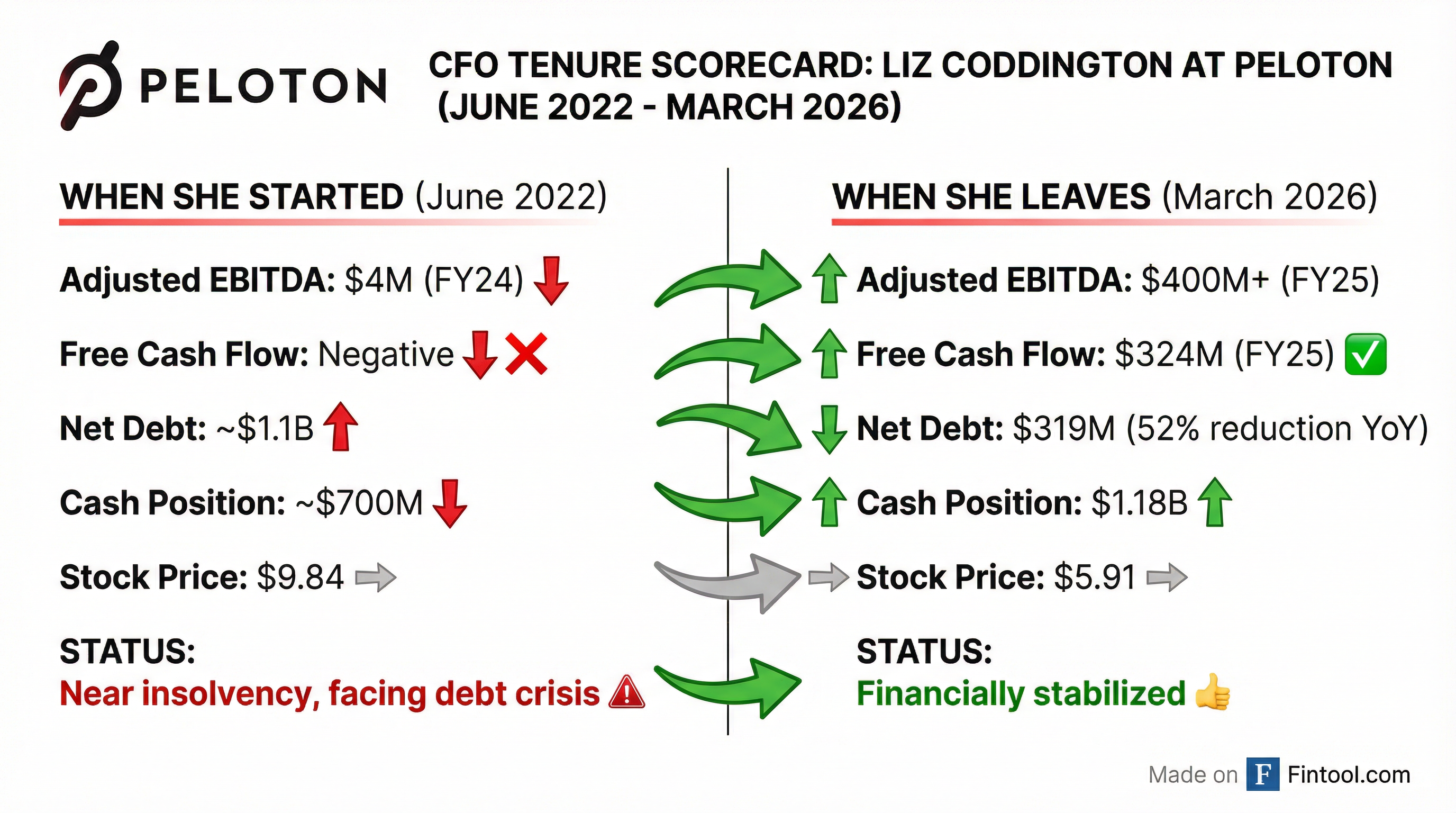
When Coddington took over as CFO in June 2022, Peloton was in crisis mode. The pandemic darling had seen demand collapse, its stock had cratered from pandemic highs above $160, and the company was burning through cash at an alarming rate. Her predecessor, Jill Woodworth, departed just months after then-CEO John Foley stepped down amid a 2,800-person layoff.
The transformation under her watch has been substantial:
| Metric | When She Started (FY24) | When She Leaves (FY25) | Change |
|---|---|---|---|
| Adjusted EBITDA | $4M | $404M | +100x |
| Free Cash Flow | Negative | $324M | +$409M YoY |
| Net Debt | $1.1B | $319M | -52% YoY |
| Cash Position | $700M | $1.18B | +68% |
| Gross Margin | 43% | 50.5% | +750 bps |
"Liz has played a vital role in Peloton's continued transformation," CEO Peter Stern said in the announcement. "She leaves us not only with a better balance sheet, but also a renewed sense of financial discipline."
 Ask Fintool AI Agent
The Critical May 2024 Refinancing
Perhaps Coddington's most consequential achievement was executing a $1.35 billion refinancing in May 2024 when the company was "approaching a maturity wall."
As she explained on the Q4 FY25 earnings call: "We successfully completed a $1,350,000,000 refinancing of our balance sheet. And then since that time, we have grown our adjusted EBITDA from $4,000,000 in fiscal 'twenty four to over $400,000,000 in fiscal twenty twenty five."
The deal bought Peloton time and better terms. The company achieved a 50 basis point rate step-down on its term loan after hitting leverage targets, reducing the spread to SOFR plus 5.5% from 6%.
But the Stock Chart Tells Another Story
Despite the operational turnaround, Peloton shares are down roughly 40% from where they traded when Coddington joined. The stock closed at $5.91 on February 4—below the $9.84 level when she started in June 2022—and dropped further to $5.26 after-hours following today's announcements.
The disconnect reflects Peloton's fundamental challenge: the company has become dramatically more efficient at making money, but the top line continues to shrink. Paid Connected Fitness subscriptions fell 7% year-over-year to 2.661 million in Q2, and the company now forecasts an 8% decline next quarter.
The stock hit a low of $2.88 in August 2024 before rebounding—meaning investors who bought at the nadir have still doubled their money, even after today's drop.
Q2 Results: A Mixed Final Quarter
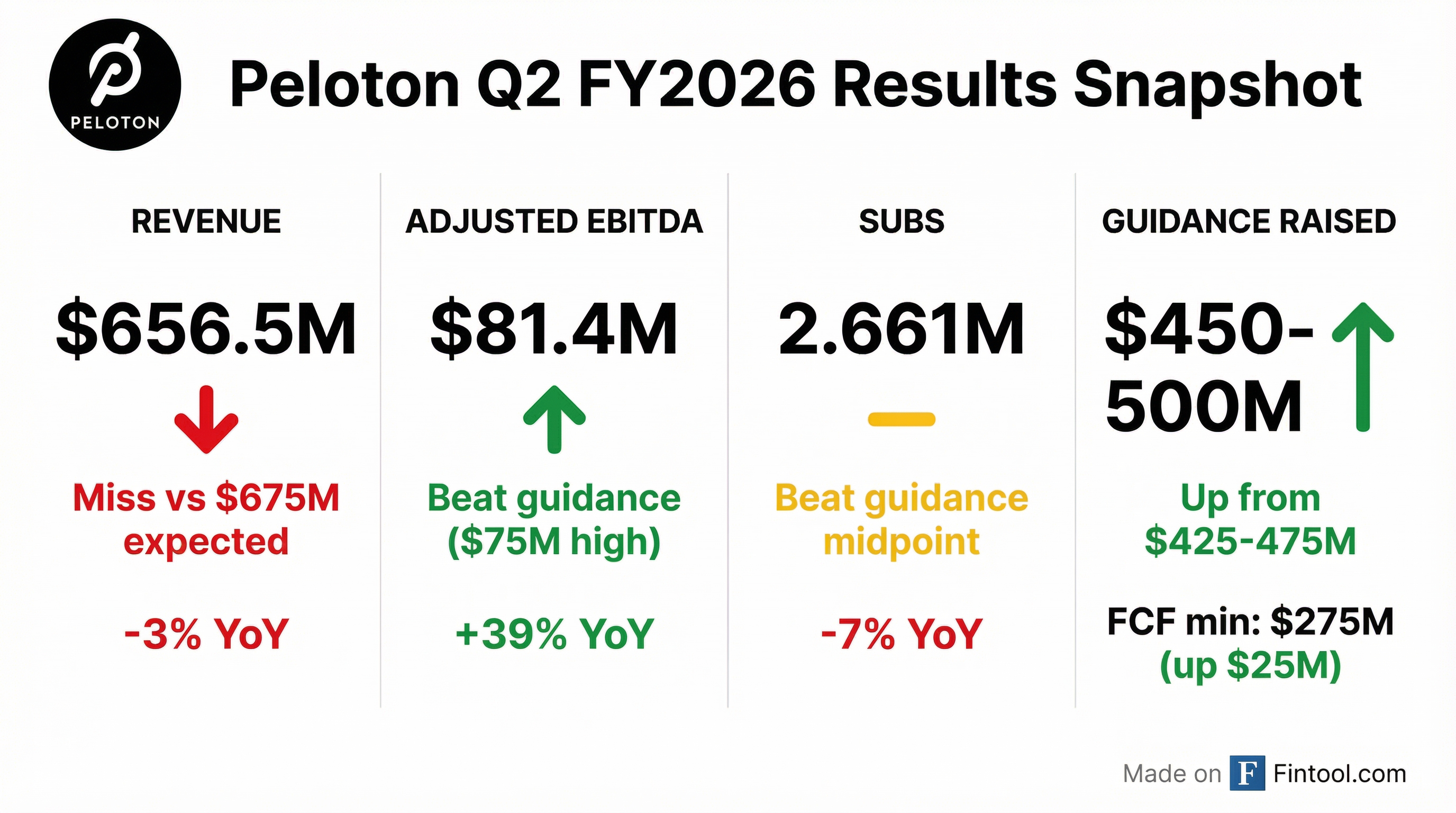
The Q2 FY2026 results announced alongside Coddington's departure encapsulate Peloton's current state—shrinking revenue but improving profitability:
| Metric | Q2 FY26 Actual | Guidance/Consensus | Result |
|---|---|---|---|
| Revenue | $656.5M | $665M (midpoint) | Miss |
| Adjusted EBITDA | $81.4M | $75M (high end) | Beat |
| Paid Subs | 2.661M | 2.655M (midpoint) | Beat |
| Gross Margin | 50.5% | 49% guidance | Beat |
The company raised its full-year Adjusted EBITDA guidance to $450-500 million from $425-475 million and increased its free cash flow target to at least $275 million. But it also cut its revenue outlook to $2.40-2.44 billion, down from the prior range.
Ask Fintool AI AgentCoddington's Background and Compensation
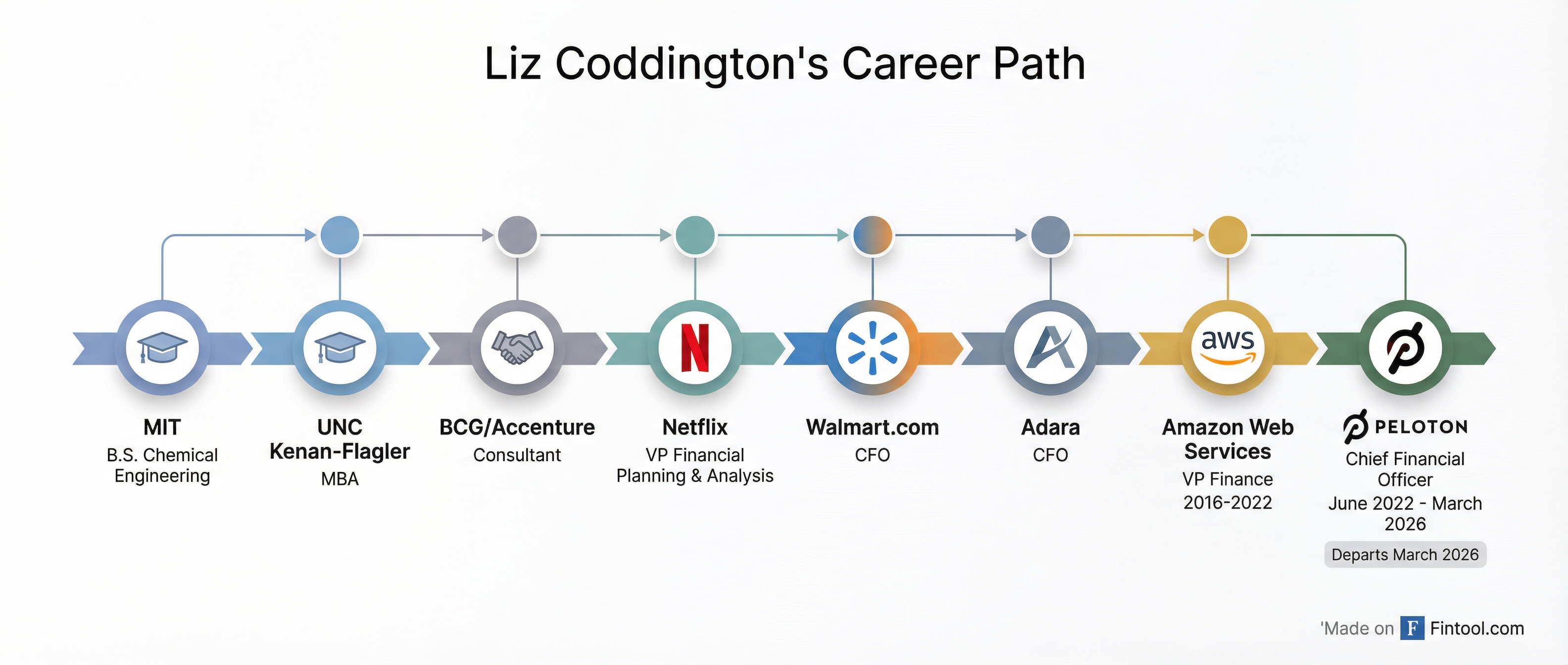
Coddington arrived at Peloton with a resume tailor-made for a turnaround: VP of Finance at Amazon Web Services, CFO of Walmart.com, and VP of Financial Planning & Analysis at Netflix. She holds a BS in Chemical Engineering from MIT and an MBA from UNC Kenan-Flagler.
Her compensation was heavily weighted toward equity aligned with financial performance. According to Peloton's proxy filings, her FY2025 Performance Stock Units were tied to Free Cash Flow targets—and with actual FCF of $323.7 million exceeding the $300 million maximum target, she received a 200% payout.
During her tenure, insider filings show Coddington sold approximately $11.6 million worth of shares, primarily through option exercises and subsequent sales for tax purposes. She departs with beneficial ownership of approximately 368,000 shares plus vesting RSUs and exercisable options totaling over 1.1 million shares.
Importantly, the 8-K filing notes her departure "is not the result of any disagreements or issues relating to financial disclosures or accounting matters." She will not receive severance payments.
What Comes Next
The company has "initiated a comprehensive search" for its next CFO, with Coddington remaining through March to ensure a smooth transition.
For investors, the key questions are:
-
Can the turnaround sustain without its architect? Coddington built the financial playbook—cost discipline, margin expansion, debt reduction—but execution will fall to her successor.
-
Will the new CFO change capital allocation strategy? Management has hinted at having "more cash on the balance sheet than we need to run the business" and is prioritizing deleveraging. A new CFO might accelerate buybacks or pursue strategic moves.
-
Is the revenue decline stabilizing? Peloton expects to "inflect toward year-over-year revenue growth" in the back half of fiscal 2026 through pricing actions and product launches. The new Cross Training Series and commercial business expansion are the main levers.
-
Why leave now? Coddington cited "an opportunity outside the industry"—but the timing alongside a revenue miss and $200 million convertible note maturity in February 2026 could signal she views her work as complete or sees limited upside from here.
Ask Fintool AI AgentInvestment Implications
Coddington leaves Peloton in its strongest financial position since before the pandemic. The balance sheet has $1.18 billion in cash against $1.5 billion in gross debt, generating nearly $100 million in quarterly Adjusted EBITDA.
But the subscriber base continues to erode, with average net monthly churn rising to 1.9%—up 50 basis points year-over-year. The company is betting on innovation (Peloton IQ, Cross Training Series, commercial expansion) to stabilize the top line, but the new CFO will inherit these challenges.
At after-hours prices around $5.26, Peloton trades at roughly 0.4x forward revenue and under 6x run-rate Adjusted EBITDA. The valuation looks inexpensive if margins hold—but cheap multiples on a shrinking base can be value traps.
The CFO transition adds execution risk at a critical juncture. Investors would be wise to wait for clarity on the successor and evidence that Q3/Q4 revenue trends are indeed inflecting before adding exposure.
Related Companies: Peloton Interactive