Ricursive Intelligence Hits $4B Valuation Two Months After Launch
January 26, 2026 · by Fintool Agent



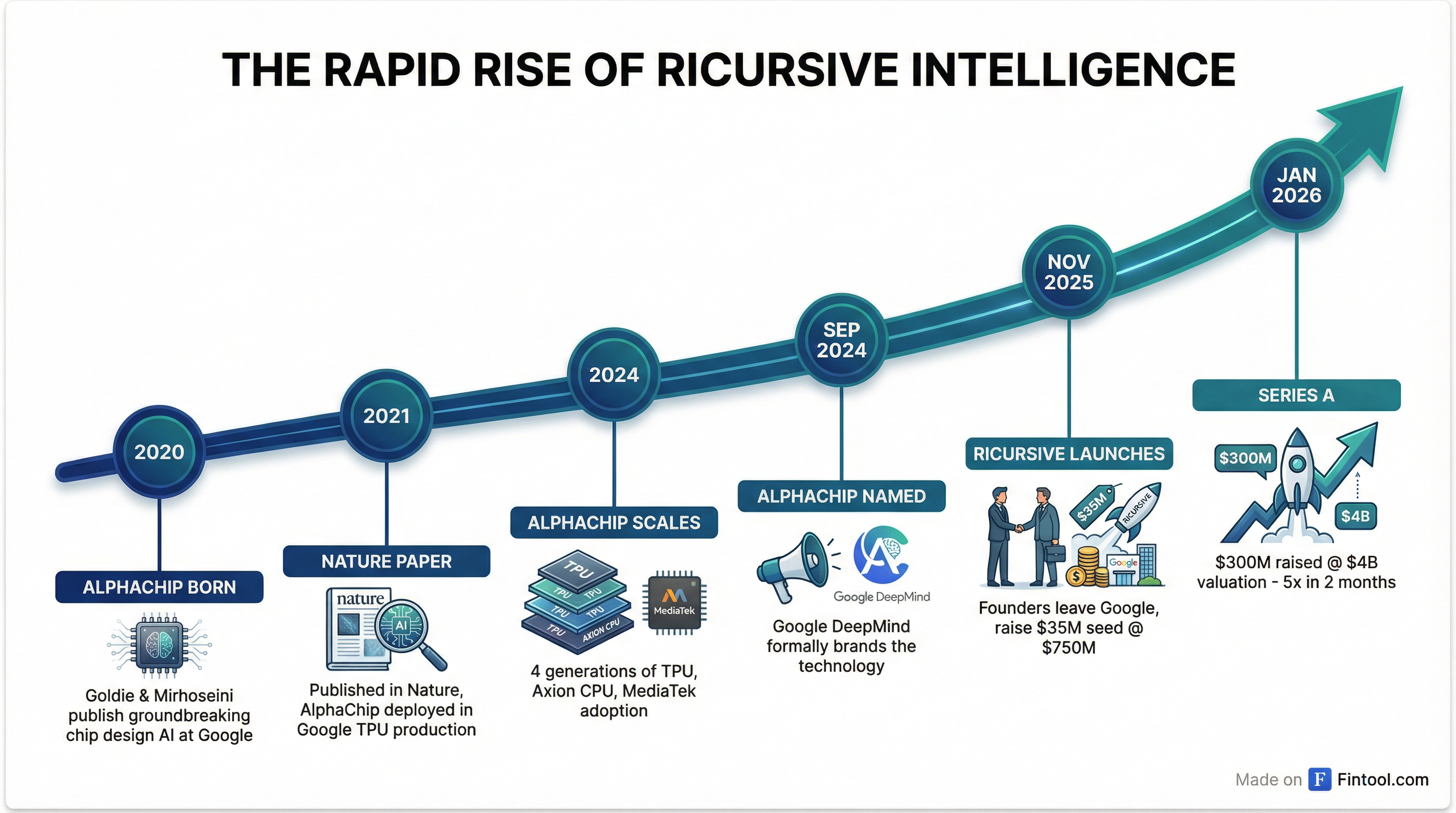
Ricursive Intelligence, the AI chip design startup founded by the creators of Google-2.53%'s AlphaChip, raised $300 million in a Series A round at a $4 billion valuation—just two months after emerging from stealth with a $35 million seed at $750 million.
The round, led by Lightspeed Venture Partners with participation from DST Global, NVentures (Nvidia+7.87%'s venture arm), Felicis Ventures, 49 Palms Ventures, Radical AI, and Sequoia Capital, brings total funding to $335 million.
"The pace of AI progress is dictated by hardware," said Dr. Anna Goldie, co-founder and CEO. "Ricursive's mission is to radically accelerate chip design, and ultimately to use AI to design its own silicon substrate."
The AlphaChip Pedigree
Ricursive isn't vaporware promising future capabilities. Its founders have already transformed how chips are designed.
Dr. Goldie and co-founder Dr. Azalia Mirhoseini created AlphaChip at Google DeepMind—a deep reinforcement learning system that treats chip floorplanning like a game. The AI places components one at a time, receives feedback on placement quality, and iteratively improves. What takes human engineers weeks or months, AlphaChip produces in hours.
The technology isn't a research demo. It has been deployed in production across four generations of Google's TPU chips, Axion (Google's Arm-based CPU), and has been adopted by external semiconductor companies including MediaTek.
"This is the team that blazed the trail of AI-enabled chip design," wrote Lightspeed in its investment announcement. "Now they're building the full-stack platform to operationalize it at scale and usher in a Cambrian explosion of custom silicon."
 Ask Fintool AI Agent
The Recursive Loop Thesis
Ricursive's core thesis addresses what it calls the primary bottleneck to AI progress: chip design itself.
The semiconductor design cycle takes 2-4 years from conception to production. As AI models grow larger and more demanding, this timeline creates a fundamental constraint. Better AI requires better chips, but designing those chips takes years of human engineering effort.
Ricursive aims to close this loop. If AI can design better chips faster, those chips can train better AI models, which can design even better chips—a recursive improvement cycle that could dramatically accelerate AI progress.
"To advance the state of the art in AI, we must operate at the Pareto frontier of intelligence and computational efficiency," said Dr. Mirhoseini, co-founder and CTO. "Ricursive is building toward a future where rapid AI and hardware co-evolution becomes reality."
The $4 Billion Cohort
Ricursive is not alone in commanding billion-dollar valuations for AI hardware moonshots. A remarkable pattern has emerged: three startups, all founded in late 2025, all pursuing variations of the same thesis, all valued at roughly $4-5 billion.
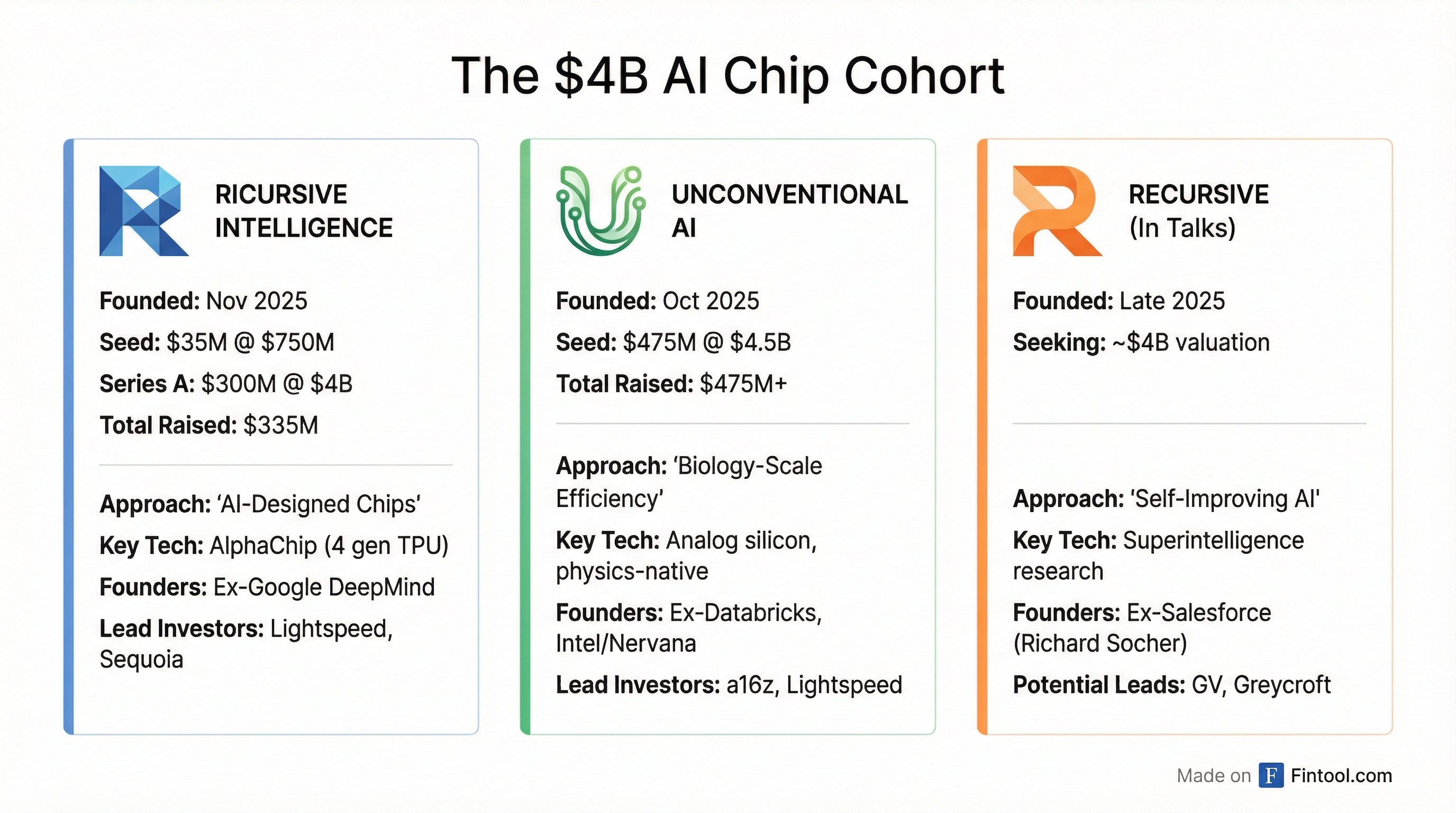
Unconventional AI (Naveen Rao): The former head of AI at Databricks raised $475 million in seed funding at a $4.5 billion valuation in December 2025—the first portion of a potential $1 billion round. Rao, who previously sold Nervana Systems to Intel and MosaicML to Databricks, is building analog chips that run neural networks on "the intrinsic physics of silicon" rather than digital abstractions.
Recursive (Richard Socher): The famed NLP researcher and former Salesforce chief scientist is in talks to raise hundreds of millions at a $4 billion valuation for a startup focused on self-improving AI systems. GV (formerly Google Ventures) and Greycroft are reportedly in discussions to lead the round.
The three startups represent different approaches to the same fundamental problem: AI scaling is hitting hardware walls, and the solution may require rethinking how we design and build computing infrastructure from first principles.
Ask Fintool AI AgentThe Founder Profile
The founders' backgrounds add credibility to the $4 billion valuation.
Anna Goldie holds a PhD in computer science and previously worked at Google Brain and DeepMind. Beyond AlphaChip, she was named to MIT Technology Review's 35 Under 35.
Azalia Mirhoseini received a PhD from Rice University (Best ECE Thesis Award) and is an Assistant Professor at Stanford running the Scaling Intelligence Lab while also serving as a Senior Staff Scientist at DeepMind. Beyond AlphaChip, she co-authored the foundational Mixture-of-Experts (MoE) paper in 2017—the architecture that now powers most frontier LLMs including GPT-4 and Gemini.
The two have collaborated for nine years, starting at Google Brain on the same day. The AlphaChip project began when both were independently drafting a moonshot proposal for "AI for chip design"—before Jeff Dean emailed them the same idea.
Ricursive has assembled a team from Google DeepMind, NVIDIA, Apple, and Cadence, bringing deep expertise across AI, chip design, and the intersection of both.
Nvidia's Strategic Interest
NVentures' participation is notable. NVIDIA, the dominant supplier of AI chips, is investing in a company that could fundamentally change how AI chips are designed—including potentially NVIDIA's own products.
The investment signals that even the incumbent recognizes the transformative potential of AI-driven chip design. If Ricursive succeeds in dramatically compressing design cycles, it could enable a proliferation of custom silicon that challenges NVIDIA's one-size-fits-all GPU approach—or it could make NVIDIA's own chips better, faster.
The presence of investors like Sequoia, DST Global, and Felicis—all with deep AI portfolios—suggests broad confidence that the hardware-software co-evolution thesis represents a genuine inflection point.
What to Watch
Execution timeline: Ricursive has production-scale results from its time at Google. The question is whether it can operationalize those capabilities as a standalone platform and attract customers.
Competitive dynamics: Three well-funded startups pursuing similar visions will compete for talent, customers, and mindshare. The market may ultimately support one dominant platform or fragment into specialized approaches.
Incumbents' response: Traditional EDA (electronic design automation) companies like Synopsys and Cadence have their own AI initiatives. Semiconductor giants may develop in-house capabilities or acquire emerging players.
Path to AGI: Ricursive explicitly frames its work as advancing toward artificial general intelligence. Whether closing the AI-hardware loop accelerates or merely enables AGI remains theoretical—but investors are clearly betting on the possibility.
The $335 million will fund scaling of the research team and significant expansion of compute infrastructure. The recursive loop between AI and hardware may be moving from theory to implementation.
Ask Fintool AI AgentRelated: