Rio Tinto and BHP Join Forces in Historic Pilbara Partnership
January 14, 2026 · by Fintool Agent


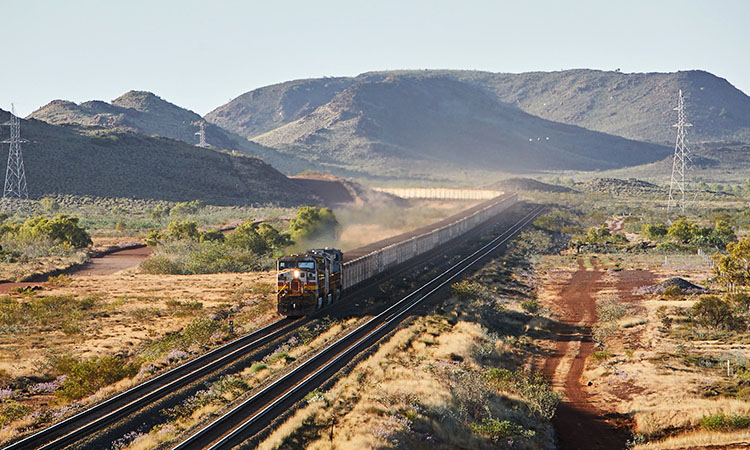
The world's two largest mining companies are joining forces. Rio Tinto and BHP announced Wednesday they will collaborate to extract up to 200 million tonnes of iron ore from neighboring deposits in Australia's Pilbara region—a move that leverages existing infrastructure while minimizing the capital investment typically required for greenfield development.
The deal comes as both companies grapple with depleting high-grade ore bodies and a looming need to replace roughly 40% of major producer output over the next decade.
Shares of both miners rallied on the news. Rio Tinto rose 2.7% to $85.88, while BHP jumped 3.2% to $66.02—a new 52-week high.
 Ask Fintool AI Agent
The Deal Structure
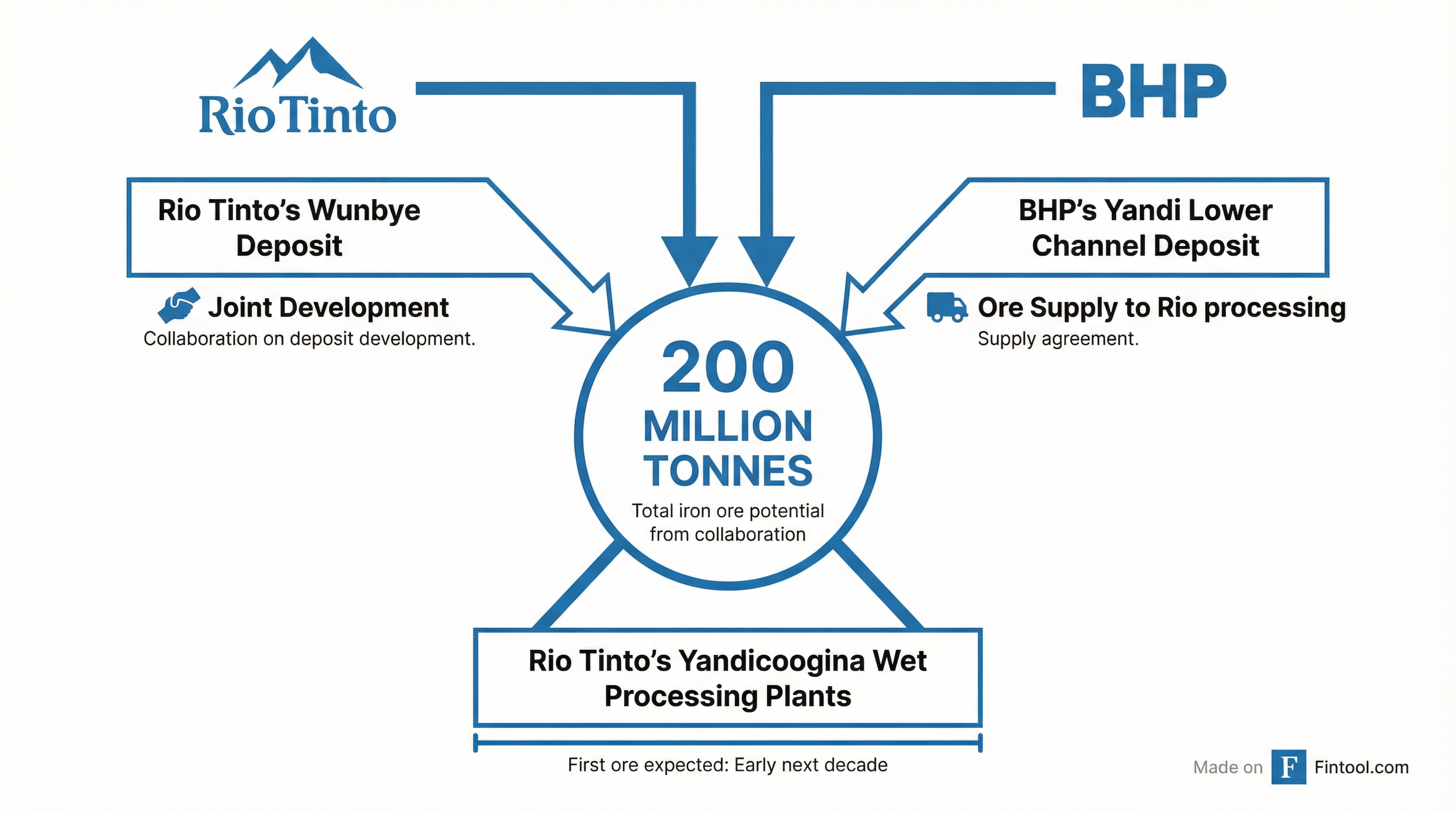
Under two non-binding Memoranda of Understanding, the companies will explore:
- Joint development of Rio Tinto's Wunbye deposit—allowing both companies to share expertise and potentially infrastructure for extraction
- BHP supplying ore from its Yandi Lower Channel Deposit to Rio Tinto—processing through Rio's existing Yandicoogina wet plants under commercial terms
The structure allows both companies to unlock ore that was previously stranded at shared tenure boundaries—and do so without building new processing facilities.
"By working smarter, we can better leverage existing infrastructure to unlock additional production with minimal capital requirements," said Matthew Holcz, Rio Tinto's Iron Ore Chief Executive.
BHP WA Iron Ore Asset President Tim Day framed it as "productivity in action—unlocking new opportunities by making the most of our existing resources."
Building on 2023 Precedent
This isn't the first time these rivals have cooperated. The new MOUs build on a 2023 agreement between Rio and BHP to mine the Mungadoo Pillar—ore located along a shared tenement boundary that was previously inaccessible due to property lines.
That earlier deal proved the concept: competitors can collaborate when infrastructure and geography make it economically rational.
The companies will now progress a conceptual study, followed by an order of magnitude study. Subject to a final investment decision, regulatory approvals, joint venture clearances, and Traditional Owner engagement, first ore is anticipated early next decade.
The Depletion Problem
The timing is no coincidence. Both Rio Tinto and BHP are facing an uncomfortable reality: the Pilbara's richest ore bodies are being exhausted.
Rio Tinto's CEO Jakob Stausholm addressed this directly on the company's H1 2025 earnings call: "Every mine goes towards depletion... The most evident thing is you can see that all the producers in the Pilbara are facing lower grade."
The math is stark. Rio's CFO Peter Cunningham noted that the contestable iron ore market totals roughly 1.9 billion tonnes annually—and "over the next ten years, we expect 40% of production from the majors needs to be replaced."
| Metric | Rio Tinto (FY 2024) | BHP (FY 2025) |
|---|---|---|
| Revenue | $53.7B* | $51.3B* |
| EBITDA | $19.1B* | $23.4B* |
| EBITDA Margin | 35.5%* | 45.7%* |
| Capex | $9.6B* | $9.8B* |
*Values retrieved from S&P Global
With Simandou's 120 million tonnes of new Guinea supply coming online and pushing out high-cost producers, the majors need low-cost replacement tonnes more than ever. The Pilbara collaboration provides exactly that.
Ask Fintool AI AgentCapital Discipline in Action
The partnership reflects a broader industry shift toward capital discipline after years of shareholder pressure. Rather than building expensive new mines, both companies are squeezing more value from existing assets.
Rio Tinto has maintained CapEx guidance of approximately $11 billion in 2025 and $10-11 billion thereafter—including about $3 billion annually for growth. The Pilbara collaboration fits perfectly within this framework: growth with "minimal capital requirements."
For BHP, which is also engaged in separate mega-merger talks with Rio Tinto and Glencore, the Pilbara deal represents a more modest—and achievable—form of value creation that doesn't require regulatory scrutiny of a transformational combination.
What to Watch
Regulatory approvals. Implementation requires clearance from Australian regulators and approval from existing joint venture partners at both operations.
Traditional Owner engagement. Both companies have emphasized the importance of engagement with Indigenous communities. Rio Tinto's Juukan Gorge destruction in 2020 remains a cautionary tale for the industry.
Iron ore prices. Current prices remain below the long-term average in real terms. A sustained price recovery would improve the economics of marginally profitable deposits.
Merger speculation. Rio Tinto is already engaged in preliminary discussions with Glencore about a potential combination. Any progress on that front could affect appetite for smaller collaborations.
Ask Fintool AI Agent