Ruger's Former CEO Leaves Board as Gunmaker Brings in Industrial Operators
February 23, 2026 · by Fintool Agent

Sturm, Ruger & Company announced a sweeping board overhaul that removes former CEO Christopher Killoy and former NRA President Sandra Froman while installing three industrial executives with no firearms background—a dramatic pivot for a gunmaker navigating declining demand, Beretta's looming interest, and a costly restructuring.
The changes, effective February 22, mark the departure of the old guard at America's largest publicly traded firearm manufacturer. Five of Ruger's nine board seats have now turned over in the past year, signaling a fundamental governance shift as the company works to stem a 27% revenue decline from its 2021 peak.
What Happened
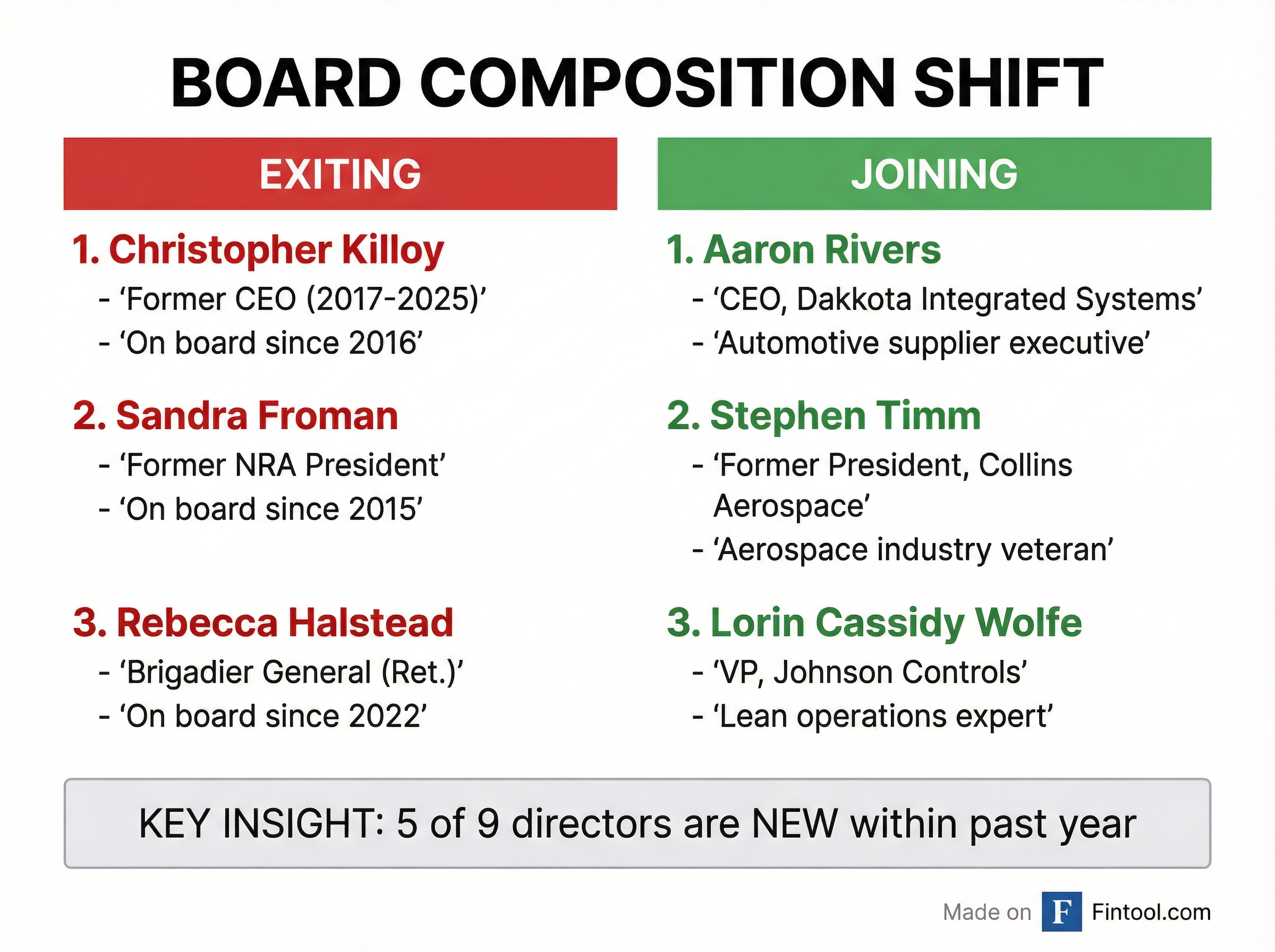
Three directors retired:
- Christopher Killoy – CEO from May 2017 to March 2025, on the board since August 2016
- Sandra Froman – Former NRA President (2005-2007), Ruger director since December 2015, chaired Nominating & Corporate Governance Committee
- Rebecca Halstead – Brigadier General (Retired, U.S. Army), joined the board in May 2022
Three new independent directors were elected immediately:
- Aaron Rivers – CEO of Dakkota Integrated Systems, a $1.2 billion automotive supplier
- Stephen Timm – Former President of Collins Aerospace, the $28 billion RTX subsidiary
- Lorin Cassidy Wolfe – VP of Business System at Johnson Controls, former Danaher executive
The 8-K explicitly states the retirements were "not by reason of any disagreement with the Company."
Why It Matters
The Killoy Exit Is Notable
Just one year ago, Killoy told shareholders he "look[ed] forward to continuing to serve on the Ruger Board of Directors" after stepping down as CEO. His departure now, alongside the activist-opposed Froman, suggests the company is accelerating its transition away from industry insiders.
Killoy led Ruger through the pandemic-era firearms boom, when revenue hit $731 million in 2021 and shares touched $90. But the subsequent normalization has been painful:
| Metric | FY 2021 | FY 2024 | Change |
|---|---|---|---|
| Revenue | $730.7M | $535.6M | -27% |
| Net Income | $155.9M | $30.6M | -80% |
| Diluted EPS | $8.78 | $1.77 | -80% |
| Gross Margin | 38.3% | 21.4% | -1,690 bps |
Stock Has Struggled Under Recent Leadership
Ruger shares traded at $59.25 when Killoy became CEO in May 2017. Today, they trade around $38—a 35% decline excluding dividends. The stock peaked near $90 during the COVID gun-buying surge in 2021 but has given back nearly all those gains.
 Ask Fintool AI Agent
The New Directors Signal Operational Focus
The incoming directors share a common profile: lean manufacturing expertise, complex industrial operations, and no prior firearms industry experience.
Aaron Rivers has spent 25 years in automotive, aerospace, and industrial sectors. At Dakkota, he reshaped operations at the $1.2 billion Tier 1 auto supplier. Previously, he ran global operations at Pall Corporation (Danaher) with P&L responsibility exceeding $1.8 billion.
Stephen Timm led Collins Aerospace's 80,000 employees until July 2024. He guided the $26 billion company through the UTC-Raytheon merger and post-COVID aviation recovery.
Lorin Cassidy Wolfe runs global continuous improvement at Johnson Controls and previously served as a private equity partner and Danaher divisional executive. Her expertise in lean business systems aligns with the operational transformation CEO Todd Seyfert announced in June 2025.
Board Chair John Cosentino framed the changes as bringing "leadership experience in global manufacturing and technology organizations with robust business systems."
Context: Restructuring and Beretta's Interest
The board changes come amid significant turmoil at Ruger:
Restructuring Underway: In June 2025, new CEO Todd Seyfert announced $15-20 million in restructuring costs for 2025, including inventory write-downs, organizational realignment, and severance.
Recent Layoffs: Earlier this month, Ruger cut 63-90 jobs at its Newport, New Hampshire facility—the town's largest employer—citing "cost misalignments."
Beretta Lurking: In October 2025, Ruger adopted a poison pill after Italian gunmaker Beretta disclosed a "significant economic interest" and expressed desire to discuss "operational and strategic collaborations." The rights plan expires October 2026.
Industry Headwinds: CEO Seyfert noted in November 2025 that firearms demand is "below pre-2019 levels," with NICS background checks down roughly 4% year-over-year.
Ask Fintool AI AgentWhat to Watch
March 2, 2026: Ruger reports Q4 and full-year 2025 results after the close. Given the restructuring charges and layoffs, expect significant earnings pressure.
October 2026: The poison pill expires. Whether Beretta makes another move—or a formal acquisition offer—could depend on Ruger's progress under the new board.
Board Committee Assignments: The company hasn't yet assigned the new directors to committees. Watch for whether operational experts land on the Nominating and Compensation committees previously chaired by departing directors.
The Bottom Line
Ruger is shedding its firearms-industry-insider board in favor of industrial operators who know lean manufacturing, supply chains, and complex transformations. For a gunmaker that's seen revenue fall 27% in three years and faces interest from a strategic acquirer, the pivot makes sense.
The question is whether it comes in time. With the poison pill ticking down, margins compressed, and demand soft, Ruger's new board will need to demonstrate operational progress quickly—or risk becoming a more attractive target for Beretta at a depressed valuation.
Ask Fintool AI AgentRelated: Ruger (rgr)