Ryder CEO Sanchez Sees $250M+ Earnings Upside as Freight Recovery Looms
February 17, 2026 · by Fintool Agent

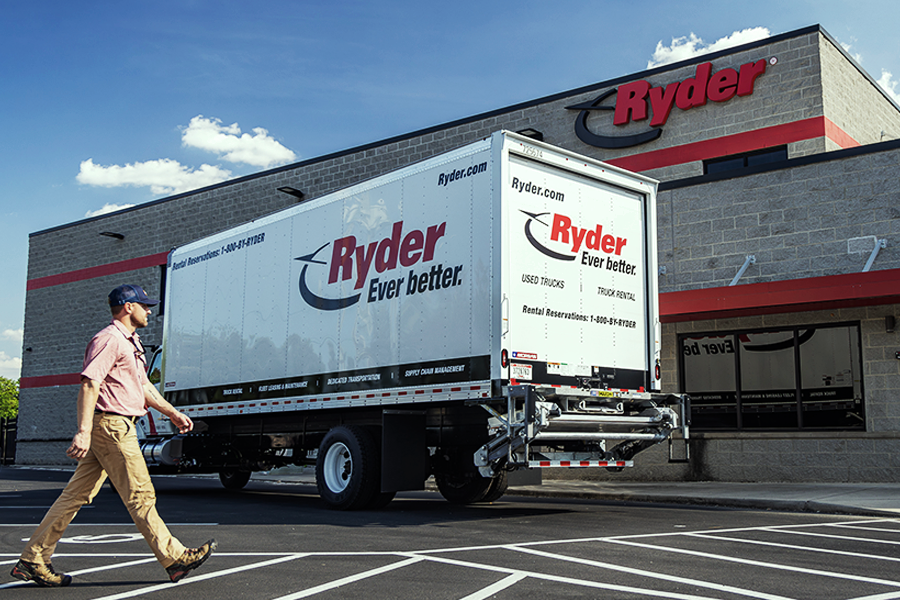
Outgoing Ryder CEO Robert Sanchez, speaking at the Citi Global Industrial Tech and Mobility Conference in Miami Beach today, quantified over $250 million in pre-tax earnings upside waiting to be unlocked as the freight market recovers—none of which is embedded in 2026 guidance.
"We did not assume any macro improvement," Sanchez told Citi transportation analyst Ben Mohr. "That $250 million benefit will accrue between now and when the market begins to turn up."
The remarks cap a transformative 13-year tenure for Sanchez, who will hand the reins to President and COO John Diez on March 31. Shares of Ryder rose 1.4% to $216.74 on the session, extending a 38% year-to-date rally that has pushed the stock within striking distance of its 52-week high of $230.39.
The Transformation Story: $6 to $13 EPS
Sanchez opened with a pointed comparison: In 2018, at the peak of the freight cycle, Ryder earned just under $6 per share. In 2025—a freight market trough—the company delivered nearly $13 per share.
"That's the tale of the tape of the transformation," Sanchez said.
The turnaround, launched in 2019 under what Ryder calls its "balanced growth strategy," rested on three pillars:
- De-risk the business model — Lowered residual value assumptions on truck leases, reducing exposure to used vehicle market volatility
- Improve returns — Raised lease pricing and optimized maintenance operations, exceeding an initial $100 million savings target
- Accelerate asset-light growth — Shifted revenue mix toward supply chain and dedicated transportation through organic growth and acquisitions
| Metric | 2018 (Peak) | FY 2025 (Trough) | Change |
|---|---|---|---|
| Comparable EPS | $6 | $13* | +117% |
| Return on Equity | 13%* | 17%* | +400 bps |
| Asset-Intensive Revenue Mix | 56%* | 38%* | -18 ppts |
*Values retrieved from S&P Global
The results speak for themselves: Return on equity improved from 13% in 2018 to 17% in 2025, with management targeting "low twenties" ROE over the cycle.
 Ask Fintool AI Agent
Segment Deep Dive: Where the Growth Comes From
Ryder operates three segments, and the conference provided granular guidance on each:
Supply Chain Solutions (43% of revenue) — The Growth Engine
SCS, which includes 300+ warehouses and over 100 million square feet of space, represents Ryder's largest growth opportunity. Sanchez confirmed strong contractual sales in 2025 that will "bleed into" 2026, with the segment expected to approach double-digit growth rates by year-end.
Margins remain resilient at 8.7% in 2025, with management guiding to target levels around 9%.
"Our ability to execute well for our customers and drive continuous improvement is what helps us win," Sanchez said, noting that automation has become "more broadly available and applicable" across warehouse operations.
Fleet Management Solutions (38% of revenue) — Waiting for the Freight Cycle
FMS, the traditional truck leasing business, remains leveraged to the freight market. Revenue was flattish in 2025 with margins around 10%, below the low-teens target.
Key catalysts to watch: rental utilization, used truck pricing, and leading indicators like the Purchasing Managers' Index (PMI) and FTR's active truck utilization metric—which has been above 95%, typically a bullish signal.
"There's usually a 6-month lag between when the spot market picks up and when we start to see people needing to rent trucks or buy used trucks," Sanchez explained.
Dedicated Transportation (19% of revenue) — Driver Market Dependent
The dedicated segment, which provides trucks AND drivers to operate private fleets, benefits from tighter driver markets. Revenue declined 1.6% in 2025 but margins held at 7.6%.
"When it's hard to hire a truck driver, that's really good for dedicated," Sanchez noted, pointing to government policies around non-domiciled CDLs and safety/insurance complexity as tailwinds.
The $250 Million Question: Where the Upside Lives
Management has quantified multiple sources of incremental earnings:
| Upside Source | Pre-Tax Earnings Impact | Timing |
|---|---|---|
| Remaining Initiatives | $70M | 2026 |
| Freight Market Recovery | $250M+ | Market-dependent |
| Contractual Growth at Target | $50M+ annually | Ongoing |
Initiatives — Ryder upsized its multi-year initiative target from $150M to $170M, with the final $70M to be delivered in 2026.
Freight Recovery — The $250M+ figure captures improvements in rental utilization and used vehicle sales as the freight market normalizes.
Organic Growth — Simply hitting target growth rates in contractual businesses (lease, dedicated, supply chain) should deliver $50M+ in annual pre-tax earnings.
Ask Fintool AI AgentLeadership Transition: John Diez Takes the Wheel
Sanchez will hand CEO duties to John Diez on March 31, 2026, remaining as Executive Chair to ensure continuity.
Diez, 54, has been with Ryder for over 20 years, serving as CFO, president of fleet management, and most recently as President and COO.
"He makes great decisions, and he's a great leader for the company going forward," Sanchez said. "A real focus around innovation and technology as the market continues to evolve."
The transition comes amid what Sanchez characterized as a "fifth or sixth inning" of the transformation, with the heavy lifting on portfolio mix complete but continued evolution expected in automation and service offerings.
AI and Technology Investments
Ryder is deploying AI across three vectors:
-
Customer-Facing Systems — RyderShare (supply chain/dedicated) and RyderGuide (fleet management) are incorporating AI to optimize operations and provide customer insights
-
Baton Acquisition — A technology company acquired through Ryder Ventures four years ago, now expanded from 5 to 40-50 engineers in Silicon Valley, building optimization software for fleet operations
-
Back-Office Automation — AI-enhanced call centers and operational processes to improve efficiency
On warehouse automation, Sanchez noted a shift: "If you go back five years ago, a very small percentage of our warehouses had automation because there wasn't really a business case for it. That has shifted."
Capital Allocation: $700-800M Free Cash Flow
Ryder guided to $700-800 million of free cash flow in 2026, with capital allocation priorities ranked as:
- Organic growth — Investment in rental fleet if freight market tightens
- Acquisitions — Looking for tuck-ins like Cardinal (co-manufacturing/co-packaging)
- Dividends — Maintaining 49+ year streak of uninterrupted payments
- Buybacks — 23% of company repurchased over last 5 years
Valuation and Estimates
| Metric | FY 2025 | FY 2026E | FY 2027E |
|---|---|---|---|
| Revenue | $12.67B* | $12.92B | $13.67B |
| EPS | $12.92* | $14.13 | $16.60 |
| P/E (at $217) | 16.8x | 15.4x | 13.1x |
*Values retrieved from S&P Global
Analysts have a consensus price target of $227.22, implying 5% upside from current levels. The stock trades at 15.4x forward earnings—a discount to the S&P 500—with meaningful earnings acceleration expected if freight markets recover.
Ask Fintool AI AgentWhat to Watch
Near-term catalysts:
- Freight market leading indicators (PMI, FTR active truck utilization, spot rates)
- John Diez's first earnings call as CEO (likely Q1 2026 results in May)
- Supply chain contract implementations accelerating through Q2-Q3
Risks:
- Prolonged freight recession delays $250M earnings recovery
- Used truck market remains depressed longer than expected
- Driver market stays soft, pressuring dedicated growth
As Sanchez concluded: "There's not too many companies that are 93 years old that have the growth spurts that we've had over the last several years. I am confident that the best years of this company are ahead of us."
Related: