Feds Override California, Approve Sable Offshore Pipeline Restart a Decade After Santa Barbara Oil Spill
December 23, 2025 · by Fintool Agent


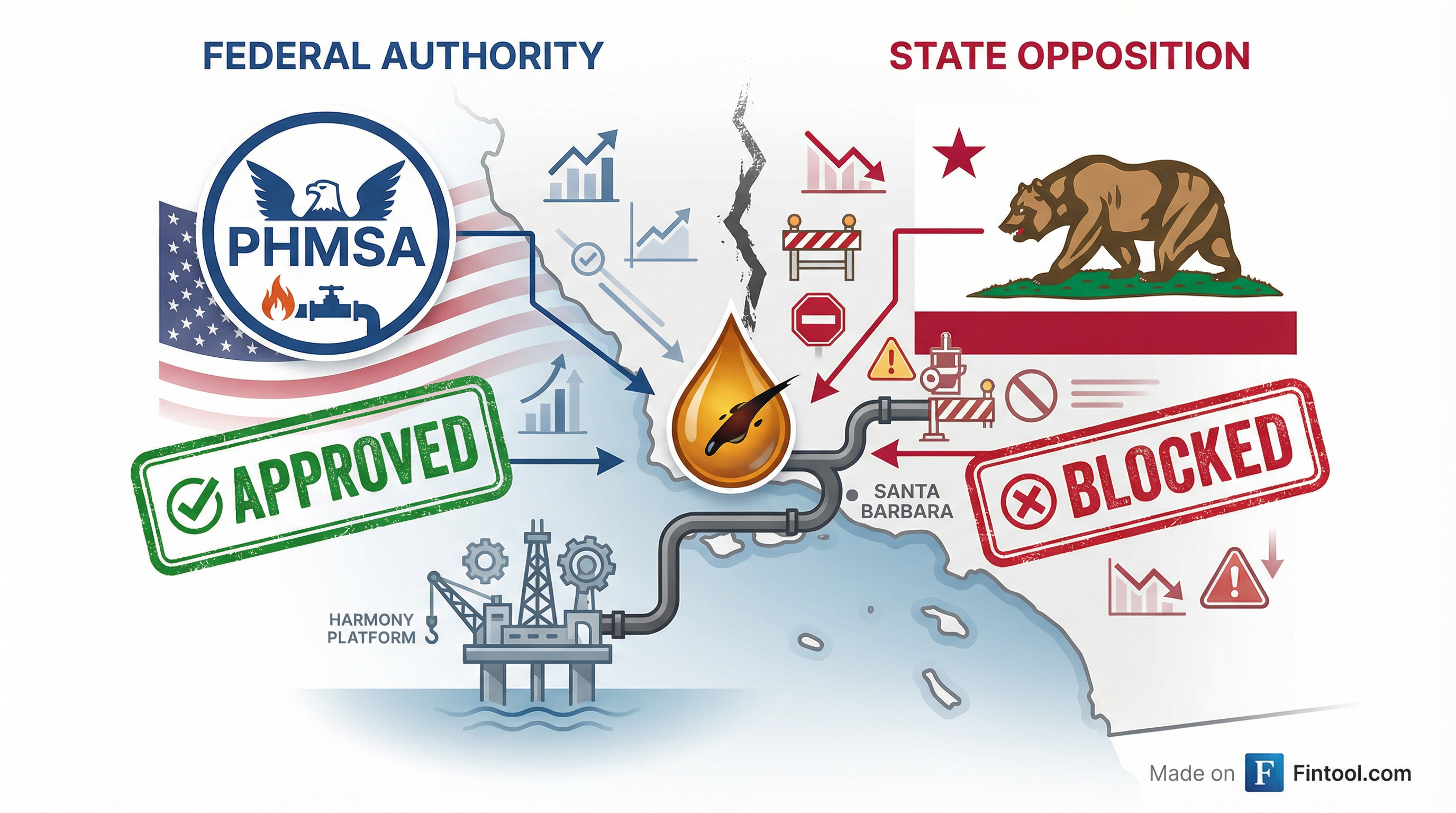
Sable Offshore stock surged 36% on Tuesday after federal regulators approved the company's plan to restart the same pipeline that caused one of California's worst coastal oil spills—bypassing state opposition in what has become a high-stakes battle over energy federalism.
The Pipeline and Hazardous Materials Safety Administration (PHMSA) notified Sable on December 22 that it approved the restart plan for the Las Flores Pipeline System, Lines CA-324 and CA-325—the infrastructure formerly known as Plains Lines 901 and 903 that ruptured in May 2015, releasing 142,800 gallons of crude oil near Santa Barbara's Refugio State Beach.
SOC shares closed at $10.36 on volume of 41.7 million shares—more than 50 times the average—after trading as high as $10.77 intraday. The stock has now doubled from its December lows below $5, though it remains 70% below its 52-week high of $35.
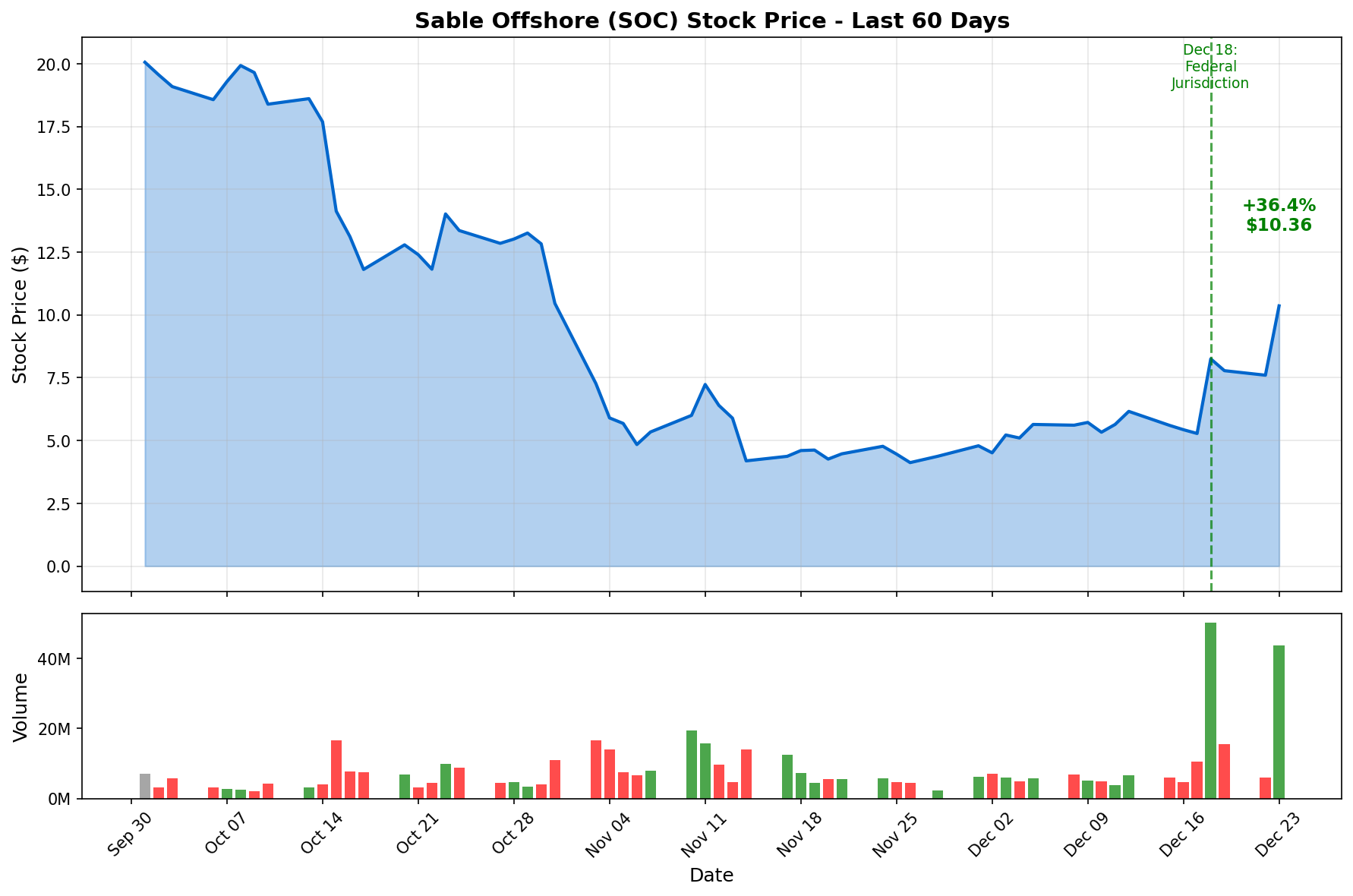
The Federal End-Run
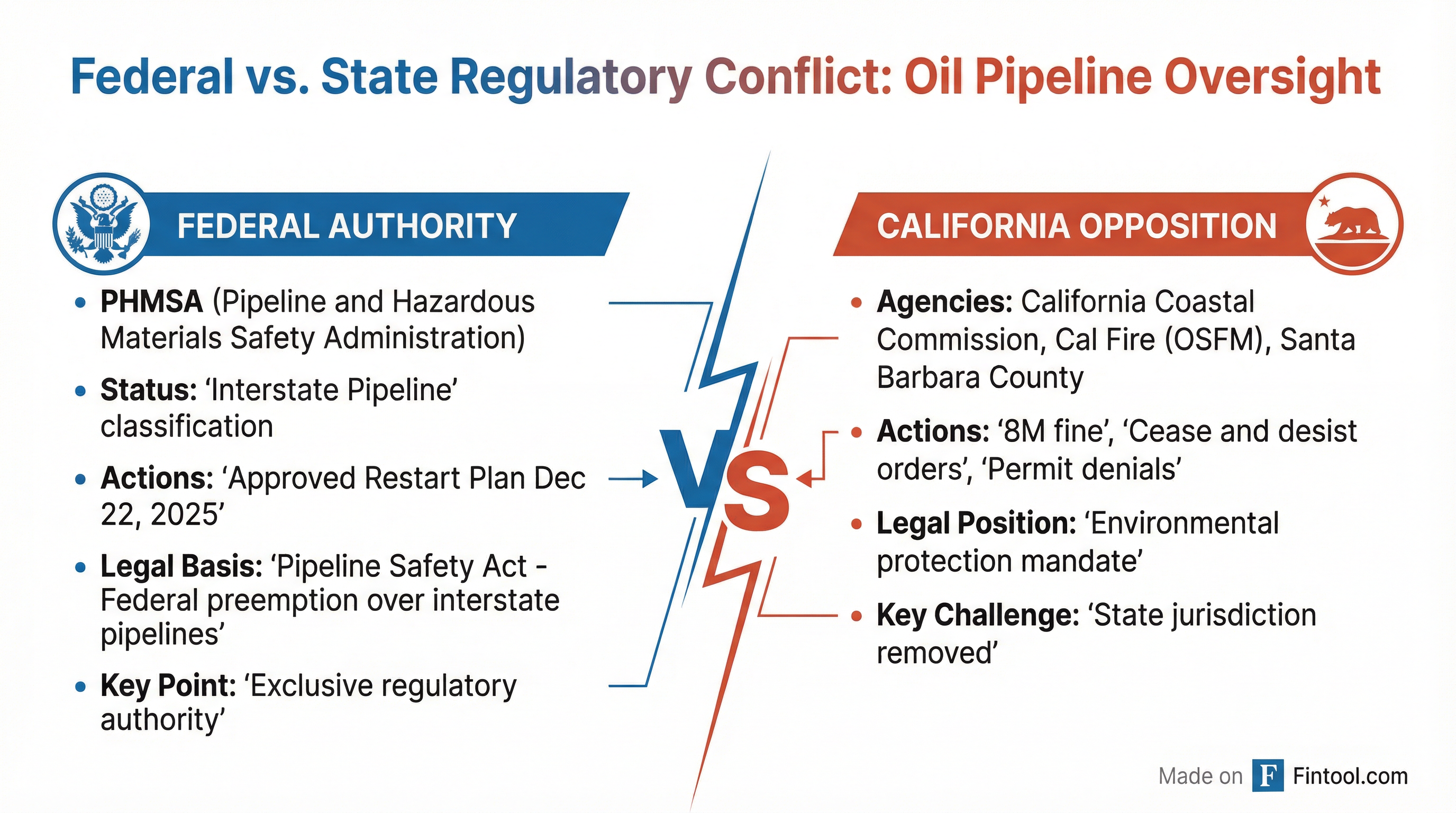
The approval caps a remarkable regulatory reversal. Just five days earlier, on December 17, PHMSA confirmed Sable's determination that the pipeline qualifies as an "interstate" facility under the Pipeline Safety Act—a designation that preempts state regulatory authority and vests exclusive oversight with federal regulators.
The reclassification was based on PHMSA's interpretation that pipelines originating on the Outer Continental Shelf are considered interstate facilities even without a Federal Energy Regulatory Commission tariff—a technical distinction with billion-dollar consequences.
The day before PHMSA's jurisdiction ruling, Santa Barbara County's Board of Supervisors had voted to deny Sable's permit applications, citing "systemic non-compliance" with California regulations.
 Ask Fintool AI Agent
A Decade of Fallout
The 2015 Refugio oil spill remains a defining moment for California's central coast. The ruptured pipeline released crude oil that coated seven miles of shoreline, killed hundreds of birds and marine mammals, and contaminated one of the most biologically diverse stretches of the Pacific Coast.
Plains All American Pipeline, the former operator, was criminally convicted for the spill and paid penalties exceeding $250 million. Exxonmobil acquired the pipeline assets in 2022, then sold them to Sable Offshore in February 2024 for $643 million—financed largely by a $623 million loan from Exxon itself.
That financing structure has raised concerns about whether the thinly capitalized Sable can handle the environmental cleanup and decommissioning liabilities attached to the aging offshore infrastructure.
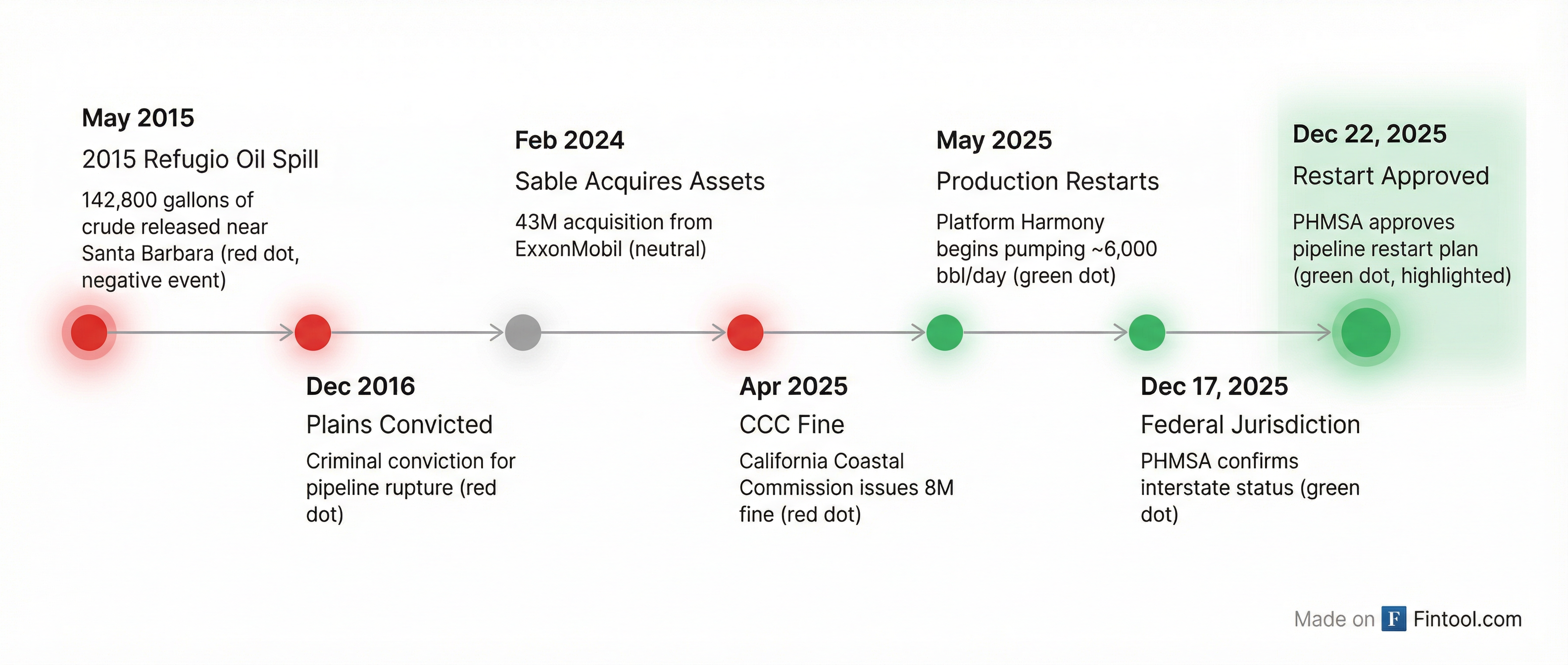
| Event | Date | Significance |
|---|---|---|
| Refugio Oil Spill | May 19, 2015 | 142,800 gallons released, 7 miles of coast oiled |
| Plains Criminal Conviction | Dec 2016 | Company found guilty of pipeline safety violations |
| Sable Acquires Assets | Feb 2024 | $643M purchase from ExxonMobil |
| Platform Harmony Restarts | May 2025 | 6,000 bbl/day production resumes |
| CCC $18M Fine | Apr 2025 | California Coastal Commission penalty |
| PHMSA Interstate Ruling | Dec 17, 2025 | Federal jurisdiction confirmed |
| Restart Plan Approved | Dec 22, 2025 | PHMSA greenlights pipeline operations |
 Ask Fintool AI Agent
California's Opposition
The federal approval came over the vocal objections of virtually every California regulatory agency involved:
California Coastal Commission: Issued two cease and desist orders, fined Sable a record $18 million for unpermitted pipeline repair work, and won a court ruling in October affirming its jurisdiction over coastal development.
Santa Barbara County: Denied permit transfers, with Supervisor Steve Lavagnino citing "too much evidence in the record that shows a pattern of noncompliance and either ignorance of our rules or just blatant disregard."
California Attorney General: Filed a lawsuit over water discharge permit violations.
Central Coast Regional Water Quality Control Board: Filed civil complaints for failure to comply with investigative orders.
Environmental groups including the Surfrider Foundation have demanded that Governor Gavin Newsom and Attorney General Rob Bonta use state powers to block the restart.
The Financial Picture
Sable's corporate situation adds urgency to the regulatory battle. The company is an "emerging growth company" with no revenue until recently and accumulated losses. Its primary asset is the Santa Ynez Unit—three offshore platforms (Harmony, Heritage, and Hondo) that were idle for nearly a decade after the spill.
| Metric | Value |
|---|---|
| Market Cap | $1.03 billion |
| Stock Price | $10.36 (+36.4% today) |
| 52-Week Range | $3.72 - $35.00 |
| Volume Today | 41.7 million (50x avg) |
| YTD Performance | -60% from highs |
| Current Production | 6,000 bbl/day |
Sable raised $250 million in November through a dilutive share offering to avoid defaulting on its Exxon loans. If the company defaults, it may be forced to return the Santa Ynez assets to Exxon—a scenario some observers believe explains Exxon's financing structure.
Ask Fintool AI AgentOffshore Tankering: The Nuclear Option
Even without California's cooperation on the pipeline, Sable has signaled it may pursue an "accelerated OS&T strategy"—using an Offshore Storage & Treatment vessel in federal waters to process and ship oil without touching California soil.
This approach was used from 1981-1994 to produce over 160 million barrels from the same platforms. It would effectively create a floating oil operation beyond California's regulatory reach—though the Coastal Commission would retain federal consistency review authority, and Santa Barbara County's Air Pollution Control District must assess offshore emissions impacts.
The irony is thick: environmental advocates in the 1980s fought to eliminate offshore tankering and bring processing onshore under stricter state oversight. If Sable goes offshore, it would undo decades of hard-won environmental protections.
What to Watch
Federal-State Legal Battle: California agencies may challenge PHMSA's jurisdiction determination in court. The Pipeline Safety Act's preemption of state authority over interstate pipelines has been upheld by courts, but the specific facts here—including the 2015 spill history and recent state regulatory actions—could test those precedents.
Pipeline Restart Timing: With PHMSA approval in hand, Sable can theoretically begin transporting oil from the Las Flores Canyon processing facility to Pentland Station in Kern County. Practical obstacles and potential legal challenges may delay this.
Trump Administration Energy Policy: President Trump's "energy dominance" agenda could accelerate federal efforts to override state environmental objections. The incoming administration's posture toward California's climate and energy regulations will shape this conflict.
Sable's Financial Runway: The company's ability to service its Exxon debt while navigating ongoing litigation will determine whether it remains an independent operator or sees its assets revert to the oil major.
For California, this may be the opening battle in a broader war over federal preemption of state environmental authority—with the ghost of a decade-old oil spill hanging over every barrel that flows through the restarted pipeline.