Samsung's HARMAN Makes $1.8B Bet on Autonomous Driving With ZF Deal
December 23, 2025 · by Fintool Agent


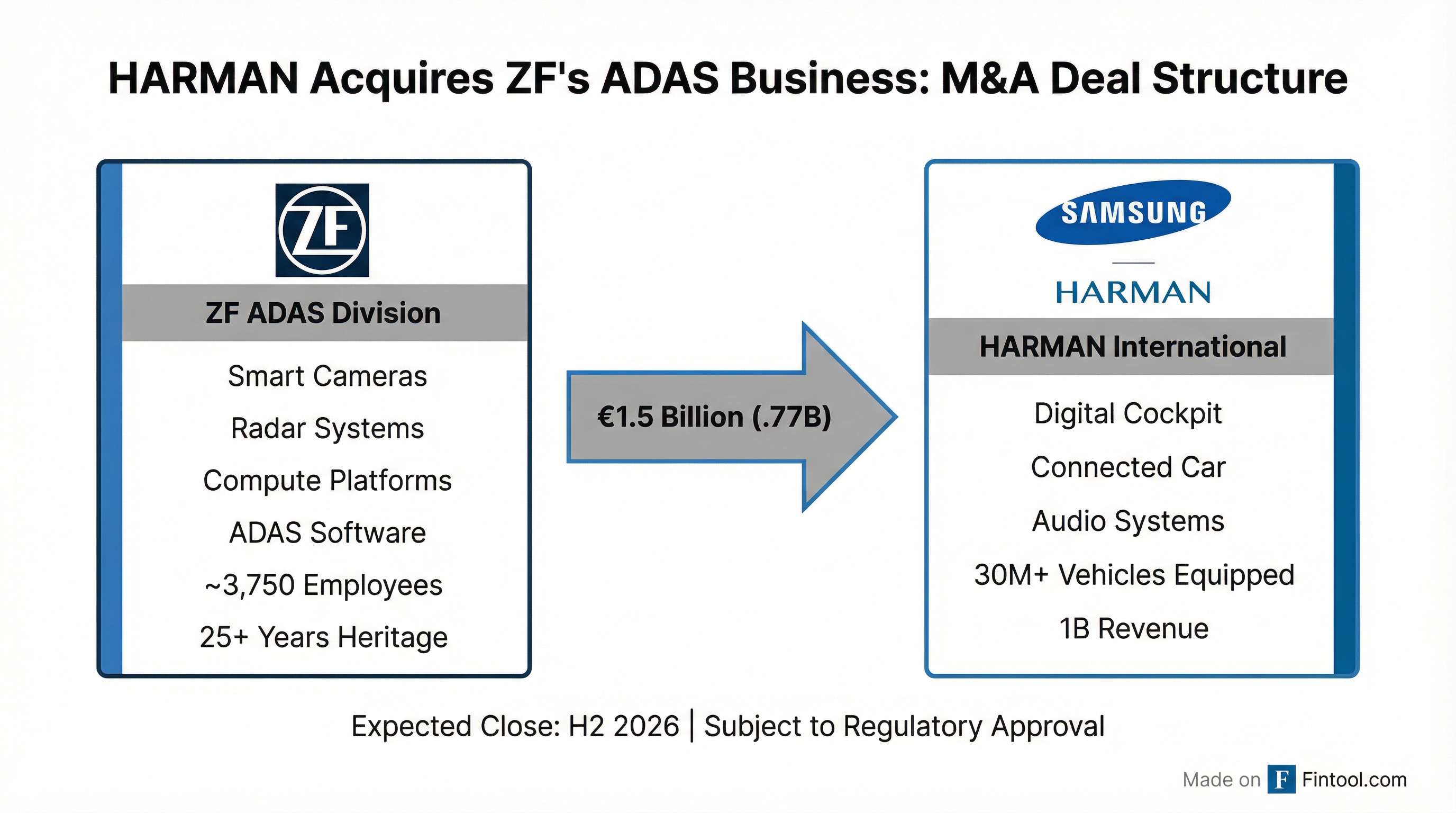
Samsung Electronics is making its biggest move in automotive technology since acquiring HARMAN International in 2017. The Korean tech giant's audio and automotive subsidiary announced today it will acquire ZF Group's Advanced Driver Assistance Systems (ADAS) business for €1.5 billion ($1.77 billion), positioning HARMAN as a full-stack player in the race to build software-defined vehicles.
The deal comes as German auto suppliers hemorrhage jobs and struggle under the weight of weak electric vehicle demand, crushing Chinese competition, and billions in acquisition-era debt. For ZF, the sale offers debt relief and strategic focus. For Samsung, it's a calculated bet that the future of automobiles lies in centralized computing platforms where safety systems and infotainment merge into a single intelligent architecture.
What Samsung Is Buying
ZF's ADAS business represents over 25 years of engineering expertise in the critical sensors and software that help vehicles see, think, and react. The acquisition includes:
| Asset | Description |
|---|---|
| Smart Cameras | Front-facing systems for lane detection, pedestrian recognition, and traffic sign reading |
| Radar Systems | Long and short-range sensors for adaptive cruise control and collision avoidance |
| Compute Platforms | Central controllers that process sensor data and execute driving decisions |
| ADAS Software | Algorithms for emergency braking, lane-keeping, and semi-autonomous features |
Approximately 3,750 ZF employees across Europe, the Americas, and Asia will transfer to HARMAN upon closing, expected in the second half of 2026 pending regulatory approvals.
 Ask Fintool AI Agent
The Software-Defined Vehicle Thesis
The acquisition reflects a profound shift in how vehicles are designed. Traditional cars used dozens of separate electronic control units—one for the engine, another for brakes, another for infotainment. Software-defined vehicles consolidate these functions into centralized computing platforms that can be updated over the air, similar to how smartphones receive software updates.
HARMAN's strategy is to combine ZF's safety-critical ADAS capabilities with its own digital cockpit systems—the screens, speakers, and interfaces that define the in-cabin experience. The result: a single computing architecture where the car's eyes (cameras and radars) communicate seamlessly with its brain (central computer) and its voice (audio and displays).
"The industry is at an inflection point where safety, intelligence, and in-cabin experience must come together through a unified computing architecture," said Christian Sobottka, CEO of HARMAN's automotive division.
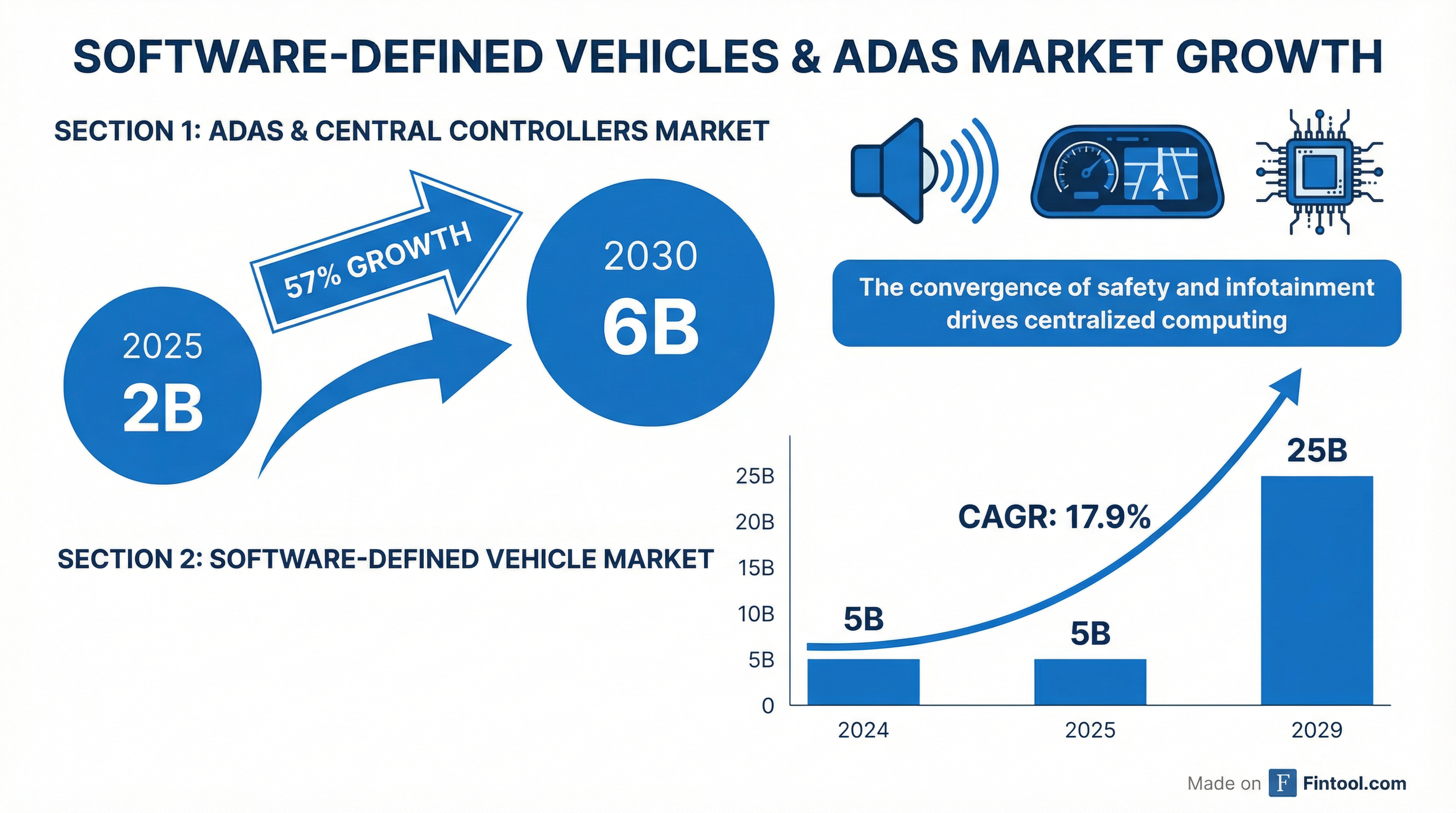
The market for ADAS and centralized vehicle controllers is expected to grow from $42 billion in 2025 to $66 billion by 2030, according to Samsung's estimates. The broader software-defined vehicle market could reach $125 billion by 2029, growing at nearly 18% annually.
Samsung's Automotive Playbook
Since acquiring HARMAN for $8 billion in 2017, Samsung has quietly built one of the world's largest automotive electronics businesses. HARMAN's revenue has grown from $7 billion to over $11 billion today, with more than 30 million vehicles equipped with its connected car and audio systems.
Samsung's approach differs from competitors like Nvidia, which sells AI computing chips to automakers, or Mobileye, which provides turnkey self-driving systems. HARMAN positions itself as a systems integrator that helps traditional automakers navigate the transition to software-defined vehicles without surrendering control to Silicon Valley.
| Company | ADAS Approach | Key Strength |
|---|---|---|
| HARMAN (Samsung) | Integrated cockpit + ADAS platform | OEM partnerships, Samsung tech ecosystem |
| Mobileye | Turnkey vision systems | Computer vision, mapping |
| Nvidia | AI computing platform | Processing power, software stack |
| Qualcomm | Snapdragon Digital Chassis | Connected car, telematics |
| Aptiv | Active safety systems | Electrical architecture |
The ZF deal accelerates HARMAN's ambitions by adding proven ADAS technology that complements rather than replaces its existing strengths. "Combined with HARMAN's long-standing automotive expertise and supported by Samsung's broader technology leadership, this positions us to help OEMs design the next generation of intelligent, empathetic and connected vehicles," Sobottka added.
Ask Fintool AI AgentZF's Calculated Retreat
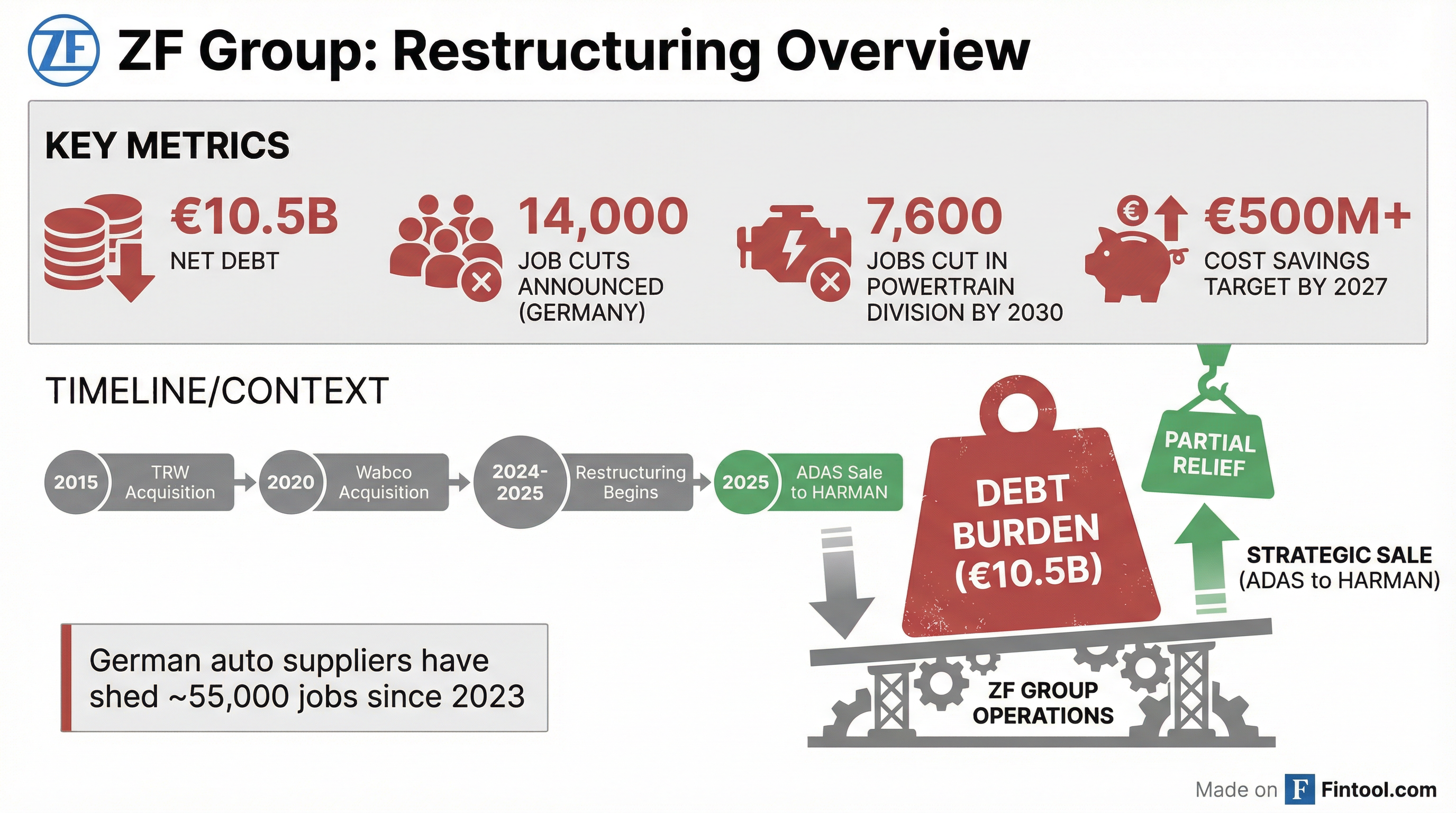
For ZF Friedrichshafen, the sale represents strategic triage. Germany's fourth-largest auto supplier has been battling a debt mountain approaching €10.5 billion, accumulated largely from acquisitions during the low-interest-rate era—most notably TRW in 2015 and brake specialist Wabco in 2020.
The company announced plans last year to eliminate up to 14,000 positions in Germany, part of a broader restructuring that has already shed 11,200 full-time equivalent positions worldwide since early 2024. In October, ZF finalized a deal with its works council to cut 7,600 jobs in its electrified powertrain division by 2030.
CEO Mathias Miedreich, who took over in October after his predecessor departed amid disagreements about divisional strategy, framed the HARMAN deal as both financial relief and strategic focus.
"With HARMAN, we have found the ideal partner to fully unlock the growth and innovation potential of our ADAS business," Miedreich said. "At the same time, this deal makes an important contribution to reducing our company's debt and allows us to focus our resources on the core technologies in which ZF is a global leader."
Those core technologies include transmissions, chassis systems, and commercial vehicle solutions—areas where ZF believes it can maintain competitive advantage against Chinese rivals and emerging EV-focused suppliers.
Ask Fintool AI AgentGerman Auto Industry in Crisis
The ZF-HARMAN transaction is the latest marker of distress in Germany's automotive supply chain. The industry has shed approximately 55,000 jobs since 2023, according to the German automotive association VDA, with suppliers bearing the brunt of the cuts.
Last week, Bosch announced an additional 13,000 job reductions, bringing its total cuts to 27,000 through 2030. Continental and Schaeffler have announced similar restructuring programs. The common threads: weak European demand, uncertainty about EV transition timing, pressure from Chinese competitors who can develop faster and manufacture cheaper, and the overhang of U.S. tariff threats.
"The effects of the powertrain transformation are worse than expected and are hitting our European sites with full force," said Frank Sell, head of the works council at Bosch Mobility.
For Samsung, the chaos represents opportunity. A well-capitalized acquirer can absorb high-quality engineering talent and proven technology at distressed valuations, then leverage global scale to compete in markets where subscale European suppliers struggle.
What to Watch
The deal's success will depend on several factors:
Integration execution: HARMAN must maintain continuity for ZF's existing OEM customers while aligning engineering teams to build next-generation platforms. Safety-critical automotive systems demand flawless transitions.
Competitive response: Mobileye, Nvidia, and Qualcomm are all pursuing variations of the centralized computing vision. The software-defined vehicle market has room for multiple winners, but platform standardization could eventually favor fewer players.
Regulatory scrutiny: Closing is expected in H2 2026, subject to approvals. Given the deal's size and Samsung's existing automotive presence, antitrust review in Europe and elsewhere is likely.
OEM adoption: Traditional automakers must decide how much control they're willing to cede to suppliers. Tesla builds its own systems. Volkswagen and BMW have announced ambitious in-house software efforts. HARMAN's bet is that most OEMs will ultimately partner rather than build.
Ask Fintool AI AgentRelated
- Aptiv PLC — Major ADAS and electrical architecture supplier
- Mobileye Global Inc. — Intel subsidiary focused on autonomous driving
- Nvidia Corporation — AI computing platforms for automotive
- Qualcomm Incorporated — Snapdragon automotive chips and connected car solutions