Shell Posts Weakest Profit in Nearly Five Years, But Maintains $3.5B Buyback While Peers Retreat
February 5, 2026 · by Fintool Agent

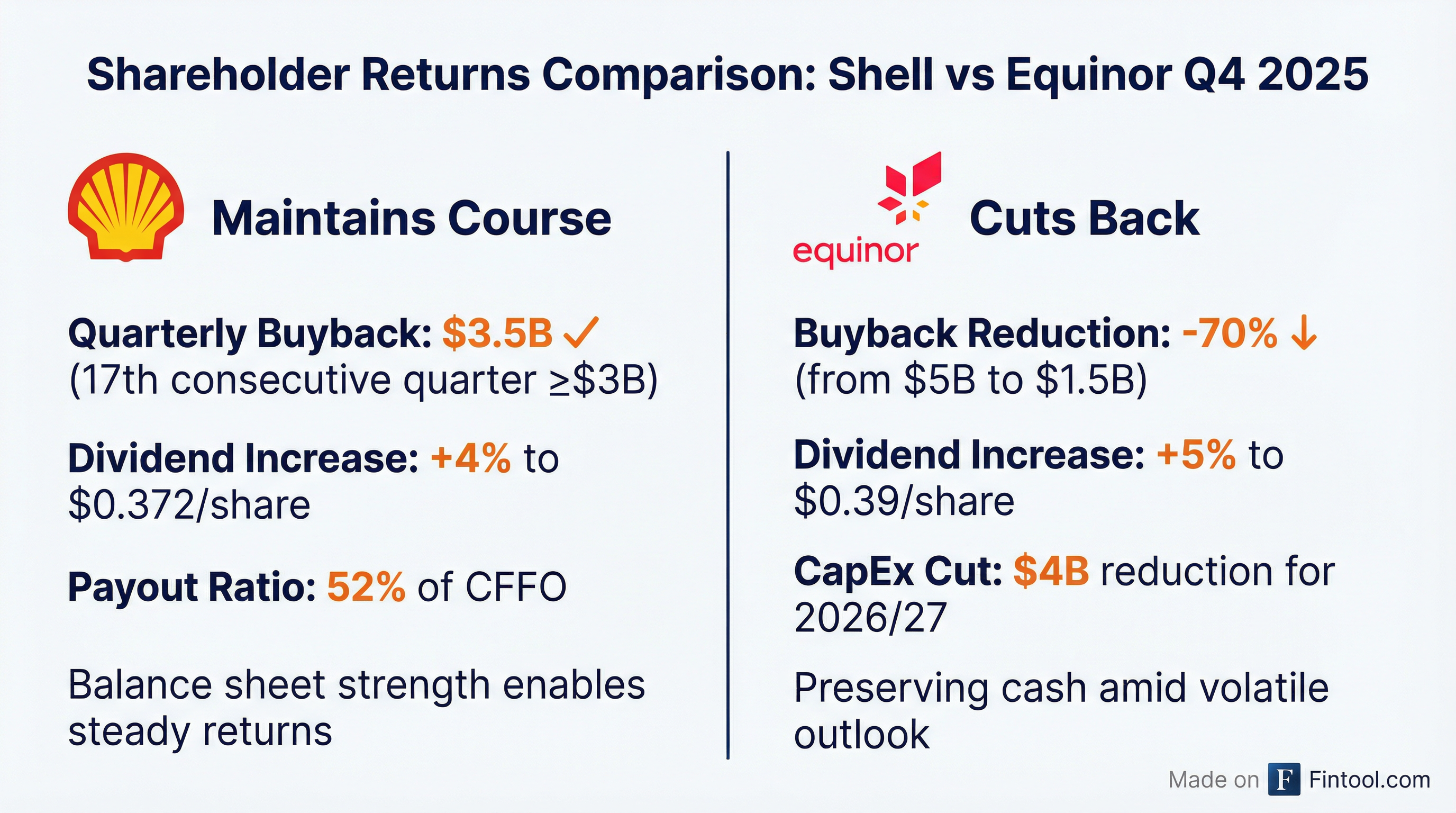
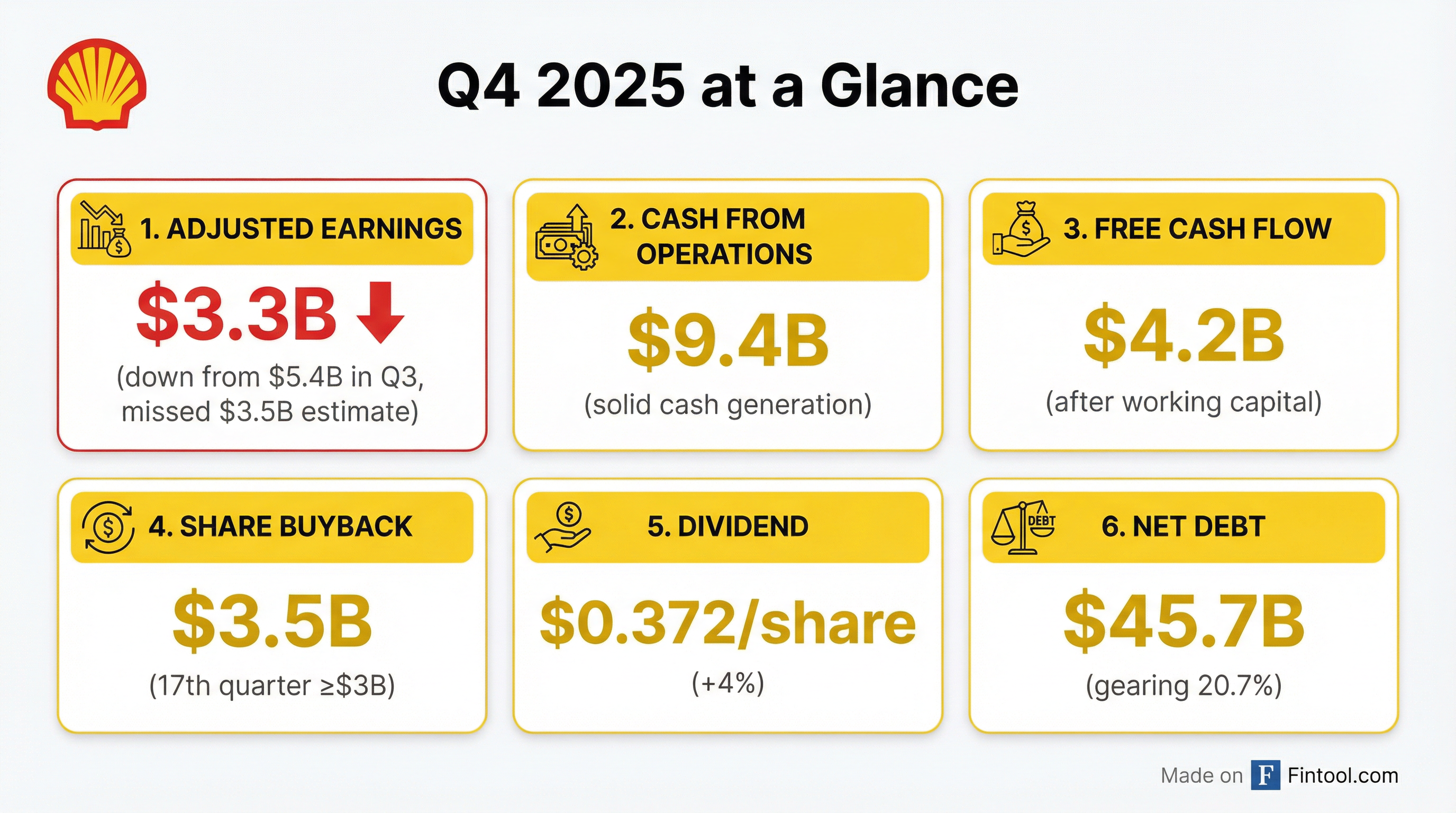
Shell reported its weakest quarterly profit in nearly five years on Thursday, with Q4 adjusted earnings of $3.26 billion missing analyst expectations of $3.51 billion. Yet the British oil major defied investor fears by maintaining its $3.5 billion quarterly buyback program—marking 17 consecutive quarters of at least $3 billion in repurchases—and raising its dividend 4% to $0.372 per share.
The contrast with peers is stark. Just one day earlier, Norway's Equinor slashed its buyback by 70%—from $5 billion to $1.5 billion annually—citing the need to "strengthen free cash flow" amid lower commodity prices. Shell's decision to hold steady on capital returns signals confidence in its balance sheet and operational execution, even as the industry braces for a challenging year.
The Numbers: Profit Miss, Cash Holds
Shell's Q4 adjusted earnings of $3.3 billion represent an 11% decline from Q4 2024 and a sharp drop from the $5.4 billion reported in Q3 2025. The miss came despite strong operational performance in upstream and integrated gas, as several headwinds converged:
- Chemicals losses deepened: The chemicals and products division swung to an adjusted loss of $66 million, down from a $550 million profit in Q3. CFO Sinead Gorman called fixing the chemicals business "a key priority in 2026."
- Trading disappointed: Oil trading and optimization was "seasonally lower" in Q4, weighing on the products segment.
- Tax adjustments: Non-cash tax impacts in joint ventures also pressured results.
For full-year 2025, Shell reported adjusted earnings of $18.5 billion, down 22% from $23.7 billion in 2024. The company generated $42.9 billion in cash flow from operations and $26.1 billion in free cash flow for the year.
 Ask Fintool AI Agent
Why Shell Held the Line on Buybacks
CEO Wael Sawan emphasized that Shell's buyback decision reflects balance sheet strength, not bravado. "We've bought back roughly 25% of our shares over the last three years, at some 20% below where our share price is today," CFO Gorman told analysts. "We still see the buybacks, particularly at this sort of price, as very much value-led."
The math supports the case:
| Metric | Shell | Equinor |
|---|---|---|
| 2026 Annual Buyback | $14B (at $3.5B/quarter) | $1.5B |
| Gearing (Debt/Capital) | 20.7% | 17.8% |
| Q4 2025 Adj. Earnings | $3.3B | $6.2B |
| Reserve Life (years) | 7.8 | 10 |
Shell's 40-50% CFFO distribution target remains "sacrosanct," per Gorman. The company distributed 52% of CFFO in 2025—slightly above target—but management indicated this was acceptable given balance sheet strength.
The Chemicals Problem
The chemicals segment has become a drag on Shell's returns. With margins compressed across the industry, management is pursuing "a few hundred million worth of cost reductions and CapEx reductions" to achieve free cash flow neutrality in the division.
When asked about potential plant shutdowns, Sawan said "nothing is off the table." The company sold its loss-making Singapore chemicals and refinery assets in 2025 and is "looking at constructs that could potentially work" for further portfolio changes, though Sawan emphasized Shell will not sell at the bottom of the cycle.
Ask Fintool AI AgentReserve Life Concerns Surface
Analysts pressed management on Shell's declining reserve replacement ratio. Reserve life has dropped to 7.8 years, down from 8.9 years in 2024—a function of deliberate portfolio choices including the Nigeria SPDC and Canadian oil sands divestitures.
Sawan acknowledged a production gap exists post-2035 but said the company has "largely" closed a 100,000 barrel-per-day gap through 2030 via $2 billion in deepwater bolt-on acquisitions and improved reservoir recovery.
"We want to make sure that the bar continues to be high," Sawan said. "We have a few years to be able to fill that gap... this is not ignoring the issue, but this is de-risking what we can see in front of us."
Management indicated M&A appetite is increasing, but only for accretive deals. "I would say I see more opportunities starting to screen now than we would have a year ago," Sawan noted.
What to Watch
Near-term catalysts:
- BP reports Q4 results February 10—will it follow Equinor's buyback cuts or Shell's steady hand?
- Shell's annual report releases March 12, with updated strategy details
- LNG Outlook publication March 16
Key debates:
- Can Shell sustain 40-50% CFFO distributions if oil falls further?
- How long before chemicals restructuring delivers results?
- Will reserve concerns force M&A at unfavorable prices?
Shell shares traded 1.4% lower on Thursday following the results, underperforming a 1.6% drop in the European energy index. Year-to-date, the stock is up roughly 3.6%.
Ask Fintool AI Agent