Skild AI Hits $14B Valuation After Raising $1.4B in Largest Robotics AI Round
January 14, 2026 · by Fintool Agent


Skild AI raised $1.4 billion in fresh capital, tripling its valuation to over $14 billion in just seven months—one of the largest funding rounds ever for a robotics AI company. The Pittsburgh-based startup is building what it calls the industry's first "omni-bodied brain" capable of operating any robot for any task, positioning it at the center of the emerging Physical AI race.
SoftBank led the round, with Nvidia+7.87%'s venture arm NVentures, Macquarie Capital, Jeff Bezos through Bezos Expeditions, and 1789 Capital also participating. Strategic investors joining include Samsung, LG, Schneider Electric, CommonSpirit, and Salesforce+0.73% Ventures. Existing backers Lightspeed, Felicis, Coatue, and Sequoia doubled down on their investments.
 Ask Fintool AI Agent
The $2 Billion War Chest
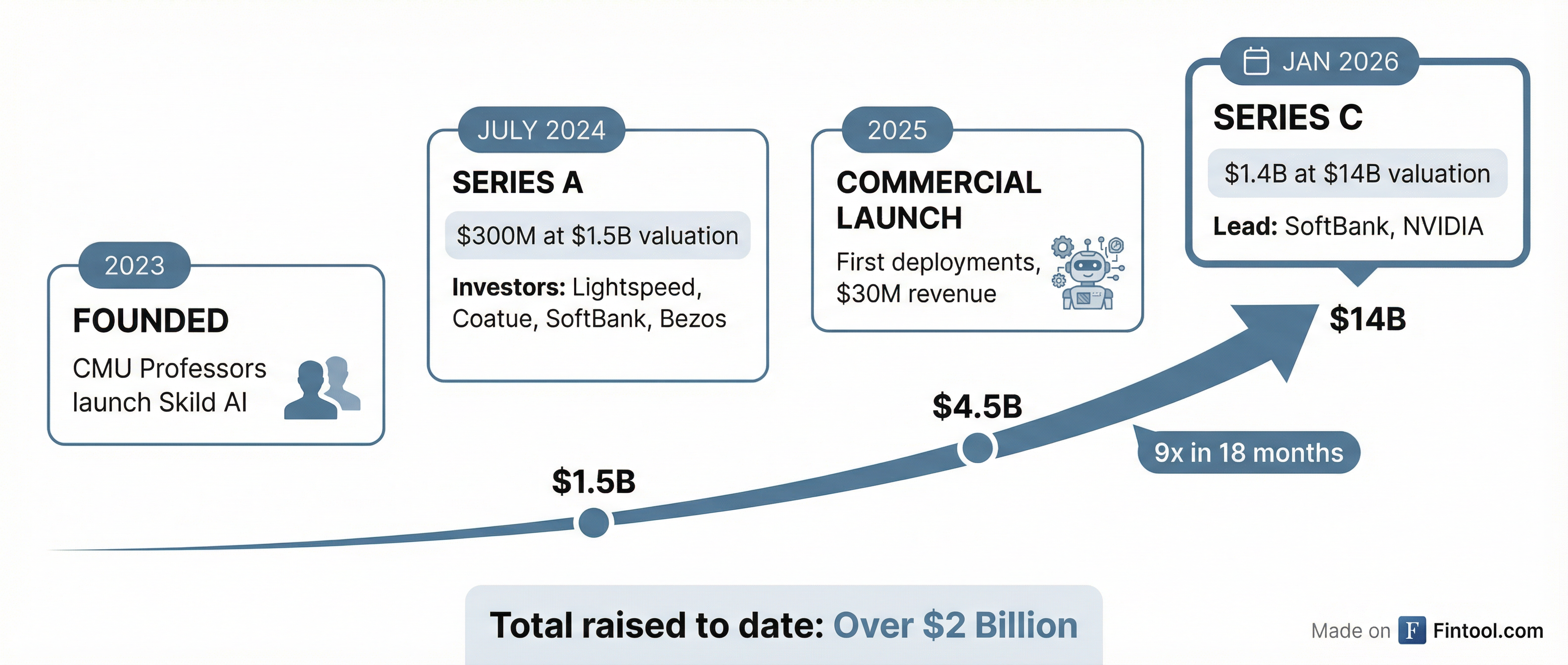
The funding brings Skild AI's total capital raised to over $2 billion since its 2023 founding. The company's ascent has been remarkably fast:
| Round | Date | Amount | Valuation | Key Investors |
|---|---|---|---|---|
| Series A | July 2024 | $300M | $1.5B | Lightspeed, Coatue, SoftBank, Bezos |
| Series B | Summer 2025 | $500M | $4.5B | SoftBank, existing investors |
| Series C | January 2026 | $1.4B | $14B | SoftBank, NVIDIA, Samsung, LG |
The 9x valuation increase in 18 months reflects both Skild AI's technical breakthroughs and the broader investor frenzy around Physical AI—technology that enables machines to navigate and manipulate the real world.
"We believe this omni-bodied learning is essential for building AGI that works reliably in the physical world," said Abhinav Gupta, co-founder and President.
The Carnegie Mellon Pedigree
Skild AI was founded by two Carnegie Mellon professors who left tenured positions to pursue commercial robotics:
Deepak Pathak (CEO) came from a small town in India, taught himself to program by writing code on paper and running it at a local cafe. He earned a gold medal in computer science at IIT Kanpur, completed his PhD at UC Berkeley, and joined CMU's Robotics Institute, where his research on adaptive robot learning has been cited over 50,000 times.
Abhinav Gupta (President) is a tenured professor at CMU's Robotics Institute and founding member of Facebook AI Research (FAIR) Robotics. His work spans robotic manipulation, locomotion, and navigation, with over 75,000 academic citations.
The team has since recruited engineers from Meta, Tesla, NVIDIA, Amazon, and Google.
"Deepak and Abhinav's approach challenges our current notion of AGI—that it can be built by learning from digital knowledge alone," Sequoia's Stephanie Zhan wrote when the firm invested. "In their vision of AGI, we learn by doing."
Ask Fintool AI AgentThe Omni-Bodied Brain: One Model for All Robots
Unlike traditional robotics systems that require extensive retraining for each hardware platform and task, Skild Brain is designed to work across radically different robots—quadrupeds, humanoids, tabletop arms, and mobile manipulators—without prior knowledge of their exact form.
The key technical breakthrough is what Skild calls in-context learning for robotics. When the model encounters a new robot body or unfamiliar environment, it adapts behavior based on live experience rather than requiring offline retraining. This research breakthrough earned best paper nominations at top robotics conferences.
Current deployment use cases span:
- Security and facility inspection
- Last-mile and point-to-point delivery
- Warehouse logistics
- Manufacturing automation
- Data center operations
- Construction tasks
The company reports growing from zero to approximately $30 million in revenue "in just a few months" during 2025, with exponential growth continuing into 2026.
The Physical AI Race Intensifies
Skild AI enters 2026 in a crowded but rapidly expanding market. Global robotics funding hit $13.8 billion in 2025—up from $7.8 billion in 2024 and exceeding the $13.1 billion raised during the 2021 peak.
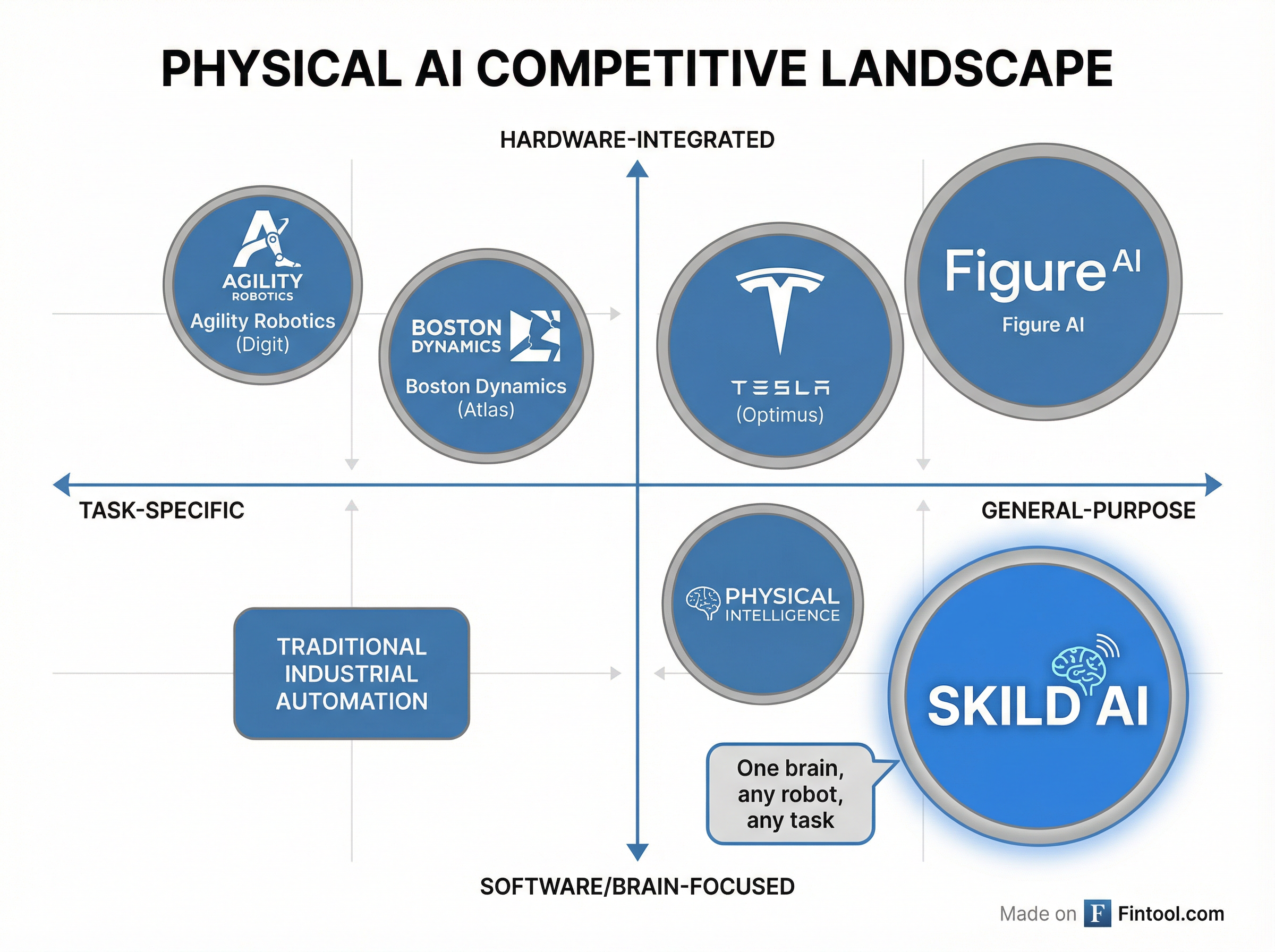
The competitive landscape splits between hardware-focused humanoid manufacturers and software-first foundation model builders:
Humanoid Hardware Leaders:
- Figure AI raised over $1 billion at a $39 billion valuation and is building manufacturing capacity for 12,000 units annually
- Tesla is deploying 5,000+ Optimus Gen 3 units in its own factories, targeting sub-$30,000 consumer pricing by 2027
- Boston Dynamics announced plans for a facility producing 30,000 Atlas robots annually
- 1X Technologies opened consumer preorders for its NEO home robot at $20,000
Foundation Model Competitors:
- Physical Intelligence raised $400 million with backing from Bezos and OpenAI's Sam Altman
- NVIDIA launched Isaac GR00T N1, its own robotics foundation model
- Google DeepMind partnered with Boston Dynamics and Apptronik on robotics AI
What differentiates Skild is its hardware-agnostic approach. Rather than building robots, it builds the brain that can run any robot—potentially making it a picks-and-shovels play in a market where hardware is commoditizing.
"Solving intelligence for the physical world unlocks enormous commercial value and long-term strategic national importance," said Rita Waite, Partner at IQT. "Skild AI is uniquely positioned to do both."
Ask Fintool AI AgentStrategic Implications
The investor roster signals where the major technology players see the robotics opportunity heading:
NVIDIA (via NVentures) extends its AI infrastructure dominance into physical systems. The chipmaker's GPUs already power most robotics training workloads; investing in Skild hedges against its own Isaac GR00T competing platform.
SoftBank is consolidating its robotics portfolio after agreeing to acquire ABB's robotics division for $5.375 billion. Skild represents the AI software layer that could unify diverse hardware investments.
Samsung and LG see consumer home robotics as a battleground adjacent to their appliance businesses. Skild's general-purpose approach could enable the next generation of home automation products.
Salesforce Ventures signals enterprise software integration potential—robotics management through familiar CRM and workflow interfaces.
The Market Opportunity
The numbers underpin the investment thesis:
| Market | 2025 Value | 2035 Projection | CAGR |
|---|---|---|---|
| Global Robotics | $64.8B | $375B | 17.3% |
| Humanoid Robots | $4.3B | $70B | 35% |
| Surgical Robotics | $14.5B | — | — |
Global humanoid robot shipments hit 13,317 units in 2025—modest, but forecast to nearly double annually through 2035, reaching 2.6 million units.
"50% of Global Domestic Product is paying humans to do work every day—human labor amounts to a marketplace of $40 trillion a year," Figure AI CEO Brett Adcock has said. "It's ten times bigger than all of transportation combined."
If foundation models like Skild Brain achieve the generalization their developers claim, the addressable market expands from specialized industrial applications to every task humans currently perform.
What to Watch
Near-term catalysts:
- First major enterprise deployment announcements (likely Fortune 500 logistics or manufacturing)
- Partnership expansions with strategic investors' hardware platforms
- Potential NVIDIA GR00T integration or competition dynamics
Longer-term questions:
- Can software-first approaches outpace integrated hardware-software players like Tesla?
- Will in-context learning prove robust in production environments?
- How quickly can Skild convert revenue growth into profitability?
The 2026 funding environment suggests investors are betting big on Physical AI despite—or because of—its technical uncertainty. Skild AI now has more than $2 billion to prove the omni-bodied brain isn't science fiction.
Related Companies: Nvidia+7.87% · Salesforce+0.73%