Super Micro Computer Posts Record $12.7B Revenue, Raises FY26 Outlook to $40B
February 3, 2026 · by Fintool Agent



Super Micro Computer delivered a blowout second quarter, posting record revenue of $12.7 billion that more than doubled sequentially and crushed Wall Street estimates by 22%. The AI server specialist raised its full-year outlook to at least $40 billion—up from $36 billion—as insatiable demand for NVIDIA Blackwell GPU systems drives unprecedented infrastructure buildouts.
Shares, which had been flat heading into the report, surged 7% in after-hours trading to $31.84 as investors cheered the guidance raise despite continued gross margin compression.
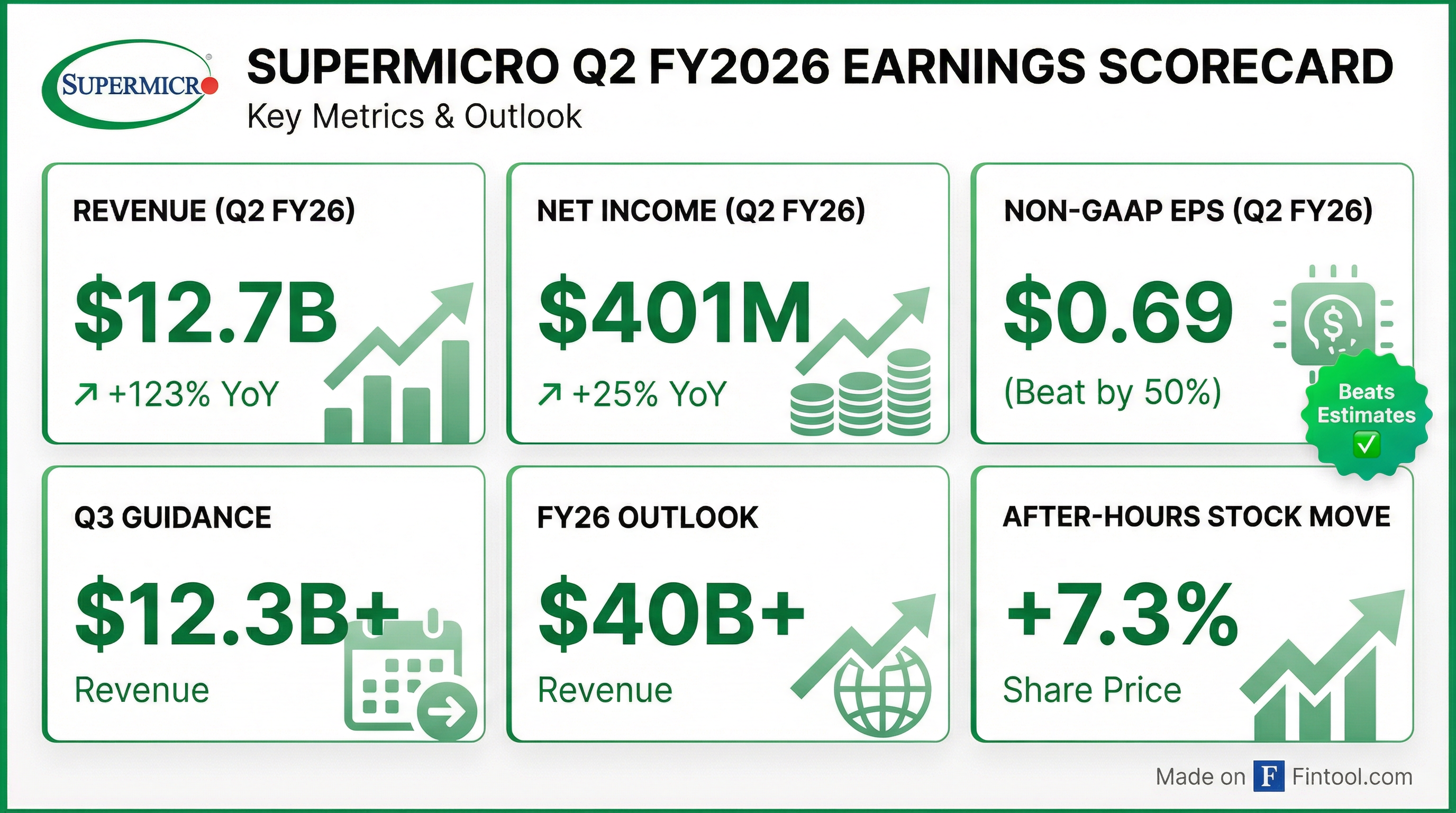
The Numbers: A Revenue Explosion
The scale of Super Micro's Q2 outperformance is striking:
| Metric | Q2 FY26 | Estimate | Beat/Miss | YoY Change |
|---|---|---|---|---|
| Revenue | $12.7B | $10.4B | +22% beat | +123% |
| Non-GAAP EPS | $0.69 | $0.46 | +50% beat | +17% |
| Net Income | $401M | $330M | +21% beat | +25% |
| Gross Margin | 6.3% | 8% | -170 bps miss | -550 bps |
Revenue more than doubled from the prior quarter's $5.0 billion and surged 123% year-over-year, reflecting a massive ramp in AI server shipments tied to Nvidia's Blackwell GPU platform. The company's net income reached $401 million, up 138% sequentially despite margin headwinds.
 Ask Fintool AI Agent
Guidance: $40 Billion Fiscal Year Now in Sight
CEO Charles Liang struck an optimistic tone, raising fiscal 2026 guidance significantly:
"With our leading AI server and storage technology foundation, strong customer engagements, and expanding global manufacturing footprint, we are scaling rapidly to support large AI and enterprise deployments."
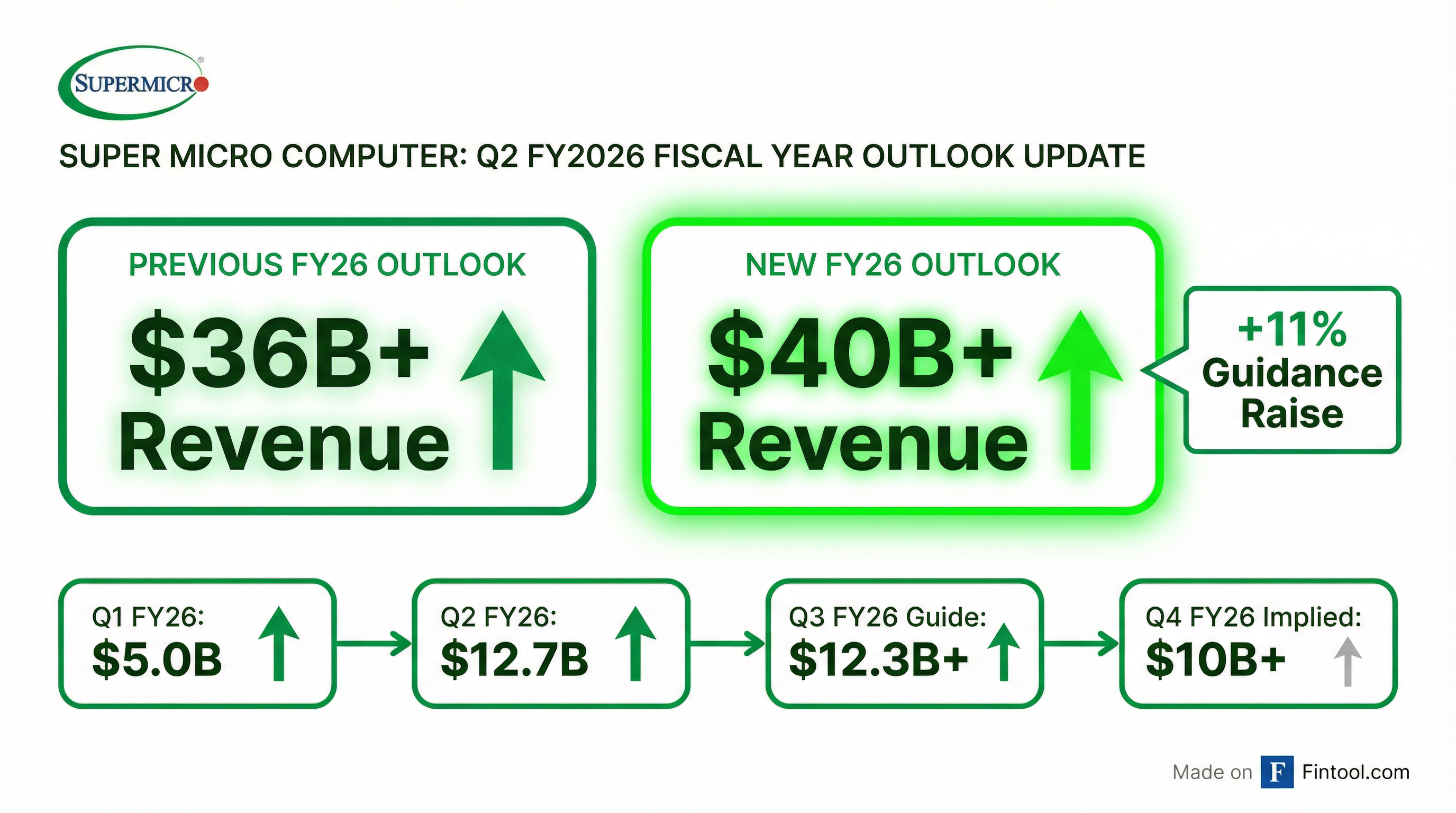
| Outlook | Previous | New | Change |
|---|---|---|---|
| FY26 Revenue | $36B+ | $40B+ | +11% |
| Q3 FY26 Revenue | — | $12.3B+ | — |
| Q3 FY26 Non-GAAP EPS | — | $0.60+ | — |
The Q3 guidance of at least $12.3 billion implies Super Micro expects demand momentum to continue, though slightly below Q2 levels. With H1 revenue already at $17.7 billion, the company has considerable runway to exceed its $40 billion target.
The Margin Tradeoff: Growth at a Cost
The headline beat comes with a notable caveat: gross margins continue to compress as Super Micro prioritizes scale and market share over profitability.
| Period | Gross Margin | Change vs Prior Year |
|---|---|---|
| Q2 FY25 | 11.8% | — |
| Q1 FY26 | 9.3% | -380 bps |
| Q2 FY26 | 6.3% | -550 bps |
Gross margin fell to 6.3%, down from 11.8% a year ago and 9.3% last quarter. The compression reflects:
- Blackwell ramp costs: Complex GPU rack integration with liquid cooling systems requires significant engineering investment
- Component costs: High memory and GPU content drives higher cost of goods sold
- Competitive pricing: Large hyperscale deals carry thinner margins as Dell and HPE compete aggressively
- Volume scaling: Initial production runs for new platforms carry elevated costs until volumes mature
Adjusted EBITDA margin similarly contracted to 5.0% from 8.4% a year earlier, though absolute EBITDA of $629 million still grew 32% year-over-year.
Ask Fintool AI AgentBalance Sheet: Scaling Requires Capital
The revenue explosion required significant working capital investment. Accounts receivable ballooned to $11.0 billion from $2.2 billion at fiscal year-end, while inventory grew to $10.6 billion from $4.7 billion.
| Balance Sheet Item | Dec 31, 2025 | Jun 30, 2025 | Change |
|---|---|---|---|
| Cash & Equivalents | $4.1B | $5.2B | -21% |
| Accounts Receivable | $11.0B | $2.2B | +400% |
| Inventory | $10.6B | $4.7B | +126% |
| Total Debt | $4.9B | $4.8B | +2% |
The company used $24 million in operating cash during Q2, a dramatic improvement from Q1's $918 million cash burn. Total liabilities reached $21.0 billion, up from $7.7 billion at fiscal year-end, driven primarily by accounts payable growth as the company finances its inventory build.
The Competitive Landscape
Super Micro operates in an increasingly crowded AI server market, competing with Dell Technologies ($76B market cap) and Hewlett Packard Enterprise ($29B market cap) for hyperscale cloud and enterprise AI infrastructure deals.
The company's key differentiator is its Data Center Building Block Solutions (DCBBS) strategy—modular, preconfigured rack-scale systems that accelerate deployment timelines. Super Micro claims DCBBS enables customers to "scale faster, greener, and at lower cost," positioning it as a preferred partner for AI factory buildouts.
| Company | Market Cap | AI Server Strategy |
|---|---|---|
| Super Micro | $18B | DCBBS modular racks, liquid cooling, first-to-market |
| Dell | $76B | PowerEdge, integrated rack solutions |
| Hpe | $29B | ProLiant, GreenLake consumption model |
All three companies are heavily dependent on Nvidia for GPU supply, creating both opportunity and concentration risk. Super Micro's close partnership with NVIDIA has enabled it to capture significant share during GPU allocation constraints.
Ask Fintool AI AgentWhat to Watch
Margin trajectory: Management has previously indicated margins should improve as Blackwell platform volumes scale and manufacturing efficiencies kick in. Q3 guidance of $0.60 EPS on $12.3B+ revenue implies gross margins stabilizing near current levels.
Customer concentration: Large hyperscale deals can create revenue volatility and pricing pressure. The rapid accounts receivable growth warrants monitoring for collection risk.
Supply chain execution: Super Micro's ability to secure GPU allocation and liquid cooling components remains critical to converting backlog into revenue.
DOJ investigation overhang: The ongoing Department of Justice inquiry into accounting practices, while not addressed in the release, remains an investor concern.
The Bottom Line
Super Micro's Q2 results demonstrate the unprecedented scale of AI infrastructure spending. Revenue that more than doubles in a single quarter—from $5 billion to $12.7 billion—is extraordinary by any measure. The raised guidance to $40 billion suggests management sees sustained momentum through fiscal year-end.
Yet the margin story introduces complexity. At 6.3% gross margins, Super Micro is essentially a high-volume, low-margin infrastructure play—more like a distributor than a technology company. The bull case rests on margins normalizing as volumes mature; the bear case worries that competitive dynamics and customer concentration will keep margins structurally compressed.
For now, the market is voting with the bulls. After-hours, SMCI shares jumped 7% to $31.84, a notable reversal for a stock that's fallen 55% from its 52-week highs above $66.
Related