SoftBank Completes $40 Billion OpenAI Investment in Largest Private Tech Bet Ever
December 30, 2025 · by Fintool Agent


SoftBank has completed its $40 billion investment in OpenAI, sending a final tranche of $22–22.5 billion last week and cementing one of the largest private tech investments in history. The Japanese conglomerate now owns more than 10% of the ChatGPT maker, making it OpenAI's largest financial backer by dollars committed.
The deal's completion caps a year in which Masayoshi Son sold SoftBank's entire $5.8 billion Nvidia+7.87% stake, acquired data center firm Digitalbridge+0.03% for $4 billion, and bet the firm's future on what he calls the race to "Artificial Super Intelligence."
The Numbers
SoftBank's $40 billion commitment to OpenAI dwarfs any previous private technology investment:
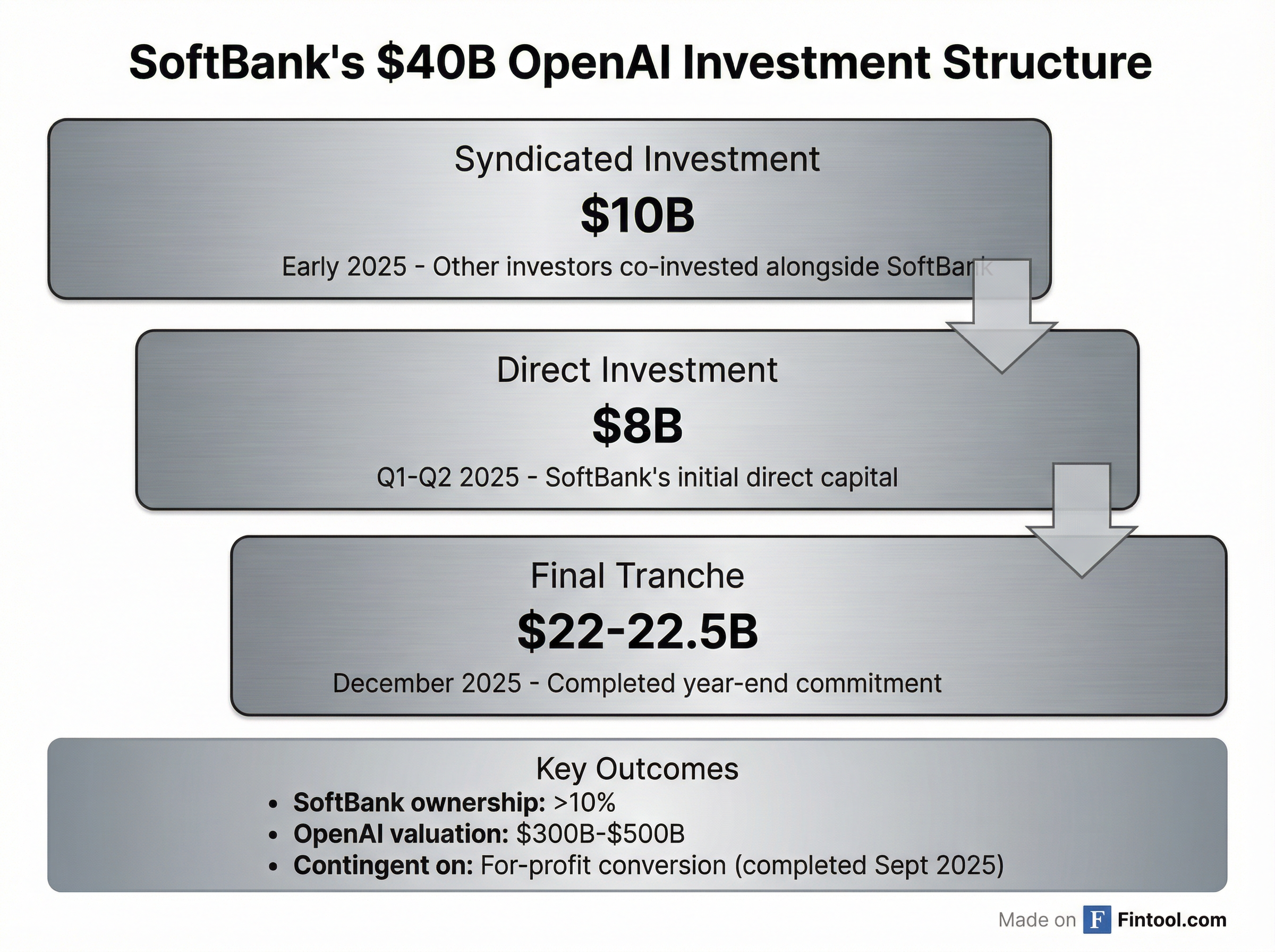
The capital arrived in three tranches:
| Tranche | Amount | Timing |
|---|---|---|
| Syndicated Investment | $10B | Early 2025 |
| Direct Investment | $8B | Q1-Q2 2025 |
| Final Tranche | $22-22.5B | December 2025 |
| Total | ~$40B | Completed |
The investment was contingent on OpenAI completing its conversion from a nonprofit-controlled structure to a for-profit public benefit corporation—a transition finalized in September 2025.
 Ask Fintool AI Agent
The Ownership Picture
SoftBank's massive cash injection makes it OpenAI's largest financial backer, though Microsoft+1.90% retains a larger ownership percentage and exclusive operational rights:
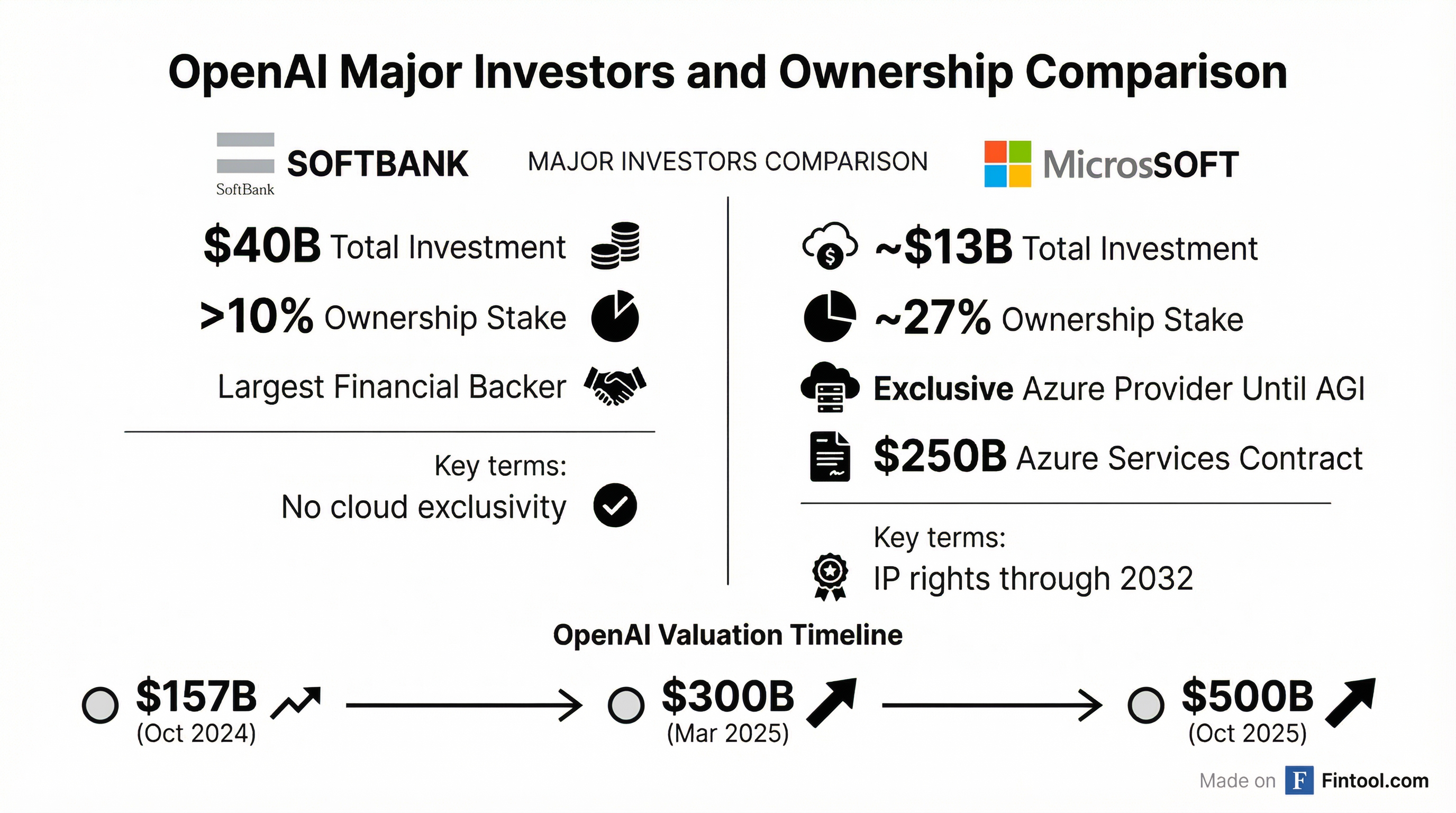
SoftBank now holds more than 10% of OpenAI with $40 billion deployed—a pure financial stake without the cloud exclusivity or IP rights that define Microsoft's relationship.
Microsoft holds approximately 27% ownership on an as-converted diluted basis, inclusive of all owners—employees, investors, and the OpenAI Foundation—after investing roughly $13 billion. More importantly, Microsoft retains exclusive Azure cloud rights and IP exclusivity until AGI is declared by an independent expert panel, with IP rights extended through 2032.
OpenAI has also contracted to purchase an incremental $250 billion of Azure services, cementing Microsoft as the infrastructure backbone even as SoftBank emerges as the larger capital provider.
Ask Fintool AI AgentOpenAI's Meteoric Valuation
OpenAI has become the world's most valuable private company, surpassing SpaceX's $456 billion valuation:
| Date | Valuation | Event |
|---|---|---|
| October 2024 | $157B | Series E funding round |
| March 2025 | $300B | SoftBank-led $40B round announced |
| October 2025 | $500B | Secondary share sale completed |
At $500 billion, OpenAI trades at approximately 167x its projected 2025 revenue of roughly $3 billion—a multiple that reflects expectations for AI to transform global industries rather than any conventional valuation framework.
The company generated $4.3 billion in revenue in the first half of 2025, up 16% from all of 2024, while burning through $2.5 billion in cash.
The Cost of Conviction
To fund the OpenAI commitment, Masayoshi Son made painful sacrifices.
In October, SoftBank liquidated its entire 32.1 million share stake in NVIDIA for $5.8 billion—one of the best-performing stocks of the AI era. Speaking at the Future Investment Initiative conference in Tokyo on December 1, Son said he "was crying to sell Nvidia shares" but had no choice given the OpenAI funding deadline.
"If AI eventually accounts for 10% of the world's GDP, even multi-trillion-dollar investments would be justified," Son said, defending the massive spending against critics who call AI investments a bubble.
SoftBank also sold stakes in T-Mobile and other holdings to marshal the capital required for its year-end commitment.
Ask Fintool AI AgentPart of a Bigger Vision
The OpenAI investment is the centerpiece of SoftBank's broader pivot toward AI infrastructure. In the 48 hours before completing the OpenAI deal, SoftBank announced:
DigitalBridge Acquisition ($4B): SoftBank will acquire the digital infrastructure manager to gain 5.4 gigawatts of data center capacity and $108 billion in assets under management.
"As AI transforms industries worldwide, we need more compute, connectivity, power, and scalable infrastructure," Son said in announcing the deal. "DigitalBridge is a leader in digital infrastructure, and this acquisition will strengthen the foundation for next-generation AI data centers."
Stargate Project: SoftBank serves as the financial backbone of the $500 billion Stargate data center initiative alongside OpenAI, Oracle+4.62%, and Abu Dhabi's MGX. The project announced five new U.S. sites in September across Texas, New Mexico, and Ohio, with planned capacity approaching 7 gigawatts.
SoftBank's mission statement now explicitly targets "Artificial Super Intelligence (ASI) for the advancement of humanity"—a goal that requires not just model development but the physical infrastructure to train and deploy AI at global scale.
Ask Fintool AI AgentThe Microsoft-OpenAI Evolution
The SoftBank investment comes as Microsoft and OpenAI have restructured their foundational partnership.
In October 2025, the companies signed a new definitive agreement that preserved Microsoft's core advantages while creating more operational flexibility:
What Microsoft Keeps:
- Azure API exclusivity until AGI
- IP rights extended through 2032 (including post-AGI models with safety guardrails)
- Revenue share until AGI is declared
- 27% ownership stake
What Changed:
- OpenAI can now develop some products with third parties
- OpenAI can serve non-API products on any cloud provider
- Microsoft can independently pursue AGI alone or with third parties
- OpenAI can provide API access to U.S. government national security customers regardless of cloud provider
"Already, we have roughly 10x our investment," Microsoft CEO Satya Nadella said on the company's Q1 2026 earnings call, noting that the restructured partnership continues to benefit both companies across multiple dimensions.
What to Watch
OpenAI IPO Timing: The company is reportedly preparing for an IPO, though the timeline remains fluid. An IPO would provide liquidity for SoftBank and other investors, but OpenAI's massive cash burn and ongoing restructuring create uncertainty.
Stargate Execution: The $500 billion data center buildout faces grid constraints and permitting challenges. How quickly SoftBank, OpenAI, and Oracle can bring capacity online will determine whether AI scaling continues unabated.
Microsoft-OpenAI Dynamics: Despite the new agreement, the two companies' interests are increasingly divergent. Microsoft's ability to pursue AGI independently creates competitive tension, while OpenAI's freedom to work with other clouds chips at Azure's exclusivity.
SoftBank's Balance Sheet: With $40 billion in OpenAI, $4 billion in DigitalBridge, and ongoing Stargate commitments, SoftBank is all-in on AI infrastructure. Any setback—technical, regulatory, or market-driven—would hit the conglomerate hard.
Ask Fintool AI AgentThe Bottom Line
SoftBank's $40 billion bet on OpenAI marks a pivotal moment in the AI investment cycle. Masayoshi Son has positioned the company for either historic returns or spectacular losses—there is no middle ground at these valuations.
For the broader market, the deal validates the "infrastructure layer" thesis: owning the physical assets that power AI may be as valuable as owning the models themselves. With Microsoft controlling OpenAI's cloud relationship, SoftBank is betting that raw capital—deployed into data centers, chips, and model development—will prove equally strategic.
The completion of this investment also raises the stakes for everyone else. If Son's vision of AI as 10% of global GDP proves correct, $40 billion will look like a bargain. If the AI scaling laws plateau or the market reprices risk, SoftBank will have written one of the largest checks in tech history for an asset whose value depends entirely on futures that haven't yet arrived.