Spotify Posts Biggest Quarter Ever: 751M Users, Stock Surges 16%
February 10, 2026 · by Fintool Agent

Spotify delivered the strongest quarter in its history, adding a record 38 million monthly active users while crushing earnings estimates by 62%. The stock surged 16% to approximately $481 as the streaming giant proved its AI-powered personalization strategy is translating into accelerating growth.
"We closed out what we dubbed as the year of accelerated execution with another solid quarter, delivering a strong finish to 2025," said Co-CEO Alex Norström. "It's just incredible to think that we now serve over three-quarters of a billion people around the world."
The Numbers That Matter
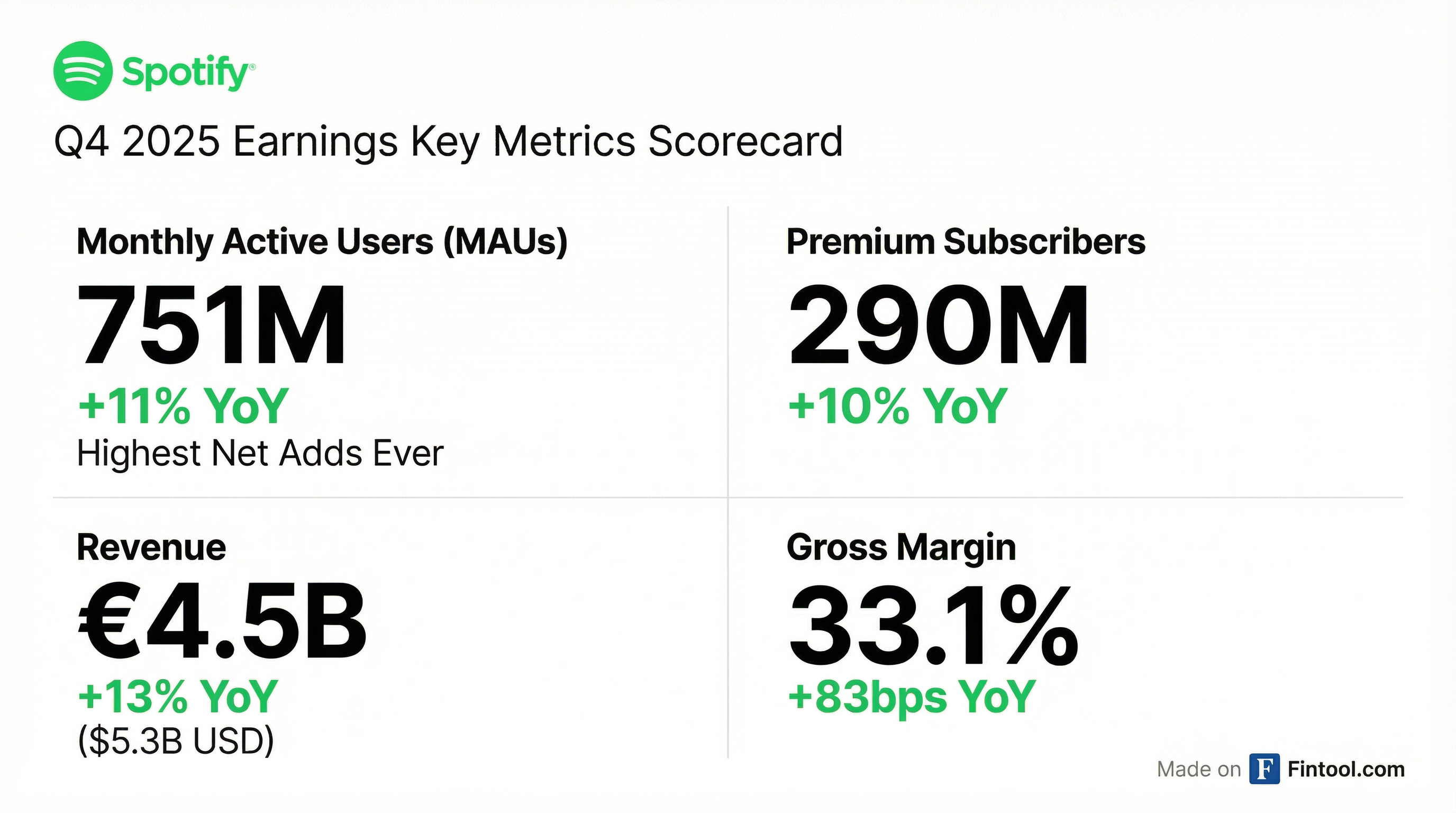
Spotify beat on every key metric in Q4:
| Metric | Q4 2025 | vs. Expectations | YoY Change |
|---|---|---|---|
| Monthly Active Users | 751M | +7M vs. guidance | +11% |
| Premium Subscribers | 290M | +1M vs. guidance | +10% |
| Revenue | €4.53B ($5.3B) | Beat by €10M | +13% |
| EPS | €4.43 | vs. €2.74 expected | +62% beat |
| Gross Margin | 33.1% | Record high | +83bps |
| Operating Income | €701M | 15.5% margin | +47% |
| Free Cash Flow (Q4) | €834M | Strong | — |
The MAU growth of 38 million represents the highest quarterly net additions in Spotify's 18-year history, driven by strength in Latin America, Europe, and "Rest of World" markets. The company also credited improvements to its mobile free tier and the viral success of Wrapped 2025, which drove over 300 million engaged users and 630 million social media shares—up 42% year-over-year.
 Ask Fintool AI Agent
Stock Reaction: Best Day in Years
Spotify shares exploded higher on the results, rising 16% to approximately $481.26 in trading—adding nearly $14 billion to the company's market capitalization.
The stock had been under pressure heading into earnings, trading down from its 52-week high of $785 to around $415. The earnings beat represents a vindication of the company's strategy and positions SPOT for potential recovery toward those highs.
The AI Playbook: From Passive to Interactive
Perhaps more significant than the numbers was management's articulation of how AI positions Spotify for the next phase of growth. Co-CEO Gustav Söderström laid out an ambitious vision for "the world's first truly intelligent agentic media platform."
The company highlighted two flagship AI products:
AI DJ: Already used by 90 million subscribers, generating over 4 billion hours of listening time. It serves as the "chat interface to Spotify"—a conversational way to discover music.
Prompted Playlist: A new "deep research mode" that lets users describe what they want to hear in natural language, accessing their full listening history and real-time cultural context. "It taps into your entire Spotify listening history, reflecting not just current obsessions, but the full arc of your music taste," Söderström explained.
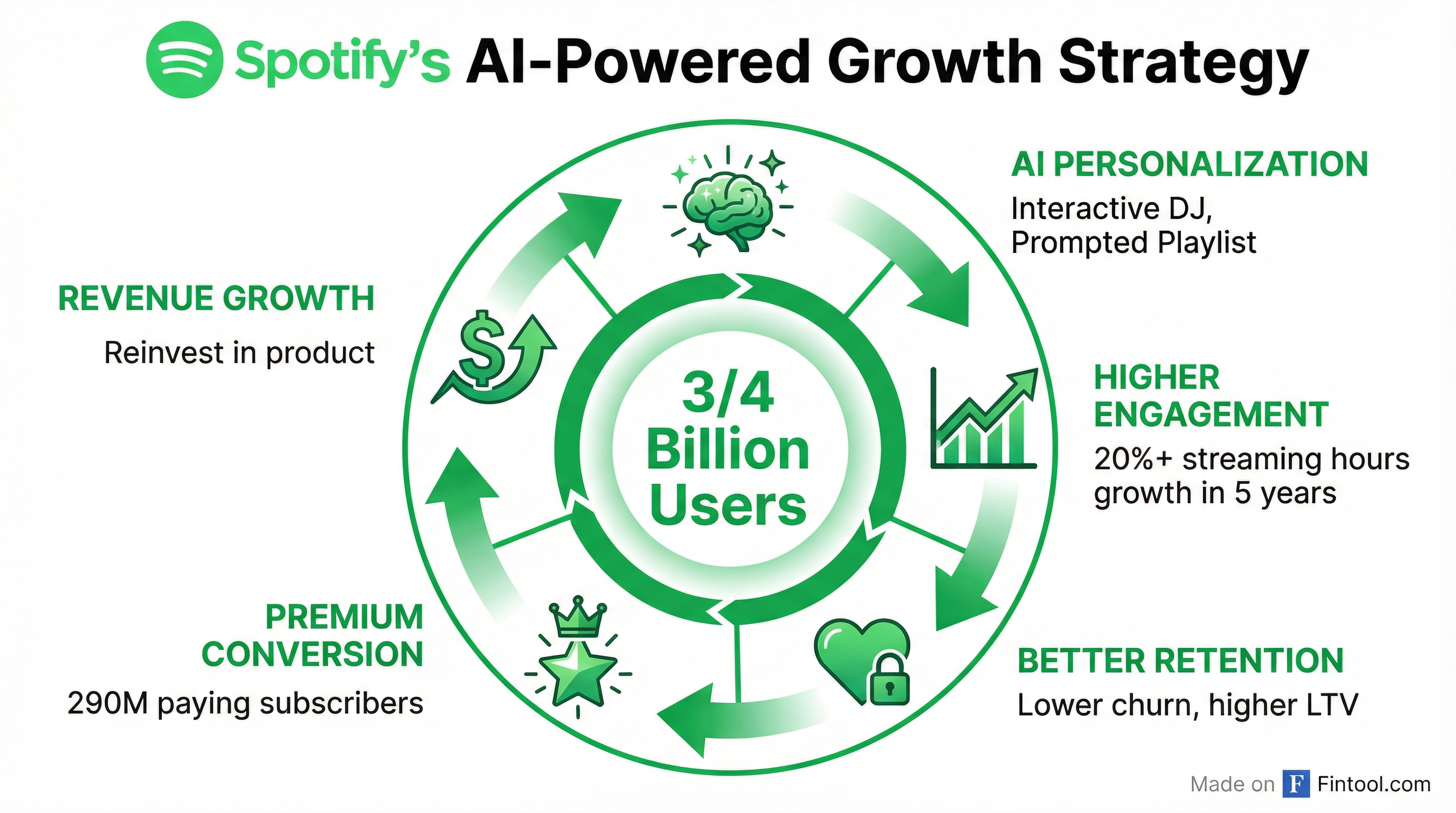
Critically, Spotify is building what it calls "the language-to-music data set"—the connection between how people describe what they want and the music that satisfies them. This data set doesn't exist elsewhere at this scale.
"You may think there is a factual answer to 'What is workout music?' There is no factual answer," Söderström said. "For an American, it's usually hip hop. For a European, it's usually EDM. For many Scandinavians, it's heavy metal or even death metal... You can't just have an LLM commoditize it as a fact. You actually need hundreds of millions of listeners across the world constantly telling you what it means for that specific person."
Ask Fintool AI AgentInternal AI Revolution: "Honk"
Spotify also revealed an internal tool called "Honk" that demonstrates how AI is accelerating product development. An engineer can now, from their smartphone on the morning commute, ask Claude to fix a bug or add a feature to the iOS app. The system pushes back a QR code so they can test the new version immediately—and merge it to production before arriving at the office.
"We've been told by key AI partners that our work here is industry-leading," Söderström noted. "We're retooling the entire company for this age."
This internal efficiency gain compounds the external product benefits. Spotify shipped over 50 new features in 2025, including Prompted Playlist, Page Match for audiobooks, and About the Song.
Content Ecosystem: $11 Billion to Rights Holders
The growth is creating a rising tide for the entire music industry. Spotify paid out more than $11 billion to music rights holders in 2025—a global record for the highest annual payment from a single source. The cumulative total since founding now approaches $70 billion.
Video podcasts are accelerating, with consumption up 90% since the launch of the Spotify Partner Program. The platform now hosts over 530,000 video podcast shows. Audiobooks continue expanding into new markets, with leading publishers crediting Spotify for driving double-digit growth in the category.
Financial Strength: Cash Machine
The profitability improvement is generating substantial cash. Free cash flow reached €834 million in Q4 alone, bringing full-year 2025 free cash flow to €2.9 billion. The balance sheet now holds €9.5 billion in cash and short-term investments.
Management indicated they will settle the €1.5 billion convertible note maturing in March with cash, while leaving room for continued share buybacks (€510 million executed in 2025).
Forward Outlook
For Q1 2026, Spotify expects:
- MAUs: 759 million (+8M sequentially)
- Premium Subscribers: 293 million (+3M sequentially)
- Revenue: €4.5 billion (with 670bps FX headwind)
The revenue guidance came in slightly below consensus of €4.58 billion due to foreign exchange headwinds, though the underlying business momentum remains strong.
Ask Fintool AI AgentWhat to Watch
Investor Day: Management teased more details about the "truly intelligent agentic media platform" vision at an upcoming investor day.
Price Increases: Spotify implemented a $1 price increase in the U.S., Estonia, and Latvia in January 2026. Churn came in "according to expectations" with no surprises.
AI Music Policy: The company is working with the industry on frameworks for AI-generated music and derivatives of existing songs—a potentially significant new revenue stream for artists.
Leadership Transition: Co-founder Daniel Ek stepped back, with Alex Norström and Gustav Söderström now serving as Co-CEOs. The earnings call suggested a seamless transition with continuity of strategy.
Related Companies: Spotify