Tenet Regains Full Conifer Ownership in $2.65B CommonSpirit Exit
February 02, 2026 · by Fintool Agent


Tenet Healthcare completed a $2.65 billion transaction Monday that returns full ownership of its Conifer Health Solutions revenue cycle management subsidiary to the company, ending a 14-year partnership with CommonSpirit Health.
The deal achieved approximately 14x multiple on impacted EBITDA—a figure CEO Saum Sutaria called "a clear example" of hidden value in Conifer that wasn't reflected in Tenet's equity valuation.
Shares of Tenet (NYSE: THC) traded at $189.97 in early afternoon trading, up modestly from Friday's close of $189.28, as investors digested the complex transaction mechanics.
Deal Structure: Cash, Equity, and Balance Sheet Cleanup
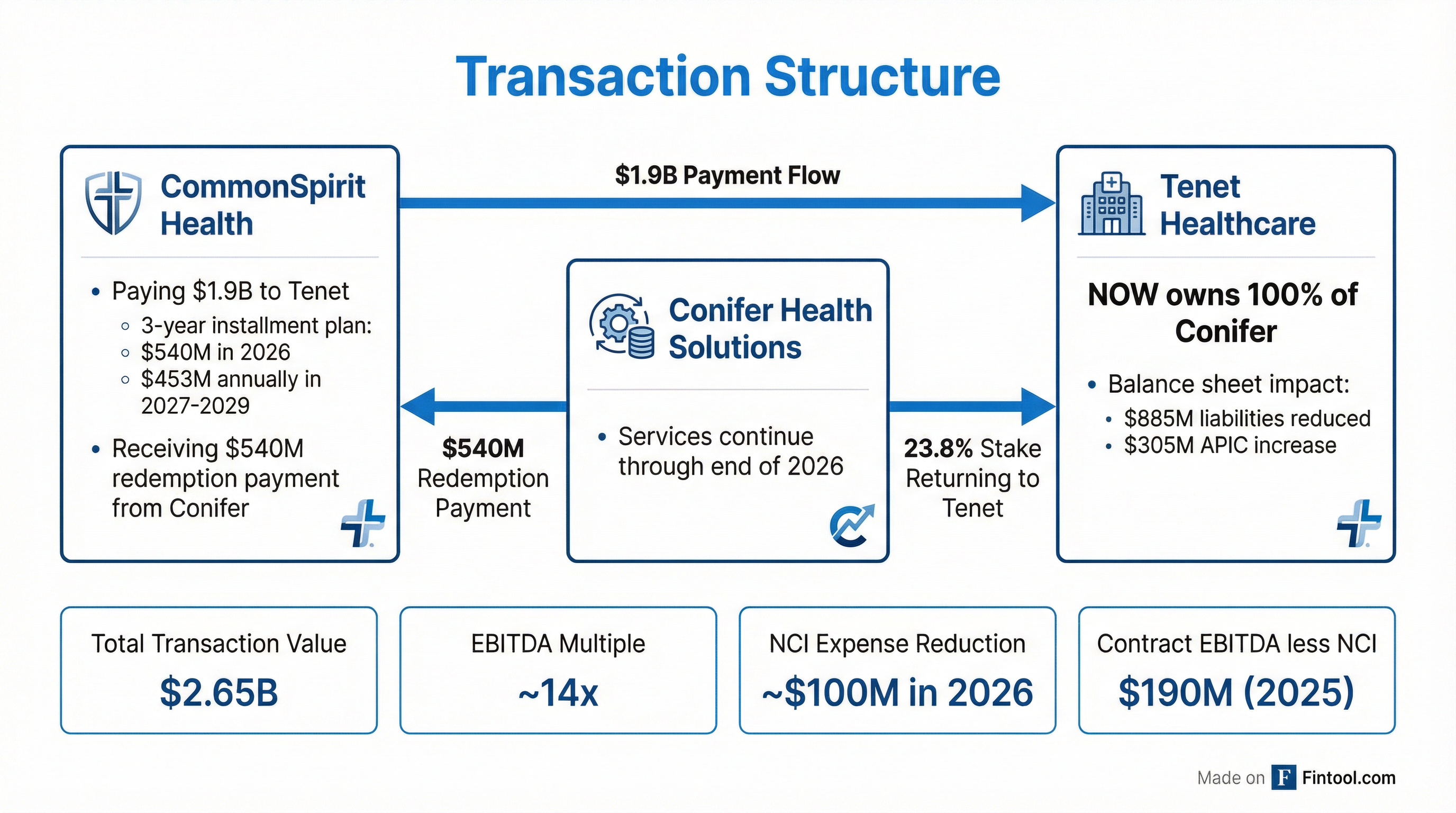
The transaction has several interconnected components that CEO Sutaria acknowledged "may not have been expected by the public markets":
Cash Flows:
- CommonSpirit pays Tenet $1.9 billion over three years: $540 million in Q1 2026, then $453 million annually through 2029
- Conifer pays CommonSpirit $540 million to redeem its 23.8% equity stake, effectively offsetting the first installment
Balance Sheet Impact:
- Tenet's redeemable non-controlling interest and other liabilities decrease by approximately $885 million
- Additional paid-in capital increases by $305 million
2026 Earnings Benefit:
- NCI expense drops approximately $100 million since the equity transfer is retroactive to January 1, 2026
- Tenet retains all Conifer economics for the full year while continuing to service CommonSpirit through December 31, 2026
| Component | Amount | Timing |
|---|---|---|
| Cash from CommonSpirit | $1.9B | 2026-2029 |
| Equity redemption payment | $540M | Q1 2026 (offset) |
| Liability reduction | $885M | Q1 2026 |
| APIC increase | $305M | Q1 2026 |
| NCI expense reduction | $100M | Full year 2026 |
| Contract EBITDA less NCI | $190M | 2025 annualized |
 Ask Fintool AI Agent
Partnership History: From CHI to CommonSpirit
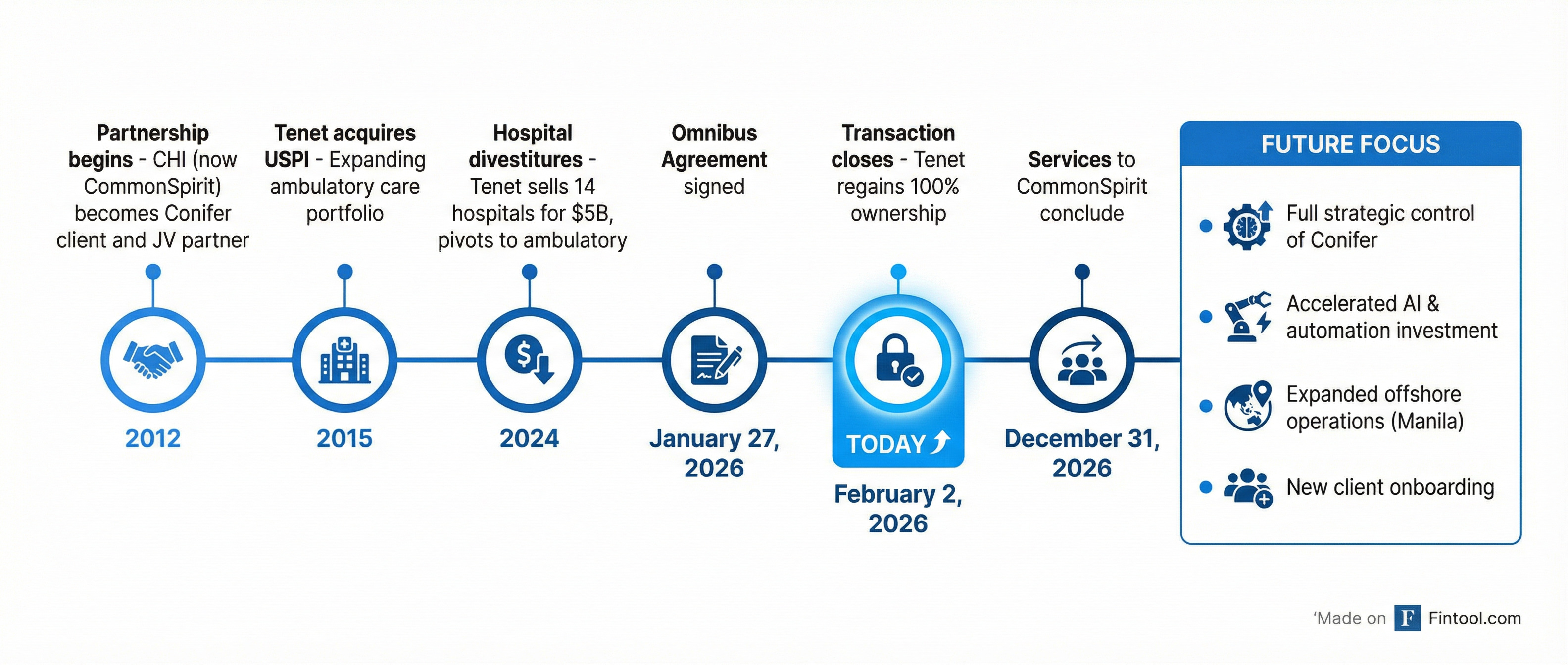
The relationship began in 2012 when Catholic Health Initiatives (now CommonSpirit Health) became both a major client and joint venture partner in Conifer. The contract was originally scheduled to run through December 31, 2032.
CommonSpirit CFO Michael Browning framed the exit as supporting the health system's "multiyear system integration strategy," noting that Conifer "meaningfully contributed to these hospitals achieving 100% of their cash collection goals."
When asked about client retention concerns following the loss of a major customer, Sutaria was dismissive: "I don't think that's even a topic of conversation. Conifer's client service and results, including Tenet, have been excellent and continue to be excellent."
The CEO emphasized that new clients are already lined up: "We expect to substantially redeploy resources at the end of this year for our growth objectives."
Strategic Rationale: Full Control Unlocks Investment
Sutaria made clear that regaining "full strategic control" of Conifer was as important as the financial terms. The joint venture structure required collaborative decision-making with CommonSpirit on capital allocation—a dynamic that limited Tenet's ability to accelerate investments on its own timeline.
"I don't want to put any kind of sense of blame that one party was constraining the other," Sutaria said diplomatically. "We were in a situation where we both had to make decisions together. We're now not in that situation."
With sole ownership, Tenet plans to accelerate investments across three priority areas:
1. Artificial Intelligence & Automation
- Automated conversion of clinical notes into claims
- AI-driven denials management to improve speed and accuracy of payer disputes
- Enhanced workflow automation powered by advanced analytics
2. Offshore Operations
- Expanded global business center in Manila
- Combined workflow automation, AI, and offshore labor to reduce cost-to-collect
3. Technology-Enabled Services
- Improved coding automation
- Robotic process automation for claims processing
"The ability to combine workflow automation, AI, and offshore creates a real opportunity to lower the cost to collect over time, progressively," Sutaria said, noting this "makes Conifer more and more competitive in the marketplace."
Ask Fintool AI Agent2027 and Beyond: The Transition Year
While management declined to provide specific guidance for 2027, CFO Sun Park acknowledged that the $190 million EBITDA contribution from the CommonSpirit contract will go away after 2026.
However, Sutaria noted that Conifer has growth opportunities "already locked in" and expects to redeploy people, technology, and resources as a "first priority" as the CommonSpirit relationship winds down.
"The actual embedded value in owning 100% of Conifer is even higher given our future growth that's already locked in with this redeployment," Sutaria said.
There will likely be restructuring charges in 2027, though Sutaria emphasized Tenet's track record: "We've demonstrated the operating discipline to manage our business effectively and grow our earnings and margins despite having had other asset sales."
Capital Allocation: Buybacks Take Priority
The transaction strengthens Tenet's cash position over the next several years, and management signaled that share repurchases will be "an important priority" alongside continued USPI M&A and organic growth investments.
Tenet has been aggressively repurchasing shares—retiring 2.6 million shares in Q1 2025 alone at an average price of ~$131. With shares now trading around $190, management appears to view the stock as undervalued.
The broader capital allocation framework remains unchanged:
- USPI M&A: Continue $250 million+ annual investment in ambulatory surgery center acquisitions
- Organic growth: Capital expenditures to fuel high-acuity service lines and new facilities
- Debt management: Maintain deleveraged balance sheet
- Share repurchase: Deploy excess cash, particularly given trading multiples
Previewing Strong 2025 Results
Tenet also disclosed that FY2025 adjusted EBITDA is expected to come in "at the upper end" of its $4.47-$4.57 billion guidance range, driven by:
- Strong same-store revenue growth
- Disciplined expense management in both hospitals and USPI
The company will report complete Q4 and full-year 2025 results on February 11, 2026.
USPI continues to be the growth engine, with Q3 2025 ambulatory segment adjusted EBITDA up 12% year-over-year. Management has added 14 ASCs in the first half of 2025 and raised full-year USPI EBITDA guidance to $1.99-$2.05 billion.
| Metric | Q3 2025 | YoY Change |
|---|---|---|
| Net Operating Revenue | $5.27B | +3.2% |
| Hospital Same-Store Admissions | +1.4% | — |
| USPI Same-Facility Revenue | +8%+ | — |
| USPI Adjusted EBITDA | $492M | +12% |
Ask Fintool AI AgentInvestor Takeaway
This transaction crystallizes value that Tenet management believed was "hidden" in the Conifer subsidiary. At ~14x EBITDA, the multiple validates Conifer's worth while giving Tenet full control to invest in AI, automation, and offshore expansion without joint venture friction.
The near-term impact is positive: $100 million less NCI expense in 2026, continued earnings from CommonSpirit services, and $1.9 billion in cash inflows over three years. The 2027 transition presents execution risk—restructuring costs and EBITDA headwinds as CommonSpirit departs—but management's confidence in the redeployment pipeline suggests they see offset growth.
For investors, the key question is whether Conifer can grow third-party revenue fast enough to replace the CommonSpirit contribution while investing heavily in technology. The answer will determine whether this deal was shrewd capital recycling or the beginning of a slower-growth chapter for the revenue cycle unit.