Tesla Loses EV Crown to BYD as Deliveries Plunge 8.6% in 2025
January 02, 2026 · by Fintool Agent


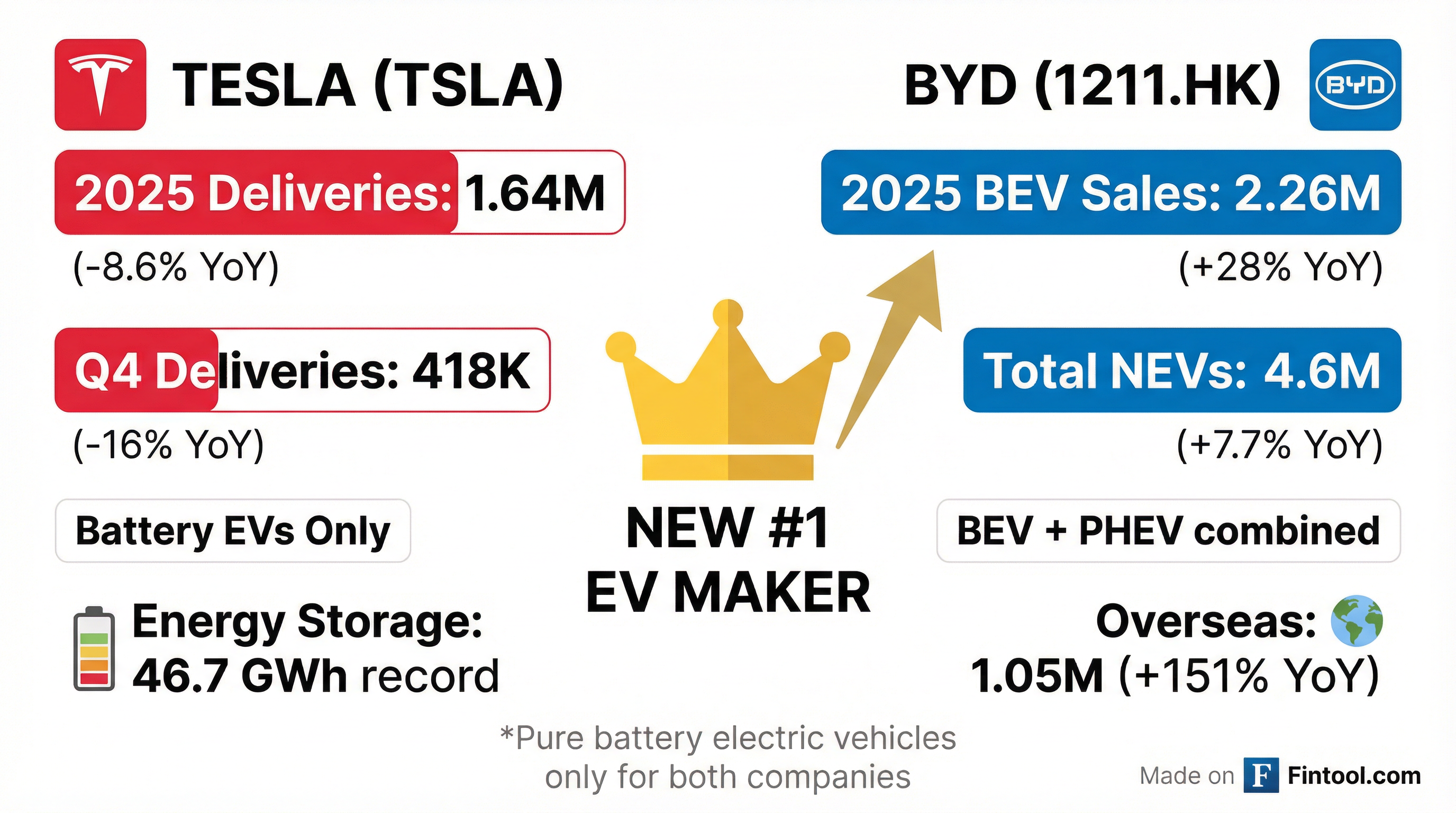
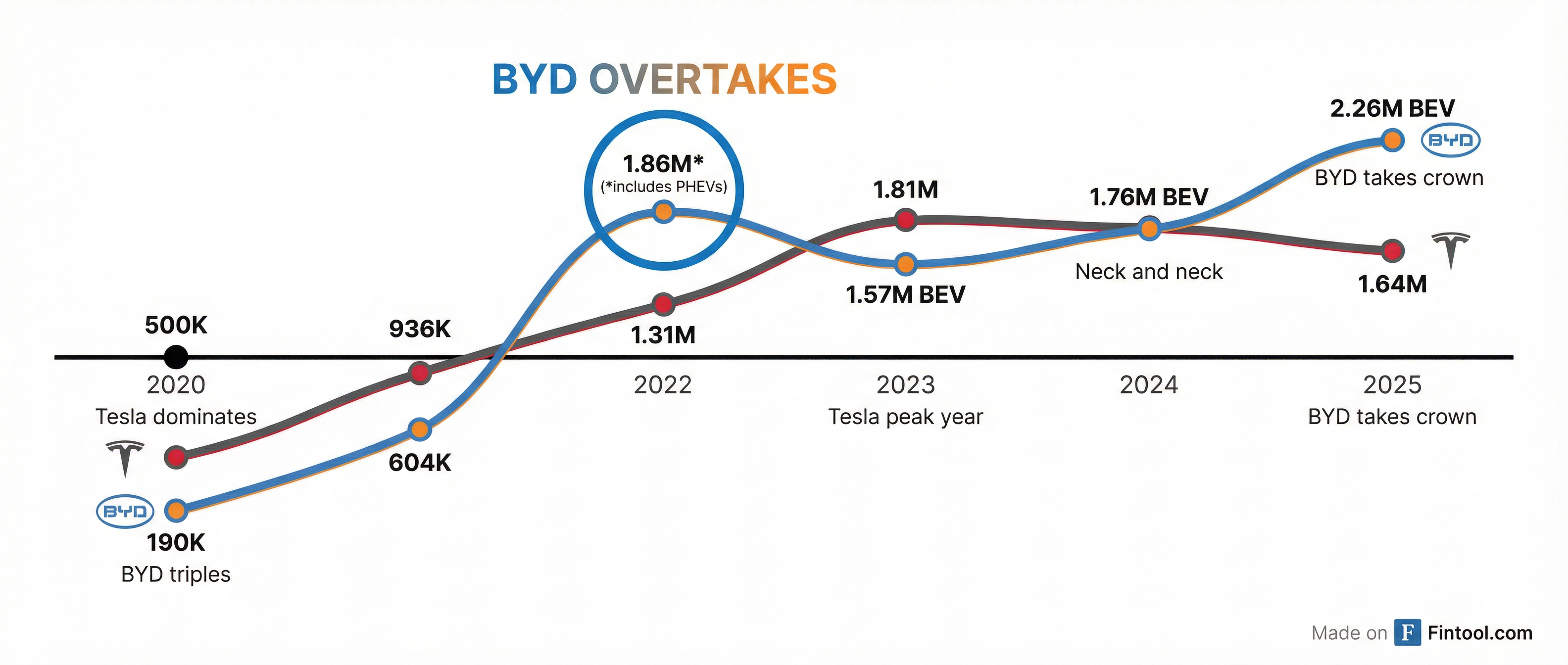
Tesla+3.50% has officially surrendered its title as the world's largest electric vehicle maker. The company reported Friday that 2025 deliveries fell 8.6% to 1.64 million vehicles—the steepest annual decline in its history—while China's BYD sold 2.26 million battery electric vehicles, surpassing its American rival for the first time on an annual basis.
The milestone caps a brutal year for Tesla: Q4 deliveries came in at just 418,227 vehicles, down 16% year-over-year and missing even the company's own bearish consensus of 422,850. The miss—following a record Q3 boosted by customers rushing to beat expiring tax credits—underscores the structural demand challenges CEO Elon Musk acknowledged would hit in late 2025.
The Numbers Tell the Story
Tesla's Q4 and full-year figures mark the company's second consecutive annual delivery decline—a dramatic reversal from the 50% annual growth it once delivered.
| Period | Production | Deliveries | YoY Change |
|---|---|---|---|
| Q1 2024 | 433,371 | 386,810 | -9% |
| Q2 2024 | 410,831 | 443,956 | +5% |
| Q3 2024 | 469,796 | 462,890 | +6% |
| Q4 2024 | 459,445 | 495,570 | +2% |
| FY 2024 | 1,773,443 | 1,789,226 | -1% |
| Q1 2025 | 362,615 | 336,681 | -13% |
| Q2 2025 | 411,499 | 384,122 | -13% |
| Q3 2025 | 446,195 | 497,099 | +7% |
| Q4 2025 | 434,358 | 418,227 | -16% |
| FY 2025 | 1,654,667 | 1,636,129 | -8.6% |
Source: Tesla 8-K filings
The quarter-to-quarter whiplash is stark. Q3's record 497,099 deliveries were driven by Americans racing to purchase EVs before the $7,500 federal tax credit expired on October 1. Q4 represents the hangover: without the subsidy, demand collapsed.
 Ask Fintool AI Agent
BYD's Rise: From Battery Maker to Global Champion
BYD's ascent has been nothing short of remarkable. The Shenzhen-based company—which Musk famously laughed at during a 2011 Bloomberg interview—sold 4.6 million total new energy vehicles in 2025, including 2.26 million pure battery EVs.
| Metric | BYD 2024 | BYD 2025 | Change |
|---|---|---|---|
| Total NEVs | 4.27M | 4.60M | +7.7% |
| Battery EVs | 1.76M | 2.26M | +27.9% |
| PHEVs | 2.49M | 2.29M | -7.9% |
| Overseas Sales | 417K | 1.05M | +150.7% |
Source: BYD Hong Kong Stock Exchange filings
The numbers reveal divergent trajectories. While Tesla's sales contracted, BYD's battery EV sales surged nearly 28%. Perhaps more significantly, BYD's overseas sales exploded 151% to over 1 million units—the company is no longer just a China story.
 Ask Fintool AI Agent
The Musk Factor
Tesla's struggles aren't purely about product or pricing. CEO Elon Musk's incendiary political rhetoric and his role in President Trump's administration have sparked a consumer backlash, particularly in Europe and among the environmentally-conscious demographic that once formed Tesla's core customer base.
Tesla shares have been remarkably resilient despite the delivery struggles, hovering near $453 after touching an all-time high of $498.83 in mid-December.* The stock's strength reflects investor enthusiasm not for vehicles, but for Musk's AI pivot—robotaxis, Full Self-Driving, and the Optimus humanoid robot.
"The reality is that in the future, most people are not going to buy cars," Musk told analysts on the Q1 2025 earnings call, comparing Tesla's situation to smartphone manufacturers who kept making flip phones as the iPhone emerged.
On the Q3 call, Musk was even more direct about Tesla's strategic direction: "I feel confident in expanding Tesla's production. That is our intent to expand as quickly as we can our future production. I was reticent to do that until we had clarity on achieving unsupervised Full Self-Driving. At this point, I feel like we've got clarity."
Ask Fintool AI AgentFinancial Health Remains Solid
Despite the delivery decline, Tesla's recent financial results show resilience in other areas:
| Metric | Q1 2025 | Q2 2025 | Q3 2025 |
|---|---|---|---|
| Revenue | $19.3B | $22.5B | $28.1B |
| Gross Margin | 16.3% | 17.2% | 18.0% |
| Operating Cash Flow | $2.2B | $2.5B | $6.2B |
| Net Income | $0.4B | $1.2B | $1.4B |
The energy storage business delivered a record 14.2 GWh of deployments in Q4, bringing the full-year total to 46.7 GWh. CFO Vaibhav Taneja highlighted this as a bright spot: "We set new records not just for deliveries and deployments, but also around a range of financial metrics from total revenues, energy gross profit, energy margins, to fresh free cash flow."
Ask Fintool AI AgentWhy BYD Won—And What It Means
BYD's victory isn't solely about Tesla's stumbles. The Chinese automaker has executed brilliantly on several fronts:
Price Competitiveness: BYD's vehicles undercut rivals significantly. Models like the Seagull start at roughly $10,000 in China—a price point Tesla cannot match.
Vertical Integration: BYD manufactures its own batteries, semiconductors, and even raw materials. This allows margin flexibility that competitors struggle to match.
Global Expansion: Despite tariffs in the U.S. and Europe, BYD has aggressively expanded into Southeast Asia, the Middle East, and Latin America. The UK became its largest market outside China in 2025.
Product Cadence: While Tesla relies heavily on Model Y and Model 3, BYD offers dozens of models across multiple brands including Denza, Yangwang, and Fang Cheng Bao.
That said, BYD faces its own challenges. Its 7.7% overall sales growth in 2025 was the slowest in five years, and domestic market share has declined from 35% in 2023 to 29% as competitors like Geely and Leapmotor have gained ground.
What to Watch
January 28: Tesla reports Q4 earnings and will provide 2026 guidance. Analysts expect commentary on:
- Demand trajectory without federal incentives
- Robotaxi expansion timeline (currently in Austin and Bay Area)
- Cybercab production start in Q2 2026
- Optimus V3 reveal timing
2026 Outlook: Analysts project Tesla deliveries of ~1.75-1.8 million vehicles, while BYD targets 1.6 million units overseas alone. The gap may widen.
Regulatory Wild Card: Full Self-Driving approvals in China and Europe could be transformative for Tesla. "We're working with regulators in places like China and EMEA to obtain approvals so that we can get FSD in those regions as well," Taneja noted.
Ask Fintool AI AgentThe Bigger Picture
Tesla losing the EV sales crown to BYD represents a symbolic shift in the global auto industry's balance of power. For over a decade, Tesla defined electric vehicles in the public imagination. Now, a Chinese company that once made phone batteries has overtaken it.
Yet the stock market's verdict is clear: investors believe Tesla's future lies beyond vehicle sales. The company's $1.46 trillion market cap—roughly 90x forward earnings—prices in a future where robotaxis and robots, not cars, drive value creation.
As Musk put it: "Optimus at scale is the infinite money glitch... if you're true of sustainable abundance, where working will be optional."
Whether that vision materializes—or whether BYD's lead becomes insurmountable—will define the next chapter of the EV revolution.
Ask Fintool AI AgentRelated:
*Stock price data from market-data skill, values retrieved from S&P Global