Tesla's FSD Powers Europe's First Government-Backed Autonomous Shuttle
December 25, 2025 · by Fintool Agent

Tesla+3.50% has achieved a significant regulatory milestone in Europe: a government-backed shuttle service powered by Full Self-Driving (Supervised) is now operational in Germany, marking the first such deployment in the European Union. The pilot program, launched in the rural Eifelkreis Bitburg-Prüm region of Rhineland-Palatinate, represents a breakthrough in Tesla's long-running campaign to bring its autonomous driving technology to Europe—and arrives just as the company pursues broader EU approval that could unlock the continent's 450 million residents.
The Pilot: Rural Mobility as Testing Ground
The shuttle service was announced by Germany's Ministry for Economic Affairs, Transport, Agriculture and Viticulture of Rhineland-Palatinate, which described the initiative as a "real gain for rural mobility."
The program is designed to complement existing community bus systems by offering more flexible and accessible transportation in areas where traditional transit options are limited. Minister Daniela Schmitt personally experienced the technology, underscoring the level of government oversight behind the pilot.
This marks a deliberate choice of venue: rural regions present different challenges than urban centers but also demonstrate clear use cases for autonomous mobility where traditional public transit is economically unfeasible.
 Ask Fintool AI Agent
Why Europe Matters for Tesla's Autonomy Thesis
Tesla's management has repeatedly emphasized that FSD approval in Europe is "the single biggest demand driver" for the company's vehicles. On the Q2 2025 earnings call, CEO Elon Musk was explicit about the stakes:
"We do not actually yet have approval for supervised FSD in Europe. So our sales in Europe, we think, will improve significantly once we are able to give customers the same experience that they have in the U.S."
The company has been working with the Dutch RDW (Netherlands Vehicle Authority) as the primary EU regulator, targeting approval by February 2026—though the regulator has cautioned that timeline "remains to be seen."
The Path from Austin to Germany
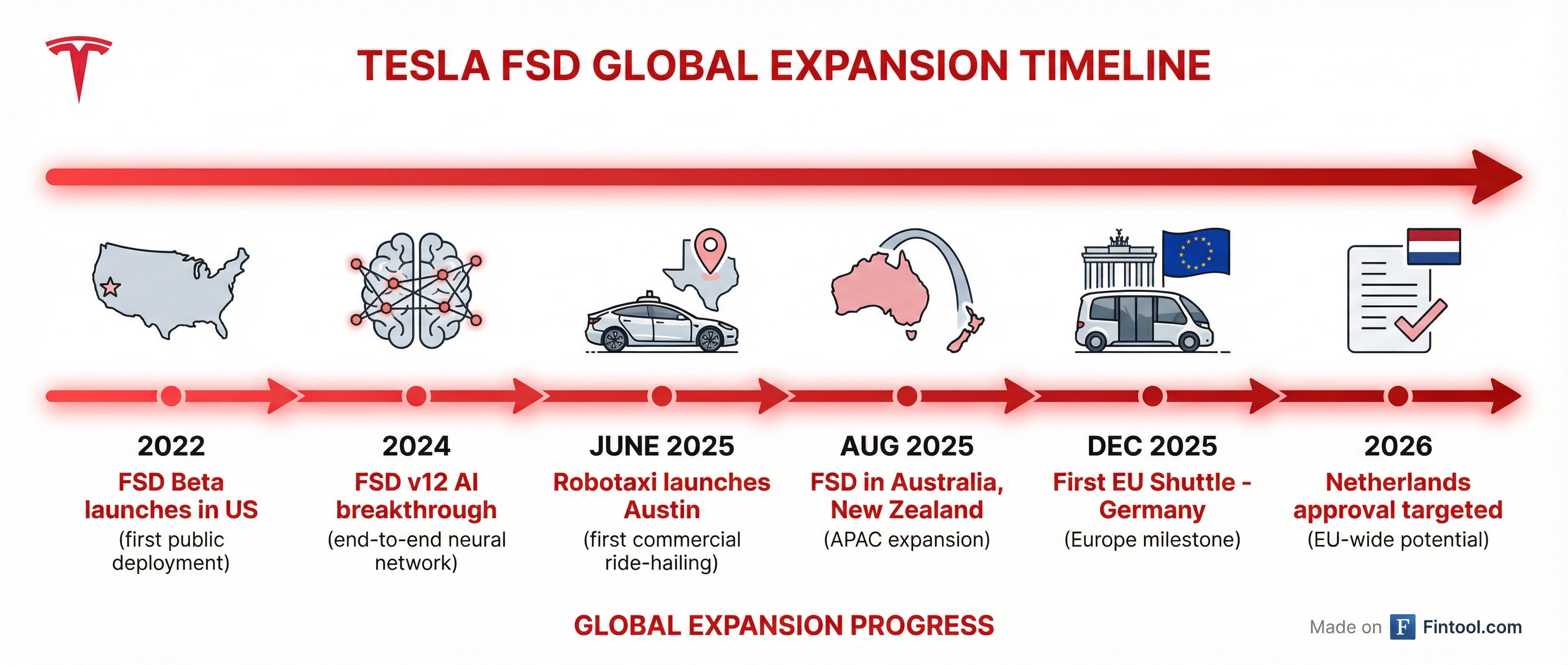
The German shuttle launch follows Tesla's aggressive 2025 expansion of FSD:
| Milestone | Date | Significance |
|---|---|---|
| Robotaxi Launch (Austin) | June 2025 | First commercial unsupervised rides |
| FSD v14 Deployment | October 2025 | Robotaxi model brought to consumer vehicles |
| Australia/New Zealand Launch | 2025 | FSD now live in 7 countries |
| Europe Ride-Alongs | Dec 2025–Mar 2026 | Demo program in Germany, France, Italy |
| Germany Shuttle | Dec 25, 2025 | First EU government-backed service |
Tesla's approach—a general AI solution rather than geofenced, high-definition maps—gives it theoretical scalability advantages. As Musk explained: "Once we can make it work in a few cities in America, we can make it work anywhere in America. Once we can make it work in a few cities in China, we can make it work anywhere in China, likewise in Europe, limited only by regulatory approvals."
Ask Fintool AI AgentRegulatory Landscape: Three Markets, Three Approaches
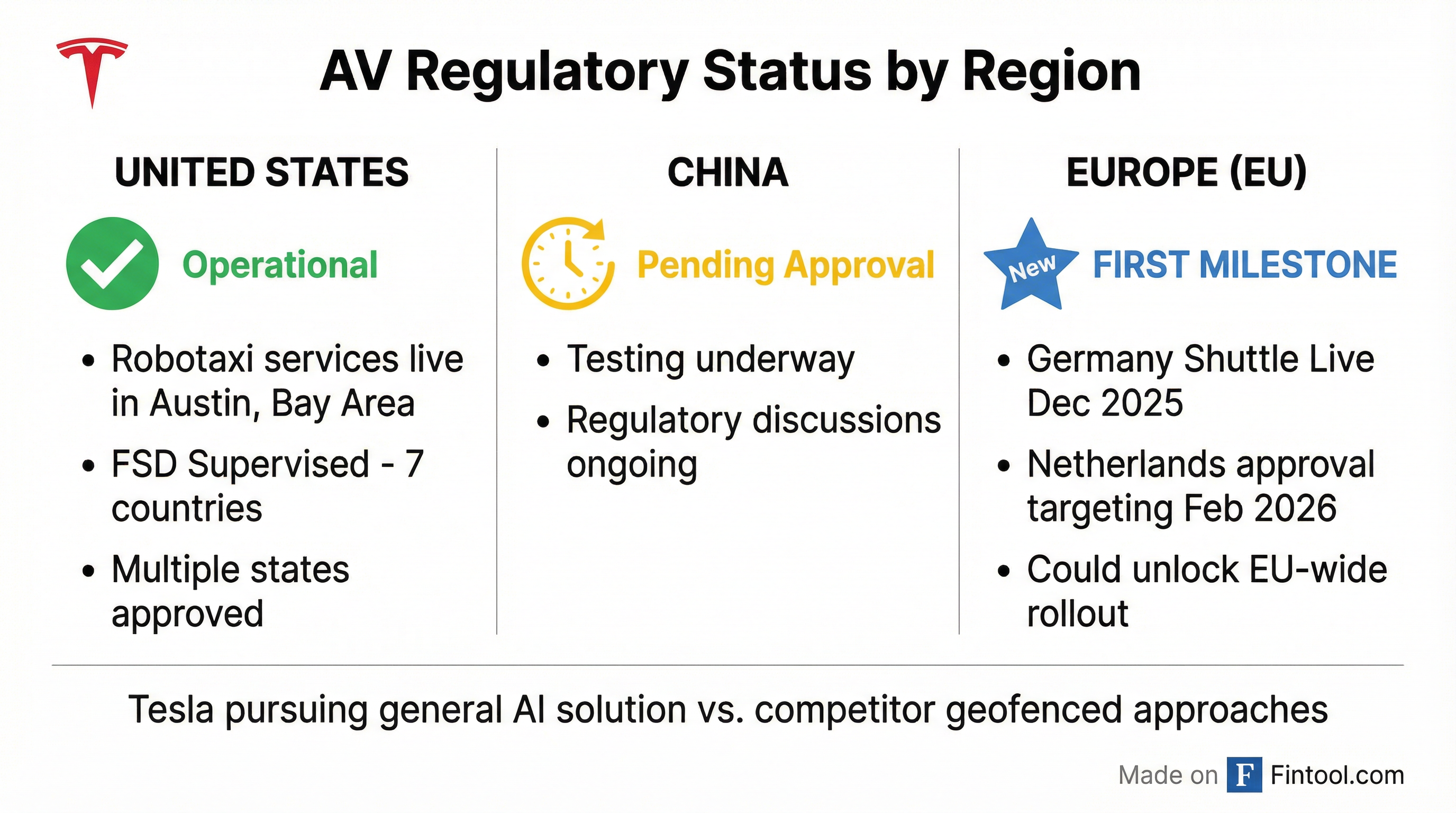
Tesla's global FSD strategy faces distinct regulatory environments:
United States: Most advanced. Robotaxi service operational in Austin with plans to expand to "half the population of the U.S. by end of year" subject to approvals. Bay Area service launched with safety operators, transitioning to unsupervised.
China: Pending. Tesla cannot currently deploy FSD in China while navigating data security and regulatory requirements. Management describes unlocking China as a "major" catalyst.
Europe: Now active. The German shuttle demonstrates Tesla's ability to work within EU frameworks. Netherlands approval would trigger EU-wide certification under mutual recognition provisions.
Financial Context
Tesla's autonomy push comes as the company shows improving fundamentals after a challenging start to 2025:
| Metric | Q4 2024 | Q1 2025 | Q2 2025 | Q3 2025 |
|---|---|---|---|---|
| Revenue ($B) | $25.7 | $19.3 | $22.5 | $28.1 |
| Net Income ($B) | $2.3 | $0.4 | $1.2 | $1.4 |
| Gross Margin | 16.3% | 16.3% | 17.2% | 18.0% |
The company's FSD deferred revenue—representing upfront purchases awaiting service delivery—stood at $3.83 billion as of Q3 2025, up from $3.60 billion at year-end 2024.
Tesla shares have gained approximately 28% year-to-date, trading near $485—within striking distance of the 52-week high of $498.83 reached on December 22.
Ask Fintool AI AgentWhat to Watch
Near-term catalysts:
- Netherlands RDW approval decision (targeted February 2026)
- Expansion of German shuttle program to additional regions
- Q4 2025 earnings (expected late January) for FSD adoption metrics
Key risks:
- Regulatory delays remain unpredictable; the Dutch regulator has explicitly pushed back on Tesla's timeline expectations
- European regulators may impose additional requirements beyond U.S. standards
- Competition from local players (Mercedes-Benz, BMW) developing Level 3 autonomous systems
The strategic calculus: If Netherlands approval triggers EU-wide certification, Tesla's FSD could become available to customers across 27 member states—potentially transforming the demand profile for a company that described European FSD as its "single biggest demand driver."
For rural communities like Bitburg-Prüm, the shuttle represents an immediate mobility solution. For Tesla investors, it's a proof point that the company's autonomous ambitions are no longer confined to Texas highways.
Ask Fintool AI AgentRelated