Tesla Ends Model S and Model X Production to Build 1 Million Optimus Robots Per Year
January 28, 2026 · by Fintool Agent

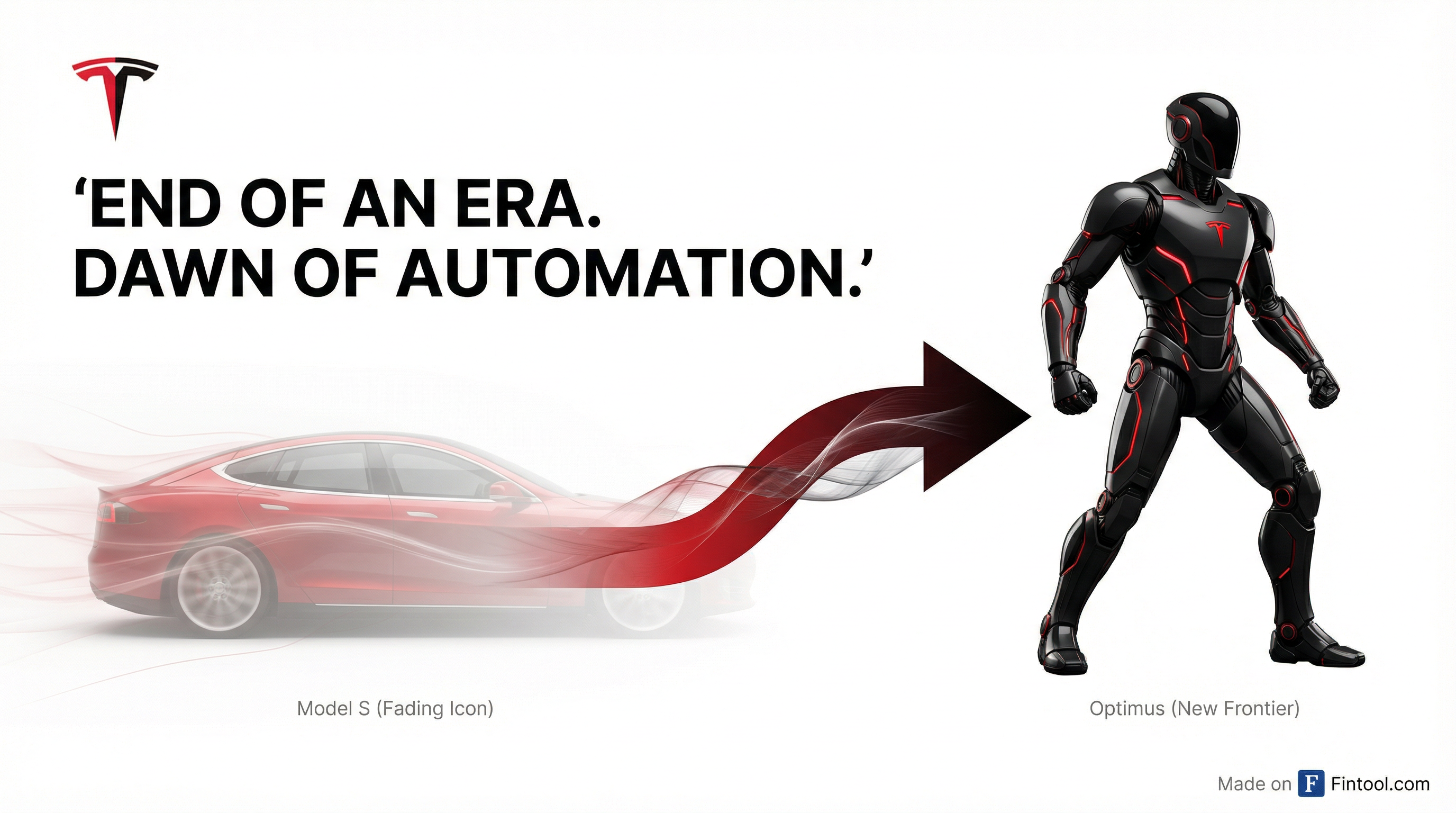
Tesla+3.50% is discontinuing its Model S sedan and Model X SUV—the vehicles that established the company as a luxury electric automaker—to convert the Fremont factory production lines into a facility capable of building 1 million Optimus humanoid robots per year.
CEO Elon Musk made the announcement on the company's Q4 2025 earnings call, the same day Tesla reported its first-ever annual revenue decline: sales fell 3% to $94.8 billion, marking a dramatic turning point for a company that grew revenues every single year since its 2010 IPO.
"It's time to basically bring the Model S and X programs to an end with an honorable discharge, because we're really moving into a future that is based on autonomy," Musk said. "If you're interested in buying a Model S and X, now would be the time to order it."
 Ask Fintool AI Agent
The End of an Era
The Model S, launched in 2012, was Tesla's first mass-market vehicle and the car that proved electric vehicles could be desirable, not just practical. The Model X followed in 2015 with its signature falcon-wing doors, establishing Tesla's premium positioning. Together, they created the foundation for Tesla's transformation from a niche startup to the world's most valuable automaker.
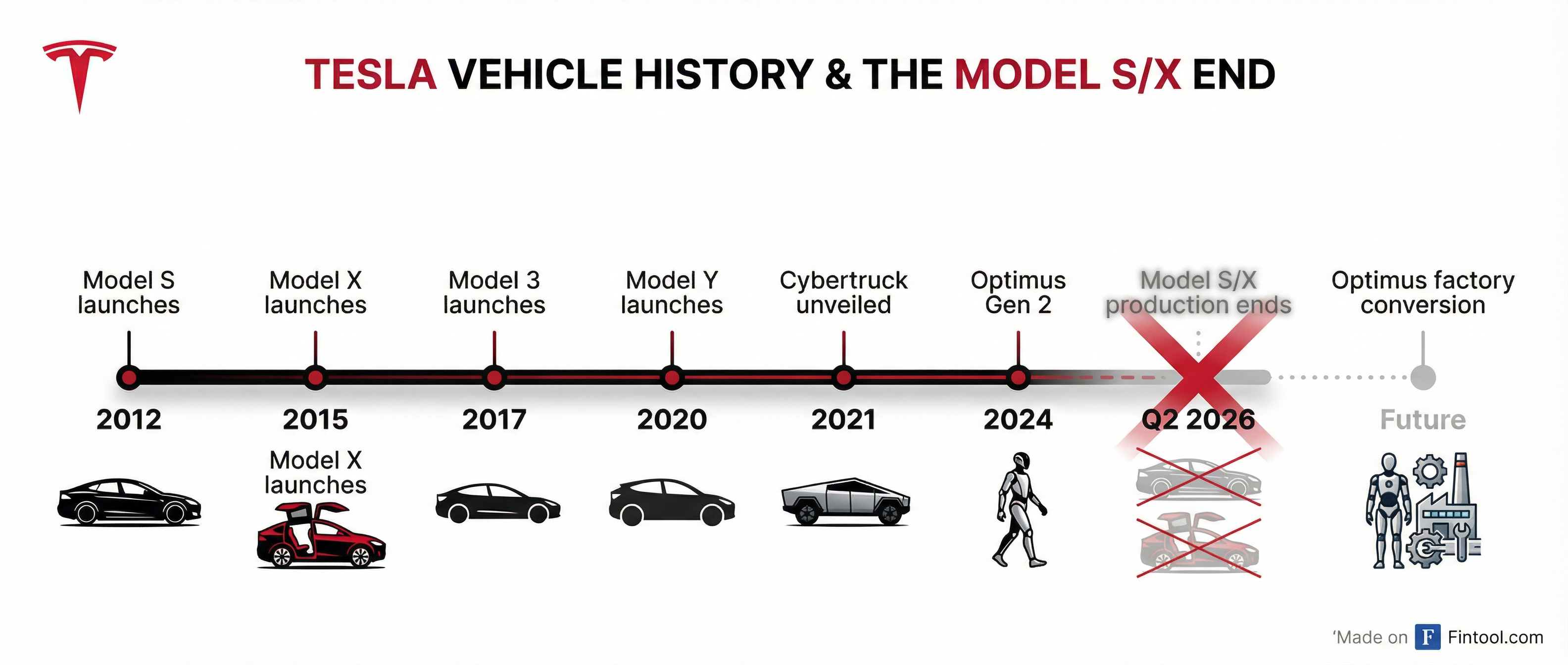
But the flagship models have become increasingly marginal to Tesla's business. The "Other Models" category—which includes Model S, Model X, and Cybertruck—delivered just 50,850 vehicles in 2025, down 40% year-over-year. In Q4 2025 alone, deliveries fell 51% to 11,642 units, compared to 23,640 in Q4 2024.
The Model 3 and Model Y now account for 97% of Tesla's vehicle deliveries, with 1.59 million units sold in 2025 versus roughly 51,000 for all other models combined.
From Cars to Robots: The Fremont Transformation
The Fremont factory—Tesla's original manufacturing hub—will undergo a dramatic transformation. The Model S and X production lines will be dismantled and replaced with an Optimus robot factory targeting 1 million units annually.
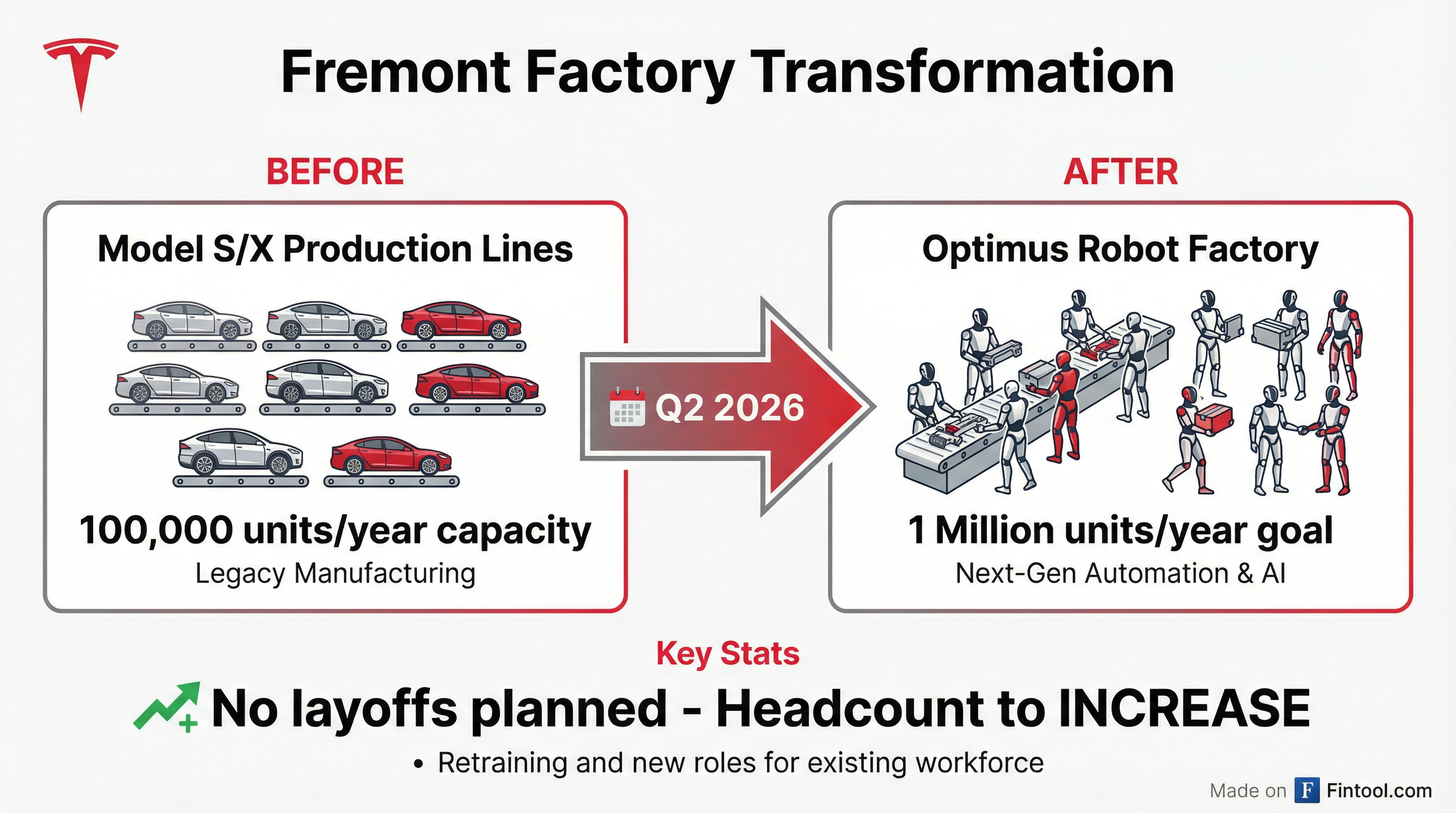
"We are replacing the SX line in Fremont with a 1 million unit per year line of Optimus," Musk stated. "Because it is a completely new supply chain, there's really nothing from the existing supply chain that exists in Optimus. Everything is designed from physics first principles."
Notably, Musk emphasized that the transition would not result in layoffs: "At our Tesla factory in Fremont, we actually expect to increase headcount over time, and to significantly increase output from our factories."
Tesla plans to unveil Optimus Gen 3—described as "the first design meant for mass production"—in Q1 2026. Musk called it "an awesome robot that minimizes any differences... People could be easily confused that it's a human."
Ask Fintool AI AgentQ4 Financial Performance: Beat on EPS, First Revenue Decline on Record
| Metric | Q4 2025 | Q4 2024 | YoY Change |
|---|---|---|---|
| Revenue | $24.9B | $25.7B | -3% |
| GAAP Net Income | $840M | $2.1B | -61% |
| GAAP EPS (Diluted) | $0.24 | $0.60 | -60% |
| Non-GAAP EPS | $0.50 | $0.60 | -17% |
| Gross Margin | 20.1% | 16.3% | +386 bps |
| Vehicle Deliveries | 418,227 | 495,570 | -16% |
Tesla beat analyst expectations for both earnings ($0.50 non-GAAP vs. $0.45 expected) and revenue ($24.9B vs. $24.79B expected), but the full-year numbers tell a more sobering story. Annual revenue fell 3% to $94.8 billion—the first decline in company history—while net income plunged 46% to $3.8 billion from $7.1 billion in 2024.
The one bright spot was gross margin improvement, which reached 20.1% in Q4—the highest level in over two years—driven by regional mix shifts favoring higher-margin markets in APAC and EMEA.
A "New Book" Begins: $20B+ CapEx for 2026
Tesla is making a massive bet on its AI and robotics future. CFO Vaibhav Taneja outlined plans for over $20 billion in capital expenditures for 2026—more than double the $8.5 billion spent in 2025—to fund six new production lines across vehicles, robots, energy storage, and battery manufacturing.
The six factories ramping in 2026:
- Lithium refinery (Corpus Christi)
- LFP battery factory (Nevada)
- Cybercab production (Nevada)
- Tesla Semi production
- New Megafactory (Houston)
- Optimus factory (Fremont)
"We're starting not the next chapter, but a new book on the progression of this company," Taneja said. "2026 year would be when all of this began."
The CapEx guidance does not include two even larger potential investments: a solar cell manufacturing facility and what Musk called a "Terafab"—a massive semiconductor fabrication plant Tesla believes it needs to build to ensure long-term chip supply for its AI ambitions.
Ask Fintool AI AgentRobotaxi Progress: Driverless Rides Now Live in Austin
Tesla's robotaxi ambitions are advancing rapidly. The company began removing safety monitors from customer rides in Austin in January 2026, with "no chase car or anything like that"—just fully autonomous vehicles carrying paying passengers.
Robotaxi expansion timeline:
| Market | Status |
|---|---|
| Austin | Ramping unsupervised |
| SF Bay Area | Safety driver (airport service active) |
| Dallas | Planned H1 2026 |
| Houston | Planned H1 2026 |
| Phoenix | Planned H1 2026 |
| Miami, Orlando, Tampa | Planned H1 2026 |
| Las Vegas | Planned H1 2026 |
Musk expects autonomous vehicles will be operating in "somewhere between a quarter and half of the United States by the end of the year," subject to regulatory approval. The company has over 500 robotaxis carrying paid customers between Austin and the Bay Area, with fleet size expected to "double every month."
Cybercab—Tesla's dedicated two-seater robotaxi without steering wheel or pedals—is on schedule to begin production in April 2026.
Mission Update: "Amazing Abundance"
Tesla officially changed its mission statement from "accelerating the world's transition to sustainable energy" to "amazing abundance"—a philosophical shift that reflects Musk's evolving vision for the company.
"We've updated the Tesla mission to amazing abundance, and this is intended to send a message of optimism about the future," Musk explained. "I think with the advent of AI and robotics, we actually are headed to a future of universal high income. Not universal basic income, but universal high income."
The new mission positions Tesla not as an automaker or even an energy company, but as an AI and robotics company that happens to make cars and batteries along the way.
Market Reaction and What to Watch
Tesla shares rose modestly in after-hours trading to $436.90, up about 1.4% from the regular session close of $431.46. The stock has traded in a wide range over the past year, hitting a high of $498.83 and a low of $214.25.
Key catalysts ahead:
- Q1 2026: Optimus Gen 3 unveiling
- April 2026: Cybercab production start; Next-gen Roadster debut
- H1 2026: Robotaxi expansion to 6+ new metro areas
- 2026: Tesla Semi production ramp
- Late 2026: Optimus volume production begins
Risks to monitor:
- $20B+ CapEx execution with uncertain returns
- Competition from Chinese humanoid robot makers
- Regulatory approval for expanded autonomous operations
- Continued EV demand weakness
The Bottom Line
Tesla's decision to end Model S and X production marks a decisive pivot from the company that revolutionized electric vehicles to one betting its future on humanoid robots and autonomous transportation. The move is both pragmatic—the luxury EVs accounted for less than 3% of deliveries—and symbolic, as Musk explicitly trades hardware legacy for AI ambition.
The question now is whether Tesla can execute. The company is committing unprecedented capital ($20B+ in 2026 alone) to build factories for products that don't yet exist at scale, while its core auto business contracts. Musk has a track record of delivering on ambitious timelines eventually, if not always on schedule.
"The future is autonomous," Musk declared. For Model S and X owners, that future arrives in Q2 2026. For Tesla shareholders, it's already here.
Ask Fintool AI Agent