NHTSA Opens Probe Into Tesla Model 3 Doors After 15 Deaths Linked to Design Flaw
December 24, 2025 · by Fintool Agent

Federal regulators opened an investigation into approximately 179,000 Tesla+3.50% Model 3 vehicles on Monday, citing concerns that emergency door releases are "hidden, unlabeled, and not intuitive to locate during an emergency." The probe comes days after a Bloomberg investigation linked at least 15 deaths to Tesla door designs that prevented occupants from escaping burning vehicles.
TSLA shares traded at $485.40 on Tuesday, essentially flat despite the news, though the stock has risen 28% year-to-date.
The Investigation
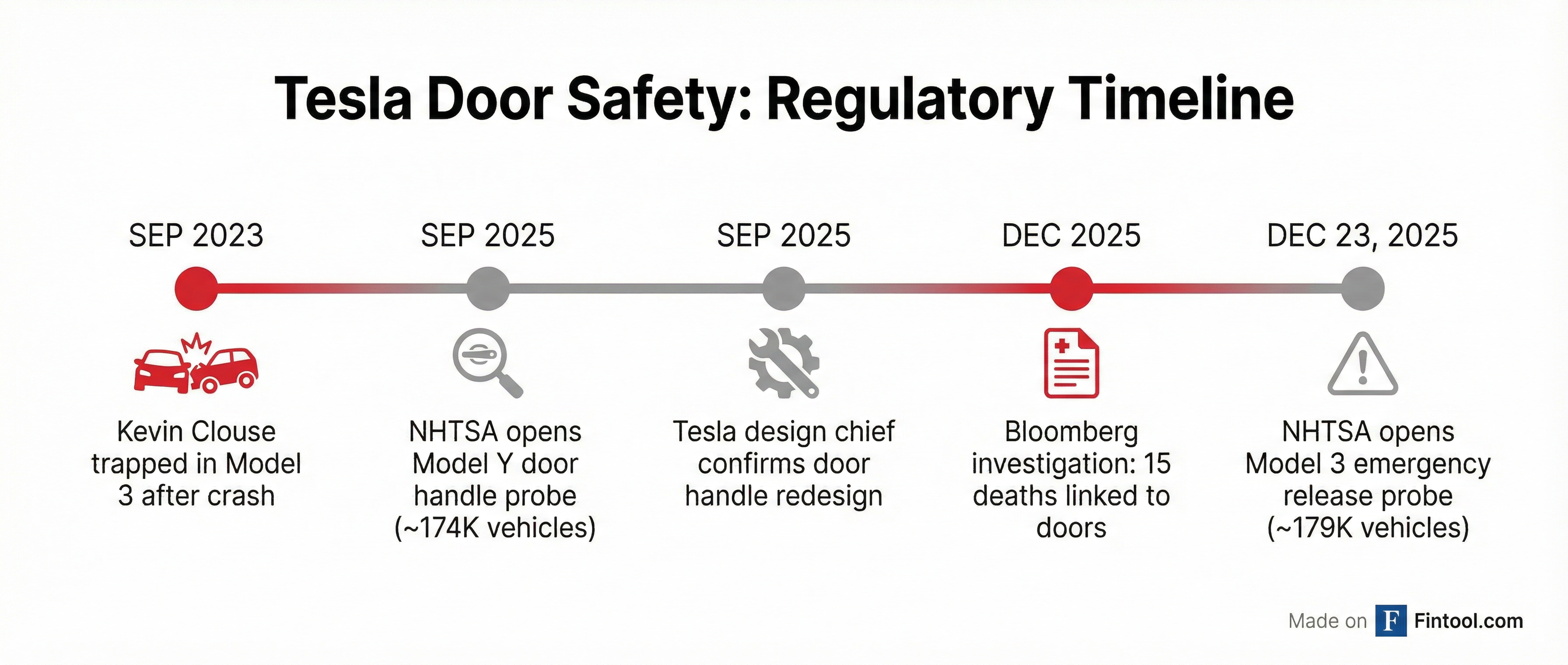
The National Highway Traffic Safety Administration's Office of Defects Investigation opened the defect petition (DP25002) on December 23, covering 179,071 model year 2022 Tesla Model 3 vehicles. The agency is evaluating whether to grant a formal defect investigation.
The petition was filed by Kevin Clouse, a Georgia Tesla owner who says he was trapped in his Model 3 following a 2023 crash and had to kick out a window to escape. "You're in a box that's on fire and you can't get out," Clouse told Bloomberg.
This marks NHTSA's second investigation into Tesla door systems in 2025. In September, the agency opened a preliminary evaluation into approximately 174,290 Model Y vehicles over reports of electronic door handles becoming inoperative—prompting some parents to smash windows to rescue their children.
15 Deaths, 12 Incidents
The regulatory action follows a damning Bloomberg investigation published December 22 that identified at least 15 deaths in a dozen incidents over the past decade where occupants or rescuers were unable to open Tesla doors after crashes and fires.
More than half of those deaths occurred since November 2024, indicating a worsening trend as Tesla's fleet ages and crash frequencies accumulate.
Key incidents cited include:
-
Wisconsin (2024): A Model S crash killed all five occupants. Witnesses reported screaming, including a woman saying "I'm stuck." Audio from a 911 call made automatically by an Apple Watch captured moaning from inside the vehicle.
-
Easton, Massachusetts (October 2025): A 20-year-old man died after his Model Y collided with a tree and caught fire. He was able to call emergency services but unable to exit.
-
Virginia (December 2025): A state trooper bashed the window of a burning Model Y when its doors wouldn't open and pulled the driver to safety—an incident captured on dashcam footage.
 Ask Fintool AI Agent
The Design Problem
Tesla vehicles use electronic door latches that open via buttons rather than traditional mechanical handles—powered by the vehicle's 12-volt battery. In crash scenarios, this battery can die or be disabled, rendering the electronic doors non-functional.
While Tesla includes manual emergency releases as backups, the NHTSA petition alleges these are critically flawed:
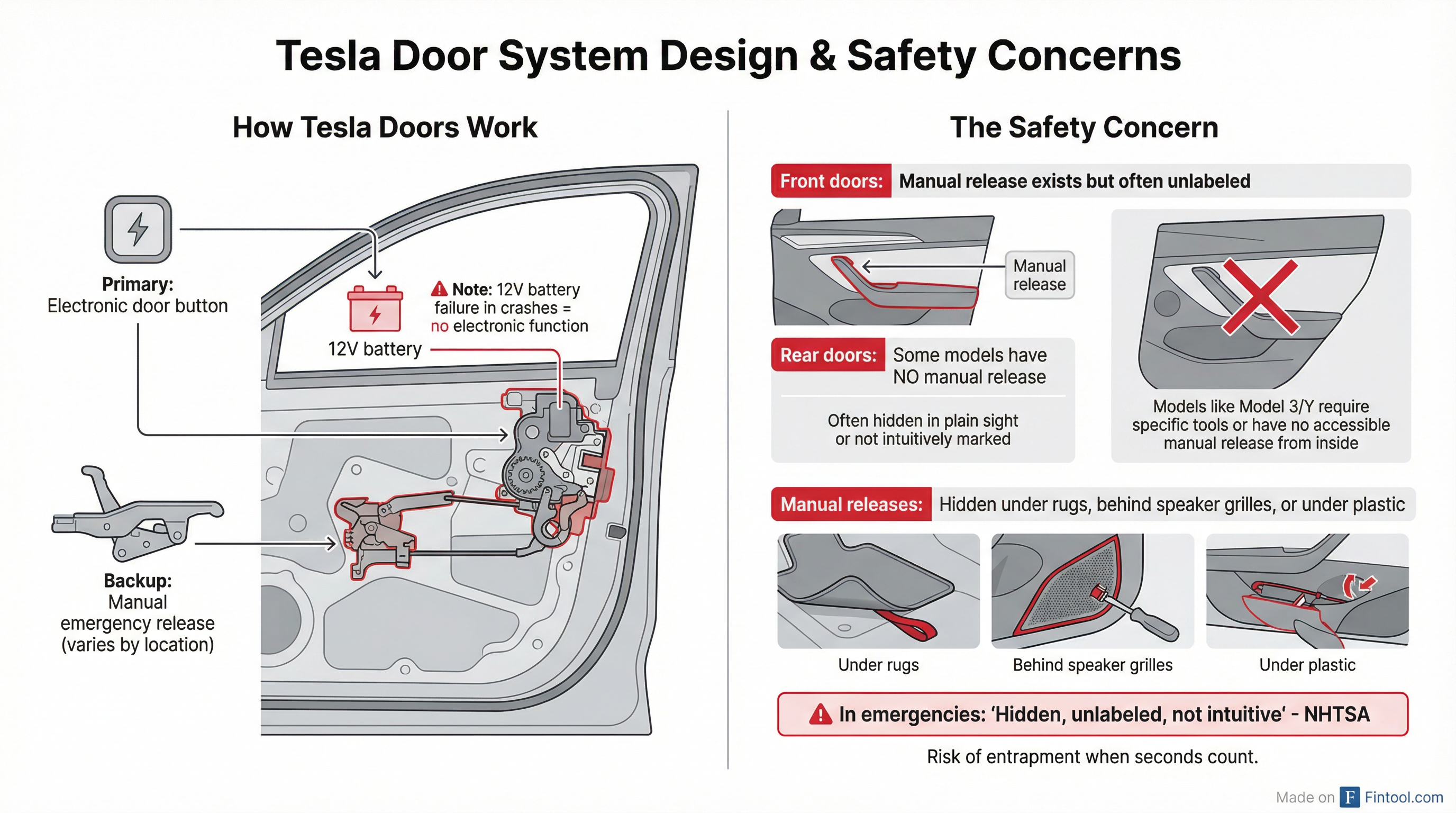
- Front doors: Manual releases exist but are often hidden and unlabeled
- Rear doors: Some Model 3 and Model Y vehicles have no manual release at all
- Location: Releases may be hidden under rugs, behind speaker grilles, or under plastic panels
- Emergency use: "Not intuitive to locate" even for adults, let alone children or passengers unfamiliar with the vehicle
Tesla is far from alone in using electronic door handles—approximately 70 models on sale in the U.S. today feature them—but the EV company accounts for the largest number of consumer complaints.
Ask Fintool AI AgentTesla's Response
Tesla did not immediately respond to requests for comment on the new investigation.
The company has maintained that its vehicles comply with federal laws and that owners can locate emergency releases using the owner's manual. Tesla recently launched a new Safety page on its website stating that doors will automatically unlock for emergency access in crash scenarios—though a footnote notes this feature may not be available on every model depending on build date.
In September, Tesla's design chief Franz von Holzhausen told Bloomberg the company was working on redesigning its door handles to incorporate mechanical and electric releases into one unit.
Notably, Tesla CEO Elon Musk acknowledged door handle issues as far back as 2015. In a Q1 2015 earnings call discussing the Model X launch, Musk said: "We have had door handle issues, like people are aware of that with the S. We don't want to have buckling door issues with the X."
Ask Fintool AI AgentLegal Exposure Mounting
The regulatory probe adds to Tesla's growing legal headaches over door design:
-
A Wisconsin family sued Tesla in November over the crash that killed five occupants of a Model S, alleging a design flaw prevented them from opening the doors
-
Families of two college students killed in a Cybertruck crash in a San Francisco suburb filed suit, alleging they were locked in the burning vehicle due to door handle design
What's at Stake for Investors
| Factor | Impact |
|---|---|
| Vehicles at risk | 353,000 (179K Model 3 + 174K Model Y in current probes) |
| Potential recall | Could require physical modifications, not just OTA software updates |
| Litigation exposure | Multiple wrongful death lawsuits pending |
| Regulatory precedent | Two NHTSA investigations in 4 months signals escalating scrutiny |
| Brand impact | Safety concerns amid Musk's high political profile |
Tesla has faced numerous recalls in 2025, including 63,619 Cybertrucks for overly bright parking lights and 12,963 Model 3/Y vehicles for battery pack contactor issues. However, a door-related recall would likely require physical repairs rather than over-the-air software fixes—significantly increasing costs.
Ask Fintool AI AgentWhat to Watch
Near-term: NHTSA must decide whether to grant or deny the defect petition, which would trigger a formal investigation that could lead to a recall order.
Regulatory timeline: NHTSA investigations can take months to years. The September Model Y probe remains ongoing.
International pressure: China has already implemented new mandates for standardized door handles on vehicles sold domestically. Europe is considering similar requirements.
Design changes: Whether Tesla accelerates the door handle redesign von Holzhausen referenced in September—and whether it will be retrofitted to existing vehicles.
The opening of a defect petition does not guarantee a recall, but it marks the first step in a regulatory review process that has now touched Tesla's two highest-volume vehicles. For a company that has made design innovation a core brand pillar, the scrutiny over a seemingly basic feature—the ability to exit a car—represents an uncomfortable spotlight.
Ask Fintool AI Agent