Texas Sues TP-Link Over China Ties, National Security Risks—First of Several Lawsuits
February 17, 2026 · by Fintool Agent


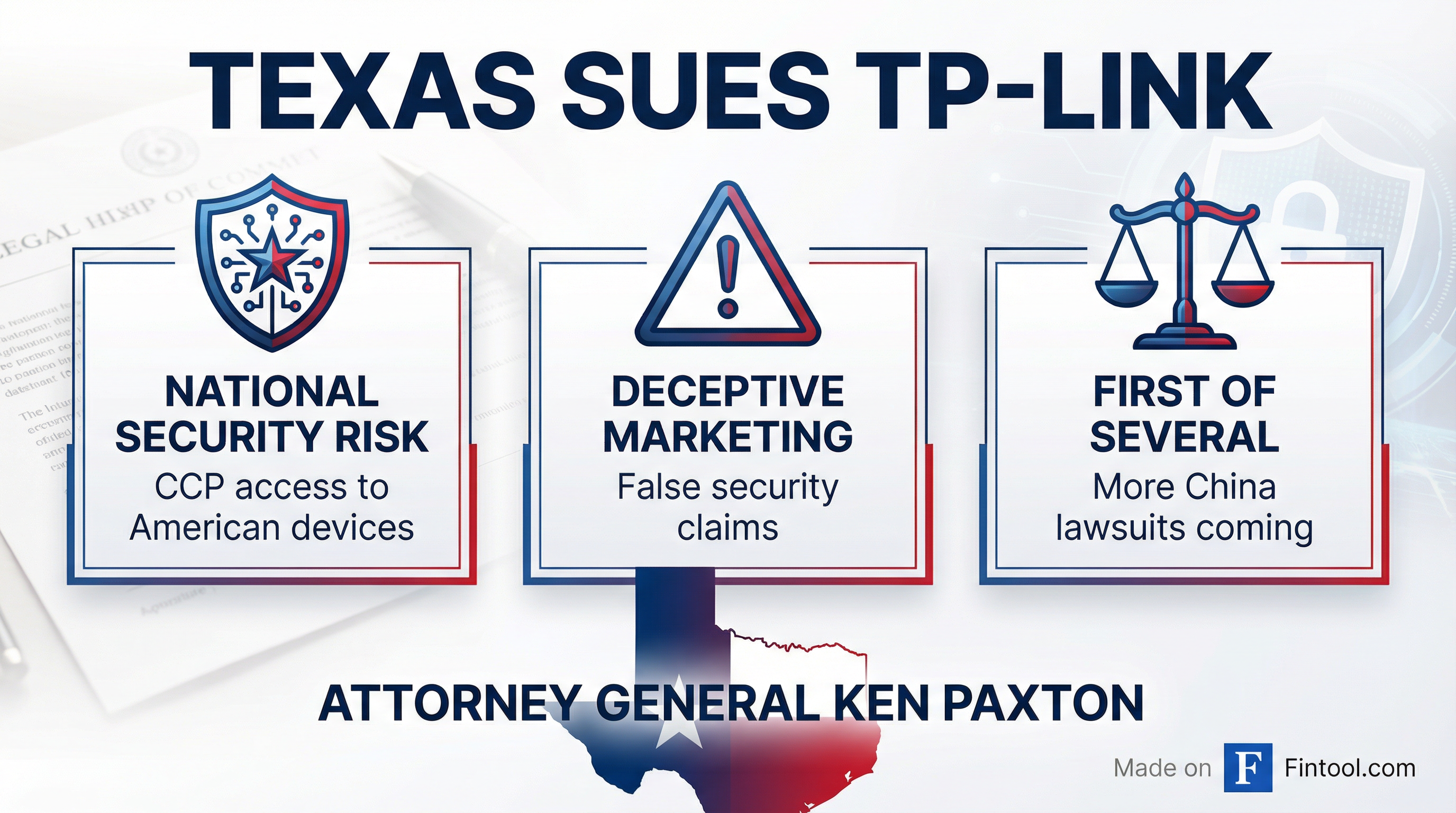
Texas Attorney General Ken Paxton filed suit against TP-Link Systems Inc. on Tuesday, alleging the Wi-Fi router giant deceived consumers about its products' security and China ties while enabling state-sponsored hackers to access American networks. The lawsuit is the first of several Paxton plans to file this week against companies he calls "CCP-aligned"—a state-level offensive that comes just days after the Trump administration paused its own proposed federal ban on the company.
The timing is remarkable: while Washington softens its stance on Chinese tech ahead of diplomatic talks, Austin is escalating.
The Allegations
The complaint targets what Paxton calls a "web of deception" around TP-Link's origins, supply chain, and security claims.
Deceptive labeling: Despite "Made in Vietnam" stickers, nearly all TP-Link components are sourced from China before final assembly in Vietnam. The lawsuit argues this conceals the company's true supply chain exposure.
False security claims: Paxton alleges TP-Link marketed its products as secure while firmware vulnerabilities have been exploited by Chinese state-sponsored hackers in multiple documented attacks, including the Volt Typhoon, Salt Typhoon, and Flax Typhoon campaigns.
Data law exposure: Because TP-Link's ownership and supply chain remain tied to China, the company is subject to PRC national data laws requiring Chinese entities to comply with intelligence agency requests—a fact Paxton says was never disclosed to consumers.
Texas is seeking civil penalties, injunctions requiring "Made in China" labeling, and orders barring TP-Link from claiming its products are secure or collecting consumer data without informed consent.
 Ask Fintool AI Agent
TP-Link's Response
TP-Link Systems Inc. fired back immediately, calling the allegations "without merit" and promising to fight the lawsuit.
In a statement to media, a company spokesperson emphasized: "TP-Link Systems Inc. is an independent American company. Neither the Chinese government nor the CCP exercises any form of ownership or control over TP-Link, its products, or its user data."
The company noted that CEO Jeffrey Chao resides in Irvine, California and has never been a CCP member, that core operations and infrastructure are located in the United States, and that US customer data is stored on Amazon Web Services servers.
TP-Link has repeatedly contested the narrative that its products are uniquely targeted by Chinese hackers. In congressional testimony, President Jeff Barney stated: "Witnesses didn't present a shred of evidence that TP-Link is linked to the Chinese government."
The company points to industry data showing that Chinese threat actors like Volt Typhoon and Salt Typhoon have exploited routers from multiple vendors—including Cisco, Netgear, ASUS, D-Link, Fortinet, and Zyxel—not just TP-Link devices.
The Market Share Question
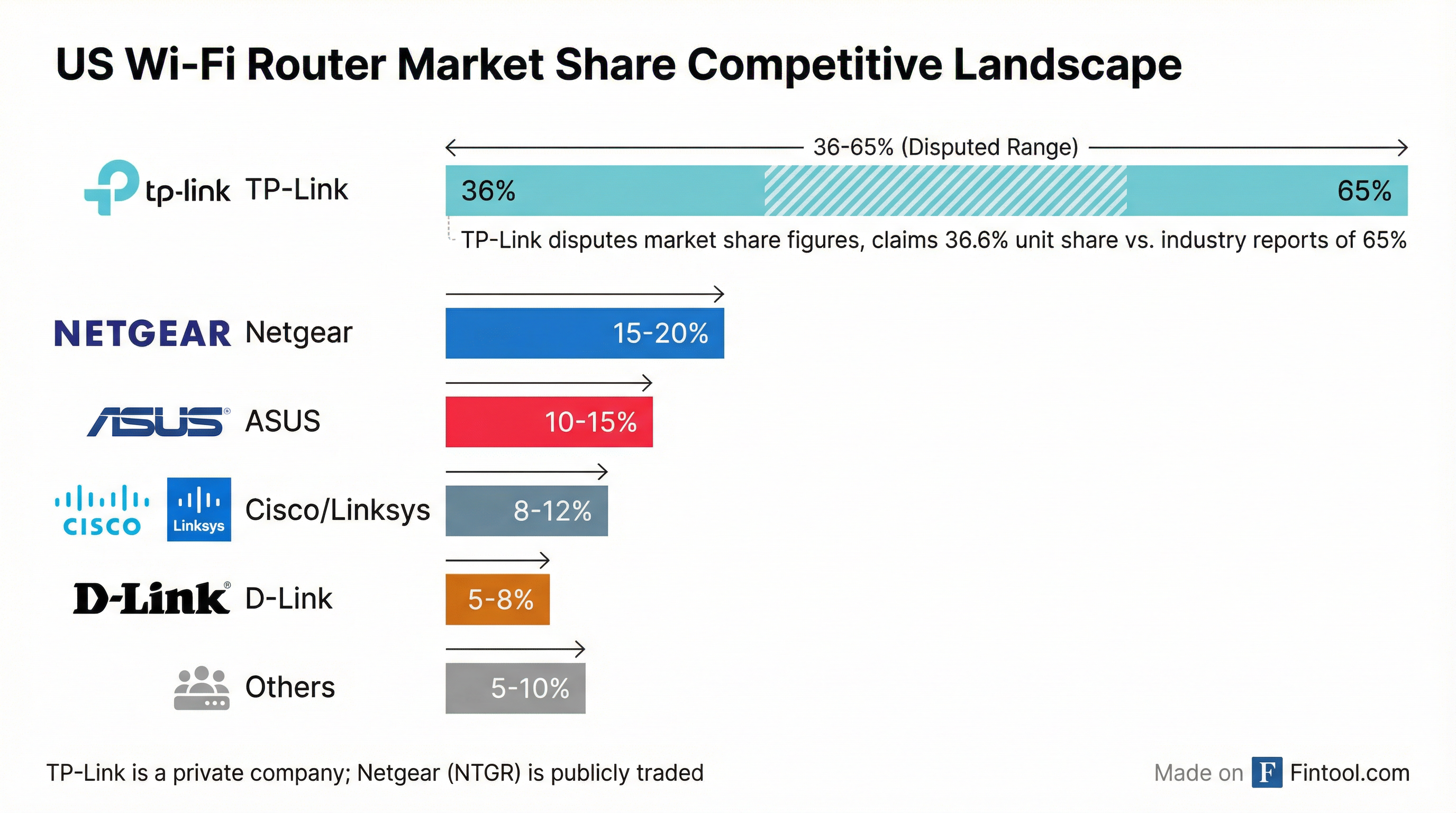
TP-Link's dominance in the US consumer router market is central to the national security debate—though the exact numbers are hotly contested.
Industry reports have cited market share as high as 65% of US retail router sales, while TP-Link itself claims the figure is closer to 36.6% based on Circana data. Either way, the company has vaulted to market leadership through aggressive pricing and an early rollout of Wi-Fi 7 routers.
Former NSA cybersecurity director Rob Joyce testified to Congress that China may have deliberately undercut the router market to vault TP-Link to the top—gaining a platform for potential cyber operations.
The key publicly-traded competitor in the consumer router space is Netgear (NTGR), with a market cap around $617 million. Enterprise networking players like Cisco (CSCO) and Ubiquiti (UI) compete in adjacent segments but have less direct exposure to TP-Link's consumer market.
Ask Fintool AI AgentRegulatory Timeline: From Federal Hesitation to State Action
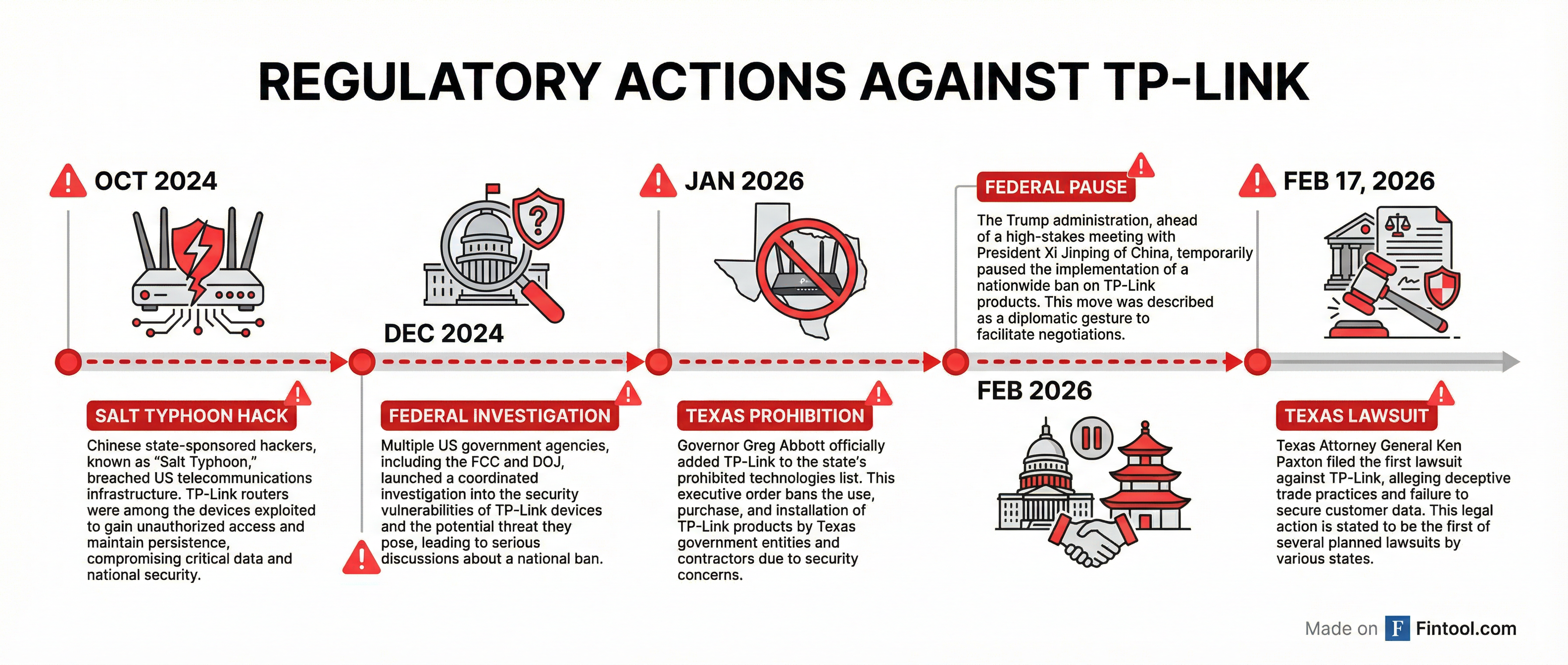
The Texas lawsuit caps an escalating series of regulatory actions—and one notable retreat:
October 2024: The Salt Typhoon hack is revealed, exposing Chinese state-sponsored infiltration of US telecom networks through compromised routers from multiple vendors, including TP-Link.
December 2024: Multiple federal agencies launch investigations into TP-Link, with reports suggesting a nationwide ban was under consideration.
October 2025: Texas AG Paxton opens a formal investigation into TP-Link.
January 2026: Governor Greg Abbott adds TP-Link to Texas's list of prohibited technologies for state employees and devices.
Early February 2026: The Trump administration pauses its proposed federal TP-Link ban ahead of a meeting with Chinese President Xi Jinping—a move Reuters characterized as part of a broader trade détente.
February 17, 2026: Texas files suit anyway, with Paxton promising additional lawsuits against CCP-aligned companies "this week."
What to Watch
The divergence between federal and state approaches creates several vectors to monitor:
Other state actions: Paxton explicitly framed the lawsuit as "the first of several" against Chinese tech companies. If other Republican attorneys general follow Texas's lead, TP-Link could face a patchwork of state-level restrictions even without federal action.
Competitive positioning: Any labeling requirements or sales restrictions would create an opening for Netgear, Cisco, and other US-based alternatives. Netgear in particular has been vocal about TP-Link's pricing practices.
Federal follow-through: The Trump administration's pause on a TP-Link ban was tied to diplomatic timing. That calculation could change—particularly if the Salt Typhoon investigation produces new findings or if bipartisan congressional pressure intensifies.
Paxton's Senate bid: The attorney general announced in April 2025 that he's challenging Senator John Cornyn in a primary. Cornyn is known for tough-on-China policies, making the TP-Link lawsuit part of a visible political positioning effort.
Ask Fintool AI AgentBottom Line
Texas is moving against Chinese tech while Washington hesitates. The TP-Link lawsuit won't immediately change the router in your home, but it signals that state attorneys general are willing to fill the regulatory vacuum—and that the US consumer networking market could see meaningful disruption if restrictions spread.
For investors, the most direct plays are Netgear (NTGR) as a pure-play consumer router competitor and Cisco (CSCO) as the enterprise networking leader. Both stand to benefit if TP-Link's market position erodes—whether through lawsuits, labeling requirements, or eventual federal action.