Mira Murati's $12B AI Startup Loses Co-Founders Back to OpenAI in Less Than a Year
January 15, 2026 · by Fintool Agent


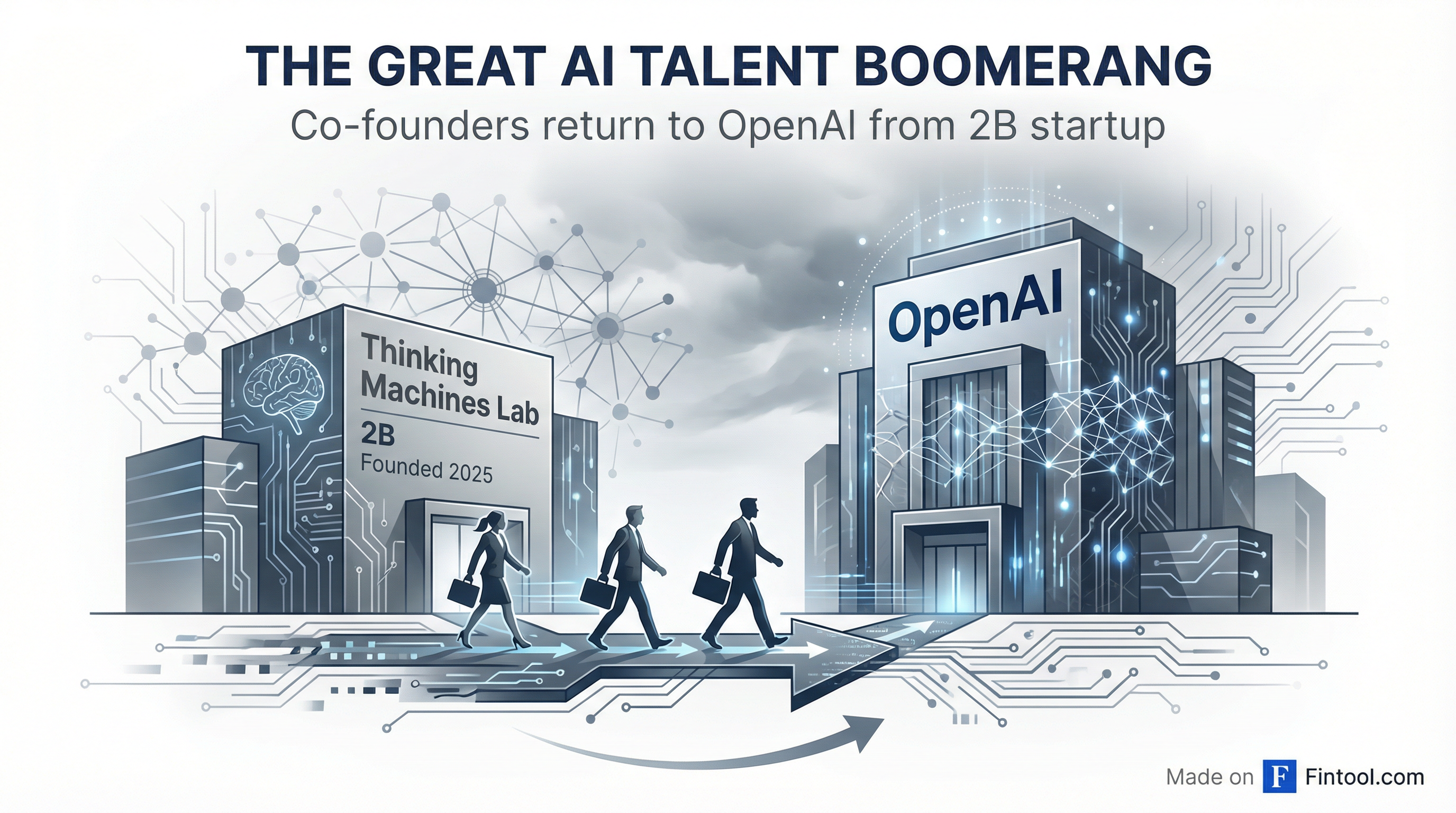
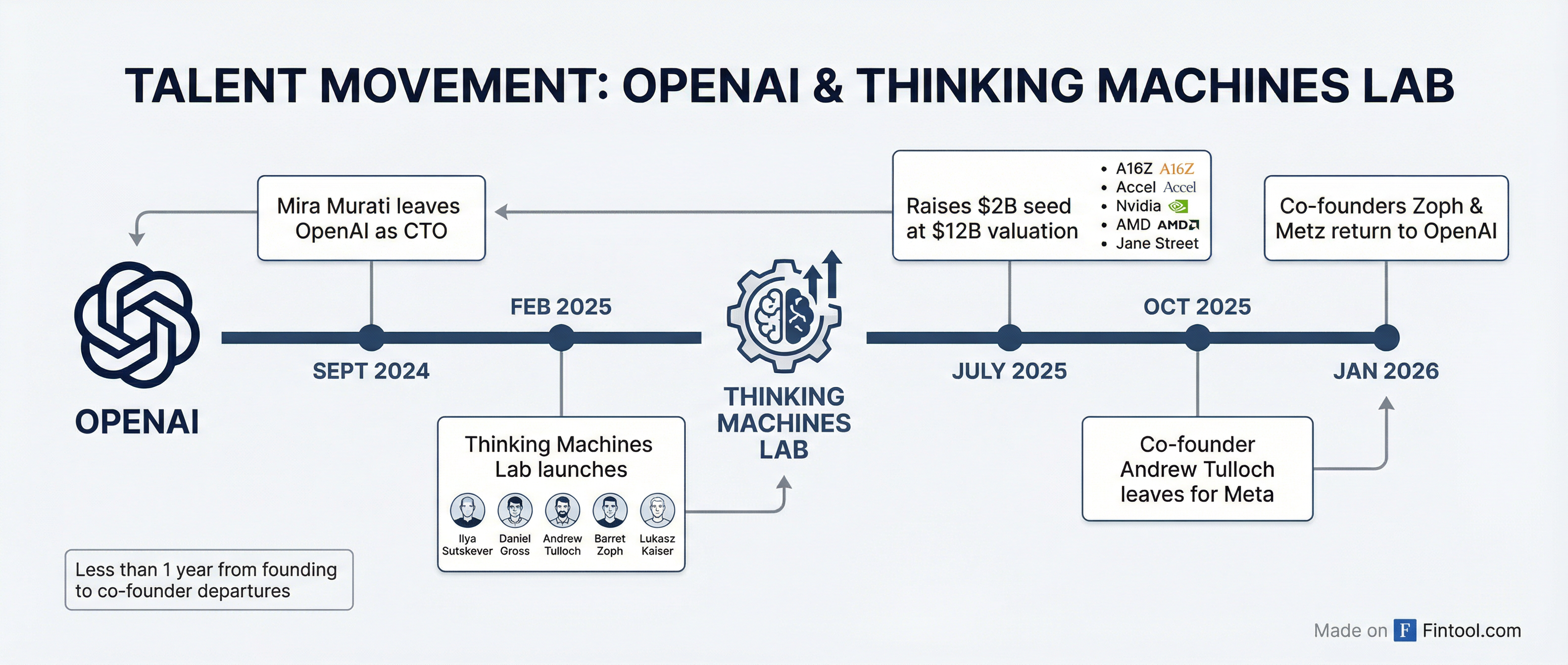
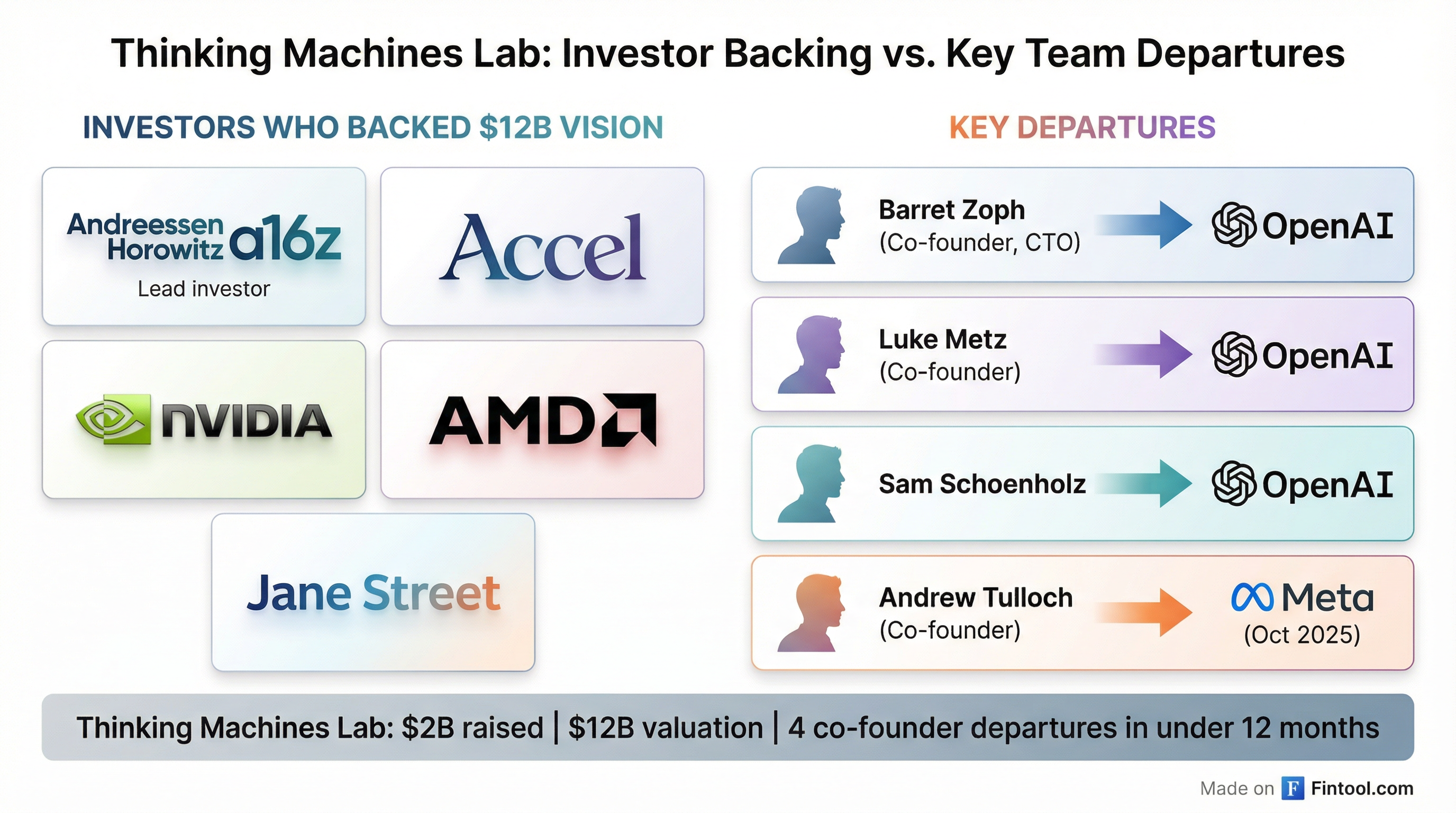
Two of Thinking Machines Lab's co-founders are returning to OpenAI less than 12 months after helping launch what was supposed to be one of the most ambitious AI startup challenges to the ChatGPT maker. Barret Zoph, who served as CTO, and Luke Metz announced their departures Wednesday—along with researcher Sam Schoenholz—in what sources describe as an acrimonious split from Mira Murati's $12 billion company.
The exodus represents a stunning reversal for Thinking Machines Lab, which raised a record $2 billion seed round last July with backing from Nvidia, Amd, Andreessen Horowitz, Accel, and Jane Street. It also underscores OpenAI's continued gravitational pull in the AI talent wars—even among executives who explicitly left to build competing systems.
The Departures
OpenAI applications CEO Fidji Simo announced the returns on X: "Excited to welcome Barret Zoph, Luke Metz, and Sam Schoenholz back to OpenAI! This has been in the works for several weeks, and we're thrilled to have them join the team."
The announcement came just 58 minutes after Murati's own post acknowledging Zoph's departure—notably without mentioning where he was headed. "We have parted ways with Barret," Murati wrote. "Soumith Chintala will be the new CTO of Thinking Machines."
Chintala, the co-creator of PyTorch and a longtime Meta AI researcher, represents a significant technical hire. But the abruptness of the leadership transition—and the near-simultaneous OpenAI announcement—suggests the parting was far from smooth.
A Pattern of Departures
The Zoph-Metz exits follow another co-founder departure in October 2025, when Andrew Tulloch left to join Meta. That means Thinking Machines has now lost three of its original co-founders in under a year.
The losses are particularly striking given the company's resources. The $2 billion seed round—led by Andreessen Horowitz with participation from Accel, Nvidia, AMD, and Jane Street—valued the company at $12 billion before it had shipped a product. That valuation implied immense confidence in Murati's ability to assemble and retain a world-class team.
 Ask Fintool AI Agent
Why This Matters
For OpenAI: The returns strengthen Sam Altman's technical bench at a critical moment. Zoph previously served as VP of research at OpenAI, while Metz spent years on the technical staff. Both bring deep expertise in post-training—the process of refining large language models after initial training—which has become increasingly important as models approach capability limits.
For Thinking Machines: The company now faces questions about whether its "public benefit corporation" mission and focus on "collaborative" AI (rather than full automation) can compete with the resources and prestige of leading AI labs. Murati founded the company to build something different than OpenAI, but several of her top people have concluded they'd rather be back at the original.
For AI investors: The episode highlights the extreme fragility of AI startup valuations that rest primarily on team composition. Even a $12 billion valuation and $2 billion in capital couldn't prevent co-founder departures. Investors in the space may need to discount valuations more heavily for key-person risk.
The Broader Talent War
The AI industry has seen unprecedented talent churn since OpenAI's November 2022 ChatGPT launch sparked a gold rush for researchers capable of building large language models:
| Executive | From | To | Date |
|---|---|---|---|
| Mira Murati | OpenAI (CTO) | Thinking Machines (CEO) | Sept 2024 |
| John Schulman | OpenAI (Co-founder) | Anthropic → Thinking Machines | Aug 2024 |
| Barret Zoph | OpenAI (VP Research) → Thinking Machines | OpenAI | Jan 2026 |
| Luke Metz | OpenAI → Thinking Machines | OpenAI | Jan 2026 |
| Andrew Tulloch | Thinking Machines (Co-founder) | Meta | Oct 2025 |
The boomerang pattern—executives leaving for startups only to return—is particularly notable. It suggests that despite massive funding rounds, few startups can match the combination of compute resources, data access, and team density available at frontier labs like OpenAI.
Ask Fintool AI AgentWhat Murati Retains
Despite the departures, Thinking Machines isn't folding. The company still has:
- $2 billion in funding with minimal burn so far
- Soumith Chintala as new CTO—a respected figure who co-created PyTorch, the dominant framework for AI development
- John Schulman as Chief Scientist—an OpenAI co-founder who joined Thinking Machines after a brief stint at Anthropic
- Mira Murati's own expertise—she oversaw the development of GPT-4 and DALL-E during her tenure as OpenAI's CTO
The question is whether a company that has now lost three co-founders in under a year can stabilize and execute on its vision—or whether further departures will follow.
What to Watch
Near-term: Any additional departures from Thinking Machines' research or leadership teams. The company has not announced layoffs or restructuring, but the rapid succession of exits could trigger further talent flight.
Medium-term: Whether Thinking Machines can ship a differentiated product before investor patience wears thin. Public benefit corporations typically operate with longer time horizons, but a $12 billion valuation creates expectations.
Longer-term: How OpenAI leverages its returning researchers. Under the new structure, Zoph will report to Fidji Simo, who oversees applications. This suggests a focus on productization rather than pure research—potentially signaling OpenAI's priorities as it completes its conversion to a for-profit structure.
Ask Fintool AI Agent